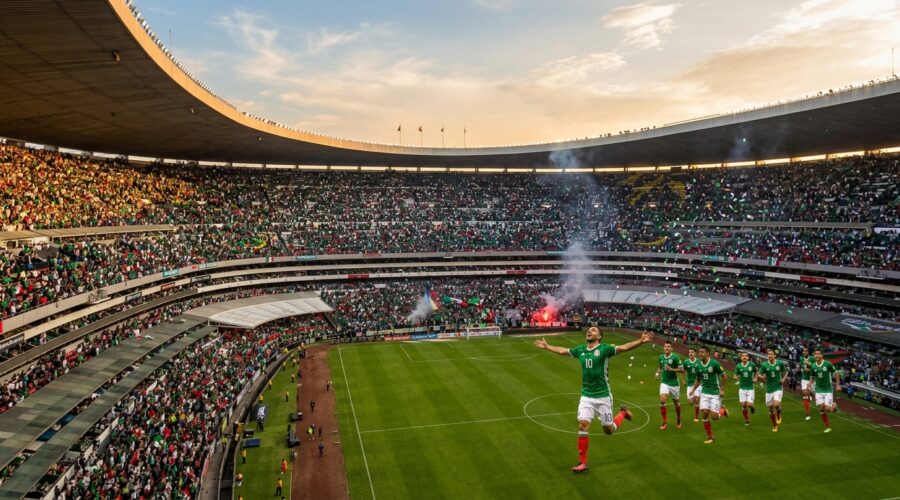
There are football matches, and then there are football matches that feel as though the sport is trying to tell you something about itself — about its capacity for cruelty and catharsis, for tedious bureaucracy and sudden, rupturing grace. The opening fixture of the 2026 FIFA World Cup was unambiguously the latter.
Mexico 2–0 South Africa. A scoreline that flatters the tidiness of the occasion. Because what unfolded inside the Estadio Azteca on June 11 was not a tidy afternoon. It was an 80,000-person collective nervous breakdown that ended in tears, in three red cards, in the kind of delirium that reminds you why you got into this in the first place.
The Cathedral Has Been Here Before
Before a ball was kicked, history was already being made beneath your feet. The Estadio Azteca — opened in 1966 and still carrying the unmistakable gravity of a place where extraordinary things have happened — became the first stadium in the history of the sport to host a third World Cup. It held the 1970 final. It held the 1986 final, the one with the Hand of God and the Goal of the Century in the same quarterfinal, four minutes apart. And now this. Mexico, meanwhile, became the first nation ever to host three World Cup tournaments, a fact their supporters greeted with the kind of pride that requires no further commentary.
The Azteca does not need introduction. But it does, always, set a tone. And the tone it set on Thursday was one of barely contained electricity.
The Ceremony: Spectacular, as Advertised
Italian impresario Marco Balich — fresh from producing the Milan Cortina Winter Olympics ceremony — staged the opening proceedings from 11:30 a.m. local time, ninety minutes before kick-off. What followed was a rather magnificent procession of Latin music, Aztec dancers, papel picado, and the kind of cultural pageant that reminded you this tournament belongs not just to football but to three entire continents worth of identity.
Lila Downs opened with a tribute to Mexico’s Indigenous heritage. Maná provided the requisite rock energy. Los Ángeles Azules, Belinda, Danny Ocean, J Balvin, Tyla, and Alejandro Fernández kept the temperature rising. Salma Hayek Pinaut appeared unannounced, to the sort of roar that suggested the crowd had been waiting specifically for her.
Then Shakira, draped in yellow, performed Dai Dai — the official World Cup song, alongside Burna Boy — live for the first time. It was her second World Cup opening ceremony, having previously performed at the 2010 opening ceremony, and entirely in keeping with her status as the competition’s unofficial musical ambassador. Andrea Bocelli followed with the official tournament anthem, DNA, performed alongside EJAE, David Guetta, and Megan Thee Stallion, a combination of voices that somehow managed to work.
It was, by any measure, spectacular. Then it ended, and the actual football began. Which is where things became genuinely interesting.
Quiñones Opens the Account — and the Tournament
Mexico came out of the tunnel wearing the weight of a peculiar hex. In seven previous World Cup opening matches — including their appearances as co-hosts — El Tri had never won. Five defeats and two draws, including the infamous 1–1 against South Africa in Johannesburg in 2010, when Siphiwe Tshabalala’s thunderous opener gave Bafana Bafana a lead that, in retrospect, set the template for sixteen years of Mexican opening-match suffering.
The hex lasted precisely nine minutes.
Erik Lira — deployed as the single pivot in Javier Aguirre’s 4-1-2-3 — pressed high and won the ball from Sphephelo Sithole on the edge of South Africa’s own box. The ball broke to Julián Quiñones on the left channel. What followed was composure personified: a low, driven shot through the legs of Ronwen Williams and into the net. The first goal of the 2026 FIFA World Cup, struck with the assurance of a man entirely unbothered by the occasion.
Quiñones is a Colombian by birth who gained Mexican citizenship in 2023 and currently plies his trade for Al-Qadsiah in the Saudi Pro League. He is not, shall we say, a household name in the traditional football markets. He was, for nine minutes on June 11 in Mexico City, the most famous footballer on earth. And he very nearly made it two before half-time, striking the base of the post from a Brian Gutiérrez lay-off in the thirty-eighth minute, the kind of near-miss that momentarily holds your breath and then exhales into the noise of eighty thousand souls.
South Africa’s Shape and Its Limitations
Hugo Broos had set his side up in a 5-3-2, the logic being reasonably sound: absorb Mexico’s pressure, keep the back five compact, and look to Iqraam Rayners and Lyle Foster on the counter. The problem was that this structure, for all its defensive intent, requires the midfield three to press with intelligence and the wing-backs to hold their lines with discipline. South Africa managed neither consistently.
Sithole’s loss of possession for the first goal was symptomatic of a midfield that found itself repeatedly caught between pressing and retreating, doing neither with conviction. The wing-backs sat too deep to offer any meaningful outlet, which meant Foster and Rayners were isolated and starved of service. Bafana Bafana had a solitary moment of menace when Mbekezeli Mbokazi tested José Rangel — Mexico’s surprising starter ahead of the veteran Guillermo Ochoa — late in the first half, but it was the exception that confirmed the rule.
The rule being: South Africa were defensively organised enough to keep the score at 1–0 at half-time, but not well-positioned enough to make Mexico pay for their occasional sloppiness in possession. And then the second half arrived and the whole thing went sideways.
Brian Gutiérrez and the Red Card That Changed Everything
Brian Gutiérrez — born in the United States and, with this start, the first American-born player ever to begin a World Cup match for Mexico — had been a constant menace down the right flank. On the hour mark of the second period, he picked up the ball in midfield and drove directly at South Africa’s retreating defence with the kind of directness that tends to make defenders make poor decisions.
Sithole made a poor decision. He lunged, he took the man, and Brazilian referee Wilton Pereira Sampaio had no hesitation: straight red, DOGSO, South Africa down to ten men early in the second period.
Ten men against eleven in a World Cup group game, when your opponents are already a goal up and the crowd is a wall of noise behind them, is not a position you recover from easily. South Africa dug in. They compressed the space. They made it awkward. But Mexico, to their considerable credit, kept their composure and kept working.
Jiménez, the Sky, and His Father
Here is what you need to understand about Raúl Jiménez before you understand what the sixty-seventh minute meant.
In November 2020, playing for Wolverhampton Wanderers at the Emirates Stadium, Jiménez challenged for a header with Arsenal’s David Luiz. The collision shattered his skull. He was given oxygen on the pitch. He was taken to hospital and underwent emergency neurosurgery. His career was, by any rational medical assessment, over.
It was not over. Jiménez returned. He played. He moved to Fulham, spent three seasons in London, and then — as his Fulham contract expired in the summer of 2026 — returned to Wolves, the club where his resurrection had begun, on a free transfer just weeks before the tournament. His father, Raúl Jiménez Vega, died in March of this year. He had never seen his son score at a World Cup.
In the sixty-seventh minute, Roberto Alvarado swung a cross from the right flank to the back post. Jiménez met it. Close-range header. Net. Mexico 2–0.
He leapt. He turned. He pointed to the sky — and then he wept, right there on the Azteca pitch, in front of eighty thousand people and the watching world, while his teammates mobbed him and the stadium came completely undone. As Gary Neville observed from the ITV gantry, it was probably the greatest single moment of his footballing life. It is difficult to argue the point.
A man who fractured his skull and wasn’t supposed to play football again just scored his first World Cup goal, on home soil, dedicated to his late father, in the opening match of the biggest World Cup in history.
Football can, occasionally, be profound.
Mora! Mora! Mora!
Just before Jiménez’s goal, a seventeen-year-old named Gilberto Mora came on as substitute. He was, at seventeen years and two hundred and forty days, the youngest player ever to appear for Mexico at a World Cup and the sixth youngest in World Cup history overall.
The Azteca greeted him with thunderous, rhythmic chants of MORA! MORA! MORA! — the kind of spontaneous stadium adoption that cannot be manufactured or rehearsed. Football crowds, when they decide to take ownership of a moment, are extraordinary things. This was one of those moments.
The Inevitable Chaos
Because this is football, and because South Africa were determined to deny the occasion any clean dramatic arc, the final quarter of an hour descended into something approaching the carnage of the Battle of Nuremberg — though three red cards is still some distance short of Valentin Ivanov’s extraordinary 2006 haul in Portugal versus Netherlands, where four players were dismissed amidst sixteen yellows in what remains the most comprehensively bad-tempered match in World Cup history.
In the eighty-fourth minute, a VAR review revealed that substitute Themba Zwane had struck Roberto Alvarado in the face during an off-ball altercation. Sampaio went to the monitor, confirmed what he saw, and produced South Africa’s second red card. Nine men.
And then, because football will always find a way to deny you a straightforward conclusion, César Montes — Mexico’s captain — was dismissed in the ninety-second minute for a DOGSO foul on Khuliso Mudau as South Africa engineered a desperate stoppage-time counter. Three red cards in a single World Cup match: the most since 2006, and unprecedented in any opening fixture.
The match ended Mexico ten men versus South Africa nine men. One imagines Sampaio had seen enough by that point.
Three red cards has a significant consequence beyond mere historical footnote: Montes, Mexico’s captain, will miss the Group A fixture against South Korea on June 19 at Estadio Akron in Guadalajara. South Africa, meanwhile, travel to Atlanta on June 18 against Czechia without both Sithole and Zwane suspended, which is a rather substantial portion of their midfield missing and suggests their path out of Group A has narrowed considerably.
The Hex Is Dead
Mexico’s opening match record had become something of a footballing legend in its own right: seven attempts, zero wins, including defeats spanning multiple tournaments and two co-hosting appearances. It had the quality of a genuine curse — the sort of superstition that sensible people dismiss and football people quietly, privately believe.
It is over. Mexico won. Mexico won on home soil, in the Azteca, on the opening day of their third World Cup, with a first-time World Cup goal for a man who nearly died, a debut for the youngest player in their tournament history, and the first U.S.-born starter in Mexican World Cup history playing a decisive role. If you were writing it as fiction you would be told to dial it back.
They top Group A with three points and a goal difference of plus two. South Korea, who beat Czechia 2–1 the following day, sit second on the same points but behind on goal difference. The group is, to put it diplomatically, wide open.
A Beginning Worthy of the Stage
The Estadio Azteca has hosted the Hand of God, the Goal of the Century, two World Cup finals, and decades of noise that has been described by people who know about these things as the most deafening in football. It now adds this to its considerable ledger: the opening night of the 2026 World Cup, three red cards, a goal from a man who was not supposed to be alive to score it, and a seventeen-year-old making grown adults weep with chants of his surname.
The tournament has forty-seven matches still to play. It will have to go some to better this one for sheer, unruly emotional force. But then, as the Azteca has demonstrated across three World Cups and six decades of football, you should never rule out what this stage can produce when the right people are standing on it.