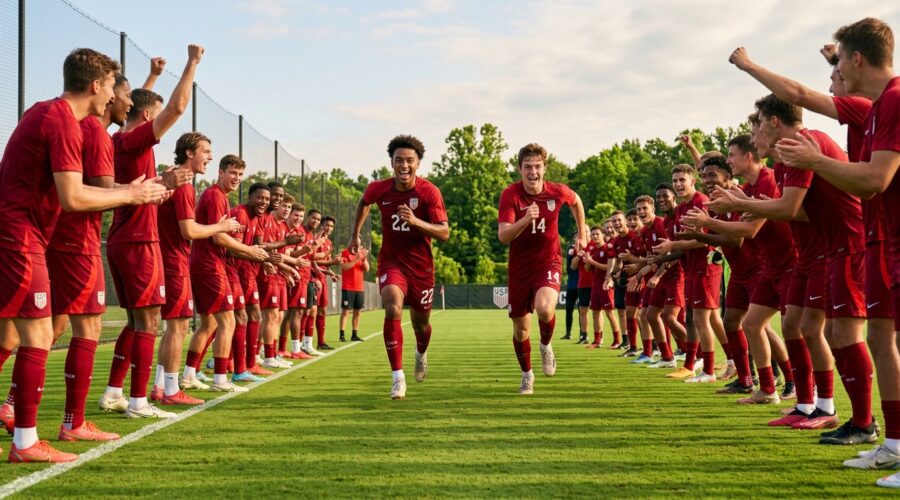
There is a particular kind of relief in football that has no adequate translation in statistics. It is the relief felt in a dressing room, in a technical area, in the gut of a coach who has spent weeks watching his two most dangerous players pedal exercise bikes and work resistance bands at the edge of a training pitch while the rest of his squad goes through its paces. On Thursday, June 11, at the Baylor School in Chattanooga, Tennessee — four days before Spain’s 2026 World Cup opener against Cape Verde — Luis de la Fuente finally got his full squad back. Lamine Yamal and Nico Williams returned to full group training, and their teammates did what footballers do when something genuinely wonderful happens: they made them run a gauntlet.
The image of two of the most thrilling wingers on the planet sprinting through a tunnel of cheering teammates, with goalkeeper Unai Simón following close behind on his birthday, was the kind of scene that the football world had been quietly hoping for and quietly dreading would not come. It came. And with it, Spain’s World Cup began in earnest.
Seven Weeks of Uncertainty, Settled in One Morning Session
To understand the weight of Thursday’s training session, you have to go back to April 22, when Yamal limped off the Spotify Camp Nou pitch during Barcelona’s 1-0 La Liga win over Celta Vigo. He had won a penalty after being fouled by Celta defender Yoel Lago in the box — and then, of course, stepped up and converted it in the 40th minute. It was immediately after scoring, as his teammates rushed in to celebrate, that he twisted his left hamstring. The official diagnosis was a biceps femoris strain. Barcelona confirmed he would miss the rest of the season and issued the kind of careful, hedged statement that immediately sent Spanish football into a spiral of speculation: he would be expected to be available for the World Cup. Expected. A word that does a lot of heavy lifting when a tournament begins in less than eight weeks.
Yamal himself captured the particular dread of those first days well enough. “I never had a hamstring injury like that,” he said, “but I knew that it wasn’t going to be a short recovery time. I was afraid that it was something serious or that it could relapse and that I would miss the World Cup.” For an eighteen-year-old preparing for his first World Cup, in a squad built substantially around his specific ability to destroy defensive lines on the right flank, that is an admission of genuine fear. The kind of fear that is entirely reasonable.
Nico Williams’s story ran on a parallel track with its own complications. He had spent much of the 2025-26 season managing a groin and pubalgia condition that severely curtailed his involvement in Athletic Bilbao’s Champions League campaign and raised, at one dark juncture, the spectre of surgery. Surgery was avoided. He returned to score a brace against Alaves on May 2 — both goals arriving in stoppage time, in the 83rd and 87th minutes, with Athletic running out 4-2 winners — which felt like a recovery. And then, on May 11, Athletic lost 1-0 to Valencia and Williams limped off in the 36th minute, approximately nine minutes before half-time, replaced by his brother Iñaki in a moment of almost cruel irony. A moderate hamstring strain to the left leg. Another conservative treatment plan. Another countdown clock.
De la Fuente named both in his 26-man squad on May 25 — announced, with a flourish that is very much in keeping with the current mood of Spanish football, in a video in which King Felipe VI delivered an introductory message while Spanish citizens from various professions and backgrounds read out the players’ names — and made his position clear: “We are not going to rush any process; we are coordinating closely with the clubs. The information we have is that everyone will be available for either the first or the second match.” It was a coach trying to project calm while operating with incomplete information, which is a perfectly ordinary situation for a manager and no less uncomfortable for that.
Chattanooga and the Art of the Bubble
Spain chose the Baylor School in Chattanooga as their World Cup base camp, and it is hard to argue with the logic. A prestigious private institution set on the banks of the Tennessee River, surrounded by trees, offering the kind of natural seclusion that large international squads require when they want to think about football rather than the endless noise around it. RFEF Technical Director for Development and Men’s Senior National Team Coordinator Aitor Karanka described the appeal succinctly: “In Chattanooga, we’re going to find the privacy in the training ground. When I was visiting the training ground, the facilities are amazing.” A school representative added that the treeline effectively creates “a bubble” — which is precisely what Spain needed as they managed two injured superstars back to fitness under the eyes of the entire footballing world.
At the first open session on June 7, Yamal and Williams trained separately from the main group with individual fitness and medical staff. It is the kind of arrangement that tells you everything about where recovery stands without anyone having to say very much at all. Three days later, they were absent from the matchday squad as Spain beat Peru 3-1 in the final warm-up friendly, with Oyarzabal and Pedri on the scoresheet and a Pedro Gallese own goal completing the rout — assurance that this squad functions perfectly well as a collective even without its most explosive components. And then Thursday arrived, and the gauntlet was run, and De la Fuente could breathe again.
What De la Fuente Actually Has — And Why It Matters
It is worth being precise about what makes Spain’s wide partnership so central to De la Fuente’s system, because this is not simply a matter of two gifted individuals being available. It is a structural point.
De la Fuente’s 4-3-3 is built on the principle of spatial superiority — winning the ball high, moving it quickly, and attacking the space created in transition before defensive lines can reset. The full-backs, Pedro Porro on the right and Marc Cucurella on the left, push high to overload wide channels. The midfield three of Rodri, Pedri, and Fabián Ruiz circulate possession with a technical fluency that makes opposition pressing exercises feel faintly futile. And at the top of the structure, Yamal and Williams operate as the primary mechanisms through which all that buildup is finally converted into genuine danger.
Yamal, at eighteen, wearing Barcelona’s No. 10 shirt with an ease that should unsettle anyone who remembers how long it took other teenagers to stop being teenagers, recorded 16 goals and 11 assists in La Liga during the 2025-26 season before his injury. He has 6 goals in 25 senior Spain appearances. At Euro 2024, in case anyone had forgotten, he became the youngest scorer in European Championship history — his curling effort against France in the semi-final, struck at 16 years and 362 days old, remains one of the tournament’s defining images — and finished with four assists, the most of any player in the competition. He also assisted Williams in the final.
That final, against England at the Olympiastadion in Berlin, is where Williams wrote his own entry in the story. He scored the opening goal in the 47th minute at twenty-two years and two days old to set Spain on their way, and was named Player of the Match. He is now 23, has 6 goals in 30 senior caps, and chose to remain at Athletic Bilbao last summer — rebuffing interest from Barcelona and several Premier League clubs in favour of a contract extension until 2035, with a release clause of over €95 million. There is something admirable about that, though it is the kind of loyalty that is easier to maintain when you are performing at the level Williams operates at. Athletic’s loss of his services for much of this season due to injury was one of the quieter tragedies of the 2025-26 campaign.
The Midfield That Nobody Talks About Enough
In any other squad, a Ballon d’Or winner returning from a serious knee injury would be the dominant subplot. Rodri spent most of 2024-25 in rehabilitation after damaging his knee, returned in Manchester City’s final Premier League fixture of the season, and now walks into the deepest midfield role in a Spain squad as the unquestioned captain. His ability to control the tempo of a match — to make the game breathe at the pace Spain want rather than the pace the opposition prefer — is the foundation on which everything else is constructed. Pedri makes the clever runs and finds the spaces. Fabián Ruiz provides the technique and the range. But Rodri is the nervous system of the whole operation, and the fact that he is fit and available for this tournament is, tactically speaking, as significant as anything happening on the wings.
The midfield trio of Rodri, Pedri, and Fabián Ruiz, anchored behind a front three of Yamal, Oyarzabal, and Williams, is the most complete unit Spain have fielded since the tiki-taka peak of 2010. It is worth saying that plainly, without excessive caveats. De la Fuente has built something genuinely formidable.
The Footnote That Is Actually a Headline: No Real Madrid
Spain’s squad announcement on May 25 carried a detail that required a moment to fully absorb. For the first time in their 92-year history of competing at the World Cup, Spain named a squad containing no Real Madrid players. Not one. Dani Carvajal’s long-term injury removed the most obvious candidate, and Dean Huijsen’s exclusion provided the quiet shock. De la Fuente’s response to the inevitable questions was to say what he always says when asked about club allegiances: “I don’t look at whether they come from one club or another. They’re all Spain players.” This is the right answer, delivered with the quiet confidence of a man whose 31-match unbeaten run in official competition makes the question feel slightly less pressing than it might otherwise.
The squad is instead populated largely by Barcelona, Arsenal, and Athletic Bilbao players, with Marc Cucurella of Chelsea and Yéremy Pino of Crystal Palace among the Premier League contingent. It is a genuinely meritocratic selection, and if Real Madrid’s domestic season did not produce players who merited inclusion, that is their concern rather than De la Fuente’s.
Cape Verde, and the Appropriate Degree of Respect
It would be easy — and not entirely unjustifiable — to treat Spain’s opening group game against Cape Verde as a formality. Spain are -1000 moneyline favourites. The two nations have never previously met. Cape Verde, a nation of approximately 500,000 people, are making their first-ever World Cup appearance, having qualified from CAF Group D — though not without setback: they suffered a 4-1 defeat to Cameroon, their only loss across the qualification period. Their oldest key veterans — captain Ryan Mendes at 36, Garry Rodrigues at 35, goalkeeper Vozinha at 40 — suggest a squad that has been waiting a long time for this moment.
And therein lies the only small warning worth issuing. Cape Verde under manager Bubista play with a clear tactical identity: a compact 4-2-3-1 built on defensive discipline, direct counter-attacks, and collective organisation. They press with intent, they win the ball in useful areas, and they attack before defences can settle. They are not a side coming to Atlanta simply to take part. Their qualifying record — seven wins and two draws, a goal difference of plus eight — reflects a team that knows what it is doing. A side making their World Cup debut with a 40-year-old goalkeeper and genuine tactical coherence is precisely the kind of opponent that catches European powers napping when those European powers arrive with one eye on the knockout rounds.
Spain should be far too good for them. But the appropriate degree of respect is not condescension dressed up as caution — it is the understanding that football occasionally makes fools of probability, and that a hamstring-cautious Yamal playing “just a few minutes,” in De la Fuente’s own careful phrase, is a different proposition from a fully fit Yamal from the first whistle.
The Question of the First Fifteen Minutes
De la Fuente has been admirably transparent about Yamal’s likely role in Atlanta. “He will be ready for the first game,” the coach said, with the caveat that involvement could be “limited to just a few minutes.” Which raises the question of how Spain actually line up at kick-off against Cape Verde on June 15. Ferran Torres or Dani Olmo as a starting right winger, with Yamal introduced from the bench to decisive effect, is one entirely credible option. Both are fine footballers. Neither is Lamine Yamal wearing the No. 10 shirt for Barcelona at eighteen years old with a market value of €200 million and the composure of a man three times his age.
Equally credible: Yamal starts, plays forty-five minutes, and is replaced at half-time as a purely precautionary measure. De la Fuente has earned sufficient trust to manage that decision without significant complaint. His record demands it.
The game that matters most for Yamal’s fitness, in any case, is June 27 in Guadalajara — Spain against Uruguay, with Marcelo Bielsa’s side and their midfield axis of Fede Valverde and Rodrigo Bentancur providing the genuine Group H examination. That is where Spain will need Yamal fully fit, fully sharp, and fully himself. Thursday’s gauntlet run in Chattanooga suggests, with the usual caveats about hamstrings and the essential unpredictability of the human body, that he will be.
A Thirty-One Match Unbeaten Run Begins Here
Spain arrive at this World Cup on a 31-match unbeaten run in official competition under De la Fuente. They have won the European Championship and the UEFA Nations League. They are ranked second in the world by FIFA. They are, by most reasonable measures, one of the two or three most complete international squads currently assembled on the planet. The final — July 19 at MetLife Stadium in New Jersey — is not a destination they are secretly wary of discussing.
When asked to describe his squad in three words, De la Fuente offered: “Quality, humanity, and competitiveness. In these areas, we are a very powerful team.” It is the kind of answer that sounds like a press conference answer until you look at the squad list and realise it is actually just accurate.
The gauntlet has been run in Chattanooga. Yamal and Williams are back. Spain are whole. Whatever comes next at the Mercedes-Benz Stadium in Atlanta on June 15, the reigning European champions are no longer managing around the edges of their own potential. They are ready to express it fully — or, at the very least, ready to express it in “just a few minutes,” which, given the player in question, may well be enough.