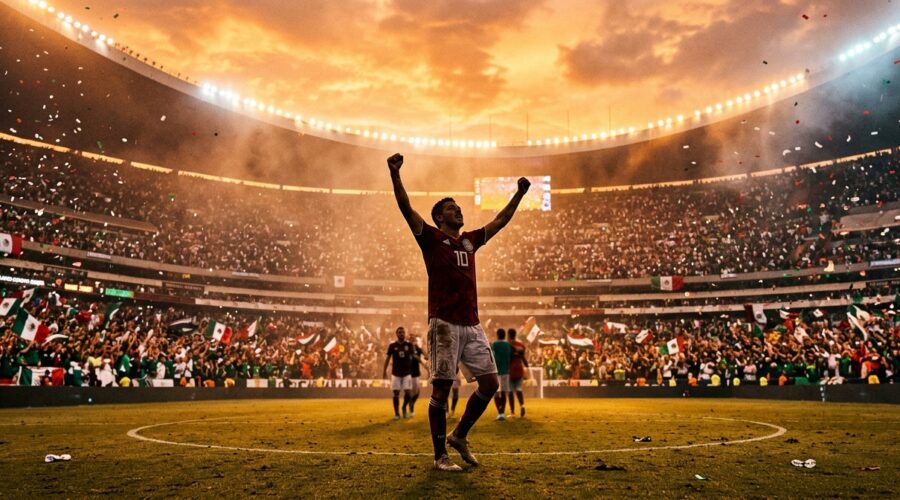
There is a particular kind of football that the opening days of a World Cup tend to produce — cautious, taut, occasionally dull, and then, without warning, alive. Day Two of the 2026 FIFA World Cup, spread across a sweltering North American summer, delivered precisely that. Two matches, two second-half comebacks, two sets of supporters who arrived in dread and left in something approaching joy. South Korea reminded a watching continent that they are more than Son Heung-min’s shadow. And Canada, on home soil, finally put a goal in the net that actually counted. Both of them deserved it. Neither of them made it easy on themselves.
Group A — South Korea 2–1 Czechia | Estadio Guadalajara, Zapopan
A First Half Best Forgotten
There will be those who claim they enjoyed the opening forty-five minutes in Guadalajara. Those people are being generous. The 44,985 inside Estadio Guadalajara — a figure that, it must be said, came with conspicuous gaps in the stands, prompting renewed criticism of FIFA’s pricing model for this expanded, commercially ambitious tournament — watched a first half of football that was dutiful rather than inspired. South Korea dominated the ball in the manner of a team that had been told possession was a virtue and had chosen to take that instruction very seriously indeed, completing 464 passes by the final whistle against Czechia’s 242. In the first half, they did very little with it. Both sides trudged off at halftime to the sound of their own supporters making their disappointment known.
The mandatory hydration breaks that FIFA has introduced at the midpoint of each half — a concession to the summer heat baking these North American venues — gave coaches something they rarely get in football: a scheduled window to think aloud. South Korea’s head coach Hong Myung-bo, who has spoken before this tournament of discipline and structure, used those minutes wisely. His side came out of the break a sharper unit.
Krejčí Opens the Scoring — and Reopens a Nation’s Memory
It was Czechia who scored first, which will have surprised nobody who had watched the first half and noticed that their tactical plan involved absorbing pressure and waiting for their moment. That moment arrived in the 59th minute, from a long throw-in by Vladimír Coufal — a weapon that belonged more to the Championship than the World Cup, and none the worse for it. Ladislav Krejčí, the Czech captain, climbed well and headed emphatically past Kim Seung-gyu.
The goal meant something beyond its immediate tactical significance. It was Czechia’s first World Cup goal in twenty years — and, in a sense, more than that. They have appeared at only two FIFA World Cups: Germany 2006, when they competed under the name Czech Republic, and this one. The intervening two decades brought near-misses, play-off defeats, and the quiet accumulation of footballing frustration — an entire era of absence from the game’s greatest stage. The reaction in the stands suggested the weight of those twenty years was well understood.
Hwang In-beom and the Eight-Minute Demolition of Czech Optimism
South Korea’s response came not in panic but in authority, and it was delivered almost exclusively by one man. Hwang In-beom, the Feyenoord midfielder who had spent a portion of his club season battling fitness concerns, had arrived in Guadalajara described by the Korean Football Association’s medical staff as “almost back to full health.” That qualification, it turns out, is more than sufficient.
His equaliser in the 67th minute was the kind of goal that requires describing carefully because it deserves to be remembered properly. He received the ball at the top of the box, assessed his options in approximately half a second, faked a shot that sent two Czech defenders into a collective crisis of confidence, and watched goalkeeper Matěj Kovář tumble out of position. What followed was almost serene: Hwang simply rolled the ball into the open net as though he were concluding a training ground exercise. The stadium, which had been growing increasingly impatient, erupted.
Eight minutes later, he was at it again — this time as architect rather than finisher. Picking up a through ball from Paik Seung-ho on the right flank, Hwang whipped in a low cross to the back post where Oh Hyeon-gyu had arrived with the calm certainty of a man who absolutely had not been running a fever of 38 degrees Celsius the previous day. Oh tapped it home. South Korea led. The substitution clock, as it happened, had already ticked past the point where one particular South Korean forward had departed the pitch.
The Son Problem
There is no comfortable way to write this, and Anders sees no reason to attempt one. Son Heung-min, thirty-three years old and the gravitational centre of South Korean football for the better part of a decade, was poor. He fired five of his six attempts wide. He was substituted in the 69th minute, two minutes after his country had equalised and before Oh Hyeon-gyu had scored the winner that Son would dearly have liked to score himself. The crowd did not boo him; the respect is too deep-rooted for that. But the mathematics of his afternoon — six shots, five wide, replaced at sixty-nine minutes, his replacement scored the winner — do not require embellishment.
It would be lazy to write Son off after ninety minutes of a tournament that runs until July. It would be equally lazy to pretend this performance was a blip rather than a symptom of a broader truth: that when great forwards age, it rarely happens gradually. It happens all at once, in front of 44,985 people on a hot evening in Guadalajara. Hong Myung-bo will know better than most that managing Son’s role — and his ego — across the coming weeks will be as tactically demanding as any defensive shape he deploys.
What is genuinely encouraging for South Korea is that the system does not need Son to function. Hwang In-beom — one goal, one assist, 91% pass accuracy, three key passes, the Man of the Match award — demonstrated that Korea have a midfield spine capable of controlling and deciding games. Kim Seung-gyu made two critical saves in the final minutes, including a correctly disallowed Tomáš Souček header, to confirm a win that South Korea deserved on the balance of play.
It is their first opening-match victory at a World Cup since South Africa 2010. The significance of that, in a dressing room that has spent sixteen years reaching for that particular reference point, should not be underestimated.
Group B — Canada 1–1 Bosnia-Herzegovina | Toronto Stadium
Home Soil, History, and Ryan Reynolds in the Stands
There is something inherently theatrical about a country hosting its own World Cup match, particularly a country that spent decades watching the tournament from a distance. Canada’s record at men’s World Cups, entering this tournament, read as follows: one appearance in 1986, where they scored no goals; one appearance in Qatar 2022, where they scored two — Alphonso Davies against Croatia, and an own goal against Morocco, which, with respect to Morocco, is the kind of goal that history records but selectively forgets. Three goals total. Fourteen qualifying campaigns, roughly speaking, to get there.
Toronto Stadium, with its view of the CN Tower and 43,002 supporters dressed predominantly in red, was the venue for the next chapter. Ryan Reynolds and Connor McDavid were in the crowd, which tells you something about the cultural breadth of a nation that has never quite settled on whether its primary sporting identity is ice, green, or pitch. On this Thursday evening, it was very much pitch.
The absence of Alphonso Davies — ruled out with the hamstring injury he sustained in Bayern Munich’s Champions League semi-final against PSG on May 6 — loomed over proceedings like an uninvited guest. Davies scored Canada’s first-ever World Cup goal, in Qatar in 2022. He is the team’s captain and, in the eyes of many neutral observers, their most recognisable face on the global stage. Jesse Marsch indicated pre-match that his captain might return for the next fixture, against Qatar on June 18. The hope, in Toronto, was palpable.
Lukić and the Danger of Set Pieces
Canada had the better of the early exchanges and fashioned their first meaningful chance in the 17th minute when Jonathan David found space inside the penalty area, only for Nikola Vasilj to make a comfortable central save. It was the kind of chance that, in retrospect, screamed forewarning. Bosnia-Herzegovina are not a team of especially intricate construction — their qualifying campaign, extraordinary as it was, featured the beating of Italy on penalties in Zenica in a play-off that the football world is still processing — but they are exceptionally organised from dead balls, and Ivan Bašić delivers a corner with the menace of a man who has been practising this specific scenario for months.
Jovo Lukić, who was only in the starting eleven because Edin Džeko had a shoulder injury and Haris Tabaković was listed as a late withdrawal for undisclosed reasons, got on the end of a flick-on at the front post in the 21st minute and finished emphatically into the net — the ball deflecting in off the initial contact before Lukić applied the decisive touch. It was his first international goal in four caps. The sort of thing that will appear, years from now, in the kind of trivia question that turns pub quiz nights hostile.
What followed was a sustained exhibition of Canada’s most persistent difficulty: the ability to create chances without the ability to take them. Tani Oluwaseyi blazed over a gilt-edged opportunity in the 36th minute. In the 54th, Richie Laryea struck the crossbar after a through ball from captain Stephen Eustáquio — Kolašinac’s boot, in a moment of accidental intervention, deflecting the effort onto the woodwork. Bosnia had a moment of their own through Ermin Demirovic at 53′, saved comfortably. The scoreboard, stubbornly, remained 1–0.
Marsch Makes His Move
Jesse Marsch had benched Cyle Larin from the start. He had also benched Ismael Koné. These are bold decisions — the kind that get a coach praised as tactically astute when they work and pilloried as inexplicably timid when they do not. Marsch introduced Larin in the 76th minute, with Canada needing a goal in front of a crowd that had been clenching its collective jaw for approximately an hour.
Two minutes later, Larin scored. He received a pass from fellow substitute Promise David — two substitutes combining, in the way that substitutes do when a manager’s plan unfolds with suspicious precision — turned cleverly at the edge of the box, and drove a left-footed shot into the net. The power of it was emphatic. The Toronto Stadium noise that followed was of a different order entirely to anything that had preceded it.
Cyle Larin, from Brampton, Ontario, scoring Canada’s first goal of the 2026 World Cup, at a World Cup, in Toronto. There is a sentence that required forty years of Canadian football infrastructure to become possible. His thirty international goals make him the second-highest scorer in the history of the Canadian men’s team. His goal against Bosnia-Herzegovina is, by the official count, only the third goal Canada have ever scored at a men’s World Cup. He had two minutes to make his mark, and he did. The Bosnian supporters who had made the journey — and there were an enormous number of them, as many as 30,000 in a stadium of 45,000, one of the largest gatherings of Bosnians outside the diaspora in recent memory — were silenced in a way that only a last-gasp equaliser can manage.
Canada pushed in the final moments — a Larin effort in stoppage time was blocked — but the draw held. On the final whistle, the noise suggested something between relief and joy, which is, historically speaking, an accurate description of how most Canadian sporting victories feel.
The Bigger Picture
A point. Canada’s first World Cup point in history, accumulated on home soil, in front of their own people. Bosnia’s second-ever World Cup appearance had yielded a credible result against a well-organised host nation. Both benches looked like they could live with the outcome.
The group arithmetic now sets up interestingly. Canada face Qatar on June 18 — a fixture that, on paper, they are expected to win, and which becomes considerably more manageable if Davies is available. Bosnia meet Switzerland on the same day, and the Swiss, who have yet to play, will have watched the footage of Bašić’s deliveries and begun planning accordingly. Whether that planning proves sufficient is Switzerland’s problem to solve.
Where We Stand
After two days of football, the narrative threads are already pulling tight. In Group A, Mexico — who beat South Africa 2–0 on the opening day — and South Korea both sit on three points, setting up a June 19 meeting between the hosts’ most passionate fanbase and a Korean side that just showed it has the tactical depth to win ugly. Czechia and South Africa are left to fight for whatever scraps remain.
In Group B, the early standings are as compressed as they were ever likely to be. Canada and Bosnia share a point apiece; Qatar and Switzerland have yet to enter the equation. Four teams, seven points maximum each, and only the barest margin between qualification and the flight home.
The Golden Boot after two match days is led by Folarin Balogun of the United States, who scored twice in the USA’s 4–1 demolition of Paraguay on June 12. Hwang In-beom sits just behind him with a goal and an assist that mark him out as the early tournament standout. Oh Hyeon-gyu, Lukić, and Larin are all on the board after single appearances.
The hydration breaks will continue. The summer heat will persist. And the football, tentatively, is beginning to find itself. Two days in, two matches worth remembering. That, at a World Cup, is more than enough to be going on with.