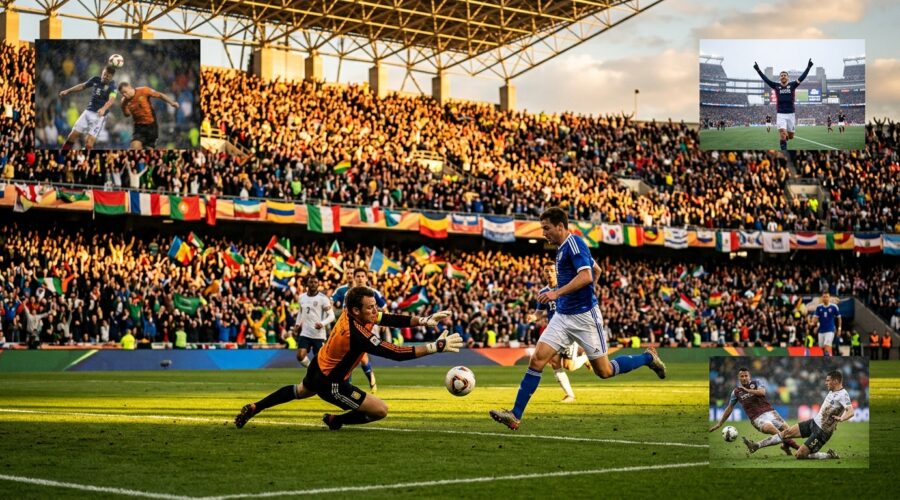
There is a moment in every World Cup — usually somewhere between the cautious, padded-out opening week and the brutal arithmetic of the knockouts — when the tournament stops being a spectacle and starts being a story. June 19, 2026 felt like that moment. Three group stage matches, played across two countries and three time zones, delivered a goalkeeper catastrophe in Guadalajara, a VAR-blessed header in Seattle, and the fastest goal in this World Cup’s brief but eventful history in a grey corner of Massachusetts. Two nations punched their tickets to the Round of 32. A third watched their captain sleepwalk through fifty-seven minutes before being quietly removed from the premises. And a twenty-five-year-old midfielder from PSV Eindhoven continued his audacious argument for the most expensive transfer fee in Bavarian football history.
It was, by any reasonable measure, a very good day of football.
Mexico 1–0 South Korea: A Gift Wrapped in Good Intentions
The first match of the day did not deserve the word classic. For forty-nine minutes, the crowd at Estadio Akron — 45,522 souls who had come expecting a fiesta — was subjected to something that might generously be described as professional caution and less generously described as a bore draw dressed up in green shirts. Mexico drew boos at halftime, which feels like the appropriate response when the home side in a World Cup group game is too timid to inconvenience a back four.
And then Seung-Gyu Kim decided to change everything.
On fifty minutes, a cross arrived at the South Korea goalkeeper — routine in its weight, unremarkable in its trajectory, the kind of delivery that a senior professional catches in his sleep. Kim did not catch it in his sleep. Kim sprawled, fumbled, and watched the ball squirm loose into the space where Luis Romo was already arriving with the predatory certainty of a man who has spent his career scoring goals at just such moments. The Chivas midfielder, who joined Guadalajara in January from Cruz Azul and has been one of Liga MX’s most reliable midfield operators for the better part of a decade, stabbed it home with his right foot. The stadium erupted. El Tri had their goal.
What followed was the more interesting tactical story, and the one that carries real implications for South Korea’s tournament. With the scoreline against them, Hong Myung-bo’s side pressed higher and began to find the pockets of space behind Mexico’s compact mid-block that had not existed in the first half. The xG numbers bear this out in unambiguous terms: South Korea finished with 0.69 expected goals to Mexico’s 0.48. They created more, threatened more, and were arguably the better side once the game opened up. The scoreline did not reflect this. Football rarely does.
The moment that best illustrated Mexico’s fragility came in the eighty-seventh minute, when a cross from substitute Ji-sung Eom caused chaos in the penalty area. It was Raúl Rangel — twenty-six years old, standing in for the veteran Guillermo Ochoa, carrying all the burden that comes with that particular job description — who produced a goal-line clearance of real composure under real pressure. It was, depending on your perspective, either a sign of admirable backup quality or a reminder that Mexico were hanging on by their fingernails against an opponent who should, by rights, have been level.
Mexico qualified for the Round of 32 regardless. They become the first team of the 2026 World Cup to do so, which is a sentence that will be noted in the history books and largely forgotten by Tuesday. The more pressing concern, in both camps, is what Rangel’s performance means for Ochoa’s future involvement, and what Heung-min Son’s performance means for South Korea’s.
Son was substituted off in the fifty-seventh minute having registered nineteen touches. Nineteen. For a player of his calibre — a man who has been one of the most effective forwards in the Premier League for the better part of a decade, who carried South Korea to back-to-back World Cup appearances and dreamed publicly of leading them to something deeper — that number is not a statistic so much as a symptom. The media circus surrounding the squad has not helped, with a reported rift between players and journalists casting a shadow over South Korea’s preparations that was already visible before a ball was kicked. Hong Myung-bo now faces a decision of some delicacy: his captain is manifestly short of his best, and the team that depends on him most has one match to save its tournament against South Africa.
United States 2–0 Australia: A Nation Settles Into Its Own Party
There is something both impressive and slightly exhausting about the way the United States men’s national team is performing at this World Cup. Impressive because the results are unimpeachable: six points from six, two clean sheets, a squad depth that has absorbed the loss of their most recognisable name without visible panic. Exhausting — for opponents, at least — because Mauricio Pochettino’s counter-pressing system has a kind of relentless, high-tempo logic to it that leaves little room for the romantic uncertainty that makes the game worth watching.
Christian Pulisic, the player whose injury was announced on the morning of the match, was always going to be the story. A kick to the left calf suffered in the opening win over Paraguay meant Ricardo Pepi led the line instead, and for the first ten minutes it seemed as though Australia might exploit the reconfiguration. They did not get long to explore the possibility.
On eleven minutes, Folarin Balogun — the Monaco striker who scored twice on his World Cup debut against Paraguay and has now established himself as the tournament’s most dangerous American forward since the days when that phrase required significant qualification — drove a low cross from the left flank into the penalty area. Cameron Burgess, attempting to clear, turned it into his own net. It was the kind of own goal that feels generous to record as an own goal rather than simply crediting the cross, which was precise and malicious in equal measure.
The second goal arrived just before the break and came wrapped in the particular drama that VAR has gifted to modern football: a deflected shot, a header by Alex Freeman, a lengthy review for offside, and then the confirmation that the United States were two goals to the good at half-time. Freeman, wearing the number sixteen shirt and carrying the increasingly confident look of a tournament player, has now become one of the genuine breakout stories of the competition. Balogun has two goals in two matches. The USMNT, co-hosting this tournament and carrying the accumulated expectations of a country that rarely underestimates itself, have answered that expectation with something close to authority.
Australia’s afternoon was largely defined by their goalkeeper. Patrick Beach — operating in place of the established first choice and making the sort of saves that earn a man a starting contract rather than a backup contract — finished with eight stops, which is the kind of individual performance that tends to look heroic in match reports and quietly devastating when considered against the final score. Nestor Irankunda offered moments of genuine quality in limited time, and will be one of the Socceroos’ primary concerns against a Paraguay side they simply must beat to have any realistic hope of progression.
Weston McKennie and Tyler Adams controlled the midfield with the comfortable authority of a side that knows it has already qualified and has nothing left to prove in the group stage. For Turkey, whose remaining match against the United States now carries purely academic significance having accumulated zero points, the less said the better.
Scotland 0–1 Morocco: Seventy-One Seconds to Silence the Tartan Army
The final match of the day at Gillette Stadium in Foxborough, Massachusetts, delivered its decisive moment before most of the 72,000 in attendance had finished negotiating the concession queues. Seventy-one seconds after kick-off — which is to say, approximately the time it takes to settle into your seat, locate your beverage, and glance at the pitch — Ismael Saibari collected a delicately weighted pass from Brahim Díaz, slipped behind two Scotland defenders with a movement of implausible simplicity, and blasted into the top-left corner past a helpless Angus Gunn.
It is the fastest goal of the 2026 World Cup. It is also, if you are inclined to read such things symbolically, a fairly accurate summary of Morocco’s general approach to the tournament: surgical, sudden, and conducted with an almost contemptuous ease that belies the tactical discipline operating underneath.
Saibari deserves more than a sentence. The twenty-five-year-old PSV Eindhoven midfielder has already agreed a €55 million move to Bayern Munich — a transfer that represents the highest fee PSV have ever received for a player, and one that his performances here are making look, if anything, modest. He scored Morocco’s goal in their opening 1–1 draw with Brazil — a composed lob over goalkeeper Alisson in the 21st minute, before Vinícius Júnior equalised for Brazil in the 32nd. He has now scored twice in two World Cup matches, sits firmly in the Golden Boot conversation, and was named the superior player of the match for the second time. Bayern’s club doctor completing his medical in New Jersey, near Morocco’s training base, is either a logistical convenience or a sign that the German champions want this done before their new midfielder does anything else to increase his own market value.
Morocco were, as they have been since their astonishing semi-final run at the 2022 World Cup in Qatar — when they became the first African nation in history to reach the last four — a side that knows precisely what it is doing and declines to be rushed into doing anything else. Achraf Hakimi caused Scotland untold misery down the right flank with his trademark overlapping runs, creating space and combinations that the Scottish backline had neither the pace nor the organisation to contain. Bilal El Khannouss hit the crossbar in the fifty-second minute and nearly converted a near-post corner from Hakimi that ought, on reflection, to have made it two.
Scotland, to their credit, improved as the match progressed. Scott McTominay was their best player in possession — creative, determined, unwilling to accept the limitations his teammates occasionally imposed — and Andrew Robertson’s cross to John McGinn in first-half stoppage time represented their clearest opportunity to change the shape of the evening. McGinn did not connect. Morocco’s physical, disciplined defensive shape held for the final thirty minutes with the minimum of incident and the maximum of competence. Angus Gunn made four saves. The Tartan Army sang, as they invariably do, with more conviction than the occasion warranted.
The consequence is stark. Scotland sit third in Group C with three points from two matches, with Brazil to come — effectively a knockout game, should the Seleção recover from their opening draw and arrive in their proper form. Morocco, with four points and Haiti on the horizon, look increasingly capable of repeating or surpassing what they achieved four years ago. Wait — Morocco’s tally requires a correction of its own: with one draw against Brazil on June 13 and now this win over Scotland, they carry four points into the next round. The Atlas Lions are not merely a nice story. They are a tactically coherent, physically formidable, technically excellent side with a midfielder who has just scored the fastest goal in this World Cup and a right back who has been the most consistently dangerous wing player in the tournament so far.
The Golden Boot Race: Messi and David Share the Summit
Lionel Messi is tied atop the Golden Boot standings alongside Jonathan David, both players having scored three goals apiece as of June 20. Messi’s contribution came via a hat-trick in a single match — a reminder that the world’s greatest player, operating in what is almost certainly his final World Cup, has no intention of fading into the background. David’s three goals, meanwhile, all arrived in a single devastating performance: the Canadian striker scored a hat-trick in Canada’s 6–0 demolition of Qatar on June 18, marking him out as a predator of the highest order rather than a mere accumulator. Saibari and Balogun sit on two apiece. Vinicius Junior has two goals and two assists in two games, which is the sort of contribution that wins tournaments rather than individual awards.
Mbappé, Haaland, Havertz, and Harry Kane have all scored twice in a single match each. Some of them will add to that tally on June 20, when the Netherlands face Sweden in what promises to be the most tactically absorbing match of the round. Brazil play Haiti in the same time window, and if Vinicius gets on the scoresheet as expected, the Golden Boot conversation may look considerably different by tomorrow evening.
What June 19 Tells Us About This Tournament
Three matches. Two qualifiers. One goalkeeper who will spend a long time revisiting the fifty-minute mark of a game in Guadalajara. The theme, if there is one, is not the inevitability of the favourites — Mexico qualified despite being outplayed on the xG chart, and the United States qualified with a first-choice forward watching from a physio table — but the quality of the individual performers emerging from unexpected corners. Saibari is not a surprise to anyone who has watched Eredivisie football this season, but he is a surprise to a World Cup audience, and that is precisely the kind of story tournaments are built around.
The round of 32 approaches. Mexico are already there. The United States are already there. Scotland are walking toward a fixture against Brazil with the look of a team that knows what is coming and has decided to turn up anyway, which is either admirable or tragic depending on your disposition.
June 20 will have answers. For now, June 19 closed with a Moroccan midfielder already en route to Munich in everything but paperwork, a South Korean captain who touched the ball nineteen times, and a goalkeeper in Guadalajara who will not soon forget the sound of a routine cross slipping through his fingers and into the back of his net.
Football, as ever, takes no particular interest in your preparations.