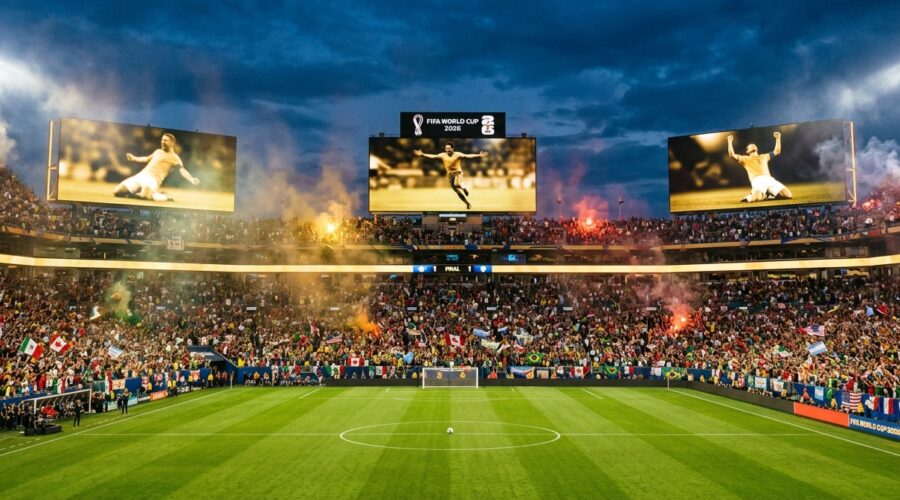
There are days at a World Cup when the group stage feels like a preamble — a set of administrative exercises before the real competition begins. June 22, 2026 was emphatically not one of them. Four matches, four teams punching their tickets to the Round of 16, and a Golden Boot race that by close of play had narrowed into one of the most compelling individual contests this tournament has ever produced. Lionel Messi with five goals. Kylian Mbappé and Erling Haaland with four apiece. Twelve days into the forty-eight team World Cup’s group stage, with numerous matches already completed across the tournament, the world’s three most feared forwards are already engaged in something that feels almost mythological.
But before we lose ourselves entirely in the numbers — and we shall keep it brief, because the football itself deserves better — let us account for what actually happened on a day that sent teams home and sent others soaring.
Group G: Egypt Dismantle New Zealand, Book Their Ticket
Egypt’s 3–1 victory over New Zealand was the most straightforward of the day’s four results, though that is not to diminish what the Pharaohs are quietly building in Group G. They came into the match having drawn 1–1 with Belgium — a competent, if unspectacular, opening — but against a New Zealand side that had managed only a draw of their own against Iran, Hossam Hassan’s team found something approaching their ceiling.
Mohamed Salah, stepping onto the World Cup stage for what may well be the last act of a career that has redefined Egyptian football, was the conductor throughout. There is something almost uncomfortable about watching Salah at this level — the way he drifts into pockets, the way he makes the angle before the ball arrives, the quiet inevitability of his involvement in everything that matters. He is departing Liverpool at the end of this season, a decision announced in March 2026 following a challenging campaign — and if anything, the freedom of this stage seems to have unburdened him.
Alongside Salah, Omar Marmoush — the Manchester City forward whose prolific Bundesliga years at Eintracht Frankfurt raised enormous expectations — was a constant menace, even if his Premier League season with City offered more modest returns than those who hoped he would replicate that form in England. The partnership between Egypt’s two Premier League-calibre attackers caused New Zealand structural problems that their backline simply had no answer to.
Elijah Just grabbed a consolation that gave New Zealand’s travelling support something to sing about in the closing stages, and it was taken with real quality — a reminder that the All Whites, despite their exit, are not simply making up the numbers. But the match belonged to Egypt, who sit top of Group G on four points with Iran and Belgium level on two behind them, each waiting nervously for their June 27 encounter to settle who follows the Pharaohs into the last thirty-two.
New Zealand are out. There is no soft way to say it. But Elijah Just’s performances across the tournament suggest a player who will return to this stage, and Chris Wood — veteran of more near-misses than most — leaves with his reputation intact if not his tournament.
Group J: Argentina and the Sheer Weight of Messi
There is a certain kind of match that Argentina under this iteration play — controlled, unhurried, with an authority that borders on the imperious — and the 2–0 victory over Austria was a textbook rendition of it. Austria arrived having beaten Jordan three goals to one in their opener, which had at least suggested they were capable of causing problems. Against Argentina, those problems evaporated within the first quarter of an hour, and Austria’s remaining sixty minutes were spent attempting damage limitation with the resigned competence of a side that knows it has already been found out.
Alexis Mac Allister ran the midfield with the kind of quiet dominance that rarely shows up prominently in match ratings but makes the entire system function. Lautaro Martínez and Julián Álvarez offered the defensive industry and movement that liberated the man behind them. And the man behind them — the man always behind them, the reason eighty thousand people in any given stadium strain their necks to watch the warm-up — was Lionel Messi.
He now has five World Cup goals in two matches at this tournament. Five. In his previous World Cup appearances across 2006, 2010, 2014, and 2018, Messi scored a combined six goals across nineteen matches. He is doing in two games what once took him entire tournaments, and he is doing it at thirty-eight years of age — with his thirty-ninth birthday arriving on June 24, just two days away — in what every observer agrees must be his final appearance on the world’s largest stage.
Argentina are through. Six points from six, a goal difference of plus-five, not a goal conceded in two matches. The question of who finishes second in Group J — Austria and Algeria are level on three points apiece, meeting on June 28 in a winner-takes-all — is of academic interest. Argentina are the story, and Messi is the story within the story.
David Alaba captained Austria with dignity and Marcel Sabitzer worked without cease, and none of it was remotely sufficient. You feel for Austria, because there is no shame in being outclassed by this team. There rarely is.
Group I, Match One: France Are Simply Too Good for Iraq
France’s 3–0 dismantling of Iraq was less a football match than a demonstration — the kind of systematic, almost clinical exercise that Didier Deschamps has spent his managerial career perfecting and which, in their better moments, his players execute with something approaching artistic satisfaction.
Kylian Mbappé has three goals in two matches. He is the defending Golden Boot winner from Qatar 2022, and he looks every inch a man with unfinished business. The pace — still among the most terrifying in world football — is augmented now by a composure and positional intelligence that was always there but has matured into something more relentless. When Mbappé runs in behind, defences do not simply get beaten. They get humiliated.
Around him, France’s supporting cast continues to impress. Michael Olise — the Bayern Munich winger whose emergence as a genuine superstar has been one of European football’s most satisfying recent narratives — offered creativity and directness in equal measure. Marcus Thuram provided a physical presence that stretched Iraq’s backline. Ousmane Dembélé, in his better moments, remained an unsolvable puzzle on the right flank. And in midfield, Adrien Rabiot and Manu Koné — with N’Golo Kanté providing experience from the bench — gave France the kind of industrious, technically assured engine that Deschamps has long relied upon.
Iraq conceded seven goals across their two group stage matches. Ali Al-Hamadi tried valiantly and Zidane Iqbal, the FC Utrecht midfielder who earned his place on the international stage via a permanent move from Manchester United in 2023, will learn from a tournament where the gap between club-level promise and international-level execution was occasionally stark. Iraq are eliminated, and so is Senegal. Group I, it transpires, has only ever had two teams capable of advancing, and they are now set to meet each other on June 26 to settle who gets top spot.
Group I, Match Two: Norway Win a Thriller, Haaland Arrives on the Grandest Stage
If France versus Iraq was an exercise in control, Norway versus Senegal was something altogether less tidy and considerably more enjoyable. The final score of 3–2 does not quite capture the full drama of an encounter that swung, lurched, and ultimately resolved itself in Norway’s favour through a combination of Erling Haaland’s ruthlessness and Senegal’s admirable refusal to simply accept defeat.
It is worth pausing on what Haaland’s presence at a World Cup means — not just for Norway, but for the tournament itself. This is a player who has been the most destructive striker on the planet for the better part of four years, a man who has scored goals at a rate that makes statisticians question their instruments, and yet the World Cup has been conspicuously absent from his CV. Norway have not qualified for this tournament since 1998 — a year and a half before Haaland was even born. The weight of that twenty-eight year wait seemed to land on him not as pressure but as fuel.
The partnership with Martin Ødegaard is the engine of this Norway side, and watching it function in real time is a genuine pleasure. Ødegaard — the Norway captain and one of the Premier League’s finest creative forces for several seasons now — finds Haaland in the spaces that Haaland demands, and Haaland does what Haaland does: he converts. Four goals in two matches, level with Mbappé, one behind Messi. Norway are through to the last thirty-two, and neutrals across the world quietly hope they stay in it as long as possible.
Senegal’s elimination, though mathematically inevitable before a ball was kicked here, carried the sadness of a side that genuinely had more to offer. Sadio Mané never stopped running, never stopped believing, and embodied everything admirable about this Senegalese generation even in defeat. Kalidou Koulibaly captained his side with the dignity of a man who understood this was likely his final act in international football at the very highest level. Nicolas Jackson caused problems throughout. It simply was not enough, and Senegal go home with nothing but the consolation of having competed.
The Golden Boot: A Three-Horse Race for the Ages
Let us address the thing that will dominate the tournament’s narrative until someone either breaks clear or falls away. Messi on five goals. Mbappé and Haaland on four apiece. Three players, three generations almost, three entirely different propositions as footballers — and all three with the games, the quality, and the hunger to win this award outright.
Messi is thirty-eight — turning thirty-nine in two days — and operating at a level that should not be physiologically possible. Mbappé is twenty-seven, at the apex of his powers, and defending a Golden Boot he won on the tournament’s biggest occasion. Haaland is twenty-five, playing his first World Cup, and approaching it with the unsettling calm of someone who has never really considered the possibility of failure.
Behind them, Deniz Undav of Germany and Jonathan David of Canada are tied fourth with three goals apiece. Undav’s return — supplemented by two assists — is genuinely excellent and German supporters will hope it continues as their side, currently topping Group E on six points, begins to look like a serious contender. David, meanwhile, has been the best Canadian player at a tournament that Canada is hosting, and will need to be the best version of himself to help his side advance from Group B’s gathering tension.
The broader group stage picture shows a tournament beginning to take shape with some familiar names at the summit: Mexico lead Group A, the USA are perfect in Group D, Germany are imperious in Group E, and Spain — always Spain — are doing enough in Group H without fully revealing what they might yet become. Brazil and Morocco are neck and neck in Group C, a mini-final that has the feel of a genuine grudge match waiting to happen. England and Ghana are level on three points in Group L, a situation that will be resolved on June 23 in what promises to be one of the tournament’s more emotionally loaded encounters.
What Comes Next
The immediate calendar offers no respite. Portugal face Uzbekistan on June 23 in a Group K match that may prove more complicated than the seedings suggest — Portugal have been surprisingly level with Congo DR, and a stumble here would cause genuine alarm in Lisbon. England versus Ghana on the same day is the kind of fixture that defies preview because both sides contain enough quality to win and enough fragility to lose, and the history between these footballing nations adds a texture that pure tactical analysis cannot quite capture.
Then comes the one everyone is already circling: France versus Norway on June 26. Six points apiece, both teams through, a match to decide who leads Group I into the knockouts. Mbappé against Haaland. Ødegaard against whatever France deploy in the middle. A match that will tell us whether Norway are genuinely capable of going very deep in this tournament, or whether the step up to elite European opposition will expose limits that Senegal and Iraq were unable to find.
And on June 28, Messi has Argentina versus Jordan — which feels less like a football match and more like a scheduled opportunity for the greatest player of his generation to add to his Golden Boot tally while Jordan pray for a miracle that the group standings suggest is not coming.
The group stage, at its best, is a tournament slowly revealing itself — teams finding their form, individuals announcing their intentions, narratives crystallising from the noise. On June 22, 2026, the World Cup did exactly that. Egypt are through and capable of surprising. Argentina look like a side that concedes nothing and fears nobody. France are clinical and perhaps not yet at full throttle, which is a disquieting thought for everyone they are yet to face. And Norway, on their first World Cup appearance in twenty-eight years, have brought with them the two best players never to have graced this stage before — and both of them, on this evidence, have been waiting a very long time to make their point.