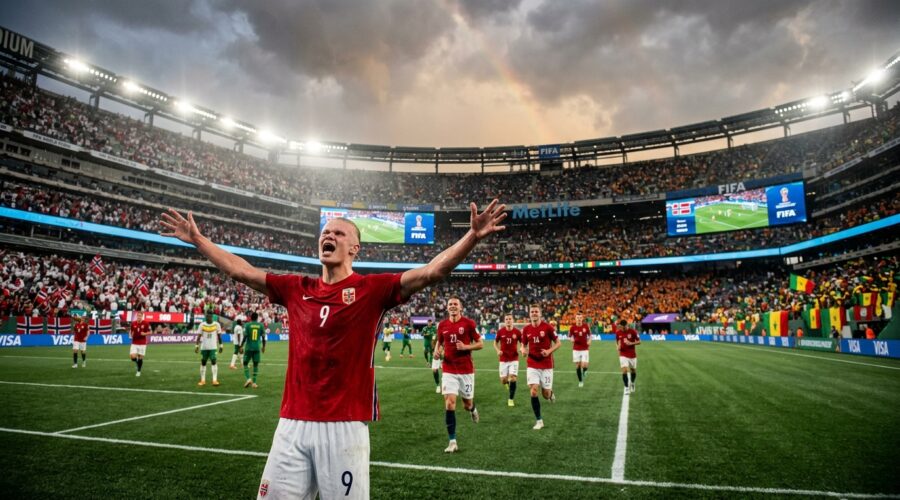
They will tell you, eventually, that this was just the group stage. That these were merely the warm-up acts, the throat-clearing before the real business of a World Cup begins. Ignore them. What unfolded across five matches on June 23, 2026, was something rarer and more irreducible than context allows: a football day that felt genuinely, unmistakably historic. A 41-year-old man scored at a sixth World Cup. A 40-year-old played in his fifth. And a 25-year-old Norwegian kept reminding the rest of the planet that the Golden Boot conversation begins and ends with him. Meanwhile, England moved the ball sideways with the diligence of a committee and the invention of a car park barrier. But we will get to that.
Norway 3–2 Senegal — MetLife Stadium, East Rutherford
It rained in New Jersey. The Norwegian fans in their Viking helmets did not care. Erling Haaland, as is his increasingly alarming habit, did not care either.
For the second consecutive World Cup match, Haaland helped himself to a brace. He now has four goals from two appearances at this tournament, and in doing so has become only the second player in fifty years to score twice in each of his first two World Cup games — the other being Harry Kane in 2018, who scored twice against Tunisia in his first match before going one better with a hat-trick against Panama in his second. The comparison, made in the same breath as Kane’s own goalless evening in Massachusetts, carries a certain quiet irony that we shall return to shortly.
Norway’s evening began with a gift they did not refuse. In the 43rd minute, Kalidou Koulibaly, the Senegal captain and a centre-back who has spent his career erasing precisely these kinds of errors, produced a misjudgment so catastrophic it seemed to belong to a different player entirely. Marcus Pedersen, in for the injured Julian Ryerson, needed no second invitation. His finish was composed; the stadium volume dropped a note on behalf of the Senegalese supporters.
Then Haaland took over the narration. Martin Ødegaard, orchestrating from the top of midfield with the quiet authority of a man who has spent years doing precisely this for Arsenal, threaded the pass that sent his international captain through for the first. The second was the kind of one-touch finish off the underside of the crossbar that looks effortless until you try it yourself and miss by eighteen inches. Norway led 3–1, and the job appeared done.
Ismaïla Sarr, who can conjure the spectacular when the occasion is ordinary and the occasion when the game is already written, pulled one back with a goal that required him to be falling in roughly three directions simultaneously. A late second made the scoreline respectably tight. It did not make it close.
Norway are through to the Round of 32. They sit joint top of Group I with France on six points. The decider on June 26 in Boston is a game that, on current evidence, deserves a much larger stage than the group phase can offer it.
Group I standings: France 6 pts (+5 GD) | Norway 6 pts (+4 GD) | Senegal eliminated | Iraq eliminated
Portugal 5–0 Uzbekistan — NRG Stadium, Houston
There will come a day when Cristiano Ronaldo plays his last competitive match. It is, presumably, approaching. He is 41 years old. But June 23, 2026, was emphatically not that day, and anyone who spent Portugal’s opening draw with DR Congo writing him off would have done well to remember what happens when you mistake a temporary silence for a permanent one.
Against Uzbekistan, Ronaldo became the first player in football history to score at six FIFA World Cups. He scored twice in the first half — the first arriving in the sixth minute, a near-post run onto João Cancelo’s low cross, powered into the bottom corner with the kind of certainty that brooks no argument. The second followed before the interval, the crowd inside NRG Stadium understanding that they were watching something beyond the usual architecture of the group stage.
The six World Cups — 2006, 2010, 2014, 2018, 2022, 2026 — span a career so long and so improbably sustained that even those of us constitutionally averse to hagiography find ourselves groping for adequate language. He did not score at the 2010 tournament; he did everywhere else. Lionel Messi, who shares the record for most tournaments, failed to score in 2010. Ronaldo did not. That distinction now belongs to him alone.
The context mattered too. Portugal came into this match with a point, a draw, and a subdued Ronaldo who had cut a peripheral figure against Congo. Roberto Martínez’s response was a team that pressed with collective hunger. Nuno Mendes added a stunning free kick for the third. An Uzbekistan own goal made it four. Rafael Leão, who makes running look like an aesthetic decision, completed the rout. Bruno Fernandes, Vitinha, and João Neves controlled the midfield with the ease of men solving a problem set several grades below their level.
Uzbekistan, the tournament debutants, had Abdukodir Khusanov in the backline. The Manchester City defender, impressive in club football’s higher registers, found the step up to a World Cup against a Portugal side in full cry to be rather more demanding than advertised. Eldor Shomurodov was anonymous. Abbosbek Fayzullaev, who had caught the eye against Colombia, could find no way in.
Portugal move to four points in Group K. They face Colombia on June 27 in a top-spot battle that, given the afternoon in Houston, carries genuine menace.
Group K standings: Colombia 6 pts (+3 GD) | Portugal 4 pts (+5 GD) | DR Congo 1 pt | Uzbekistan eliminated
England 0–0 Ghana — Gillette Stadium, Foxborough
Seventy-nine percent possession. Zero goals. The English experience, distilled to its purest, most recognisable essence.
Thomas Tuchel’s side came into this match as heavy favourites, riding the momentum of a 4–2 opening win over Croatia. Ghana, organised, physical, and excellently drilled through the middle where Thomas Partey — now at Villarreal and apparently in the form of his career — set the tempo with a composed authority that England’s midfield never quite managed to disrupt or replicate.
Partey was the story of the afternoon at Gillette. He dropped deep to cut off supply lines, won second balls, and generally administered proceedings in England’s half with the unhurried confidence of a man who had prepared specifically for this shape, this moment, this opponent. He had. England had not prepared sufficiently for him.
Harry Kane, who needs one more World Cup goal to move clear of Gary Lineker as England’s all-time leading scorer at the tournament, stood level with that record and conspicuously failed to improve on it. He had his moment — a gilt-edged opportunity that was asked of him and quietly refused. These things happen to centre-forwards. They do not usually happen in the 79th minute of a game your team have spent ninety minutes constructing the conditions for. Ghana’s goalkeeper Lawrence Ati-Zigi, barely troubled, commanded his area with the composure of a man who had been told in advance how little he would be required to do.
Jude Bellingham earned his 49th England cap, one short of the half-century milestone, which is a number that speaks to the sheer volume of football this young man has played for his country and which the match itself did not allow to feel celebratory. Noni Madueke and Anthony Gordon struggled against Ghana’s disciplined, narrow bank of four. Ghana had penalty appeals waved away, which added a final note of indignation to an evening that the Black Stars had, by any reasonable measure, deserved not to lose.
Declan Rice told the cameras afterwards that England are still in a good position and simply need to go and win the last game. He is correct. He sounded like a man aware that correctness was not the same thing as comfort.
Group L standings: England 4 pts (+2 GD) | Ghana 4 pts (+1 GD) | Croatia 3 pts (-1 GD) | Panama eliminated
Panama 0–1 Croatia — BMO Field, Toronto
If you wanted a single image to carry the weight of what Croatia means to contemporary international football, you might choose this one: Luka Modrić, forty years old, in a protective face mask, earning his 198th cap for Croatia and extending his record as the Croatian player with the most World Cup appearances, now playing in his fifth FIFA World Cup tournament across 2006, 2014, 2018, 2022, and 2026.
He remains among the most capped outfield players in men’s football history — approaching the rarefied company of Cristiano Ronaldo, Bader Al-Mutawa, and Lionel Messi, the three male outfield players who have reached 200 international appearances. The mask, worn after a recent facial injury, gave his silhouette something gladiatorial; the football he produced was, as ever, a masterclass in temporal control — knowing when to keep the ball, when to release it, where the space was before it had materialised.
The first half was cagey. Panama, who have now been eliminated without disgracing themselves, created eight shots and were denied on multiple occasions by Dominik Livaković, who produced three saves of genuine quality to keep his side in the match. Panama fight hard and finish poorly, which is a combination that tends to end tournaments before the knockout rounds.
Zlatko Dalić, Croatia’s coach and a man with a well-documented talent for half-time recalibration, made his interventions. Ante Budimir came on for Petar Musa. Joško Gvardiol came on too. In the 54th minute, Josip Stanišić found the right channel and delivered the cross; Budimir met it, scored, and Croatia had their winner.
Mateo Kovačić provided the engine alongside Modrić — the interplay between them familiar from years of watching this midfield pairing thread together with the ease of long habit. Croatia managed the final half-hour with practised efficiency. Panama gave everything they had. It was not quite enough, but it rarely is against a side whose default setting is to make life exceptionally difficult and then win 1–0.
Croatia go into the final group matchday needing a result against Ghana. England face Panama simultaneously. The three-way conversation that decides Group L happens on June 27, and the mathematics, while manageable for all three, leave no room for complacency from anyone.
Jordan 1–2 Algeria — Levi’s Stadium, Santa Clara
A late evening in California, and Algeria kept their tournament alive with the kind of performance that reminds you they are considerably more than a side making up the numbers. Their squad — assembled largely from the upper reaches of French and Spanish football — carries a technical fluency that Jordan, admirably spirited throughout, could not consistently match.
Amine Gouiri opened the scoring from a corner, slotting past Yazeed Abu Layla with the confidence of a player accustomed to finding space in tight areas. Riyad Mahrez and Mohammed Amoura were prominent going forward, combining the experience of the former with the energy of the latter in a partnership that periodically threatened to be more damaging than the scoreline suggested.
Jordan’s reply came through Musa Al Taamari, the team’s most creative outlet and the one player who consistently found angles where none appeared to exist. His equaliser was deserved in the sense that Jordan’s tenacity deserved something to show for it. Algeria, however, were not finished, and their retaken lead ultimately held.
Algeria and Austria now share three points in Group J ahead of a June 28 decider. Argentina, already qualified and sailing, look on with the detached serenity of a side who know they will be there regardless. Algeria’s European-based talent gives them structural advantages that a one-off match can mask or expose; they will be hoping it is the former against a disciplined Austrian side.
The Golden Boot: A Race With Three Serious Claimants
After the matches of June 23, the Golden Boot leaderboard reads as follows: Lionel Messi on five goals in this tournament, having broken the all-time World Cup goals record with a brace for Argentina on June 22 — his 17th career World Cup goal surpassed Miroslav Klose’s previous record of 16, and he added an 18th in the same match. Kylian Mbappé on five, following a double in France’s win over Iraq that brought his career World Cup total to 15 goals, placing him third all-time in tournament history. Erling Haaland on four, following this evening’s display in New Jersey.
Deniz Undav of Germany and Jonathan David of Canada are on three goals apiece, which is the kind of return that makes the conversation interesting but does not yet make them favourites for the award itself. Ronaldo’s brace against Uzbekistan brings him into the frame, though catching Messi from two goals back at 41 years of age, against progressively tougher opposition, is a task even the most ardent admirer would hesitate to describe as straightforward.
The Messi-Mbappé-Haaland triangle is the real story. Three players, three different systems, three entirely different methods of arriving at the same conclusion: the back of the net. Messi through intelligence and the accumulated wisdom of a career spent dismantling defences. Mbappé through pace and the slightly terrifying directness of a player who sees the goal as a personal problem to solve quickly. Haaland through positioning, power, and a finishing technique so complete it looks less like a skill and more like a structural inevitability.
Watch that leaderboard. It is not done moving.
What Comes Next
The schedule ahead is loaded. Norway against France on June 26 is a genuine heavyweight confrontation for first place in Group I, with both sides having won their opening two matches. Whoever loses goes through second and faces a tougher last-sixteen draw; whoever wins earns something like a psychological advantage for the rounds beyond.
June 27 brings the Group L reckoning: England against Panama, Croatia against Ghana, both kicking off simultaneously. England’s possession machine will face a Panama side with nothing to lose, which is historically not a comfortable assignment. Croatia against Ghana is the evening’s pivotal fixture — a win for Ghana sends them through above England on goal difference if the Three Lions only draw; a win for Croatia puts Dalić’s side into the knockout rounds at England’s potential expense. The numbers work in several directions and none of them are comfortable.
Portugal meet Colombia on June 27 in what amounts to a straight contest for first place in Group K. Given the afternoon in Houston, Roberto Martínez’s side will arrive with considerable momentum and a 41-year-old captain who has, once again, emphatically declined to cooperate with the idea of his own irrelevance.
Algeria and Austria settle the Group J second spot on June 28. It is the kind of match that a tournament this large occasionally swallows whole; it deserves to be watched.
The Broader Picture
This is the first 48-team World Cup — 12 groups, expanded rosters, new venues across three countries — and what June 23 made plain is that the expansion has not diluted the drama. If anything, the sheer weight of simultaneous storylines has produced days where it is genuinely difficult to know where to look. Records fell today that will not fall again for years, perhaps decades. A 41-year-old scored at a sixth World Cup. A 40-year-old played in his fifth tournament. A 25-year-old is hunting the Golden Boot with the same dispassionate efficiency he brings to every target he sets himself.
June 23, 2026 was, in the end, a day that football will remember clearly. The group stage, we were told, is just the warm-up. Someone should have said that to Ronaldo before he scored twice in Houston. He did not appear to receive the memo.