There are days at a World Cup when the draw merely produces results, and there are days when the tournament announces itself — when the fog of the group stage lifts and you suddenly understand what kind of competition you are watching. July 6, 2026 was the latter. Across three venues in three time zones, England survived the Azteca with ten men and a borrowed prayer, Spain quietly dismantled the greatest player of his generation’s final dream, and Belgium reminded everyone that the co-host fairy tale was always exactly that. By the time the last whistle sounded in Seattle, the shape of the quarter-finals had begun to emerge — and it looked very much like a tournament in which sentimentality had been formally retired.
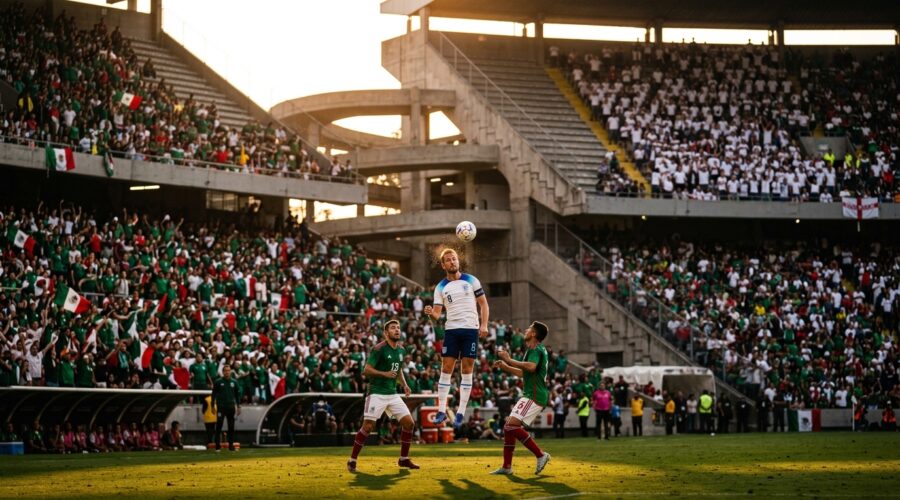
Mexico 2–3 England | Estadio Azteca, Mexico City
Bellingham Rewrites History in Ninety-Eight Seconds
If the Estadio Azteca has a memory, and on the evidence of forty years of accumulated mythology there is little reason to doubt it, then it will have taken a long moment to process what Jude Bellingham did inside its walls on Monday afternoon. In the space of ninety-eight seconds — thirty-fifth and thirty-seventh minutes — he headed home a Bukayo Saka cross and then tucked away a Harry Kane lay-off to put England two goals up in a ground that was supposed to eat them alive. He became, in doing so, the first player to score twice in a World Cup match at the Azteca since Diego Maradona did so against Belgium in the 1986 semi-final.
That comparison will be made casually, as these things always are, and then it will be made more carefully, and eventually it will settle somewhere useful. What it tells you is not that Bellingham is Maradona — nobody is Maradona, and the game no longer produces players who exist quite so completely outside the laws of physics — but that he is a player capable of seizing the symbolic weight of an occasion and bending it to his will. The Azteca crowd, 90,000 strong and expecting a coronation for El Tri, found themselves silenced by a twenty-two-year-old from Birmingham who plays football with the composed authority of a man twice his age.
Both goals were, in their own way, instructive. The first, a header into the bottom left corner from the Saka delivery, was the product of intelligent movement — Bellingham ghosting between defenders rather than simply overpowering them. The second, a right-footed finish from close range off Kane’s assist, was simpler: a man arriving at exactly the right moment. Four goals in this tournament now, with an assist. He picked up his third Player of the Match award of the competition, and it was not a gift.
Quiñones, the Red Card, and the Siege
Mexico responded with the only thing they had available to them, which was passion and sustained forward pressure, and for stretches of this match it was more than enough. Julián Quiñones, quiet as a fox in the penalty area, tapped home from a set-piece in the forty-first minute to make it 1–2 — his fifth goal of the tournament, equalling Luis “El Matador” Hernández’s record as the highest scorer by a Mexican player in a single World Cup edition, set in France in 1998. It was a record worth acknowledging even in a losing cause, and it was typical of the bittersweet texture of the whole afternoon for the home side.
Then came the fifty-fourth minute, and Jarell Quansah’s red card, and the match tipped onto a different axis entirely. England with ten men against Mexico in Mexico City, needing only to hold on. Quansah becomes only the fourth England player sent off at a World Cup, joining Ray Wilkins in 1986, David Beckham in 1998, and Wayne Rooney in 2006 — a roll call that reads, historically, as something close to a death sentence. England, characteristically, chose this moment to score again.
Kane’s penalty on the hour, dispatched with the particular calmness of a man who has been taking penalties under impossible pressure long enough to find it restful, made it 1–3 and gave England something to defend. He also became, in what is fast becoming a tournament of improbable footnotes, the first player in World Cup history to both score and concede a penalty in a single match. It was not a distinction he seemed especially concerned with.
The final half hour was a siege. Mexico had 59 per cent possession across the match, fired twenty shots, twelve of them from inside the box, and won twelve corners. Jordan Pickford, who had been making crucial saves since as early as the fourteenth minute when Raúl Jiménez’s header looked destined for the net, produced the performance of his tournament. Raúl Jiménez rattled the woodwork. Jiménez then converted a late penalty to make it 2–3 and set up eleven minutes of stoppage time that felt considerably longer. Santiago Giménez went off injured with substitutions already exhausted, as though the football gods decided the chaos was insufficiently biblical without that particular detail.
England held on. The scoreline — 3–2 to the visitors, at the Azteca, with ten men — is the kind that gets framed and hung in dressing rooms. Thomas Tuchel, never a man who reaches instinctively for the theatrical, called it “proper mentality,” which in the context of what his side had just survived qualifies as understatement of the tournament. Harry Kane, weighing his words with the thoughtfulness of a captain who knows that occasions like this are what captains are remembered for, said simply: “All the occasion, everything against us — we found a way.”
Kane now has six goals in the tournament. England face Norway in the quarter-finals on July 11.
Portugal 0–1 Spain | AT&T Stadium, Arlington, Texas
The Machine and the Mortal
There was always going to be a mythology around the match that ended Cristiano Ronaldo’s World Cup career, whatever the result. That it ended with a 1–0 defeat to Spain, decided by a substitute’s header in the ninety-first minute, and that the cameras found Ronaldo on his knees in tears on a Texas pitch, will lend the occasion a kind of operatic completeness that football very rarely organizes for itself so neatly. He is forty-one years old. He confirmed, afterwards, that this was his last World Cup. “I’m sad to be leaving like this,” he said. “I gave it my all. I did my best, and I’m leaving with a clear conscience.”
The facts of his World Cup career deserve a moment before the tactics are attended to, because the facts are extraordinary. He scored in six different World Cups — 2006, 2010, 2014, 2018, 2022, and 2026 — the only player in the history of the competition to do so. He leaves as one of football’s most durable competitive figures, a man who has bent time to his will for long enough that his presence in a 2026 tournament alongside Lamine Yamal felt less anomalous than it perhaps should have.
And yet. The argument that Portugal underperformed because of him is not a new one, and Chris Sutton on BBC Radio 5 Live made it with the bluntness that these situations demand: “Gonçalo Ramos played in the last 16 at the last World Cup and scored a hat-trick when the manager did have a bit of courage to leave Ronaldo out. We’re four years further on, Ronaldo is four years older and look what’s happened.” It is a clean line, and an uncomfortable one. The World Cup winner’s medal that Ronaldo always described as his greatest ambition will not be coming. It is the most significant gap in the most decorated individual career the game has produced.
Spain’s Six-Match Wall
For most of ninety minutes, this Iberian derby looked exactly like a match between a team that had conceded zero goals in five previous matches and a team finding reasons not to attack properly. David Raya made two key saves. Diogo Costa was busy at the other end. Dani Olmo had a header ruled offside after a Pau Cubarsí touch. João Cancelo’s left-footed attempt drifted wide with the particular sadness of a chance that knows it is going wide before it leaves the boot. Renato Veiga made a crucial last-ditch interception to deny Lamine Yamal a clear run on goal, in what was the best moment of an otherwise reserved Spanish performance.
Then Mikel Merino, the substitute, headed in the winner in the ninety-first minute — the same Mikel Merino who sent Spain into the Euro 2024 final with a late header, a player who appears to have decided that ninety minutes is simply a warm-up. Spain win 1–0. Six clean sheets in six matches. They are the first team in World Cup history to achieve it — no side had previously managed more than five clean sheets in a single tournament. Goalkeeper Unai Simón has now gone 609 minutes without conceding in the competition.
Luis de la Fuente’s record at major tournaments reads W10 D2 L1 across thirteen matches — six at the Tokyo 2020 Olympics and seven at Euro 2024 — with nine goals conceded in total. That solitary loss, a 0–2 defeat to Brazil at the Olympics, stands as the lone blemish on an otherwise formidable managerial CV at the highest level. Spain, with Lamine Yamal dazzling in patches and the defensive structure suffocating in others, look the most complete team left in this tournament. They face Belgium on July 10 in Los Angeles, and it will tell us a great deal.
United States 1–4 Belgium | Lumen Field, Seattle, Washington
The Host Dream Ends With a Goalkeeping Error
Lumen Field was primed for something. The United States had won two group stage matches — defeating Paraguay 4–1 and Australia 2–0 before losing to Turkey — and the crowd in Seattle brought the specific, slightly desperate energy of a nation that has been asking football to take it seriously for thirty years and sensed that tonight might finally, finally be the night.
Charles De Ketelaere had a different view. His ninth-minute finish gave Belgium the lead with a composure that felt slightly impolite given the occasion, and when Malik Tillman curled in a deflected free-kick in the thirty-first minute to equalize — Lumen Field in genuine, joyful eruption — you felt, briefly, that the script might bend toward the home side. It did not. Sixty-one seconds later, De Ketelaere headed home his second. That is not a typo. Sixty-one seconds. The momentum that Tillman had manufactured in front of a roaring crowd was taken away so quickly that the crowd was still making noise when Belgium were already ahead again.
The third goal, in the fifty-seventh minute, was the one that finished the match as a contest. Matt Freese, the United States goalkeeper, took too long on the ball outside his penalty area, was dispossessed, and watched Hans Vanaken roll it into an open net. There are goalkeeping errors, and then there are goalkeeping errors that echo through a country’s football history. Given that the USA has now been eliminated in the Round of 16 at the last three World Cups it has participated in — 2014, 2022, and now 2026, having failed to qualify in 2018 — this one will take some time to process. Romelu Lukaku added the fourth in stoppage time, because Lukaku is nothing if not thorough.
Kevin De Bruyne pulled the strings throughout with the economy of a player who has never needed to prove himself at a World Cup as desperately as some and therefore never wasted energy trying. De Ketelaere’s brace was the performance of his career. Belgium, unfashionably competent in an era that prefers its dark horses slightly more exotic, now face Spain in the quarter-finals. That match, on July 10 in Los Angeles, may well be the best game of this tournament.
For Mauricio Pochettino, the questions will be significant. A 4–1 loss on home soil in the Round of 16, despite the best group stage performance in American football history, leaves him in the particular purgatory of a manager who improved things and fell short simultaneously. The co-host dream is over — USA, Mexico, and Canada all eliminated in the last sixteen, all three in the same round, all three going home while their stadiums continue to host the tournament they organised. It is a bittersweet outcome with which North American football will be reckoning for some time.
The Bigger Picture: A Day That Sorted the Contenders
What July 6 produced, beyond the results themselves, was clarity. The Golden Boot standings sharpen the picture further: Kylian Mbappé and Erling Haaland lead on seven goals apiece, with Lionel Messi level with them on seven. Harry Kane sits on six, a goal behind and still very much in it. The quarter-final bracket — France against Morocco, Spain against Belgium, England against Norway, and one fixture still to be confirmed — reads as a genuinely open competition with no obvious tournament winner, which is exactly what a World Cup should feel like at this stage.
Spain’s defensive architecture suggests they are the most likely finalist in the upper half of the draw. England’s capacity for controlled chaos, and Bellingham’s talent for deciding matches at the moments that matter most, makes them the most interesting side still standing. Belgium are the team nobody is quite frightened enough of yet, which has historically been a useful position from which to do damage.
And the Estadio Azteca will sit with the memory of a twenty-two-year-old from Birmingham who scored twice in ninety-eight seconds on the same pitch where Maradona produced the two most famous minutes in the history of the game. Football has always understood the weight of its own theatre. On July 6, 2026, it staged three acts simultaneously, and each of them was worth watching.