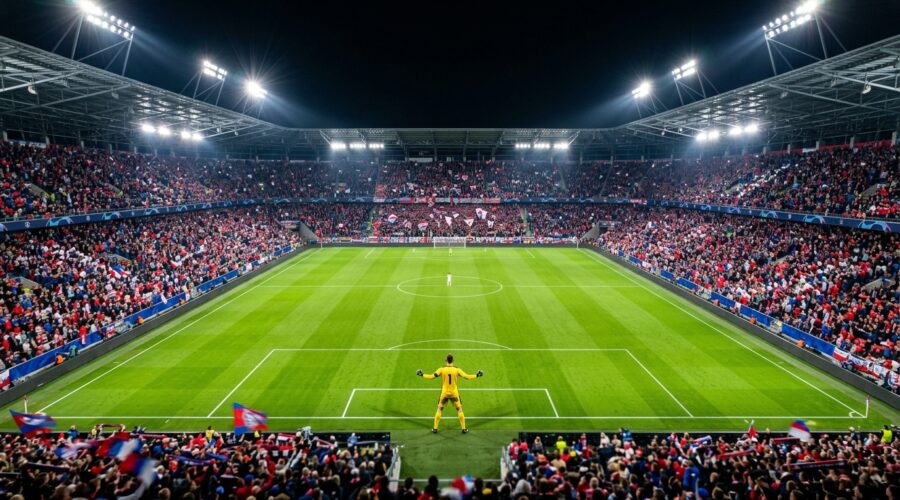
There are days at a World Cup when the tournament simply decides it has been holding back, and releases everything at once. Tuesday, July 7, 2026 was one of those days. Three matches. Three countries eliminated. One penalty controversy that touched the White House. One comeback that will be replayed until the sport no longer exists. And one goalkeeper standing on a penalty spot in Vancouver, staring down a man who needed to score to keep his nation alive, doing precisely what the occasion demanded of him. By the time the final whistle had blown on the last of the three ties, football had done what it occasionally remembers to do: made itself completely impossible to ignore.
This is the round of sixteen on July 7. Pull up a chair. There is rather a lot to get through.
USA 1–4 Belgium | Seattle Stadium, Seattle
The Hosts Are Duly Dispatched
It says something about Belgium’s evening in Seattle that their most recognisable attacking trident — Kevin De Bruyne, Romelu Lukaku, and Jeremy Doku — did not all start the match. De Bruyne and Doku both featured in the starting eleven, but Lukaku was held in reserve. By the time he had been introduced, the tie was effectively over, and his only meaningful contribution was to score a fourth goal and cup his ear at 66,925 people who had come to cheer the home nation. One senses he enjoyed that.
The Americans were beaten in every dimension of the game from the ninth minute onwards, when Charles De Ketelaere tapped home from close range from a cross by Nicolas Raskin — who had collected the ball in the penalty area after Leandro Trossard’s involvement in the build-up — with a directness the hosts simply had no answer for. The defensive shape was passive, the pressing disorganised, the second balls repeatedly conceded. Against a Belgian side operating at perhaps sixty percent of its available attacking register, that was always going to be a problem.
There was, briefly, hope. Malik Tillman’s deflected free-kick wrongfooted Thibaut Courtois in the thirty-first minute — the deflection, with a certain dark irony, coming off Hans Vanaken — and the noise inside Seattle Stadium was briefly extraordinary. Forty thousand Americans rediscovering their belief in the span of about four seconds. It lasted one hundred and sixteen seconds. De Ketelaere rose to meet Trossard’s left-wing cross and headed Belgium back in front before the stadium had quite finished exhaling. The brace was deserved, the timing almost clinical in its dismissiveness.
The game’s most depressing moment arrived in the fifty-seventh minute, though it was not of Belgium’s designing so much as of Matt Freese’s unmaking. The goalkeeper, inexplicably, turned over possession outside his own penalty area — an error of such magnitude that it barely needs further analysis — and Vanaken, arriving with the composure of a man strolling to collect a newspaper, scored from thirty-five yards. Freese’s tournament had already been a difficult one. This did not help.
Christian Pulisic had twisted his right ankle in the fifty-second minute and was substituted off seven minutes later, which spared him the indignity of witnessing the remainder. The sight of one of the nation’s most recognisable footballers helped from the field is the kind of image that attaches itself to a tournament whether it likes it or not. He was, by his own admission, unable to produce the moments he had been hoping for. The moments, in fairness, were always unlikely to come against a team of this calibre, in a system that never quite found a way to use him.
Lukaku converted the fourth in stoppage time, after a defensive mix-up involving Chris Richards that was symptomatic of the entire ninety minutes. He cupped his ear. The crowd responded as crowds do. Belgium’s social media account posted a photograph of the goal with the caption Overturn this — a two-word editorial on a controversy that had loomed over the fixture since the moment the teams were confirmed.
The Balogun Affair
There is no graceful way to write about this, so the facts will have to do. Folarin Balogun received a red card in the round of thirty-two, triggering an automatic one-match ban. FIFA, following direct lobbying by President Donald Trump, invoked a rule allowing punishments to be suspended with a probationary period, conditionally lifting the ban for one year pending good behaviour. Balogun played. He had little impact and was substituted in the ninetieth minute. Belgium won by three goals.
De Ketelaere, in his post-match interview, suggested the lifted ban had given his side extra motivation. Whether that was a diplomatic response or a pointed one was left to the listener to interpret. What is less ambiguous is the precedent. FIFA’s institutional independence, never the most robust of constructs, has now been tested by the leader of the world’s most powerful nation in the context of a sporting competition. That it capitulated — even conditionally — is the part that will be studied in governance seminars for years.
Belgium go to Inglewood to face Spain. They will not need any external motivation.
Argentina 3–2 Egypt | Mercedes-Benz Stadium, Atlanta
The Greatest Comeback the Game Has Ever Seen
There are matches that exist before the final whistle and there are matches that only truly exist in retrospect, once the shape of what happened has had time to settle. This one belongs entirely to the second category. Experienced in real time, it was the kind of football that makes people reach for superlatives they cannot quite justify and then, an hour later, realise the superlatives were entirely appropriate.
Argentina trailed Egypt 2–0 with eleven minutes of normal time remaining. They had missed a penalty. They had hit the woodwork from a free-kick. Their goalkeeper had watched Mostafa Zico sweep in a counter-attack goal after Mohamed Salah drove forward and found Haissem Hassan sprinting down the right side, with Hassan’s cross into the box then finished by Zico — a move that had unlocked the entire Argentine defensive structure in a single moment. The defending champions, eliminated at the round of sixteen: that was the story that had been writing itself across four hundred and fifty-odd minutes of football.
It did not end up being that story.
Yasser Ibrahim’s towering fifteenth-minute header from Marwan Attia’s cross had announced Egypt’s intentions early. What followed from Argentina was not so much a performance as a sustained display of individual brilliance from Lionel Messi that his own team seemed almost unable to keep pace with. He missed the penalty — Mostafa Shobeir flying to his left to produce a save that would have been the defining image of the match in almost any other context. He struck the crossbar from a free-kick. He was, for sixty-seven minutes, exceptional in every respect except the one that matters most on a scoreboard.
Egypt had a third goal disallowed by VAR. Hossam Hassan’s men, playing with the organised, counter-attacking intelligence of a team that had genuinely studied their opponents, were twenty-three minutes from one of the great upsets in World Cup history. Then Cristian Romero arrived at the back post to meet Messi’s cross with a header that Shobeir — who had been extraordinary all evening — could not quite reach. 2–1.
Four minutes later, a loose ball fell to Messi six yards out. He tapped it home. His face collapsed into something that is difficult to describe as anything other than relief rendered physical — tears, an open mouth, arms that did not know where to go. The image, multiple outlets noted simultaneously, may be the defining one of his extraordinary career. He became, in that moment, the first player in the history of the game to score in nine consecutive World Cup matches.
His record in this tournament now reads six goals in five matches — bringing his overall World Cup total to nineteen goals in thirty-two appearances. To contextualise that: he has missed a penalty and hit the post in the same game, and still scored. The Golden Boot, if Argentina continue in this vein, is not a competition.
Enzo Fernández won it in the ninety-second minute, arriving at the back post to head home from Lautaro Martínez’s cross. Argentina 3–2. Somewhere in a dressing room, grown men were singing and dancing. Messi confirmed this later. Nobody who watched the final eleven minutes found it difficult to believe.
Egypt’s Dignified Exit
It would be a disservice to Egypt to allow Argentina’s heroics to entirely swallow the narrative of their performance. Shobeir was the best goalkeeper of the tournament so far — his penalty save alone would have been sufficient to establish that — and Salah was magnificent throughout, then magnanimous afterwards: shaking the referee’s hand, de-escalating tensions between Egyptian players and officials, carrying himself with the quiet authority of someone who understands what sport requires of its ambassadors even when it has treated him unkindly.
Hossam Hassan was rather less magnanimous. He suggested he would not be watching any more games from the tournament. Given that his side were denied a third goal by VAR and had a strong penalty appeal waved away moments before Enzo Fernández’s winner, his fury was at least comprehensible, even if the manner of its expression left something to be desired. Egypt came to Atlanta to win a football match. On most evenings, they would have.
Switzerland 0–0 Colombia (AET) | Switzerland win 4–3 on penalties | BC Place, Vancouver
Seventy-Two Years of Waiting, One Save to End Them All
The third match of the day was, by any objective measure, the least spectacular. It was also, in its own way, the most quietly satisfying — the kind of game that a tournament needs alongside its chaos: disciplined, tactical, unresolved for one hundred and twenty minutes, and then decided in the cruellest and most logical fashion by the goalkeeper who had been the best player on the pitch all evening.
BC Place was, as it has been throughout the tournament for Colombia’s fixtures, an ocean of yellow. The atmosphere was extraordinary. The football was frequently not. Colombia had the better of the opening exchanges — Luis Díaz’s overhead kick was blocked, James Rodríguez and Díaz combined with the kind of intricate, quick-footed invention that occasionally persuades you they are about to score, and never quite leads anywhere. Switzerland, missing three players through injury — Johan Manzambi, Luca Jaquez, and Michel Aebischer — defended in a low, compact shape and waited.
Gregor Kobel made a stunning save in the twenty-first minute, diving to his left to deny Gustavo Puerta’s curling attempt from around eighteen yards towards the far corner, and that save, rather than any Colombian attack, established the tone of the remainder. Switzerland were not here to win beautifully. They were here to win.
Extra time had its moments. Jhon Lucumí’s header crashed off the crossbar. Granit Xhaka, who had been calm and authoritative for a hundred and nine minutes, made a defensive error that sent Jáminton Campaz clear on goal with only Kobel to beat. Campaz curled his shot over the bar. The kind of miss that haunts a career. The kind that every player who has ever had a clear sight of goal from twelve yards and sent it skyward will recognise in the pit of their stomach without needing it explained.
Penalties. Ruben Vargas converted Switzerland’s first with the precise, unhurried composure of a man who has done this before in conditions considerably worse than Vancouver. Arias replied for Colombia. Zeki Amdouni scored. Davinson Sánchez hit the crossbar. Cédric Itten scored. And then Cucho Hernández stepped up, needing to score to keep Colombia alive, and Kobel went to his right and saved it, and that was effectively that. Xhaka converted the fourth to make it official. 4–3 on penalties. Switzerland are in the last eight.
The last time that sentence was true was 1954 — the most recent of Switzerland’s three quarterfinal appearances, following those of 1934 and 1938. There are people in Zurich today who were not alive even for that last occasion, more than seventy years ago. They will be watching Argentina in Kansas City on July 11. One suspects Kobel will have a reasonable evening regardless of what happens.
Colombia, meanwhile, go home having suffered penalty shoot-out defeats at the 2018 and 2026 World Cups — against England and Switzerland respectively. The margins are infinitesimal. The exits are not.
The Co-Hosts Have All Left the Building
It is worth pausing, before discussing what comes next, to record what has happened to the tournament’s hosts. The United States lost 4–1 in Seattle. Canada departed in the round of sixteen. Mexico departed in the round of sixteen. All three co-hosts, in a tournament they spent years preparing to showcase themselves upon, eliminated at the same stage. The collective CONCACAF performance in the most high-profile World Cup the confederation has ever staged is a conversation that will not conclude quickly, and will not conclude comfortably.
For the USA specifically, the combination of a heavy defeat, a goalkeeping error of genuine embarrassment, a suspended captain, and a penalty controversy that reached the highest office in the country constitutes a day that will not be easily forgotten. Whether it constitutes a turning point depends on what the Americans choose to do with the memory of it.
What Comes Next
The quarterfinals are as follows: France face Morocco in Foxborough on July 9. Spain face Belgium in Inglewood on July 10 — which, given everything, should be magnificent. Norway face England in Miami on July 11. And Argentina face Switzerland in Kansas City on the same evening.
The Golden Boot standings, for those keeping score: Messi leads with six goals in five matches in this tournament — nineteen in total across his World Cup career. Mbappé and Haaland follow on seven. Harry Kane has six. Folarin Balogun, with three, is eliminated.
Tuesday, July 7 produced a host nation’s humiliation, the most contentious regulatory decision in recent FIFA history, the greatest individual World Cup performance anyone under the age of forty has ever watched, and a penalty save in Vancouver that ended a decades-long drought. If the quarterfinals match even half of that, the tournament will deserve every superlative it is going to receive. On this evidence, it might manage rather more than half.