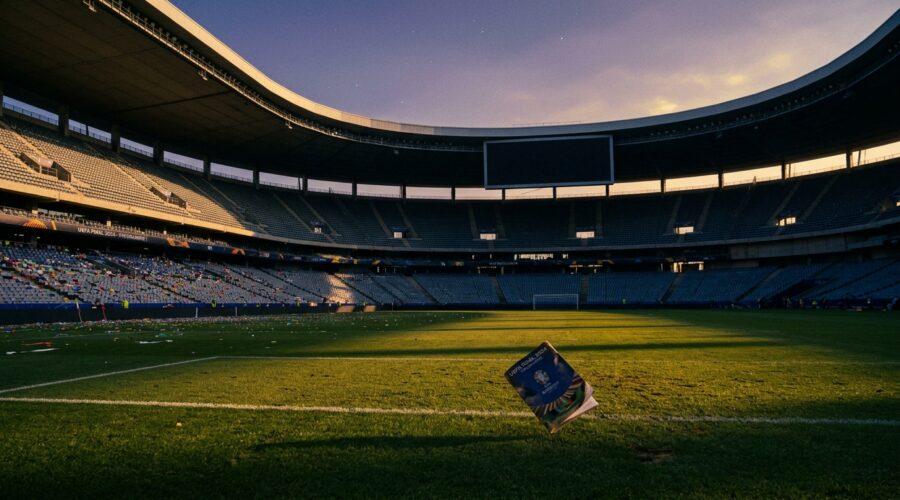
July 8, 2026. No matches. No whistles. No VAR reviews — at least not officially. Just the strange, suspended silence of a World Cup rest day, the tournament holding its breath between the knockout drama of the Round of 16 and the quarterfinals that begin tomorrow in Boston. It is the kind of day made for stepping back and surveying the wreckage: fallen giants, improbable heroes, one Argentine wizard who refuses, with almost tiresome insistence, to do anything ordinarily.
The last four days of football have been, without much exaggeration, some of the finest and most scandalous this tournament has ever produced. So let us go through it all — methodically, reverently, and in the case of the Folarin Balogun affair, with the weary disbelief of someone who thought they had seen everything.
USA 1–4 Belgium: The Host Goes Quietly Into the Seattle Night
There is a particular cruelty in the way the host nation’s tournament ends. The bunting is still up. The replica shirts are still in shop windows. And yet the team is gone, beaten convincingly in a manner that suggested not so much a close contest decided by fine margins as a fairly comfortable Belgian stroll through a side that, on the night, simply could not match the occasion.
Charles De Ketelaere was magnificent — the kind of magnificent that makes you wonder how a player of his intelligence and technique manages to generate so little consistent top-level noise outside of these months when the whole world is watching. His opener in the ninth minute was a sharp, darting finish from close range, his movement off the shoulder of the American backline precisely the sort of run Tim Ream had no answer for. His second, in the 33rd minute, was better still: rising above Ream inside the six-yard box to head Leandro Trossard’s cross into the upper-right netting with the assured authority of a man who had already decided the match was his.
In between those two goals, there was a brief, flickering American revival. Malik Tillman’s equalizer — a deflected free kick that spun off a Belgian defender’s head and looped beyond Thibaut Courtois — was the sort of goal that gives a crowd life precisely because it had no right to go in. And for approximately two minutes, Seattle roared. Then De Ketelaere headed home his brace, and the roar became something considerably quieter.
Hans Vanaken made it three in the 57th minute, poking home after De Ketelaere’s pressure forced Matt Freese into a fumble, and when Christian Pulisic limped off two minutes later, clutching what looked like a hamstring, the American comeback — already a distant prospect — became a formal impossibility. Romelu Lukaku, who had been saving his legs on the bench with the patience of a man who knows he is still capable of embarrassing people, trotted on and added a fourth in stoppage time just to make the scoreline honest. The statistics told the same story: Belgium’s 15 shots to the USA’s seven, an xG of 2.10 to 0.63. The hosts had possession — 51 per cent of it — and did almost nothing useful with it.
The USA’s tournament is over. All three co-hosts — Canada, Mexico, the United States — have been eliminated from their own World Cup. There is a joke in there somewhere, though it would take a harder heart than mine to make it in front of 66,925 disappointed people in Seattle.
The Balogun Affair: What Happens When the President Calls
But the story of the USA versus Belgium match was not purely a footballing one, and we would be negligent not to address what may be the most constitutionally bewildering episode in World Cup history since Garrincha was somehow cleared to play after his red card at Chile ’62.
Folarin Balogun received a straight red card in the Round of 32 against Bosnia and Herzegovina on July 1, stepping on the ankle of Tarik Muharemovic in a challenge that the VAR review confirmed as worthy of dismissal. Balogun was representing the United States — the nation whose tournament would subsequently unravel quite so publicly. Under standard FIFA regulations, an automatic one-game suspension followed. This is not a grey area. It has not been a grey area for as long as automatic suspensions have existed.
Then, on Thursday, President Donald Trump called FIFA President Gianni Infantino. Directly. To discuss a red card.
By Sunday, the suspension had been lifted. FIFA cited Article 27 of its disciplinary code, which grants the governing body the authority to fully or partially suspend a disciplinary measure. The Royal Belgian Football Association, quite reasonably, described the decision as a “direct contradiction” of competition regulations and filed an appeal. FIFA dismissed that appeal as “inadmissible” without apparent hesitation.
Asked about his intervention by reporters, Trump offered what may be the most unintentionally perfect summary of the entire affair: “I asked for a review because I didn’t think it was a foul. I didn’t know what the hell a red card was.”
UEFA called the ruling “incomprehensible” and said it had “crossed a red line.” They are not wrong. The precedent this sets for the integrity of FIFA’s disciplinary process is not a comfortable one, and the fact that Belgium subsequently won 4–1 — rendering the entire episode moot in sporting terms — does not diminish the institutional damage. It was, to borrow a phrase, a great injustice to the concept of sporting governance, whatever the president may have posted on Truth Social.
Argentina 3–2 Egypt: The 3,000th Goal and a Goalkeeper Who Deserved Better
If the USA-Belgium match was a fairly tidy affair whose storylines existed largely off the pitch, the Argentina-Egypt encounter at Mercedes-Benz Stadium in Atlanta was the opposite: an almost operatically dramatic ninety-plus minutes that produced the finest goalkeeping display of the tournament, one of the great World Cup comebacks, and a header that — with the kind of timing only football can manufacture — became the 3,000th goal in World Cup history.
Egypt arrived with a plan. It was a good plan. Pack the defensive lines deep, frustrate Argentina’s interplay, absorb the inevitable pressure, and punish on the counter. Hossam Hassan’s side executed it with discipline and quality, and Mostafa Shobeir — the 26-year-old goalkeeper who had already saved an Iran penalty in the group stage — was the linchpin around which the entire system revolved.
Yasser Ibrahim gave Egypt a shock lead in the 15th minute, heading home Marwan Attia’s cross after getting in front of Lisandro Martínez — a rare lapse from the Argentine centre-back. Argentina pressed, probed, and were repeatedly denied. Shobeir saved a Messi penalty — the fourth time in World Cup football that Messi has failed from the spot, following earlier misses against Iceland in 2018, Poland in 2022, and Austria earlier in this tournament — diving to his right to push it away. He then made world-class stops from Alexis Mac Allister and Julián Álvarez. The man was in the form of his life, playing the match of his life, against the greatest player of his generation on football’s largest stage. He deserved more than he got.
A Mostafa Zico goal in the 58th minute was ruled out by VAR for a foul in the build-up on Lisandro Martínez — a decision that will haunt Egyptian supporters for some time — and nine minutes later, Zico scored legitimately, Haissem Hassan’s run and cross providing the finish that made it 2–0. At that point, with eleven minutes of normal time remaining, Argentina’s defence of their 2022 title appeared to be ending in Atlanta.
Lionel Scaloni’s substitutions changed the game. Lautaro Martínez was already on, and it was his cross in the 79th minute that Cristian Romero swept home from close range. Four minutes later, Messi — already penalised for his missed spot-kick, apparently in the mood to remind everyone who he is — collected, drove, and smashed home an equaliser that reduced Shobeir, for the first time all evening, to helplessness. And then, in the second minute of stoppage time, Enzo Fernández arrived at the back post and guided a header into the net. The 3,000th goal in World Cup history. The winning goal. Argentina through. Egypt out, with heads held deservedly high.
Shobeir became only the fourth goalkeeper in World Cup history to save two penalties in games within a single tournament, joining Jan Tomaszewski, Brad Friedel, and Wojciech Szczesny. The company is distinguished. The outcome, for him, was still heartbreak. Football is frequently unkind.
Messi, post-match, offered something characteristically simple: “We never give up. This team never gives up.” With 8 goals in 5 appearances and a Golden Boot lead, it is difficult to argue.
Switzerland 0–0 Colombia (4–3 on Penalties): Kobel, a Crossbar, and Seventy Years of Waiting
There are matches that live in the memory for the quality of their football, and there are matches that live in the memory for the quality of their tension. Switzerland versus Colombia at BC Place in Vancouver was emphatically the latter. One hundred and twenty minutes of modest attacking output — four shots on target across the entire evening — followed by a penalty shootout that managed to condense all of the drama the game itself had declined to provide.
Gregor Kobel was Switzerland’s story throughout. Three key saves in regulation and extra time kept Colombia scoreless when they should not have been, and when Cucho Hernández stepped up in the shootout, Kobel flung himself to his left and saved it decisively. Davidson Sánchez had already struck the crossbar. Switzerland, who had seen Manuel Akanji blaze his spot-kick over, needed only Rubén Vargas — a fitness doubt who came on in extra time — to drive his penalty into the bottom-left corner, and the Swiss were through.
Their first quarterfinal since 1954, when they hosted the tournament themselves. Seventy-two years of waiting, resolved in a Vancouver shootout on a Tuesday evening in July. Rubén Vargas will be buying his own drinks for the foreseeable future in Seville, where he has been playing his club football for Sevilla since his permanent transfer there in January 2025.
Luis Díaz stood on the BC Place pitch at full time, visibly undone. He has been one of the players of this tournament. The tournament has not been kind to him in return.
Portugal 0–1 Spain: The End of an Era, and the Indignity of a Practical Exit
Mikel Merino came off the bench and scored in the 90th-plus-one minute from a Ferran Torres cross at AT&T Stadium in Dallas. Spain are through to the quarterfinals. And Cristiano Ronaldo’s World Cup is over.
He is 41. He played the full ninety minutes on a warm Texas evening, had two tame shots on target, and remained on the pitch until the final whistle with the stubbornness of a man who was not going to be substituted in his last World Cup match whatever anyone said. He leaves with 11 World Cup goals across six tournaments — a record that may stand for generations — and with the clear conscience he cited in the mixed zone afterwards. “I leave with a clear conscience. I’ve done everything I could.”
Whether the 2026 World Cup will be judged the correct moment to cling on will be debated. Portugal were not bad; they were simply beaten by a Spain side that has not conceded a goal from open play in the entire tournament and that possesses, in Merino, a substitute capable of deciding knockout matches in stoppage time. Roberto Martínez resigned immediately after the elimination. His tenure ends without a major tournament, defined ultimately by fine margins — and the finer details, always the finer details.
Merino’s winner was not, as it happens, the moment that etched itself into the statistical record books for late drama. That distinction belongs to Enzo Fernández, whose 92nd-minute header in Atlanta the previous day became the tournament’s tenth last-minute goal — scored in the 90th minute or beyond — making this World Cup edition the most prolific for late drama in the competition’s history. One suspects the statisticians noted it with the same quiet satisfaction that Fernández himself felt in the moment of arriving at that back post.
The Quarterfinals: What Awaits
The bracket is set, and it is a genuinely compelling one.
France vs. Morocco (July 9, Gillette Stadium, Boston) is the rematch nobody quite planned for and everybody wanted. France are tournament favourites at just under 2–1 odds, with Kylian Mbappé on 7 goals and operating in the kind of form that makes tactical planning feel slightly futile. Morocco — the first African nation to reach back-to-back World Cup quarterfinals — are without the suspended Ismael Saibari, which is a meaningful absence in midfield. But Azzedine Ounahi has been electric, Brahim Díaz provides craft, and Achraf Hakimi offers a threat on the overlap that no side in this tournament has yet fully solved. If any team can threaten France, Morocco have the structural discipline and the individual quality to do it.
Spain vs. Belgium (July 10, SoFi Stadium, Los Angeles) is the tie of the quarterfinals on paper. Spain have been the tournament’s most defensively coherent side; Belgium are arriving off the back of a dominant, ruthless performance against the host nation. De Ketelaere and Jérémy Doku in transition against a Spanish backline that has yet to be breached from open play. There is a tactical intrigue here that the other ties, for all their glamour, cannot quite match.
Norway vs. England (July 11, Hard Rock Stadium, Miami) gives us what the tournament’s golden boot race has been teasing for weeks: Erling Haaland against Harry Kane, or more precisely, Haaland’s Norway against England’s depth. Norway defeated Brazil 2–1 in the Round of 16 and deserve considerable respect. England are nonetheless 9–2 favourites, and with Jude Bellingham providing the creative spark that their previous tournament squads lacked, there is a coherence to Gareth Southgate’s side — or whoever it is managing England these days — that makes them genuine semi-final candidates.
Argentina vs. Switzerland (July 11, Arrowhead Stadium, Kansas City) is, in some sense, an appointment with inevitability. Messi, 39, chasing back-to-back World Cups, the Golden Boot, and one more chapter in the longest, most extraordinary individual story this sport has produced. Switzerland, meanwhile, have Kobel and a penalty record at this tournament that Argentina’s backroom staff will have been studying with significant anxiety since full time in Vancouver. “They’ve got a date with Lionel Messi,” remarked one commentator during the Swiss celebrations. The Swiss know. They do not seem especially intimidated.
The Ledger, As Things Stand
The scorers’ chart, before the quarterfinals begin, reads as follows: Messi leads with 8 goals, Mbappé and Haaland with 7 each, Kane with 6. The four in pursuit — Quiñones, Vinicius Jr., Bellingham, Oyarzabal — are on 4. Brazil are out. Germany are out. All three North American co-hosts are out. The Final, scheduled for July 19 at MetLife Stadium in East Rutherford, New Jersey, remains eleven days away.
Enzo Fernández’s header — number 3,000 in World Cup history — hangs in the Atlanta air somewhere, still travelling. Shobeir’s penalty save, Kobel’s outstretched hand in Vancouver, Merino arriving late at the back post in Dallas — these are the images the rest day gives us time to absorb before the quarterfinals replace them with new ones.
Tomorrow, the football resumes. And it has, at every turn in this tournament, been worth watching.