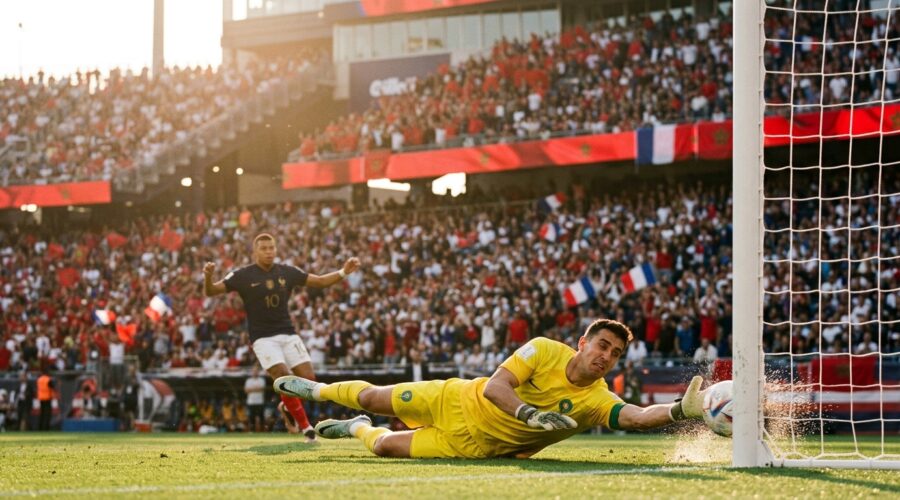
Foxborough, Massachusetts. July 9, 2026.
There is a particular cruelty to watching a team play well enough to deserve something and receive nothing in return. Morocco deserved nothing on the scoreboard against France on Thursday afternoon at Gillette Stadium, and yet, for nearly an hour, they had precisely that — a scoreline that kept their hopes breathing and their goalkeeper’s legend growing by the save. Then Kylian Mbappé, apparently uninterested in the concept of karmic punishment for missed penalties, curled the ball into the far corner with his left foot, and the illusion dissolved. It always was going to, eventually. That it took until the sixtieth minute was the most Morocco could have hoped for, and the most Yassine Bounou could extract from a frame that was never quite his to defend.
France are in the semi-finals of a third consecutive World Cup — matching a feat they have achieved before, most recently in 1982 and 1986, but which has lost none of its impressiveness for the repetition. They have won every single match of this tournament — six from six, no draws, no fright nights, no moments where a reasonable person might have fancied the opposition. Patrick Vieira, watching from the ITV studio with the quiet authority of a man who once shared a dressing room with these traditions, said he did not see anyone stopping them from reaching the final. He did not say it like a compliment. He said it like a weather forecast.
The First Half: A Goalkeeper’s Sermon
The shape of the afternoon was written within the first four minutes, when Mbappé ghosted in behind the Moroccan defensive line and dragged his shot wide. It was a warning that carried no consequence, but it established the terms of engagement with mechanical precision: France would come in waves; Morocco would defend deep, stay compact, and trust Bounou to do what Bounou does.
For much of the first half, that arrangement held. Morocco sat in a low block with a discipline that was tactically coherent if aesthetically uninspiring — Vieira, with characteristic honesty, described their plan as holding on for an hour and trying to win afterwards. It was the correct plan. It was also, against a French side of this quality, the kind of plan that depends entirely on everything going right and nothing going wrong.
In the twenty-fifth minute, something went wrong. Noussair Mazraoui, caught in two minds inside the penalty area, brought down Mbappé, and the referee pointed to the spot without hesitation. The stadium, a capacity crowd of just over 64,000 on a warm Massachusetts evening, understood the moment for what it was: Mbappé, the tournament’s leading scorer with seven goals at that point, against Bounou, a goalkeeper who had by now saved as many World Cup penalties as any other in history.
Bounou won.
It was not a spectacular save in the conventional sense — Mbappé’s effort was tame, directed low to the goalkeeper’s left, the kind of penalty that invites a save if the goalkeeper guesses correctly and commits early. Bounou did both. What followed was not pandemonium in the Moroccan end so much as a collective exhalation — the releasing of breath that had been held since the whistle. For Mbappé, it was an uncomfortable addition to a penalty-missing habit that his talent has never quite managed to expunge.
France, unbothered at the systemic level, continued to pour forward. Lucas Digne struck the crossbar from distance with a swerving effort, in the forty-sixth minute, that deserved more than the woodwork. The halftime scoreline — nil-nil — was Bounou’s doing as much as Morocco’s defensive organisation, and it felt provisional in the way that only a scoreline against a steamroller can feel provisional.
The Second Half: Redemption, Then Confirmation
Fifteen minutes into the second half, Mbappé resolved the matter of his missed penalty with the kind of finish that makes post-match debate feel slightly beside the point. Collecting the ball at the edge of the area, he shaped onto his left foot and curled a shot that bent away from Bounou at precisely the angle that goalkeepers write angry letters about. It was his twentieth World Cup goal. His career record in this competition now sits two behind Lionel Messi’s all-time total of twenty-two, a record that — given both men are active in the same tournament — has an interesting few weeks ahead of it.
That was the sixty-first minute. In the sixty-sixth, it was over. Mbappé, generously acting as provider rather than finisher, played in Ousmane Dembélé, who arced a low shot past a helpless Bounou to make it two. Dembélé’s fourth goal of the tournament — a tally that would be leading the Golden Boot conversation in almost any other edition of this competition, were it not for the inconvenience of his own international teammate.
There is something worth pausing on with Dembélé. The reigning Ballon d’Or winner, playing in a World Cup in which he has four goals and two assists across five matches, has been somewhat crowded out of the broader narrative by the magnetic pull of Mbappé’s record chase. That Dembélé has been one of the most consistent performers at the entire tournament — not just in the French squad, but anywhere in the field — feels like a fact that the highlight packages have not quite caught up with yet.
Mbappé came off in the seventy-seventh minute with what was described as a minor injury concern. He walked off steadily and turned to wave at the crowd — a gesture that read more as reassurance than farewell — and was reported to be fine afterwards. France, with eleven minutes remaining, two goals ahead, and the deportment of a side that regards jeopardy as a theoretical concept, barely needed to break stride.
The System Behind the Scoreline
Twenty-two shots to four. One Moroccan shot on target across ninety minutes. These are the numbers, and they tell a story that the football broadly confirmed.
Didier Deschamps has constructed something at France that operates with the logic of a well-maintained machine: pressurised at the front, metronomic in the middle, and deeply reluctant to be breached at the back. The defensive unit — Upamecano and Koundé as the central pairing, Saliba, and the Hernández brothers occupying the flanks — has been largely untested through six matches, conceding two goals in the group stage and almost nothing since. The midfield pairing of Koné and Rabiot provides the kind of positional stability and ball-winning capacity that gives Mbappé and Dembélé the freedom to express themselves without defensive obligation.
What is striking about this France side, tactically, is how little they allow their shape to be destabilised. Against a Morocco team that had beaten the Netherlands on penalties in the Round of 32 and knocked out co-hosts Canada 3-0 in the Round of 16, France’s defensive structure barely registered the attack. Morocco had four shots. The system simply did not permit more than that.
Deschamps, whose touchline demeanour suggests a man perpetually calculating odds rather than experiencing emotion, surpassed Helmut Schön’s record of twenty-five appearances as a World Cup manager with this match, his twenty-sixth. He already held the record for most wins by any manager in tournament history, eighteen, and will be looking to extend it in Arlington on the fourteenth of July. One suspects he already knows exactly how.
Morocco: A Farewell
In 2022, France knocked Morocco out in the semi-finals in Qatar, winning 2-0, with Theo Hernandez and Randal Kolo Muani on the scoresheet. Now, in 2026, it is France again, by the same scoreline, at an earlier stage, on a different continent. The detail of it — the same opponent, the same result, the same scoreline — has a quality that sits somewhere between statistical coincidence and poetic cruelty.
Morocco had arrived in Foxborough without Ismael Saibari, their top scorer with three goals in the tournament, who had been ruled out with a hamstring injury sustained against Canada. His absence hollowed out their attacking options at precisely the moment they needed them most. Without the focal point of a genuine threat, the low block became less a tactical choice and more a structural necessity, and France, with their defensive solidity and their capacity to weather a goalless first half without panic, were never seriously troubled by what Morocco could offer on the counter.
Bounou was, as he has consistently been, the final and most stubborn obstacle. His penalty save in the twenty-eighth minute was his fourth World Cup penalty stop across the 2022 and 2026 tournaments — tying the record for any goalkeeper in the competition’s history, shared with Harald Schumacher, Sergio Goycochea, Danijel Subašić, and Dominik Livaković. He made that save, and several more besides, and he kept Morocco alive until the sixtieth minute, which is the longest you can reasonably ask a goalkeeper to prop up a tactical plan against twenty-two shots. By that measure, he succeeded. By the only measure that ultimately counts, Morocco were eliminated.
Their run — a semi-final in 2022 and a quarter-final in 2026, built on collective organisation, defensive togetherness, and the considerable individual excellence of a goalkeeper born in Montreal to Moroccan parents — represents something that the scoreline cannot diminish. African football has yet to produce a World Cup finalist, but Morocco, in reaching the semi-finals in Qatar four years ago, came closer to that threshold than any team from their continent before them. The mourning in Casablanca, in Rabat, in the Moroccan diaspora communities across Europe and North America, will be genuine and entirely deserved.
Looking Ahead: The Last Four
France await the winner of Spain versus Belgium, who meet in Los Angeles on Friday, with the semi-final scheduled for the fourteenth of July at AT&T Stadium in Arlington, Texas. Spain topped their group with a perfect defensive record and eliminated Portugal in the last sixteen; Belgium knocked out the host Americans 4-1 in Seattle. Either will provide a more serious examination than anything France have faced to this point, though Vieira’s assessment — that he does not see anyone stopping them reaching the final — will carry through the week like an ominous background hum.
The Golden Boot race has a clarity to it that is almost theatrical: Mbappé on eight goals, Messi on eight goals, Erling Haaland on six with Norway facing England in Miami on Saturday. The Norwegian and the Englishman will contest their own miniature boot race within a quarter-final, which is the kind of subplot that makes this tournament feel almost generously constructed for narrative purposes.
Messi, thirty-eight years old and operating with the smooth, unhurried excellence of a man who has decided to enjoy his last World Cup rather than endure it, takes Argentina to Kansas City to face Switzerland on Sunday. The all-time scoring record is there, two goals away, if Mbappé can reach it before the Argentine does. At twenty-seven, with a World Cup semi-final on the fourteenth and potentially a final beyond that, the opportunity is plainly his.
But then, everything about this French squad, in this tournament, at this moment, seems plainly theirs. The only team not to drop a single point. The only team with two players in the top five of the Golden Boot. A manager whose managerial record in this competition is without parallel. The only question the quarter-final raised was whether Morocco might somehow hold on long enough to create an upset, and the answer came at the sixty-first minute in the form of a curling left-footed strike from a man who had already missed a penalty and decided, apparently, that this was not an afternoon for regret.
Mbappé redeemed himself. France marched on. Morocco went home, again, to France, again, by the same score. Some storylines, in football, have a way of repeating themselves with slight variations until they become something else entirely — not repetition, but fate.