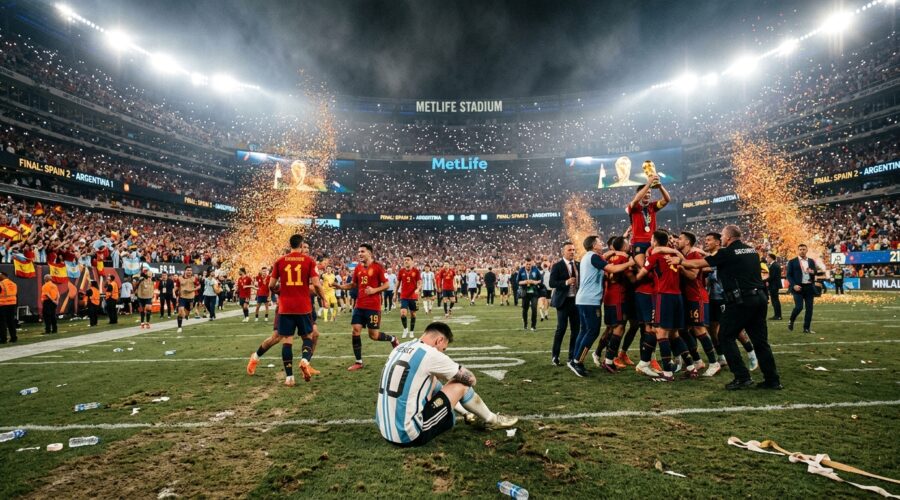
There is a particular cruelty in watching the greatest footballer who ever lived spend ninety-three minutes as a passenger in his own final. One touch in the opening fifteen minutes. A single blocked shot in the 117th. Tears at the final whistle. And somewhere in the MetLife Stadium press gallery, a journalist writing the sentence that will follow Lionel Messi for the rest of his days: “Not even Lionel Messi had any answers.” He is thirty-nine years old. He almost certainly played his last World Cup match. And he did it on a night when Argentina — the defending champions, the South American colossus, the team built in his image — managed precisely two shots across one hundred and twenty minutes of football against the best side on the planet.
Spain are world champions again. And it was, if you were watching with clear eyes, a result that was never seriously in doubt — only the clock stood between Luis de la Fuente’s side and the trophy, with Emiliano Martinez doing everything in his considerable power to make that clock feel eternal.
A Final That Told Its Story in the First Five Minutes
The shape of this game was established before most people had finished arguing about their seat at MetLife Stadium. In the 5th minute, Lamine Yamal — nineteen years old and already conducting himself with the casual authority of someone who has been the best player on the pitch his entire life — received the ball from Dani Olmo on the right side of the box and drove a low shot that Martinez was forced to claw away at his near post. Argentina, in response, contributed nothing. Zero shots in the first forty-five minutes. Zero. The scoreline at halftime read 0–0 only because Martinez’s reflexes exist somewhere between the athletic and the metaphysical.
This was not a contest between two evenly matched teams feeling each other out. This was Spain playing football — probing, patient, relentlessly positional — and Argentina deciding that the correct tactical response was to absorb, resist, foul when necessary, and hope for something alchemical from their thirty-nine-year-old talisman. Lisandro Martinez was booked in the first half for tripping Mikel Oyarzabal. Leandro Paredes shoved Rodri and sparked a confrontation of the sort that tends to indicate a team losing the tactical argument and trying to settle the thing on different terms. None of it worked. Spain had twenty shots across the ninety minutes to Argentina’s total of none. If Martinez had not been playing at something approximating the limit of human possibility, this would have been a different conversation entirely.
The Man Who Won the World Cup From the Bench
Luis de la Fuente made the decisive call of the tournament in the 62nd minute, withdrawing Oyarzabal and introducing Ferran Torres. It was, at first glance, an unremarkable substitution — Torres had not scored a single goal across the entire tournament before that moment. He arrived in New Jersey as a squad player, a capable option, someone whose name would appear in the match programme and be noted respectfully and without particular excitement. He left it as the man who won Spain the World Cup.
The goal, when it came in the 106th minute, was the kind of thing that looks inevitable only after it has happened. Pedro Porro — consistently one of Spain’s most important contributors throughout the knockout stages — delivered a deep, pinpoint cross to the back post. Nico Williams directed a perfect flick-header back across goal, the sort of intuitive, trained movement that Spain have been drilling into their players since before some of their squad were born. And Torres arrived at the near post and lashed a first-time left-footed shot into the roof of the net, just under the crossbar, past a Martinez who — for once, and perhaps for the only time all night — had absolutely no answer.
“It was a goal scored by forty-seven million people,” Torres said afterwards. It was the right thing to say. It was also the only thing to say. He had spent the tournament as a footnote and spent the match’s decisive moment as its author. Football, when it is being itself, still manages this kind of irony with some regularity.
Enzo Fernandez and the Art of Making a Bad Situation Catastrophic
Argentina were already losing the match on every conceivable metric when Enzo Fernandez contrived to lose them the argument entirely. He had received his first yellow card for dissent toward referee Slavko Vincic — the kind of booking that is, in professional football, considered a fairly strong hint to moderate one’s conduct for the remaining minutes of a World Cup final. Fernandez, apparently, did not receive the memo. In the 90th minute plus three, with the game heading to extra time and Argentina still mathematically alive, he committed a reckless lunge on Pau Cubarsic that left Vincic no choice whatsoever. Second yellow. Red card. Argentina to face an entire period of extra time with ten men.
Alan Shearer, watching from the BBC studio, put it with characteristic directness: “How daft is that from Enzo Fernandez? He is on a yellow card for dissent. He knows that. For him to go into a challenge like that is crazy.” It was crazy. It was also, perhaps, symptomatic of a side that had been suffocating for ninety minutes under the weight of Spanish possession and had begun to operate on instinct rather than intelligence. Fernandez became only the sixth player in World Cup final history to receive a red card — joining, with considerable irony, two of his own compatriots from 1990 and Zinedine Zidane from 2006. He kicked a pitchside microphone on his way off, raised his arms to the Argentine supporters, and left his teammates to defend with ten men for thirty additional minutes against a side that had been finding ways through with eleven.
Martinez: The Record That Could Not Save the Match
There is a particular kind of cruelty reserved for goalkeepers who produce the performance of their lives and still finish on the losing side. Emiliano Martinez made twelve saves in this final — a new all-time World Cup final record, surpassing whatever previously stood in the books. He made stops that defied reasonable physical expectation. He produced a stunning denial of Yamal’s free kick in stoppage time that, under any other circumstances, would have been the defining image of his career. He won the Best Goalkeeper award for the tournament. He also ended the night on the wrong side of a 1–0 scoreline, which is the kind of arithmetic that goalkeeping records cannot address.
His save count is both a record and an indictment — a statistical monument to how completely Spain dominated this match, and how thin the margin between an improbable 0–0 and the inevitable 1–0 actually was. Martinez was brilliant. He was also, ultimately, a man standing in the path of a tide with remarkable technique and insufficient reinforcements.
Messi’s Final Chapter
He had eight goals and four assists across the tournament. He had carried Argentina through the knockout rounds with the kind of influence that defies straightforward statistical capture. He arrived at the final having suggested, without quite saying the words directly, that this was his last World Cup. He left it with one touch in the opening fifteen minutes, one blocked shot in the 117th, and tears streaming down a face that has expressed every conceivable emotion that football can produce over the past two decades.
The 2022 World Cup in Qatar remains, and will remain, the crowning individual achievement — the one that completed the argument, that gave Messi the only thing his career had technically lacked. This final could not take that away. It could not diminish what he is or what he has been. But it was a brutal kind of farewell for a player of his stature: reduced, by Spain’s defensive architecture and his own advancing years, to near-irrelevance in the match that mattered most. Football is not sentimental. It does not stage appropriate endings. It simply produces results, and this one, for Messi, was the wrong result on the wrong night.
Yamal and the Next Chapter
If the final was Messi’s curtain call, it was also — and perhaps more importantly in the long run — Lamine Yamal’s coronation. At nineteen, playing in his first World Cup, he was Spain’s most dangerous attacker throughout the match and, by most accounts, the most compelling individual presence of the entire tournament. He tormented Argentina’s defensive line with the kind of direct running and technical audacity that cannot be coached into a player; it either exists or it does not. His free kick in stoppage time — saved spectacularly by Martinez — was, in a different final, the goal that settled everything. He will have other opportunities. Many of them. There is the unnerving sense, watching Yamal operate, that you are witnessing the opening chapters of something very long.
Spain’s Beautiful Symmetry
Both of Spain’s World Cup titles were won in extra time. Both by a single goal. In 2010, Andres Iniesta settled it against the Netherlands in Johannesburg. In 2026, Ferran Torres settled it against Argentina at MetLife Stadium. Sixteen years apart, same narrative architecture: suffocating possession, defensive solidity, a period of extra time, and a single moment of clinical finishing that closes the argument. There is something almost too neat about this — the kind of symmetry that, if you encountered it in fiction, you might mark as contrived. In football, apparently, it is simply what Spain do.
De la Fuente led his side through eight matches without defeat. They drew once — a goalless opening group game against Cape Verde Islands, in the way that champions sometimes greet the early stages of a tournament with polite restraint — and won everything else. They beat Portugal and France along the way, which is not a straightforward thing to do. They beat Argentina in the final, which was the hardest thing of all.
Meanwhile, England and France Were Having an Entirely Different Kind of Fun
The bronze medal match on July 18, played in Miami, was everything the final was not: open, chaotic, operatically high-scoring, and almost entirely without defensive competence from either side. England beat France 6–4. This is a scoreline that belongs in the 1950s — it is, in fact, the most goals ever scored in a World Cup third-place match, which is the kind of record that arrives wearing an asterisk. For context, the highest-scoring match in World Cup history remains Austria’s extraordinary 7–5 victory over Switzerland on 26 June 1954, a match that produced twelve goals in total.
Bukayo Saka scored a hat-trick. Declan Rice opened the scoring with a long-range rocket inside three minutes. Ezri Konsa headed home from a corner at fifteen minutes. England were 4–0 up at halftime, at which point the match appeared settled. It was not. Kylian Mbappe — who had other things on his mind — pulled one back, Bradley Barcola made it 4–3, and France briefly made things uncomfortable before England’s quality in the final third reasserted itself. Thomas Tuchel’s side finished with bronze — their best World Cup result since the 1966 championship. For a country that has spent sixty years in a complicated relationship with near-miss, this qualifies as genuine progress.
Mbappe, for his part, scored the goal that mattered most to him personally in the 66th minute: his 22nd World Cup goal, breaking Messi’s all-time record of 21. He finished the tournament with ten goals and four assists and the Golden Boot, which is an extraordinary return for a player whose team finished fourth. He also, presumably, filed the record-breaking goal away as the one thing from this tournament that truly satisfied him.
The Expanded World Cup: A Verdict
One hundred and four matches. Record attendance. Record goals. A 48-team format that many had viewed with suspicion — another FIFA expansion project, stretching the tournament’s credibility in the name of commercial reach — that ultimately delivered spectacle on a scale commensurate with its ambition. There were, doubtless, group stage matches that would not have survived editorial scrutiny. But the knockout rounds produced drama, records, and at least one final that will be discussed as long as the sport is played. The United States, Canada, and Mexico staged the whole thing with the logistical competence of hosts who understood the assignment. MetLife Stadium, on a July afternoon in New Jersey, turned out to be an entirely appropriate setting for the world’s biggest sporting event.
The Trophy Goes Home to Madrid
The post-match scenes were not entirely graceful. Nahuel Molina and Leandro Paredes reacted with the aggression of men who had just lost a World Cup final in circumstances that would not sit easily. Paredes shoved Gavi and was sent off after the final whistle — Argentina’s second red card of the evening, which suggests a team that had allowed frustration to corrode its discipline entirely. Scaloni, furious on the touchline, was involved in pushing and shoving that Spain’s players had to help settle. None of it was edifying, and none of it was particularly surprising given how completely the match had gone against them.
Spain celebrated, as champions should. Ferran Torres, the man from the bench with no goals in the tournament until the one that decided everything, held the trophy with the expression of someone who will spend the rest of his life being asked about the 106th minute and will not once be tired of answering. Rodri, Pedri, Dani Olmo, Nico Williams, Lamine Yamal — the core of a team that plays football with a collective intelligence that most nations can only observe with a mixture of admiration and mild despair.
Two World Cups. Both in extra time. Both by a single goal. Spain do not do things easily, but they do them completely. The 2026 World Cup belongs to them, and if the next generation is what Lamine Yamal suggests it might be, the conversation about when the next one arrives may already be worth having.
As for Messi — he walked off the pitch in tears. The greatest player the sport has ever produced deserved a better last game, and football, as it so often does, declined to provide one. His 2022 triumph in Qatar remains untouchable. What happened in New Jersey on July 19, 2026, is simply the final footnote — bittersweet, inevitable, and wholly human. The sport has a way of reminding us, even at its greatest players, that it owes nobody a fairytale ending.
Spain have theirs anyway. And they earned every last second of it.