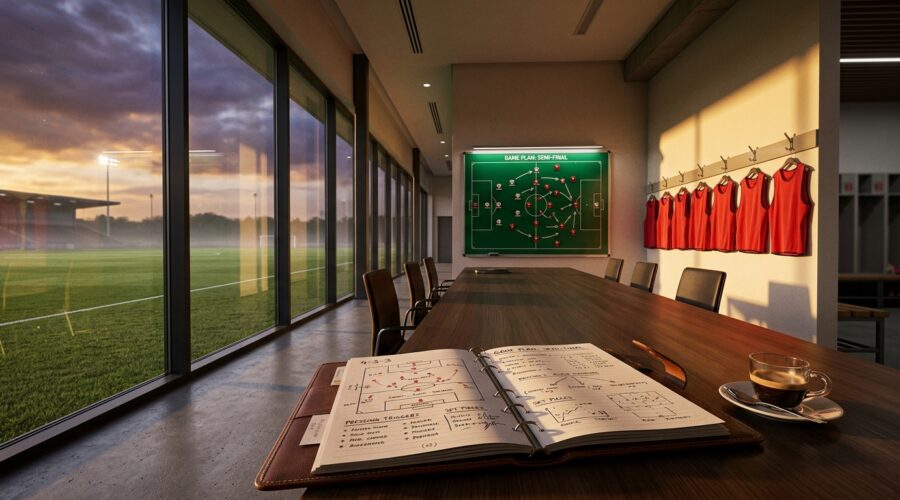
There is a question that has haunted English football for nine decades, and it belongs entirely to Arsenal. The last time they successfully defended a league title was 1934-35. Not the last time they were close. Not the last time they had a squad capable of it. The last time they actually did it. King George V was still on the throne. The country was eight years away from the start of the Second World War. And nobody at Highbury had any earthly reason to suspect it would not happen again fairly soon.
It did not happen again fairly soon. Nor has it happened in the Premier League era at all. No Arsenal side, not even the Invincibles of 2003-04, went back-to-back. So when Mikel Arteta stands in his technical area at the Emirates on August 21 to watch his champions face newly-promoted Coventry City, managed — with a certain cosmic irony — by Frank Lampard, he will be attempting something his club has not managed in ninety-one years. And he will be doing it with eight midfielders who, on paper at least, constitute the most frightening engine room in English football.
That is either a tremendous problem or an extraordinary luxury, depending on how well you tolerate abundance.
What Arsenal Actually Won and How They Won It
Before projecting forward, it is worth dwelling briefly on what Arteta’s side actually accomplished in 2025-26, because the numbers are not merely good — they are historically peculiar. Arsenal finished with 85 points, seven clear of Manchester City, having led the table for 32 of 38 gameweeks and spent 234 days at its summit. That is not a team that sneaked a title on goal difference in April. That is a team that sat on the trophy for most of the winter and dared someone to come and take it.
The forensics of how they did it are equally striking. Nineteen goals from corners — a Premier League record. Twenty-nine set-piece goals across all competitions. Zero penalties conceded. Zero red cards. The first team in the league’s history to achieve that particular double of immaculacy. David Raya kept 19 clean sheets. Gabriel Magalhães led the division with 34 shot blocks. They conceded fast-break goals precisely once all season, which tells you everything about the defensive shape Arteta drilled into his side: organised, compressed, suffocating.
And then there was the academy. Max Dowman, sixteen years old, became the youngest goalscorer in Premier League history. Myles Lewis-Skelly, nineteen, started a Champions League final. Ethan Nwaneri, also nineteen, scored nine goals across all competitions, placing him alongside Wayne Rooney and Michael Owen in the rarefied company of teenagers who have contributed meaningfully at the highest level. The cups eluded them — penalty defeat to PSG in the Champions League final in Budapest, a loss in the EFL Cup final — but the league was theirs, and it was not particularly close.
This is the foundation. What Arteta builds on top of it for 2026-27 is the question that makes the coming season genuinely fascinating.
Eight Midfielders: The Luxury Problem
Let us be honest about what Arsenal’s midfield situation actually represents. Not just depth, but an embarrassment of it — the kind that forces a manager to make choices that will upset excellent players. Declan Rice. Martín Zubimendi. Martin Ødegaard. Mikel Merino. Eberechi Eze. Myles Lewis-Skelly. Ethan Nwaneri. And now, pending the formal completion of an agreement reached with Newcastle United on August 5, Bruno Guimarães for £75 million.
Eight options for a midfield of three. Even accounting for injuries — and in a season following a World Cup, injuries are less an eventuality than a scheduling commitment — Arteta will consistently be leaving three or four genuinely elite midfielders out of his starting eleven. There is something almost lavish about it, like a restaurant that employs eight head chefs and serves a set menu of three courses.
The Guimarães saga alone was its own minor drama. Arsenal opened with £55 million. Rejected. They returned at £65 million. Rejected. They nudged to approximately £70 million. Still rejected. Newcastle, who had already sold Anthony Gordon to Barcelona for approximately £69.3 million and Sandro Tonali to Tottenham for £100 million, were haemorrhaging their best players but proved admirably stubborn about the Brazilian’s valuation — until, as these things tend to conclude, a number was found that made everyone uncomfortable enough to agree. At £75 million, Guimarães arrives as one of the more expensively assembled midfielders in Premier League history, and arguably as the piece that transforms Arsenal’s midfield from very good to something closer to genuinely unmanageable for opponents.
The Architecture of the Midfield
To understand why Guimarães matters, you have to understand what the title-winning midfield actually looked like under stress. Zubimendi, the £55.8 million signing from Real Sociedad, was the deep-lying pivot who unlocked Rice’s capacity to operate as a genuine number eight rather than a defensive midfielder playing at altitude. That shift — Rice unshackled from the base, free to arrive late into spaces — was perhaps the most tactically significant decision Arteta made all season. Zubimendi carrying the defensive weight, Rice carrying the ball and the goals, Ødegaard conducting from the ten position: it was a beautiful arrangement for about thirty gameweeks, before Zubimendi visibly ran out of steam and Rice, whose body absorbed neural pain in his hamstring, a calf knock, and a sickness bug at the World Cup on top of 4,454 club minutes in 2025-26, began to look like a man who had simply done too much.
Guimarães solves this. Not by replacing anyone, but by distributing the physical load across a broader surface. A midfield of Zubimendi at the base, Rice and Guimarães as the driving eights — aggressive, physical, ball-carrying, capable of winning the ball in tight spaces and arriving in the box with genuine menace — gives Arteta something he did not quite have last season: redundancy in quality. When Rice needs managing — and Rice will need managing, given the cumulative toll of the past eighteen months — Guimarães does not represent a drop in level. He represents a lateral move, with different characteristics but equivalent authority.
The creative axis, meanwhile, tilts towards Ødegaard and Eze as rotational weapons rather than guaranteed starters in the big matches, which is a sentence that would have been considered slightly absurd twelve months ago. Ødegaard, 27 and with a title lifted and a Norway captaincy confirmed, enters the season with motivation and fitness restored after missing two months of 2025-26. Eze, whose five goals against Tottenham in a single season constituted a feat no Arsenal player had managed in approximately ninety-one years — since Ted Drake’s 1934-35 campaign — brings the kind of unpredictable, diagonal-running creativity that rigid defensive blocks cannot easily pre-plan against. When Arteta needs to open a game rather than control it, those two coming off the bench represents an option that most managers would offer their firstborn to possess.
And then there is the young core. Lewis-Skelly’s transition from left-back auxiliary to genuine central midfielder was the quiet subplot of Arsenal’s title win — a nineteen-year-old who started a Champions League final and became a senior England international in the same season, now being analysed in August pre-season footage operating in an advanced midfield role against Girona with the composed authority of someone a decade older. Nwaneri, whose Arteta-designed future lies centrally rather than wide, may finally get the consistent opportunity to demonstrate whether his teenage brilliance can sustain itself across a full campaign at the deepest level. His loan at Marseille was a productive stint — 11 appearances, 2 goals, and a debut strike 13 minutes into his first match against Lens — but the door in north London is now fully open, contingent, as Arteta typically makes these things, on demonstrating it not for a week or a month, but at the very highest level.
The Risks Arteta Cannot Entirely Control
There is a shadow over the title defence that has nothing to do with midfield configurations or transfer fees. William Saliba’s back injury, which resurfaced during France’s World Cup semifinal defeat to Spain, has prompted Arsenal to acknowledge publicly that he may miss an extended period at the start of the season. This is a significant concern. Saliba was imperious in 2025-26 — arguably the finest ball-playing centre-back in England, a player whose presence in the defensive line shapes the entire system’s capacity to press aggressively and build from the back. Without him, Arsenal are still formidable. But the version of Arsenal that spent 234 days at the top of the table was specifically the version with Saliba as its defensive cornerstone. Gabriel Magalhães, Piero Hincapié — whose season-long loan from Bayer Leverkusen was wisely made permanent for £34.5 million, announced on June 25 — and Riccardo Calafiori can fill the gap credibly. They cannot fill it identically.
Bukayo Saka, who was in fine form at the World Cup, is also on a managed return schedule. Both Saka and Rice were absent from the Girona friendly. Viktor Gyökeres, whose partnership with Arteta’s system matured into something approaching elite-level in the second half of 2025-26 with 13 goal involvements across all competitions from January alone, was present and correct. The full ensemble, including the World Cup returners, is not expected until the week of August 10 — giving Arteta less than a fortnight to integrate his most important players before the Community Shield against Manchester City on August 16, and five more days before Coventry arrive at the Emirates.
It is a compressed timeline that applies equally to every club with international players. The difference is that Arsenal’s World Cup commitments were especially extensive: sixteen players at the tournament, spread across Spain’s title-winning campaign, England’s run to the third-place playoff, and various other nations. Zubimendi and Merino are arriving as World Cup winners alongside Raya; Rice arriving as a man who gave his body to England across five matches through genuine physical adversity; Saliba arriving with his back in a state that has already caused official anxiety. The compressed six-week window between the tournament final on July 19 and the season’s opening weekend is not a peculiarity unique to Arsenal — but Arsenal, as defending champions, carry the weight of expectation into it that nobody else does.
The Challengers: What Each Rival Actually Represents
The most significant story of the summer — perhaps the single most consequential development for the 2026-27 title race — is not a transfer. It is an absence. Pep Guardiola, after ten seasons and twenty major trophies at Manchester City, has left. The first Premier League season without Guardiola on a touchline since 2016 is upon us, and the vacuum that creates is psychological as much as tactical. City remain dangerous. Erling Haaland, twenty-two goals in the league last season, has signed a contract extension through 2034 and shows no visible signs of being a mortal. The £116 million signing of Elliot Anderson from Nottingham Forest gives Enzo Maresca’s midfield the physical dynamism of one of the tournament’s standout players. But Maresca himself — a man who resigned from Chelsea in January in what was plainly a difficult debut in Premier League management before being appointed by City as Guardiola’s successor — is an unproven quantity at this level. The system will be familiar to City’s players from the inside. Whether it will be executed with Guardiola’s precision and ruthlessness is a legitimate question, and the teething pains of a managerial transition at a club that size are not to be underestimated.
Chelsea, priced at 10/1, deserve more respect than that number suggests. Xabi Alonso, appointed on a four-year contract beginning July 1, inherits a squad that finished tenth last season but did so in circumstances of considerable managerial chaos — Maresca’s mid-season resignation in January — and now possesses a significant structural advantage: no European football in 2026-27. When every other contender is rotating through Thursday evening commitments and international jaunts to Istanbul and Lisbon, Chelsea can rest, sharpen, and prepare for the Premier League with an undivided focus that has not been available to a genuine title challenger in years. Add Morgan Rogers — whom Arsenal refused to pay more than £80 million for and Chelsea happily bought for the full £117 million asking price — alongside Cole Palmer, Enzo Fernandez, and Caicedo, and you have a side that could become genuinely threatening by December, when Alonso’s methods have had time to embed. The 10/1 is not without logic, but it flatters to deceive as a number that suggests Chelsea are merely a long shot. They are a long shot with a meaningful scheduling advantage, a world-class manager, and a free-spending ownership group that just demonstrated it will pay whatever is required.
Liverpool, at 11/2, are in genuine transition. Andoni Iraola arrives from Bournemouth — the very Bournemouth whose 1-1 draw with Manchester City on May 19 mathematically handed Arsenal the title — on a two-year contract, having been appointed on June 4, tasked with rebuilding a club that finished fifth, lost Mohamed Salah, and were beaten 4-0 by Leeds in pre-season in Chicago. Jeremy Jacquet and Victor Muñoz are credible additions. The core of van Dijk, Alisson, Szoboszlai, Gravenberch, and Florian Wirtz retains genuine quality. But the post-Salah identity is the central unknown of the season, and a 4-0 pre-season defeat, however much context surrounds it, does not project the aura of a club primed to immediately challenge for a title.
Manchester United, at 6/1, remain the most intriguing subplot. Michael Carrick, appointed interim in January, guided United to a strong second half of the season and steered the club to third place and Champions League football. He has been given the permanent role, which feels both overdue and entirely earned. Youri Tielemans at £35 million from Aston Villa is a quiet, excellent signing — a midfielder whose consistency the Premier League has undervalued for years. Andrey Santos at £48 million from Chelsea represents genuine upside. But a first full season with European football on top, in Year One of a new permanent managerial era, makes a title challenge feel premature. Top four is the realistic ceiling; proving they belong there again would be achievement enough.
The Number That Says Everything
Arsenal are 6/4 favourites to retain the title. History offers no comfort here: even Manchester City, for all their sustained dominance, could not string together a true sequence of consecutive titles without interruption. No Arsenal team has done it in the entire history of the Premier League. The last time Arsenal won back-to-back top-flight titles, the Everton players who had just lost the 1934-35 championship were listening to Tommy Dorsey on a wireless set.
These are the kinds of historical footnotes that football writers reach for when they want to suggest the task is nearly impossible. And it is not nearly impossible. It is merely extremely difficult, for a club whose response to extreme difficulty over the past three years has been systematic, patient, and ultimately triumphant. Arteta arrived at Arsenal and built the most disciplined defensive structure in the league, the most productive set-piece operation in the league’s history, a goalkeeper who kept 19 clean sheets, a centre-back who made 34 blocks, a forward who racked up 13 goal involvements across all competitions in half a season, and a sixteen-year-old who became the youngest goalscorer in the competition’s history. Then he went and signed three more world-class players in the summer.
The Saliba concern is real. The World Cup hangover is real. The compressed pre-season is real. Chelsea’s scheduling advantage is real. Guardiola’s absence changes the landscape in ways that are not yet fully legible. All of it is real.
But the midfield Arteta is assembling — Rice and Guimarães and Zubimendi as the physical spine, Ødegaard and Eze as the creative disruption, Lewis-Skelly and Nwaneri as the future already living in the present — is not the midfield of a team preparing to be run close. It is the midfield of a team that intends to settle the question of who is best in England before Christmas, and spend the second half of the season letting everyone else work out if they are right.
On August 16, Arsenal face Manchester City in the Community Shield. Five days later, Frank Lampard’s Coventry City — back in the top flight after twenty-five years away, blinking at the Emirates in the August sunlight — arrive as the first official Premier League obstacle. It is a gentle enough opening. Then the real story begins.
Whatever happens between August and May, ninety-one years of waiting has already ended. The only question now is whether Arteta’s Arsenal are merely a very good team that finally won the league, or the beginning of something that makes the wait feel, in retrospect, entirely worth it.