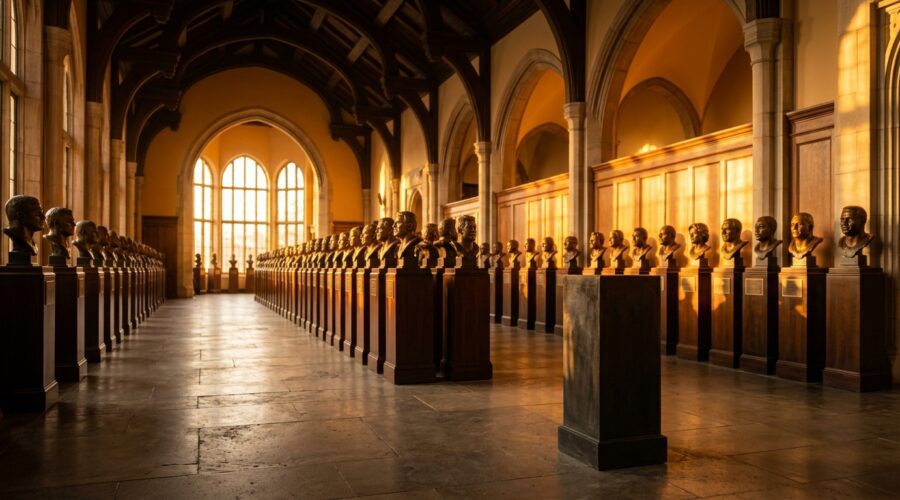
Five men are being inducted into the Pro Football Hall of Fame on August 8, 2026, in Canton, Ohio. A quarterback who rebuilt a hurricane-ravaged city. A wide receiver who spent 17 years being absolutely loyal to a franchise that never quite deserved him. A linebacker who fit a full Hall of Fame career into eight seasons before his own brain told him to stop. The greatest clutch kicker in the history of organized football. And a running back who did something in 1985 that only two other human beings have ever done in the 100-plus-year history of the NFL, and who had to wait 32 years for Canton to notice.
That last part is not a typo. We will get to it.
The Class of 2026 — announced February 5 at the 15th Annual NFL Honors at the Palace of Fine Arts in San Francisco, three days before Super Bowl LX — is a genuinely excellent class. It is also a five-member class in a year where six names probably deserved enshrinement, which means there is a subplot involving the winningest coach in NFL history sitting at home in a non-gold jacket, and that subplot involves cheating scandals, structural ballot math, and enough institutional awkwardness to fill a separate article. We will get to that too.
But first, the five people who actually got in. They earned this.
Drew Brees: A First-Ballot Saint in Canton
Drew Brees is the first first-ballot Hall of Famer in New Orleans Saints franchise history. The franchise was founded in 1967. That is 59 years. One first-ballot inductee. So yes, Brees was a pretty significant personnel acquisition.
The statistical case for Brees is so overwhelming it almost loops back around to being boring, but let us run through it anyway because the numbers deserve to be read out loud. Eighty thousand, three hundred and fifty-eight career passing yards — second all-time, behind only Tom Brady. Five hundred and seventy-one touchdown passes — second all-time. A 67.7% career completion percentage — third all-time at the time of his retirement, though Joe Burrow (68.5%) and Tua Tagovailoa (68.0%) have since surpassed him in the current NFL record standings. Seven thousand, one hundred and forty-two career completions — an NFL record. Thirteen Pro Bowls. Five All-Pro selections. Five seasons with 5,000+ passing yards, which is also an NFL record because of course it is.
And then there is the one game that crystallized everything: Super Bowl XLIV on February 7, 2010. The New Orleans Saints — a franchise that had never won a championship, representing a city that had been partially destroyed by Hurricane Katrina four and a half years earlier — beat Peyton Manning and the Indianapolis Colts 31–17. Brees completed 32 of 39 passes for 288 yards and two touchdowns. He was named MVP. The image of Brees holding his infant son Baylen while confetti rained down on Sun Life Stadium is one of the most reproduced photographs in modern NFL history, and it earns that status.
What gets lost in the statistics is the backstory that makes the statistics meaningful. Brees suffered a catastrophic shoulder injury — a dislocated shoulder with a pan labral tear (360-degree labrum tear) and a partial rotator cuff tear — in the final game of the 2005 season with the San Diego Chargers. The Chargers had already drafted Philip Rivers. They moved on. Brees, a 26-year-old quarterback with a destroyed shoulder and genuine uncertainty about whether he could throw an NFL football again, signed with New Orleans in March 2006. The Saints had just relocated from a city that was still digging out from one of the worst natural disasters in American history. Brees and New Orleans needed each other, and they both delivered.
“I know New Orleans was looking for a quarterback,” Brees said, “but I promise you I needed New Orleans more than New Orleans needed me.”
He will be presented by Sean Payton, who coached him for 15 of his 20 NFL seasons and called Brees’ ask to present him an emotional moment. Under Payton, Brees threw for 68,010 yards and 491 of his 571 career touchdowns. The math on that is amusing: Brees threw 80 TDs in five seasons without Payton, which would be a Hall of Fame career by itself for most quarterbacks. The door knock was delivered by Dan Fouts, who knows a thing or two about being a Hall of Fame quarterback from San Diego. Brees joins a distinguished group of Saints in Canton that includes Willie Roaf, Rickey Jackson, Morten Andersen, Sam Mills, Jim Taylor, Doug Atkins, Earl Campbell, Jim Finks, Hank Stram, and Eric Allen, among others — and he has immediately become its most decorated resident.
Larry Fitzgerald: The Greatest Cardinal in History, and a First-Ballot Wide Receiver
Larry Fitzgerald spent 17 seasons in Arizona. All 17. With one team. In the modern NFL — where player movement, cap casualties, and strategic rebuilds make multi-decade loyalty an almost quaint concept — Fitzgerald played every single snap of his career as an Arizona Cardinal. He either had an extraordinary amount of patience, an extraordinary amount of loyalty, or the Arizona Cardinals made a very convincing argument that they were always just one piece away. Probably some combination of all three.
The career statistics place Fitzgerald in a category of one, and that category is labeled “Everyone Except Jerry Rice.” He finished with 1,432 receptions (second all-time, behind Rice), 17,492 receiving yards (second all-time, behind Rice), and 121 touchdown receptions — sixth all-time, behind Jerry Rice (197), Randy Moss (156), Terrell Owens (153), Cris Carter (130), and Marvin Harrison (128). He holds the NFL record with eight seasons of 90-plus receptions. He made 11 Pro Bowls. He is, by almost every objective measure, one of the greatest receivers in the history of professional football.
The numbers that deserve the most attention, though, are the 2008 postseason numbers, because they represent one of the most complete individual performances in NFL playoff history. Over four games in Arizona’s Super Bowl run, Fitzgerald posted 30 receptions, 546 receiving yards, and seven touchdown catches — records for postseason receiving yards and touchdowns in a single playoff run that still stand. In Super Bowl XLIII against Pittsburgh, he caught a 64-yard touchdown pass in the final minutes to give the Cardinals a lead that lasted about 35 seconds before the Steelers answered. Arizona lost 27–23. It remains one of the cruelest endings to one of the greatest individual Super Bowl performances ever.
Fitzgerald grew up in Minneapolis, served as a Vikings ballboy as a teenager, and got to interact with Cris Carter, Randy Moss, and Warren Moon. He went to Pittsburgh, won the Biletnikoff Award in 2003 as a sophomore — the first sophomore to win the Walter Camp Player of the Year award — and was taken third overall by Arizona in 2004. Randy Moss, one of his early influences, delivered the Hall of Fame knock. His son Devin will present him, making Devin the 33rd son to present a Hall of Famer. Both the Fitzgerald and Kuechly presenter announcements were made on Father’s Day 2026, which was either a very deliberate programming decision or a genuinely wonderful accident, and either way it worked.
Luke Kuechly: Eight Seasons, One Hundred Percent Effort, and a Brain That Said Enough
Here is how you evaluate Luke Kuechly’s Hall of Fame case: from 2012 through 2019, he recorded more tackles than any player in the NFL (1,092) and more interceptions than any linebacker in the NFL (18). He won AP Defensive Rookie of the Year in 2012 and AP Defensive Player of the Year in 2013. He made seven Pro Bowls and seven All-Pro selections — five of them first team. He made 100-plus tackles in every single season of his career. He played college football at Boston College and set an ACC record with 532 career tackles, finishing with 191 in 2011 alone — a 15.9 tackles-per-game average that stands as an FBS record for tackles per game in a single season. He won the Butkus Award, the Nagurski Award, and the Lombardi Award simultaneously.
He did all of this in eight seasons.
He retired at 28 years old, in January 2020, because of the cumulative effects of repeated concussions. He said at the time that he still could have played, but not at the level he demanded of himself. That level — the one he felt he could no longer sustain — was the standard by which every other linebacker in the league was being judged. Three of his final five seasons involved concussions significant enough to affect his availability. In 2016, he was carted off the field while sobbing uncontrollably after a hit, one of the most gut-punching images in recent NFL history, a reminder that the sport’s most invisible injury does not discriminate based on talent or toughness.
At enshrinement, Kuechly will become the second-youngest inductee in Pro Football Hall of Fame history at age 35, trailing only Gale Sayers, who was inducted at 34. He was narrowly passed over in 2025, his first year of eligibility. On missing it by a year: “I was hoping it would be a year ago, but it’s going to be great when all this stuff comes together. No matter what happens, it always happens when it’s supposed to happen.” That level of grace, from a man whose career was cut short by a condition the league is still figuring out how to address, says something.
His father Tom will present him — the 12th father to present a Hall of Famer. The Hall of Fame knock was delivered by Julius Peppers, Kuechly’s former Panthers teammate, who surprised him at a Charlotte restaurant while Kuechly’s family coordinated backstage. The Carolina Panthers, Kuechly’s only NFL team, appeared in the 2026 Hall of Fame Game against the Arizona Cardinals — their first Canton appearance since their inaugural 1995 season.
Adam Vinatieri: The Greatest Clutch Kicker in NFL History, and It Was Not Close
The argument for Adam Vinatieri as the greatest kicker in NFL history runs something like this: he is the all-time leading scorer in NFL history (2,673 career points), made 599 field goals, holds the record for consecutive field goals made (44), holds the record for most seasons with 100-plus points (21), has more postseason points than any player in NFL history (238), and won four Super Bowl rings — more than any kicker who has ever played professional football. He played 24 seasons, starting as an undrafted free agent out of South Dakota State in 1996 and finishing in 2019 as the last active player from the 1990s still competing in the NFL. He was 46 years old at the end of his final season. He is the third pure placekicker inducted into the Pro Football Hall of Fame, joining Jan Stenerud and Morten Andersen. Carlie Irsay-Gordon, the Indianapolis Colts Owner & CEO, will present him at enshrinement. That Irsay-Gordon’s family connection runs so deep to Vinatieri’s legacy — and that Vinatieri eventually surpassed Andersen’s all-time scoring record — makes for a poetry all its own.
The statistical case is airtight, but the case that actually mattered was built in specific, high-leverage moments. In the 2002 AFC Divisional Playoff — later called the Snow Bowl — he hit a field goal through a blizzard to force overtime. Then he made the game-winner in overtime. Then, two weeks later, in Super Bowl XXXVI, with the Patriots and Rams tied at 17 and no time left on the clock, he hit a 48-yard field goal as time expired. Patriots 20, Rams 17. First Super Bowl title in New England history. Tom Brady was 24 years old. Vinatieri was the one who actually won the game.
Two years later, in Super Bowl XXXVIII, he did it again — 41-yard field goal with four seconds left, Patriots 32, Panthers 29. He became the first player in Super Bowl history to be the deciding factor in two separate championship victories. Then he left New England after the 2005 season, signed with the Colts in 2006 at age 34, went to the playoffs in his first season in Indianapolis, set single-season postseason records with 49 points and 14 field goals, and won his fourth Super Bowl ring. Tom Brady’s quote about Vinatieri — “When you look up clutch in the dictionary, it should have your picture” — is the kind of endorsement that does not require further analysis.
Carlie Irsay-Gordon will present him — continuing a tradition started by her late father Jim Irsay, who presented Marvin Harrison (2016), Edgerrin James (enshrined in 2021 as part of the Class of 2020, with the ceremony delayed from August 2020 due to COVID-19 public health precautions), and Dwight Freeney (2024). The Irsay family has now presented four Colts legends in Canton, which is a remarkable institutional commitment to honoring the people who built something worth honoring. Vinatieri will also be inducted into the Colts Ring of Honor during Indianapolis’s Week 6 home game against the Tennessee Titans, which means he will have a very busy fall.
Roger Craig: The Blueprint for the Modern Running Back, 32 Years in the Making
In 1985, Roger Craig rushed for 1,050 yards and caught passes for 1,016 yards. He became the first player in NFL history to surpass 1,000 rushing yards and 1,000 receiving yards in the same season. His 92 receptions that year led the entire NFL — not just running backs, every receiver in the league. In the 40-plus years since, only two other players have done what Craig did that season: Marshall Faulk in 1999, and Christian McCaffrey in 2019. That is three players. In the history of professional football. And Craig did it first, with high-knee action that punished defenders, in a Bill Walsh offense that was basically operating a decade ahead of its time.
He won three Super Bowls with the 49ers (XIX, XXIII, XXIV), scored the first three-touchdown performance in Super Bowl history in Super Bowl XIX against the Dolphins — recording two receiving touchdowns and one rushing touchdown — won AP Offensive Player of the Year in 1988 with 1,502 rushing yards and 534 receiving yards, finished his career with 8,189 rushing yards, 4,911 receiving yards, and 73 total touchdowns, and was the prototype upon which every modern dual-threat running back was eventually constructed.
He first appeared as a modern-era semifinalist for the Class of 2009. He waited more than 32 years from his NFL debut to his enshrinement. He was eventually elected via the Seniors Blue-Ribbon Committee — a separate track for players whose cases were overlooked during their primary eligibility windows. The fact that it took this long for a player of Craig’s significance to reach Canton is a fairly embarrassing institutional failure, and the Hall of Fame should acknowledge it as such even while celebrating the moment it finally corrects itself.
The door knock was delivered jointly by Ronnie Lott and Charles Haley — both Hall of Famers, both 49ers teammates — who arrived at Craig’s home together, which is exactly the kind of moment NFL Films was built to document. His presenter is Jamie Williams, a lifelong friend who attended the same elementary school, junior high, high school, and college (Nebraska) as Craig, and then overlapped with him on the 49ers for the 1989 Super Bowl XXIV championship season. Jerry Rice said of Craig: “High knee action, how he would punish the defender. Just overall, just a fantastic teammate that laid everything out there on the football field.” Coming from Jerry Rice, that is not a throwaway compliment.
The Belichick Problem, Explained in the Most Direct Terms Possible
Bill Belichick coached for more than four decades in the NFL. He won eight Super Bowls. He is the winningest coach in league history. He did not get into the Hall of Fame in his first year of eligibility, and the explanation for why involves both genuine moral complexity and genuine structural absurdity in roughly equal measure.
The moral complexity: Spygate (2007) and Deflategate (2015) came up in the deliberations. Multiple voters reportedly cited character concerns rooted in both scandals. A voter told ESPN that the cheating “really bothered some of the guys.” Reasonable people can disagree about how much weight a Hall of Fame voter should give to competitive integrity violations when evaluating a coaching legacy, and that disagreement is not going away before the 2027 vote.
The structural absurdity: Belichick was eligible in a combined Seniors/Coaches/Contributors category in which voters could select a maximum of three of five finalists. Also in that group were Roger Craig, Robert Kraft, and two others. The math required voters to make impossible choices, and the structure essentially guaranteed that deserving candidates would be excluded by ballot architecture rather than merit evaluation. The Hall subsequently announced expected procedural reforms, including reducing committee size, adding non-media experts, and potentially returning to in-person voting. Belichick is widely expected to be in the Class of 2027. The procedural fix, if implemented properly, should ensure the ballot geometry does not do the damage again.
None of this diminishes what the Class of 2026 accomplished. It just provides necessary context for why a class this good came in at only five members, the second-smallest in 20 years.
Enshrinement Week and the Numbers That Define This Class
The ceremony takes place Saturday, August 8, at noon Eastern at Tom Benson Hall of Fame Stadium in Canton. The week includes the Gold Jacket Dinner on August 7, the Grand Parade on the morning of August 8, and a Raising Cane’s Concert for Legends featuring Lainey Wilson on August 9. The voting results were certified by Ernst & Young, the class was narrowed from 128 modern-era nominees to 26 semifinalists to 15 finalists, and each candidate required at least 80% positive votes (40 of 50) for election. The total Pro Football Hall of Fame membership now stands at 387.
The Hall of Fame Game on August 6 featured the Arizona Cardinals against the Carolina Panthers — directly tied to Fitzgerald and Kuechly — and served as the first NFL action since Super Bowl LX, which the Seattle Seahawks won over the New England Patriots. It was Mike LaFleur’s head coaching debut for Arizona, and rookie quarterback Carson Beck, a third-round pick out of Miami who led the Hurricanes to the CFP National Championship Game before falling 27-21 to Indiana, started under center. The Panthers had not appeared in Canton since their inaugural 1995 season. Both Fitzgerald and Kuechly were honored on the field during pregame. The Hall of Fame did not subtly engineer the matchup between these two teams. Or maybe they did. Either way, it worked out.
What This Class Means When You Step Back and Look at the Whole Thing
Five players. One who redefined quarterback precision and became the emotional anchor of a recovering city. One who redefined what loyalty and longevity look like at wide receiver, spending 17 seasons as the best player on a team that rarely gave him enough support to win. One who compressed a Hall of Fame timeline into eight seasons and retired before the sport extracted everything it had to take. One who proved definitively that a kicker can be a franchise-altering legend and that clutch is a skill, not a personality trait. And one who built the blueprint for the modern all-purpose running back in 1985 and waited 32 years for the institution to catch up to what he actually was.
The Class of 2026, presented by Visual Edge IT and enshrined in Canton on August 8, is a genuinely worthy collection of football’s best. The gold jackets are earned. The wait, in at least one case, was far too long. And somewhere in the procedural aftermath of this year’s voting, the Hall of Fame is presumably doing the institutional reckoning required to make sure the math never again becomes the reason the right answer gets delayed.
Five hundred and seventy-one touchdown passes. Fourteen hundred and thirty-two receptions. One thousand and ninety-two tackles. Two thousand, six hundred and seventy-three points. One thousand yards rushing and one thousand yards receiving in the same season, forty years before it became fashionable. Three hundred and eighty-seven members of the Hall of Fame. These are the numbers. The stories behind them are why Canton exists.