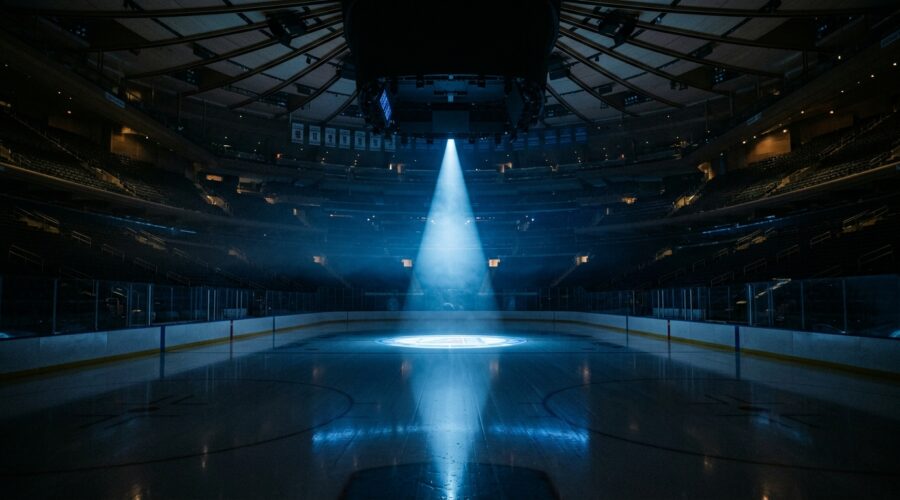
There is a date that haunts the hallways of Madison Square Garden more than any other. It is not the anniversary of the last Stanley Cup. It is not the day Artemi Panarin was traded away, or the afternoon a 24-year-old superstar nearly got shipped to Ottawa. The date is July 1, 2028 — the moment Connor McDavid, the best hockey player alive, becomes an unrestricted free agent.
Everything the New York Rangers are doing right now, in the summer of 2026, has to be understood through that lens. The trades, the signings, the one-year band-aid deals, the aggressively restructured defensive corps — it all makes a different kind of sense when you accept that this organization is running two parallel front offices simultaneously: one trying to win hockey games next October, and one quietly building the most attractive destination on earth for a man who currently has no intention of leaving Edmonton.
This is the story of a franchise at a crossroads, two players whose futures hang in the balance, and the distant star they’re all orbiting.
The Dream Deferred
When Connor McDavid signed a two-year, $25 million extension with the Oilers on October 6, 2025 — one day before the season opener — the air went out of every front office that had been quietly penciling his name into their salary cap software. The Rangers were among the most deeply deflated.
For months, the narrative in New York had been intoxicating. With Artemi Panarin’s $11.64 million cap hit partially coming off the books following his trade to the LA Kings — the Rangers retained 50% of his salary, leaving them still carrying $5.82 million of his cap hit — a surging salary cap projected to hit $104 million, and a market unlike any other in professional sports, the Rangers looked positioned to execute the most consequential free agency pitch in franchise history. The plan, as Mike Rupp confirmed on Daily Faceoff, was not subtle: “I think they’ve always had an eye on Connor McDavid and that situation and monitoring that. I think there’s probably a plan to do something big.”
Then McDavid signed two years at $12.5 million AAV — the same cap hit as his previous deal, a number that Kirill Kaprizov’s new eight-year, $17 million AAV contract immediately rendered absurd by comparison — and the Rangers were left, as The Athletic’s Peter Baugh wrote in October 2025, “in an unenviable position: With the cap rising, New York will be flush with financial flexibility next summer yet have no superstars to spend it on.”
The dream was not dead. It was deferred. And in some ways, a two-year extension is more tantalizing than a long-term commitment would have been. McDavid will turn 31 in January 2028, still in his prime, still posting video-game numbers — 138 points in 82 games in 2025–26 alone — and still without a Stanley Cup ring after a painful Eastern Conference Finals loss to the Florida Panthers in 2024 and subsequent playoff absences. The short-term extension was a mutual dare between McDavid and the Oilers: win now, or the conversation changes entirely.
Rupp put it plainly on the Tri-State Hockey Podcast: “They need to have a dominant guy like that. So I think they’re always planning and maybe scheming for that.” According to those in Rangers circles, McDavid is not the only name on the 2028 board — Auston Matthews and Leon Draisaitl are also being tracked — but he is the name that gives a franchise 30 years removed from its last championship reason to believe in something transformational rather than incremental.
The estimated market value for McDavid in 2028 has already been floated at $17 to $18 million AAV — a number that would require extraordinary cap architecture to accommodate. But the Rangers are already building that architecture, one painful decision at a time.
A Franchise in the Mirror
Before you can understand the offseason optimism, you have to sit with the 2025–26 season honestly. The Rangers finished 34-39-9 for 77 points — dead last in the Metropolitan Division, 36 points behind the division-leading Carolina Hurricanes, and marking their second consecutive missed playoff appearance. In the franchise’s centennial season, no less.
On January 16, 2026, GM Chris Drury sent a letter to fans that used a word every professional sports organization dreads having to define: retool. “This will not be a rebuild,” Drury wrote. “This will be a retool built around our core players and prospects. We will target players that bring tenacity, skill, speed, and a winning pedigree with a focus on obtaining young players, draft picks, and cap space to allow us flexibility moving forward.”
What followed was the most aggressive offseason of Drury’s tenure. Panarin went to the Los Angeles Kings. Vincent Trocheck was shipped to the Utah Mammoth in exchange for Sean Durzi, Cole Beaudoin, and a 2027 third-round pick. The Rangers traded the 26th and 92nd overall picks in the 2026 Draft, plus a top-10 protected 2028 first-round pick, to the Vegas Golden Knights for Pavel Dorofeyev — then immediately locked the 25-year-old goal-scorer into a seven-year, $77 million extension. Marcus Pettersson was acquired from Vancouver. Oliver Bjorkstrand signed for one year at $4.5 million. Alberts Smits was selected fifth overall in the Draft.
Drury was clear-eyed enough about the implications of these moves to speak to them directly. “I’m not going to sit here and put a time on anything,” he told NHL.com. “The only timeline I operate on is trying to get better every single day.” That is a careful answer from a man who knows his team may be a year or two from relevance, and who also knows the clock on the most important free agent opportunity in franchise history is ticking.
The Dorofeyev deal is the most revealing transaction of the summer. Trading a top-10 protected 2028 first-round pick signals something specific: Drury believes — or at minimum needs to believe — the Rangers will be competitive enough in 2027–28 that their pick will fall outside the lottery. That is not blind optimism. It is a structural commitment to a timeline.
The Schneider Problem: Stuck in No Man’s Land
Among the quieter storylines of this offseason is one that carries enormous consequences for the franchise’s long-term defensive identity. Braden Schneider, the 19th overall pick of the 2020 Draft, has never quite been what the Rangers needed him to be. In 2025–26, that gap between expectation and reality became undeniable.
Playing a career-high 20:27 per game, Schneider posted just 18 points — matching his worst point total since his rookie season — with a minus-5 rating and an xGF% of 44.0 at 5-on-5, the worst figure among Rangers regulars according to Natural Stat Trick. His expanded role did not elevate his game. It exposed its ceiling.
The offseason did not improve the picture. Schneider filed for salary arbitration on July 5, 2026 — though a date for his hearing had not yet been announced at that time. The July 29 hearing date was set later, after the filing. Eight days after filing, on July 13, the two sides settled on a one-year, $5.5 million deal to avoid the hearing — a sign that contract negotiations had stalled significantly before ultimately finding resolution.
As The Hockey News noted bluntly: “Schneider essentially finds himself in an identical situation to the one he was in going into the 2025-26 season.” The Rangers now have a defenseman making top-four money who projects to play third-pair minutes, because the additions of Sean Durzi and Marcus Pettersson have pushed the depth chart decisively above him.
The projected 2026–27 defensive pairs — Fox and Gavrikov on the first, Pettersson and Durzi on the second, Schneider and Robertson on the third — represent a dramatic downgrade in opportunity for a player who needs to expand his game, not shrink it. Blue Seat Blogs has been among the loudest voices drawing the K’André Miller parallel, and it is a comparison that stings.
K’André Miller, traded to Carolina on July 1, 2025, for Scott Morrow, a conditional 2026 first-round pick, and a 2026 second-round pick, proceeded to lead the Hurricanes in average ice time during the 2026 playoffs at approximately 24:03 per game and earned serious Conn Smythe consideration, ranking sixth in Trophy power rankings entering the Stanley Cup Final. He was everything the Rangers said they were moving away from: a big, left-shot defenseman without enough offensive upside. He then went to Carolina and played some of the best hockey of his career on a championship contender.
The uncomfortable question is whether Schneider is next in that line — a player being held past his maximum trade value while the franchise debates what it has and what it needs. An anonymous NHL scout interviewed by The Athletic offered a counter-argument: “You’re going to put yourself in a bad spot moving a 25-year-old right-hand defenseman… who probably played himself into an average number for his next contract. That guy’s going to be nothing but valuable.”
Right-shot defensemen are among the most coveted commodities in the modern NHL. That part is true. But value is relative to context, and right now Schneider’s context is a third-pair role on a team that needs him to either grow into more or become a trade chip for something that accelerates the timeline. The one-year deal resolves nothing. The 2026–27 season is the audition that will determine whether Schneider is part of the solution or becomes the next cautionary tale on Broadway.
The Lafrenière Question: Franchise Litmus Test
No storyline captured the complexity of this franchise’s identity crisis more vividly than what happened to Alexis Lafrenière in 2025–26. The former first overall pick of the 2020 NHL Draft — a designation that has followed him like a scarlet letter throughout his career — arrived at training camp needing a statement season and instead endured one of the most turbulent years of his professional life before engineering one of its most compelling second-half surges.
By January 2026, with the Rangers mired in the Eastern Conference basement, coach Mike Sullivan demoted Lafrenière as trade rumors reached a fever pitch. “We need more,” a coach’s source told amNewYork. Through 47 games at that low point, he had 9 goals, 15 assists, and a minus-7 rating. Ottawa kicked tires. Montreal was mentioned. The Athletic reported a summer trade was a genuine possibility.
Then Artemi Panarin was traded to the Kings on February 4, 2026. And something changed.
In the final 27 games of the season without Panarin — without the safety net, without the distraction, without the gravitational pull of a $11.64 million winger demanding the puck in every offensive zone sequence — Lafrenière posted 14 goals and 28 points. His 5-on-5 GF% in that stretch was 54.2%. His xGF% was 53.0%. He recorded a second career hat trick in a 4-0 shutout of Calgary on March 10.
“I just feel like my confidence the last 30, 40 games, just making plays and trusting yourself,” Lafrenière said. “I feel that that’s a big part of playing good, if you play with confidence. So I feel like that was the biggest difference.”
The Rangers ultimately elected to keep him. Two league sources told The Athletic’s Vincent Mercogliano and Peter Baugh that the team “plan to keep him unless they get blown away.” With seven years remaining on his seven-year, $52.15 million deal at a $7.45 million AAV, the contract is reasonable if — and only if — the second-half version is the real Lafrenière.
That is the franchise litmus test. For 2026–27, Lafrenière steps into the most significant role of his NHL career: projected right wing on the top line alongside Mika Zibanejad and Gabe Perreault, with PP1 deployment and no Panarin above him. It is the opportunity every observer of this franchise has argued he needed since his rookie season. The first overall pick, fully unfettered, in a contract year for his identity if not for his paycheck.
If Lafrenière becomes a 70-point player in 2026–27, the Rangers’ retool has a face and a foundation. If he regresses without Panarin’s shelter, it exposes something more troubling about the talent ceiling at the top of the lineup — and makes the absence of a true franchise center feel that much more acute. Blueshirt Banter has already noted that simply reaching 60 points should be considered the baseline for success, not the ceiling. The bar, at last, is appropriately high.
What 2028 Actually Requires
Here is the honest version of the McDavid plan: it requires a near-perfect sequence of events that the Rangers can influence but cannot control.
It requires Edmonton to fail to win the Stanley Cup in either of the next two seasons — a real possibility given their recent playoff struggles, but far from guaranteed. It requires McDavid to decide that his next chapter belongs somewhere other than the city where he was drafted, where he has played his entire career, and where he remains the most beloved athlete in the province. It requires the Rangers to have built something compelling enough in that window that “come to New York” is a more attractive proposition than whatever the Oilers, or Toronto, or any other deep-pocketed franchise offers.
And then it requires the actual roster construction to support a player who will likely command north of $17 million AAV — a number that would consume roughly 15% of the projected cap and demand extraordinary depth on deeply team-friendly deals surrounding him.
The Rangers are building toward that possibility on multiple fronts simultaneously. The Dorofeyev signing at $11 million AAV gives them a legitimate offensive weapon who is 25 years old and under contract through his early thirties. Gabe Perreault, if his development continues, gives them a playmaking center-wing capable of operating alongside elite talent. Adam Fox remains one of the best defensemen in hockey. The prospect pipeline — Smits at five overall, Scott Morrow developing quietly, Vincent Iorio and Matthew Robertson waiting in the wings — provides the kind of upside that wealthy franchises can point to in recruiting conversations.
But the most honest reading of where this franchise stands today is that they are a work in progress hoping to become a destination. That is not a criticism — it is a description of every team not currently holding the Cup. The difference for the Rangers is that they have staked a significant portion of their organizational philosophy on a specific, named, theoretical outcome that depends on a man in Edmonton choosing to leave.
Drury’s legacy will ultimately be measured against the distance between where these offseason moves take the franchise and where they needed to go. His most active summer produced a younger, faster, more cap-flexible roster. Whether it produced a winner — or a placeholder for the biggest signing in NHL history — remains the defining question of the next two years.
The Longest Game
What makes the Rangers’ situation genuinely fascinating, rather than merely frustrating, is the clarity of the goal even amid the uncertainty of the path. Most franchises in transition are running toward something vague — a better record, more youth, a playoff spot. The Rangers are running toward a specific date, a specific player, and a specific version of themselves they believe can attract him.
Everything that happens between now and July 1, 2028 is infrastructure. Braden Schneider either proves his worth or gets moved for assets that improve the foundation. Lafrenière either emerges as the winger this franchise has always needed or confirms that the top of the lineup requires an external solution. Pavel Dorofeyev either validates the cost of his acquisition or becomes a cautionary tale about overpaying for goal-scorers on losing teams. Gabe Perreault either develops into a franchise center or leaves the biggest roster hole in the organization exposed and gaping.
And Connor McDavid either lifts the Stanley Cup in Edmonton in the next two springs — which would almost certainly keep him there — or he arrives at July 1, 2028 as the most consequential unrestricted free agent in the history of North American professional sports.
The Rangers will be waiting. The question is whether, by then, they have built something worth coming to.