On December 14, 2025, with less than two minutes left in a forgettable 16–13 loss to the Los Angeles Chargers, Patrick Mahomes planted his left leg, felt something give way, and walked off the field under his own power while carrying the weight of an entire franchise’s season with him. By the next morning he was in Dallas on an operating table. By that afternoon, a dynasty’s championship window was, at minimum, on a mandatory eight-month pause.
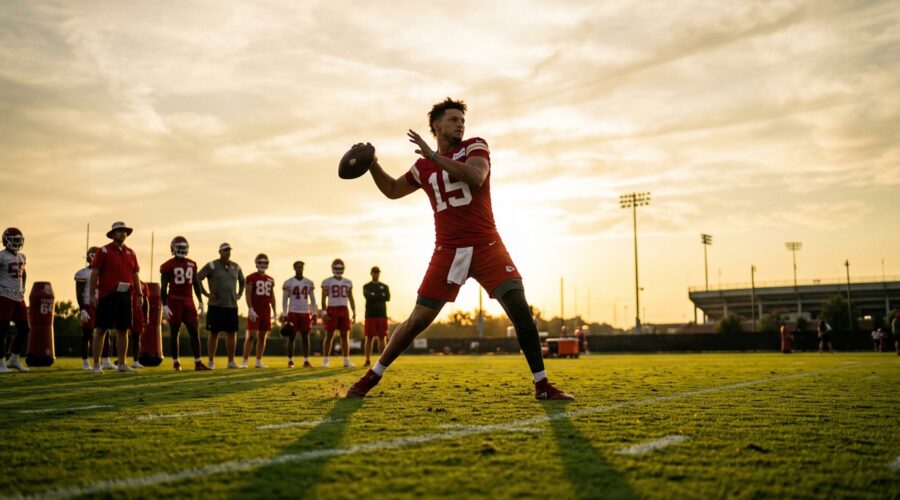
Fast forward to August 11, 2026. Training camp at Missouri Western State University in St. Joseph, Missouri. A RosterWatch observer watching Mahomes run routes in the August heat wrote the sentence that Chiefs fans have been waiting to read since December: “Patrick Mahomes moved normally, had a soft brace on, but under his leggings, he looks ready for Week 1.”
That is, more or less, the whole story. But since “he looks fine” does not fill a blog post, let us do what responsible football people do and work through every layer of this thing — the injury, the math behind the recovery, the supporting cast drama, the very large elephant in the room wearing a Denver Broncos uniform, and what all of it actually means for September 14 on Monday Night Football.
The Injury: Why This Was Not a Routine ACL Tear
There is a meaningful difference between tearing your ACL and tearing your ACL and your LCL in what physicians classify as a posterior lateral corner injury. The distinction matters not just medically but structurally, and understanding it helps explain why the Chiefs moved with such unusual urgency.
An isolated ACL tear is bad, obviously. But it is a well-mapped injury with a well-mapped surgical protocol. Surgeons typically wait days or even weeks to let swelling subside before operating. The LCL avulsion component of Mahomes’ injury did not allow for that luxury. An avulsion means the ligament tore away from the bone, and avulsed tissue needs to be reattached promptly before the window for clean surgical reattachment narrows. That is why Dr. Dan Cooper — the Dallas Cowboys’ head team physician and one of the more respected orthopedic surgeons operating on elite athletes — performed surgery the very next night, December 15.
The Chiefs’ VP of Sports Medicine Rick Burkholder confirmed publicly that there was no artery damage, no nerve damage, no joint surface damage, and no meniscal involvement. In other words, the injury was as contained as a combined ACL/LCL tear can possibly be. Burkholder called the ballpark recovery window nine months, with a stated range of one to two months in either direction.
Here is the math everyone was doing in December: nine months from December 14 puts you at September 14, 2026. The Chiefs’ regular season opener is September 14, 2026. The universe has exactly zero chill.
Now here is the part that makes medical professionals nervous. Published research on multi-ligament knee injuries in NFL players — specifically injuries involving the ACL and the posterolateral corner — shows a return-to-play rate of only about 55.6%, compared to roughly 70.8% for ACL/MCL combinations. Mean time to return for ACL/PCL/LCL injuries in NFL athletes has been recorded at over 459 days, with some presentations extending past 600. Mahomes will be working with a roughly 272-day window from surgery to Week 1. That is the lower end of the data, not the comfortable middle of it.
The counterargument, of course, is that Patrick Mahomes is not the mean. He is a statistical outlier in almost every measurable way a quarterback can be. And the camp reports are leaning hard in his direction.
The Recovery Timeline: From Cinderblock Walls to 11-on-11
What Mahomes described when he arrived at camp on July 25 was both straightforward and slightly poetic. “I’ve been seeing cinderblock walls rehabbing every single day in Kansas City,” he told reporters. “Now, to be on that practice field with my teammates, it’s going to be a lot of fun.”
The invisible infrastructure behind those cinderblock walls included assistant trainer and lead physical therapist Julie Frymyer, who coordinated daily rehabilitation from December through the spring. Mahomes handled 7-on-7 work at the June minicamp while Reid held him out of 11-on-11 periods. He received full training camp clearance on July 24 from Dr. Cooper — confirmed remotely — plus the Chiefs’ in-house medical staff.
The camp progression looked like this:
- July 29: Takes the field wearing a personal-choice knee brace under his uniform, participates in individual drills, successfully rolls left and right before throwing downfield — which was the specific mobility test everyone was watching.
- August 3–4: Full 11-on-11 team drills with Travis Kelce, Kenneth Walker III, and the first-team offense. ESPN’s Dan Graziano, who has been careful and measured throughout this process, described Mahomes’ progress as pointing “really does point, barring some kind of setback, to a Week 1 return.”
- August 5–6: First padded practices. This is where things got interesting. During a two-minute drill, Mahomes found no open receiver on fourth down, scrambled right, ran into rookie DT Peter Woods, reversed direction, attempted an underhand lateral to Kenneth Walker III, and went to ground. The Chiefs turned it over. The internet briefly panicked.
- August 8: Mahomes said something at the Family Fun Day practice that is arguably the most meaningful data point of the entire camp: “When you’re tired sometimes, you don’t even think about the knee.” That is not a quote about physical healing. That is a quote about the neurological and psychological barrier every post-ACL athlete has to clear — the moment the injury stops living rent-free in the conscious mind during physical activity.
- August 10–11: Observers note a noticeably faster running pace than early summer. The brace remains, by Mahomes’ personal choice, not medical mandate.
Andy Reid has been characteristically unforthcoming with guarantees, which is both appropriate and exactly what you would expect from a Hall of Fame coach who has been doing this for thirty years. His quotes have followed a consistent pattern: high praise for how Mahomes looks, zero public commitment to a timeline, and deference to the medical staff. “He’s doing a great job. He’s really doing everything that he normally does, and doing it well,” Reid said in late July. On August 7, Reid confirmed what everyone already suspected — Mahomes will not play in the August 15 preseason opener against the Rams.
Mahomes, for his part, said he was “willing to go no matter what” if given clearance. That tracks for a man who has made a career out of attempting things that are inadvisable on paper and brilliant in execution.
The Scramble Moment, and What It Actually Tells Us
The August 5–6 scramble sequence involving Peter Woods deserves more analysis than it got, because it is being interpreted in two completely opposite ways depending on who you ask and neither interpretation is wrong.
The pessimistic read: Mahomes ran into a rookie defensive tackle, reversed direction under duress, and threw an underhand lateral that was recovered as a turnover. In a real game, that sequence ends either in a sack, a fumble, or a bad decision. Mahomes playing hero ball eight months post-surgery is not a desirable outcome.
The optimistic read: Mahomes physically ran, planted, changed direction, and extended a play under contact. The fact that the competitive instinct kicked in at all — that his body responded to a pressure situation rather than shutting down — is meaningful positive data. Athletes who are subconsciously protecting an injury do not scramble and cut back. They give themselves up.
Mahomes addressed this himself with clarity: “I’m trying to hold myself back because I’m just a competitor. I like competing. All of a sudden, I’m running and cutting back and trying to pitch the ball. But when it’s fourth down, you want to try to make a play happen. I’m not going to lose who I am, but I’m going to try to keep myself smart and keep myself in position to be out there for my teammates.”
That is a very adult sentence from someone who tore two knee ligaments eight months ago and is currently ranked as the most important football player on the planet. The coaching staff did not appear alarmed. Reid’s comments the next day were as calm as ever.
The Rest of the Chiefs Camp: It Is Not All About Mahomes (But Mostly It Is)
While the entire sporting world has been focused on Mahomes’ brace measurements and stride length, several other significant storylines have been unfolding in St. Joseph that will directly affect the Chiefs’ 2026 ceiling.
The Quarterback Room Is Actually Interesting
Justin Fields arrived in March via trade carrying career numbers that read like a cautionary tale with genuine upside: 62.8% completion rate, 1,259 yards, 7 touchdowns, 1 interception, 383 rushing yards, and 4 rushing touchdowns across nine games for the Jets in 2025. Fields took his first 11-on-11 reps with the first-team offense on August 6 and will start the August 15 preseason opener against the Rams. He has shown the playmaking athleticism and scramble ability that makes him a credible backup, along with the occasional deep ball misfire — a floated throw that was intercepted by safety Xavier Nwankpa confirmed that the ceiling and floor remain somewhat wide apart.
Fields on learning from Mahomes: “Any question that I have — he’s been in this offense for 10 years now, so he knows every little detail. Any questions that have popped up, he’s explaining to me perfectly.” That is both a genuine endorsement and a subtle reminder that Mahomes being a football encyclopedia makes everyone around him better at their jobs.
The genuinely surprising subplot is seventh-round pick Garrett Nussmeier out of LSU, the Senior Bowl MVP. Camp observers have described him as more controlled and more accurate than Fields in his reps, with one analyst going on record to say Nussmeier could overtake Fields on the depth chart by mid-season. Seventh-round quarterbacks who project to make 53-man rosters in Week 1 are not common. Nussmeier appears to be on that trajectory, which means the Chiefs may have accidentally landed a developmental QB1 while everyone was busy watching Patrick Mahomes jog.
Rashee Rice and Xavier Worthy: The WR Room Is a Medical Chart
Rashee Rice underwent knee debridement surgery in May to clean out inflammation and loose debris from his previously repaired right knee. He was unavailable through OTAs and mandatory minicamp. On August 4 he participated in 7-on-7 drills and caught his first pass from Mahomes since before the surgery. On August 5 he was in 11-on-11 drills, including red zone reps. The trajectory is positive enough that regular season availability looks realistic, though nobody should schedule a parade yet.
Xavier Worthy entered camp loudly announcing that “last year I was never 100%,” which is both an honest self-assessment and a reason for optimism heading into a contract year. Then he sprained his right shoulder in camp and is now listed as Questionable for the August 15 preseason opener. The football gods are nothing if not consistent in their storytelling.
Undrafted wideout Cyrus Allen has been described by ESPN’s Nate Taylor as “an early star” of Chiefs training camp. He is a regular target in Mahomes’ team period reps, dealt with a shin injury that cost him minimal time, and is viewed as a roster lock. Late-round receiver becoming a camp hero is one of the more reliable NFL training camp plot devices, but the early returns on Allen suggest there may be real substance behind it.
The Defense Has Its Own Storylines
Mansoor Delane, the Chiefs’ first-round pick (sixth overall) in the 2026 draft out of LSU, arrived with a shoulder concern and has been in a yellow non-contact jersey at times. He is Questionable for the preseason opener. Given that he is expected to step into the starting corner role vacated by Trent McDuffie, this is worth monitoring.
Rookie CB Jadon Canady, taken at pick 109 in the 4th round, has been playing nickel slot and recorded a diving interception on a Justin Fields deep pass. Rookie corners recording interceptions in camp is a strong early indicator. Canady looks like he belongs.
Rookie DT Peter Woods — the same man who cut off Mahomes’ scramble path in the two-minute drill — has shown immediate NFL-caliber interior disruption. Getting to the quarterback of the Kansas City Chiefs in a padded practice eight days in is not nothing.
Kenneth Walker III has taken clear control of the starting running back job. Travis Kelce (76 receptions, 851 yards, 5 touchdowns in 2025 despite a 6-11 season) looks sharp with both Mahomes and Fields. Jared Wiley at tight end has quietly impressed enough dynasty analysts that he has moved up rankings boards. The skill position depth is real.
On the injury front: Ethan Downs tore his ACL in the rookie portion of camp and had surgery on August 5. He’s on injured reserve and his season is over before he played a professional snap. That is a brutal way to begin an NFL career, and it is worth acknowledging beyond just the depth chart implications.
September 14: The Game That Changes Everything
Let us be honest about what the Denver Broncos represent here, because this matchup is not just a Week 1 opener. It is the football equivalent of a grudge fight that has been seven months in the making.
The Broncos went 14–3 in 2025. They swept the Chiefs. They snapped Kansas City’s nine-year AFC West title streak. They won the AFC’s number-one seed. Bo Nix threw for 3,931 yards with a 63.4% completion rate and an 87.8 passer rating, added 356 rushing yards and five touchdown runs, and went 14–3 in the regular season before a playoff win in overtime that ended when he suffered a broken ankle — meaning his availability for the 2026 opener is its own storyline to monitor. The Broncos’ 2025 season was legitimately excellent, not a fluke.
Meanwhile, the Chiefs went 6–11 without a healthy Mahomes. Six and eleven. A team that had made ten consecutive playoff appearances and won three Super Bowls in five years posted a record that looks like it belongs to a rebuilding franchise. That is what one injury to one player did to this organization. It is the single most compelling data point for why Mahomes’ return matters on a level that extends well beyond any individual stat line.
The Chiefs have home field advantage. They have Mahomes, if the medical staff signs off on a return to form. They have a defense with genuine playmakers. And they have approximately seven months of institutional embarrassment fueling their preparation.
Monday, September 14. GEHA Field at Arrowhead Stadium. ABC/ESPN. 7:15 p.m. ET. The stadium will be so loud that Bo Nix will not be able to hear his own offensive linemen, assuming he is fully recovered from his own ankle injury. It is already the most compelling game of the 2026 NFL regular season, and it has not been played yet.
What To Watch Between Now and Week 1
The remaining relevant dates before September 14 operate like a countdown clock:
- August 12–13: Final public practices of camp. These are the last unobstructed looks at Mahomes in an unofficial setting.
- August 15: Preseason Game 1 vs. the Rams. Mahomes will not play. Justin Fields starts. Watch Nussmeier if he gets reps. Watch the offensive line. Watch Rashee Rice’s workload if he suits up at all.
- August 22: At Tampa Bay. This is the preseason game where Reid’s calculus on Mahomes gets genuinely interesting. Week 2 of the preseason is where starters often get a series or two. Whether Mahomes plays here tells you something real about how the medical staff views his readiness.
- August 29: vs. Seattle. Final tune-up. By this point, you will know essentially everything you need to know about Mahomes’ status for Week 1.
- September 14: Everything.
The Only Number That Actually Matters
Patrick Mahomes tore two ligaments in his left knee on December 14, 2025. He had surgery the following night. He received full training camp clearance 221 days later. He was running at what observers described as normal speed by August 10 — eight days into camp, with a brace he chose to wear rather than one he was required to wear. His own description of his knee on August 8 was that sometimes, when he gets tired enough, he forgets about it entirely.
Forgetting about it is the goal. That is the entire psychological arc of ACL recovery in elite athletes. The knee stops being a conscious variable and starts being part of the background. Based on everything out of St. Joseph, Mahomes appears to be somewhere in that neighborhood ahead of a Week 1 game that falls at exactly the outer edge of his surgical recovery window.
The medical literature says combined ACL/LCL injuries carry a return-to-play rate below 60% in NFL athletes. It also says Patrick Mahomes is not a typical NFL athlete, which the literature does not specifically state but which everyone who has watched him play for the last eight years understands implicitly.
The Chiefs went 6–11 without him. The Broncos went 14–3 in his absence. The math of what needs to happen next is not complicated. It just requires a 30-year-old quarterback with a repaired left knee, a competitive instinct that apparently cannot be surgically removed, and a Monday night game at Arrowhead against the team that took his division.
If you know anything about Patrick Mahomes, you already know how he feels about that combination.