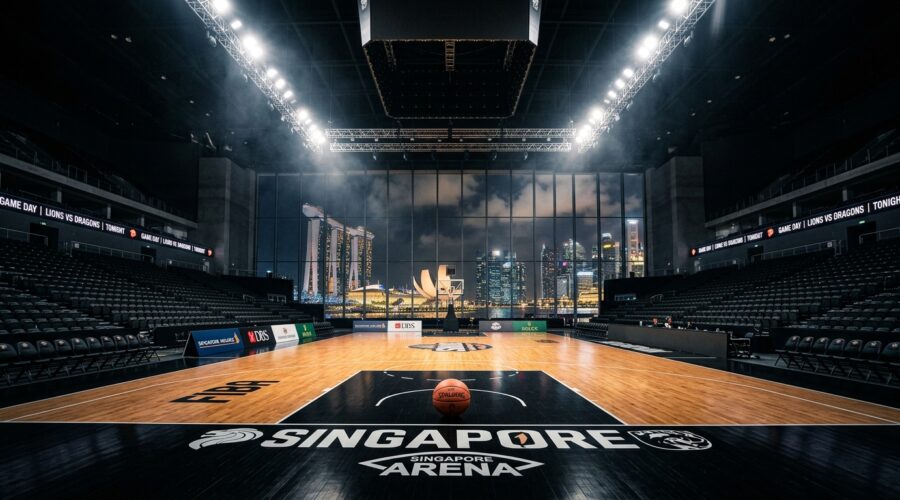
While the WNBA spent the summer of 2026 wrestling with existential questions it could not bring itself to answer, a startup league headquartered in Singapore quietly answered them. On August 12th and 13th, Project B — the Formula 1-style global touring basketball circuit founded by two former University of Michigan roommates — announced it would adopt IOC and FIBA gender eligibility guidelines for its women’s competition, restricting participation to biological females. No lengthy task force. No memo. No statement denouncing “bad-faith efforts.” Just a policy, and a reason for it: “consistency and confidence for players and stakeholders.”
That contrast alone tells you nearly everything you need to know about why Project B is, perhaps unexpectedly, the most interesting new organization in professional sports.
Built on a Dinner Conversation, Backed by a Grand Vision
Project B was conceived in 2023 by Grady Burnett, a former director of online sales and operations at Google and VP of global sales and operations at Facebook, and Geoff Prentice, a co-founder of Skype. The two are longtime friends and former college roommates. At a dinner, they looked at the global sports landscape and identified a gaping hole: basketball, the world’s most universally played sport, had no global touring professional league — nothing that moved city to city the way Formula 1 moves circuit to circuit, building drama, local champions, and season-long narratives simultaneously.
They started with the women’s game. Not as an afterthought, and not as a charity project. As Burnett told The Athletic in October 2025: “Sport has become this massive global asset class. For the vast majority, the players have not participated in the economics of that.” Project B was designed from its foundation to fix that — offering players not just salaries exceeding $2 million per year, but actual equity stakes in the league itself, vesting based on tenure, performance, and community involvement.
To put that figure in context: the brand-new 2026 WNBA collective bargaining agreement — widely heralded as a historic leap forward for women’s basketball — set its maximum player salary at approximately $1.4 million per year. Project B is offering multiples more, plus ownership. “We’re paying multiples higher than is available right now in the world of women’s sports,” Burnett said flatly.
The Roster: A Who’s Who of the Global Women’s Game
Talk is cheap. The player signings are not. As of August 13, 2026, Project B had confirmed 15 players of staggering caliber, with 51 additional spots remaining across its six teams of 11 players each.
The confirmed roster includes:
- Nneka Ogwumike — First player ever signed; Los Angeles Sparks forward, former WNBA MVP, and, critically, the sitting President of the WNBPA
- Alyssa Thomas — Phoenix Mercury; 2025 WNBA MVP Finalist
- Jonquel Jones — New York Liberty; 2021 WNBA MVP (won while playing for the Connecticut Sun)
- Jewell Loyd — Las Vegas Aces; multiple All-Star
- Kelsey Mitchell — Indiana Fever; second-leading scorer in the WNBA at 24.3 points per game in 2026
- Sophie Cunningham — Indiana Fever; the player who became the most polarizing figure in American sports this summer
- Azzi Fudd — Dallas Wings; the No. 1 overall pick in the 2026 WNBA Draft
- Kamilla Cardoso, Alanna Smith, Awa Fam, Justė Jocytė, Leonie Fiebich, Li Meng, Leïla Lacan, Mai Yamamoto
The roster is genuinely global — representing the United States, Brazil, Australia, Lithuania, Germany, China, Japan, France, Spain, and Senegal. That is not an accident. Project B’s entire premise is that the audience for elite women’s basketball is not a domestic American audience. It is the world.
Alana Beard, the Women’s Basketball Hall of Fame inductee (class of 2025) who serves as co-founder and Chief Basketball Officer, has been the league’s most forceful public voice. “We want the best of the best playing in our league. That’s a full stop.” The roster, so far, makes a compelling case that she means it.
An Investor List That Demands to Be Taken Seriously
Beyond players, the advisor and investor bench signals that Project B has attracted real institutional and celebrity credibility. The list includes Candace Parker, Cheryl Miller, and Lauren Jackson — three of the greatest players in WNBA history. It includes Novak Djokovic, Sloane Stephens, and Steve Young. On the institutional side, Quiet Capital, Mangrove Capital Partners, and Sequence Equity have all committed, with Sequence co-founder Marcus Stroud calling it “our biggest investment to date.”
On the broadcasting side, Host Broadcast Services (HBS) — the official host broadcaster of the FIFA World Cup since 2002 and the Rugby World Cup — signed a multi-year deal with Project B in June 2026. Every game will stream globally on YouTube, with HBS handling multi-camera production, live player mics, immersive camera systems, commentary in multiple languages, studio programming, and highlights. This is not a scrappy startup broadcasting arrangement. It is the infrastructure of a major global sporting event, applied to women’s basketball.
One persistent controversy has surrounded Saudi Arabia’s involvement. Event partner Sela, a PIF-linked entity, is confirmed as a project partner — but Burnett has drawn a firm distinction: “We’re building a global basketball league, so we want a global diversified cap table around us. That doesn’t include any dollars from Saudi Arabia.” Critics have not fully accepted that distinction, and it remains a sore point for a league still working to define its brand identity.
The Format: Formula 1 Meets Five-on-Five
The inaugural season, now scheduled to run from December 2026 through April 2027 (pushed back from a Fall 2026 target), will feature six teams across seven global tour stops spanning Europe, Asia, and the Americas. Each stop runs approximately two weeks, crowning a local champion, with those victories accumulating toward a season-long title.
Confirmed venues include Valencia’s Roig Arena from March 12 to 21, 2027 — timed to coincide with Las Fallas, one of Spain’s most electric cultural festivals — and Tokyo’s Toyota Arena from March 26 to April 4, 2027. Additional stops are expected across Europe, Asia, and at least one location in the Americas.
The schedule is carefully designed. It does not conflict with the WNBA season, which runs May through September. It does overlap with Unrivaled, the three-on-three league primarily based in Miami that runs from January through early March — but Project B plays traditional five-on-five basketball and positions itself as a complement to, rather than competitor of, the domestic league. Beard has been explicit: “This is not a gimmick. We’re playing five-on-five, we’re playing elite basketball.”
The Gender Eligibility Decision: A Deliberate Stand
Project B’s announcement that it would follow IOC and FIBA gender eligibility guidelines landed at a historically charged moment — and that moment requires full context to understand.
On March 26, 2026, IOC President Kirsty Coventry, the first female president in the organization’s history, announced a sweeping new policy effective for the 2028 Los Angeles Summer Olympics: eligibility for any female category event would be determined by one-time SRY gene screening — a saliva, cheek swab, or blood sample test. “At the Olympic Games, even the smallest margins can be the difference between victory and defeat,” Coventry said. “So, it is absolutely clear that it would not be fair for biological males to compete in the female category.”
In April 2026, FIBA announced it would follow the IOC’s lead, forming a Gender Eligibility Committee to report back at the start of 2027. In the interim, FIBA is “not entertaining any transgender eligibility requests.”
Meanwhile, the WTA Tour was reportedly moving toward genetic sex testing as well, with American tennis star Jessica Pegula indicating testing was expected around the Cincinnati Open in mid-August 2026. A cross-sport alignment was forming — and Project B simply stepped into it, citing consistency with the governing bodies of global basketball and Olympic competition.
The Summer That Broke the WNBA’s Silence
To understand the significance of Project B’s policy announcement, you have to understand how aggressively the pressure had been building on the WNBA throughout summer 2026.
It started on July 21, 2026, when Indiana Fever guard Sophie Cunningham gave a wide-ranging interview to ESPN in which she said: “I want to protect young girls in a locker room, or young girls in sport who shouldn’t have to go against biological men.” The quote detonated across the sports media ecosystem. Protests and rallies appeared at Fever road games in Seattle and Portland. Cunningham was booed walking into a game. Fans waved transgender flags. JD Vance praised her “courage.” The debate reached the White House via social media. Minnesota Lynx coach Cheryl Reeve fired back, calling it a human rights issue. The Golden State Valkyries’ Gabby Williams offered a public rebuttal.
Then came the stunts. On August 8, 2026, former NBA center Enes Kanter Freedom posted a video declaring for the 2027 WNBA Draft, exploiting the league’s single-line eligibility rule — “Only players who are women are eligible to play in the WNBA” — which contains no definition of “women” based on identity or biological sex. The following day, Royce White, a former NBA first-round pick, appeared on Fox News and declared himself transgender “for the purpose of basketball, professional basketball,” also declaring for the 2027 Draft. “I think I’d be unstoppable,” White said. (White had run in a Minnesota Senate Republican primary in August 2024 — nearly two years earlier — a separate chapter of his public life that was not concurrent with his WNBA declaration.)
The WNBA’s response was telling in its caution. Commissioner Cathy Engelbert sent an internal memo on August 7th, acknowledging the issue and forming a task force of team presidents and general managers. On August 13th, that task force met virtually and released a careful statement: “There are no immediate eligibility matters affecting the WNBA,” while strongly condemning “bad-faith efforts to use these topics to demean or marginalize others.”
The WNBPA, led by Nneka Ogwumike — who, to be clear, is also a signed Project B player — released its own statement embracing “justice, equity, diversity, and inclusion” and condemning hate directed at transgender people.
In the space between those two statements, Project B published its policy.
The Ogwumike Paradox
There is no more revealing storyline in this entire situation than the position of Nneka Ogwumike. She is simultaneously the President of the WNBPA — the union that publicly condemned hate toward transgender people and declined to endorse any eligibility restriction — and the first player ever signed by Project B, a league that has explicitly adopted IOC and FIBA gender eligibility rules restricting competition to biological females.
She negotiated the 2026 WNBA CBA on behalf of players. She represents the union’s values publicly. And she signed with a league whose policy is in direct philosophical tension with those stated values.
Project B has confirmed that all signed players were aware of and agreeable to the league’s gender eligibility stance before signing. Ogwumike has not, as of this writing, made a public statement reconciling the two positions. That silence is itself a statement. Perhaps the most honest one anyone has made in this entire debate.
Alana Beard’s Challenge to the Establishment
While the WNBA chose careful neutrality, Alana Beard chose the opposite. On August 12, 2026, Beard publicly criticized the WNBA’s handling of the gender eligibility crisis in pointed terms: “Where’s the accountability, the integrity, the intentionality? All of it is needed right now, in what could become one of the most defining moments in the history of the sport.”
That is not a diplomatic statement from someone trying to stay in the good graces of the establishment. That is a challenge. Project B, through Beard, was positioning itself as the organization willing to make hard decisions while the incumbent league equivocated.
Whether that positioning wins converts or alienates allies remains to be seen. What it unquestionably does is force a conversation that professional women’s basketball could not avoid much longer.
The Questions That Define What Comes Next
Project B has credibility — in its roster, its investors, its broadcasting infrastructure, its compensation model, and its global ambition. But significant uncertainty remains.
The league has confirmed 15 of 66 total roster spots. It has publicly announced only two venues. It has already pushed its launch back once. The first known player dropout, French star Janelle Salaün, signed with Galatasaray in Turkey instead, though she was replaced by fellow French player Leïla Lacan. The men’s league — originally planned to run parallel to the women’s circuit — has produced no formal player announcements as of August 2026, with former NBA player Landry Fields serving as Head of Men’s Basketball while the men’s circuit sits on hold, potentially targeting fall 2027.
And the largest questions are existential: Will the WNBA eventually define what “woman” means in its CBA — a change that would require collective bargaining with the WNBPA? Will FIBA’s Gender Eligibility Committee, reporting in early 2027, align with or complicate Project B’s current stance? How will the IOC’s SRY gene screening actually work in practice — logistically, legally, ethically — when it takes effect for the 2028 Los Angeles Olympics? And even its scientific validity is contested: the scientist who discovered the SRY gene, Andrew Sinclair, has publicly stated that the test “isn’t cut-and-dried” and “does not tell you how SRY is functioning.”
The Bigger Picture: A Sport at a Crossroads
This is not, at its core, a story about one startup league. It is a story about what women’s professional basketball is, what it stands for, and who gets to decide that.
The WNBA is navigating a genuinely difficult terrain: a union with strong pro-inclusion values, ambiguous legal language, bad-faith provocateurs exploiting every gap, and a player base that is not monolithic on this issue — as the Ogwumike paradox makes plain. The league’s instinct toward caution is understandable. It is also, in a climate this charged, increasingly untenable as a long-term posture.
Project B has made a bet. It is a bet that the players who want clear rules, global competition, equity ownership, and salaries that actually reflect their market value will prioritize those things over ideological alignment with established institutional positions. And it has signed enough of those players — including the president of the players’ union — to suggest the bet is not a foolish one.
The league’s inaugural season tips off in December 2026. Between now and then, the courts, the unions, the governing bodies, and the players themselves will continue to reshape what professional women’s basketball looks like. Project B has drawn its line. Now it has to build a league worthy of it.