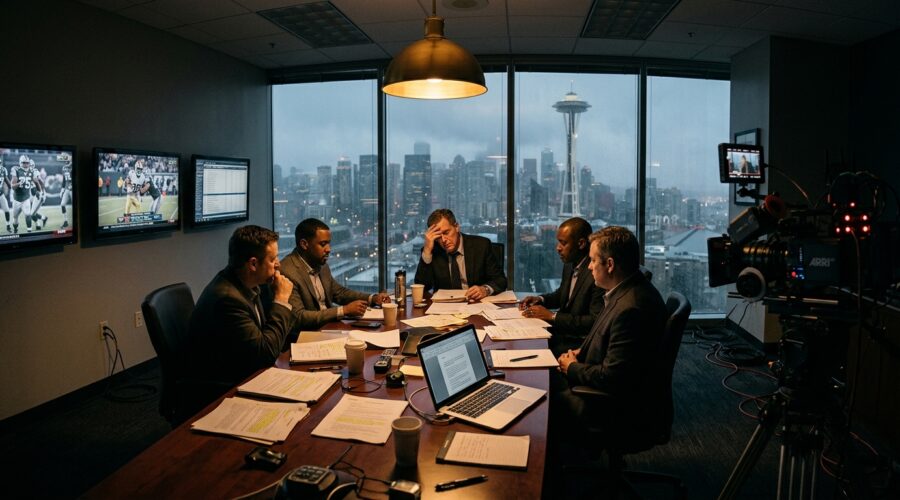
Let’s start with the basic facts, because the basic facts are genuinely extraordinary. The defending Super Bowl champion Seattle Seahawks — fresh off a 29–13 dismantling of the New England Patriots in Super Bowl LX, riding a defense so suffocating they nicknamed it the “Dark Side” — signed a cornerback facing eight felony charges, including three counts of kidnapping and three counts of armed robbery with a firearm or deadly weapon. The maximum sentence, if convicted on all counts, is life in prison. The contract value: one year, $1.145 million. And the entire deliberation process — John Schneider pacing in his office, his defensive coordinator coining the phrase “spy mode,” a backup quarterback vouching for his best friend — played out in real time on HBO.
This is not a normal story. So let’s not treat it like one.
Who Is Terrion Arnold, and Why Does Seattle Want Him Badly Enough to Do This
Terrion Arnold was the 24th overall pick in the 2024 NFL Draft, selected by the Detroit Lions after they traded up, swapping slots with the Dallas Cowboys, specifically to get him. At his pro day and during draft weekend, he reportedly told then-Lions defensive coordinator Aaron Glenn: “I need to be coached by you.” That’s a 21-year-old kid not playing the game — he knew who he wanted to work with and said it out loud. You don’t do that without supreme confidence in your own ability.
At Alabama, he put together one of the more dominant junior seasons a cornerback can have: five interceptions in 2023, tied for the SEC lead with 17 passes defended, and first-team All-American honors to close it out. He entered the draft after his junior year at 6-foot-0, 189 pounds, ran a 3-cone time in the 93rd percentile (6.65 seconds, for the lateral quickness nerds), and posted a 129-inch broad jump in the 89th percentile. His athleticism profile is real. His football instincts are real. The Lions believed in him enough to expect a contract extension before the 2026 season.
His NFL production, while unspectacular in raw numbers, checks out for a young corner still developing: 79 combined tackles and 16 pass deflections as a rookie across 14 games, then 72 combined tackles, seven PDs, and one interception across 12 games in 2025 before a knee injury ended his season. He had never played a full healthy sophomore year in the NFL. That’s the baseline the Seahawks are betting on — a 23-year-old former first-round pick with demonstrable starting ability who has yet to reach the ceiling of his talent.
For the Seahawks specifically, the fit makes football sense that is difficult to argue with. They lost Tariq Woolen in free agency (one-year, $15 million to Philadelphia) and Coby Bryant (three years, $40 million to Chicago). Their safety Nick Emmanwori — who plays slot corner on over 300 snaps as part of his versatile defensive role and finished second in Defensive Rookie of the Year voting last season — is sitting on PUP with an ankle injury. Behind Devon Witherspoon and re-signed Josh Jobe, the CB3 competition consisted of Noah Igbinoghene, Nehemiah Pritchett, and two seventh-round rookies. The Seahawks needed a third cornerback who could actually play cornerback. Arnold, at minimum, is that.
What Actually Happened on February 4, 2026
The allegations are serious enough that they deserve a clear accounting, separate from the football conversation. Here is what prosecutors say happened, and here is what the defense says in response — because both matter.
According to the Hillsborough County State Attorney’s Office, it started with a theft. On February 1, 2026, more than $250,000 in cash, Rolex watches, and Louis Vuitton bags were stolen from Arnold’s Airbnb in Largo, Florida. Two days later, Arnold reported the theft to Largo police. Investigators would later determine that the three men Arnold believed were responsible had nothing to do with the robbery. They were the wrong targets.
According to prosecutors, Arnold did not wait for the investigation to conclude. Instead, he allegedly became the architect of a revenge operation involving six co-defendants. Two women, Arianna Del Valle and Jasmine Randazzo, were allegedly used to lure one of the victims to an apartment. Two men, Christion Williams and Lyndell Hudson II, were allegedly waiting in a closet. When the three victims arrived around midnight on February 4, Williams and Hudson emerged at gunpoint, pistol-whipped the victims, and held them for approximately one hour. Del Valle allegedly streamed the assault in real time via group chat to Arnold, co-defendant Boakai Hilton Jr., and Freddie Lee Hughes III. Arnold, per prosecutors, directed the operation remotely before allegedly arriving on scene an hour in. State prosecutor Kevin Riley put it plainly in court: “The only reason that this plan or this act gets off the ground is because of Mr. Arnold.”
Del Valle and Randazzo both pleaded guilty and agreed to testify against the remaining defendants. Randazzo received four years in Florida State Prison. The four remaining co-defendants — Hilton, Hughes, Williams, and Hudson — were held without bond.
Arnold voluntarily turned himself in and was taken into custody at Orient Road Jail on June 25, 2026. His attorney, R. Timothy Jansen, stated unequivocally that Arnold “is absolutely denying these allegations.” Arnold’s agent at EAG Sports Management went further, arguing that “there is no credible evidence linking Mr. Arnold to these allegations” and that the prosecution is relying on “testimony from multiple convicted felons who have admitted their own involvement and may have substantial incentives to shift blame in an effort to lessen their sentences.”
That is the actual legal argument, and it is not a frivolous one. The judge agreed to a $1 million bond — not zero, but not no-bond either — and explicitly noted that prosecutors were “not there yet” in proving their case. The key physical evidence is cell phone records and group chat logs. The key testimonial evidence comes from two co-defendants who have already pleaded guilty and whose sentences depend, in part, on how helpful they are to the prosecution. Juries have acquitted defendants in cases built on exactly this kind of framework. They have also convicted them. That is why trials exist.
Arnold’s next court date is October 5, 2026. The Seahawks’ regular season opener is September 9.
The Hard Knocks Factor: Television as Due Diligence Theater
Here is the part of this story that has no precedent, because it is genuinely unprecedented. The entire decision-making process played out on HBO before the signing was announced.
Hard Knocks 2026 marks the first time in the show’s history that the defending Super Bowl champions have been featured — the last team to win a Super Bowl and appear on the show was the 2001 Baltimore Ravens, who were the inaugural subjects. The Seahawks under Mike Macdonald were already a compelling subject. Then Episode 2 aired on August 11, and the final act was Arnold’s workout at the Virginia Mason Athletic Center in Renton, Washington, filmed in full and presented without audio of any coaching conversations. The episode ended on a cliffhanger. Would they sign him?
The Seahawks’ inner deliberation was already on tape. GM John Schneider was filmed in his office asking — and this is an actual direct quote — “I’m trying to remember, like, with this Terrion Arnold thing, what would be another controversial signing that’s happened so we can kind of like understand that situation.” That is the general manager of the defending Super Bowl champions, live on HBO, searching his memory for a comparable controversial signing while deciding whether to make a controversial signing. Defensive coordinator Aden Durde described Schneider’s research process, which apparently involved calling family members and community contacts, by saying Schneider “has gone in spy mode.” It is a very good line.
The character endorsement came from an internal source: Jalen Milroe, the Seahawks’ backup quarterback, who is also Arnold’s best friend and former Alabama teammate. Schneider relayed Milroe’s assessment: Arnold is “just like Devon Witherspoon,” he is “elite,” he has a “nice football body,” and Milroe believed Arnold could play in the preseason. Milroe told reporters publicly, “Man, of course he’s my best friend so I can pump and hype him up a lot. But man, I really hope he can come here. He can definitely be a difference-maker for us.” Points for transparency, if not objectivity.
Two days after the episode aired, Adam Schefter reported on August 13 that Arnold planned to sign with the Seahawks. Ian Rapoport confirmed it was a one-year deal. Schefter’s Instagram post was succinct: “Terrion Arnold’s workout with the Seahawks was shown on Episode 2 of Hard Knocks. Earlier in the episode, GM John Schneider was shown in his office discussing the idea of bringing him in. Seattle has now done just that.”
What television show has ever functioned as a real-time scouting report and contract announcement platform simultaneously? The answer is none of them, until now.
The Competitive CB3 Market and Why Arnold Won It
Arnold was not short on suitors. The Houston Texans hosted him for a visit. The New Orleans Saints hosted him for a visit. The New York Giants worked him out on August 12 — the day before Schefter broke the Seahawks news — and head coach John Harbaugh spoke about Arnold publicly in terms that one reporter noted sounded “almost like a pitch.” Arnold was also wearing an ankle monitor for all of this, permitted by the judge specifically for work-related travel. He was doing free agent visits on an ankle monitor. That is an unusual sentence to type.
Seattle won the sweepstakes for a few reasons. One, the internal connection through Milroe provided a trust factor that is genuinely meaningful in these situations. Two, the Seahawks’ defensive infrastructure — Macdonald’s scheme, Aden Durde’s coaching, and the daily practice environment alongside Devon Witherspoon — is arguably the single best situation in the NFL for a developing cornerback. If Arnold can play anywhere near the level his draft pedigree suggests, the “Dark Side” gives him the best possible context to prove it. Three, the contract itself — $1.145 million — is the veteran minimum. Seattle is absorbing almost zero cap risk. If the NFL places Arnold on the Commissioner’s Exempt List before the season, they lose essentially nothing. If he plays and contributes, they got a first-round talent at minimum wage.
That restricted free agent angle for 2027 is also worth noting. If Arnold plays well this season and his legal situation improves, Seattle holds the right to match any offer sheet. For $1.145 million, they are buying an option on a potentially very good cornerback. The math is not complicated.
The Part Where Reasonable People Disagree
Seattle Times columnist Matt Calkins described this as the first “Whoa, they brought on that guy?” moment of the Mike Macdonald era. He is correct that it is that. He was also direct about what separates this situation from the typical NFL character question: “This isn’t like Marshawn Lynch’s DUI or Mychal Kendricks’ insider-trading arrest. Arnold’s charges allege planned, malicious violence.” Richard Sherman and Mike Florio of ProFootballTalk both weighed in critically. Florio’s observation that “former first-round picks, like cats, often have nine lives” was dry enough to qualify as high praise in some circles.
The counterargument is the one Arnold’s defense is making, and it is the one the American legal system is built on: he has pleaded not guilty, the charges are allegations, and the prosecution’s case rests substantially on the testimony of co-defendants with direct incentives to minimize their own culpability. The judge’s own skepticism about the prosecution’s current evidentiary position is not irrelevant to that argument. Arnold has not been convicted of anything.
Both of those things are true simultaneously, and the discomfort that creates is not something that resolves cleanly by picking a side. The Seahawks have decided to hold that discomfort and see what happens. Some teams — including franchises that have made similar calculations with similar players in similar situations throughout NFL history — would make the same call. Others, including the Lions, concluded the other way. Dan Campbell described releasing Arnold as “difficult but necessary.” Neither organization is obviously wrong in how they weighed the same set of facts.
What is worth acknowledging plainly: the charges, if true, describe something categorically different from a bad decision or a moment of poor judgment. The prosecution alleges coordination, premeditation, and direction of a violent assault against three people who turned out to be innocent. That is the floor of what the Seahawks accepted when they signed the contract. The judge’s skepticism and the defense’s arguments may ultimately prove out. But the Seahawks signed him before any of that is resolved.
Where This Goes From Here
The NFL was still reviewing the situation under its personal conduct policy as of August 14. The Commissioner’s Exempt List remains a live possibility, which would make Arnold ineligible to practice or play while his case proceeds — essentially an unpaid suspension with full legal limbo attached. The Seahawks’ preseason opener against the Dallas Cowboys was scheduled for August 15. Their regular season opener — a Super Bowl LX rematch against the New England Patriots — is September 9. Arnold’s next court date is October 5.
There is a version of this story that looks, in retrospect, like a smart low-risk reclamation project by a well-run organization that had done its homework and trusted a process. Devon Witherspoon potentially securing the richest cornerback contract in NFL history in the coming weeks will occupy most of Seattle’s secondary headlines. Arnold quietly develops behind Witherspoon and Jobe, contributes in the slot while Emmanwori heals, and turns a $1.145 million flier into a legitimate depth piece and possible long-term option. Mike Macdonald adds another chapter to what is already an impressive two-year body of work.
There is another version where the Commissioner’s Exempt List lands before Week 1, the legal proceedings drag across multiple NFL seasons, and the signing becomes a PR footnote to an otherwise championship-caliber team.
And there is a third version — the one no one on either side wants to discuss explicitly — where the prosecution’s case holds, the trial proceeds, and the Seahawks spent training camp featuring a convicted felon’s road to a contract on HBO.
John Schneider went into spy mode. He talked to family members. He consulted a backup quarterback who is the player’s best friend. He searched his institutional memory for comparable controversial signings. And then he signed the guy anyway, for the veteran minimum, one day before the preseason started, with the whole thing already on tape.
Whether that looks like diligence or recklessness will depend entirely on what happens next — in a Tampa courtroom and on an NFL football field — and the Seahawks won’t know which one it is for a long time. That is the bet they made. For $1.145 million and a cliffhanger episode of Hard Knocks, they decided it was worth making.