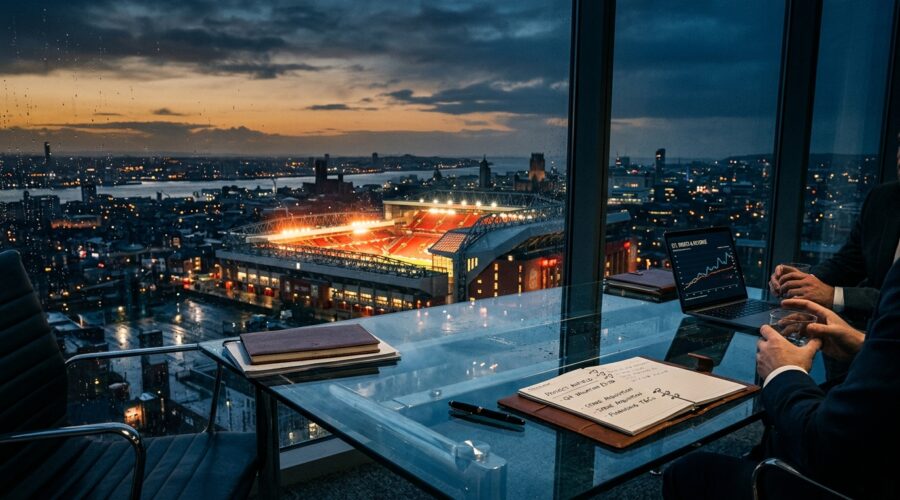
There is a particular kind of press release that arrives not to inform but to soothe. The language is warm and deliberately vague, heavy with words like long-term philosophy and shared values and unique opportunity. FSG’s statement confirming the sale of a roughly thirty-percent stake in Liverpool Football Club to a consortium called 1892 Holdings reads exactly like one. On August 14, 2026, the club that Bill Shankly built — and that Fenway Sports Group purchased for £300 million in October 2010 — was formally valued at somewhere between £5.2 and £5.5 billion. The stake itself is worth approximately £1.65 billion. The man whose name will appear most prominently in every headline put in more than a billion dollars of that and will not sit on the board. His name is Jeff Bezos, and this is, somewhat improbably, his first-ever confirmed investment in a sports team.
Welcome, then, to the Silicon Valley era of English football. Try not to mind the draughts.
Three Men and a Name From the History Books
The consortium is named 1892 Holdings — after Liverpool’s founding year, a detail that someone in a meeting room clearly felt was important, and which will mean something to supporters in roughly the same way that a new owner wearing a scarf at a press conference means something: it is a gesture toward belonging that costs very little and proves very little. The actual architecture of the deal, however, is genuinely interesting.
The lead partner and consortium architect is Amit Bhatia, 46, a British-Indian entrepreneur and son-in-law of steel magnate Lakshmi Mittal, whose fortune sits somewhere in the vicinity of £23 to £40 billion depending on the steel market on any given day. Bhatia is the one who spent years on the board at Queens Park Rangers — latterly as chairman — and who quietly divested his QPR shareholding in July 2026 to satisfy FA multi-club ownership regulations, a detail that suggests this deal had been in serious preparation for considerably longer than the public timeline implies. He is the one FSG regard as the primary partner, and he takes the title of Liverpool Vice Chairman on the expanded board. In Bhatia, FSG have found someone with a genuine football pedigree, a formidable family network across Asian and emerging markets, and the presence of mind to sort his regulatory housekeeping months before the announcement. That is not the profile of a man making a trophy buy.
Then there is Eduardo Saverin — the Brazilian-born Facebook co-founder, worth somewhere between $32 and $36 billion, investing through EE Capital, the family office he runs with his wife Elaine. Saverin was reportedly part of the unsuccessful 2022 consortium bid for Chelsea. Liverpool, then, is his first confirmed foothold in football ownership, and he arrives via the side door: Eduardo himself takes no board seat. It is Elaine Saverin, as Executive Chairwoman of EE Capital, who joins Liverpool’s board as a director. The arrangement is practically tidy and symbolically interesting — the visible face of this particular fortune will be hers.
And then there is Bezos. Amazon founder, sometime Blue Origin rocketeer, Washington Post proprietor, and now, finally, sports franchise owner. He invests more than a billion dollars through K5 Sports, part of K5 Global — the venture capital firm founded by Michael Kives and Bryan Baum in 2018, in which Bezos is a lead investor. Baum will represent the Bezos interest on Liverpool’s expanded board. Bezos stepped back from Amazon’s day-to-day operations in 2021, which gives the arrangement a layer of separation that matters to the Premier League’s fit-and-proper tests and, frankly, to anyone still paying attention to Amazon’s complicated relationship with football broadcasting. Prime Video held UK Premier League rights for several seasons before withdrawing from the most recent £6.7 billion cycle. The analytical types will spend considerable energy wondering whether Bezos’s Liverpool stake is the opening move in a new play for broadcast infrastructure. The honest answer is: probably not, but you would be naive to rule it out entirely.
The Return on Investment That Would Make a Hedge Fund Blush
Before examining what this deal means for Liverpool’s future, it is worth pausing on what it says about FSG’s tenure. They bought the club in October 2010, from Tom Hicks and George Gillett, for £300 million. The transaction was messy, the era it ended was corrosive, and the fanbase was deeply suspicious of any American ownership. Now, nearly sixteen years later, FSG are crystallising an implied valuation of £5.5 billion on a minority stake sale — a fifteen-to-eighteen times return on their original investment. Over that period, they also won a Champions League in 2019, ended a thirty-year wait for the league title with a Premier League triumph in 2019-20, won it again in 2024-25, redeveloped Anfield’s capacity to approximately 61,000, and watched annual revenues surpass £700 million for the first time, enough to rank Liverpool as the highest-revenue Premier League club in the most recent Deloitte Football Money League.
Kieran Maguire, the University of Liverpool economist who tracks football finances with scholarly precision, put it plainly: “It’s a great deal for FSG. They generate more than £1 billion from the deal and still keep control — this represents the best of both worlds.” The numbers do not really require embellishment.
It is worth noting, too, the internal trajectory. In September 2023, Dynasty Equity purchased approximately three percent of Liverpool for around $200 million — implying a club valuation upward of $5 billion. The 1892 Holdings deal implies $7.1 billion at minimum, and ESPN’s calculation of the per-share price pushes that closer to $7.45 billion. In three years, the headline valuation has grown by roughly sixty percent. That is not football mathematics. That is private equity mathematics wearing a football scarf.
The Clause Nobody Wants to Talk About Loudly
The detail that changes the entire texture of this story is the one CNBC’s Alex Sherman broke exclusively on the day of the announcement, subsequently confirmed by The Athletic: embedded within the deal contract is a twelve-month option clause granting 1892 Holdings the right to purchase a controlling stake in Liverpool Football Club at a valuation of approximately $8 billion.
Both sides have been careful, almost choreographed, in their language around it. It is not a binding commitment. It is not a pre-agreed sale. It is “a contractual framework for potential future investment.” FSG’s official position — that they “continue to retain majority ownership and operational control of Liverpool FC” — is technically correct in every particular. And yet. A twelve-month window in which the largest financial contributor to the minority deal can move to seize a controlling stake is not a footnote. It is, potentially, the actual story. The $900 million uplift from $7.1 billion to $8 billion represents the standard change-of-control premium. Someone priced this very deliberately.
If the option is exercised, it would constitute the most consequential shift in Liverpool’s ownership since FSG arrived in 2010. John Henry, Tom Werner, and Mike Gordon have spent the better part of sixteen years building something. Whether they intend to retain it, or whether the 1892 Holdings structure is, at least in part, an orderly queue for the exit, is the question that hangs over every reassuring press release.
The Inconvenient Truth About Transfers
Within hours of the announcement, the discussion on supporter forums and social media had pivoted to the transfer market. This is both entirely predictable and entirely misguided. The deal does not produce a transfer budget.
From the 2026-27 season, the Premier League’s old Profitability and Sustainability Rules — the three-year £105 million loss cap that kept lawyers employed for much of the previous five years — are replaced by the Squad Cost Ratio. Under SCR, clubs must keep total squad costs (wages, transfer amortisation, agent fees) within eighty-five percent of football-related revenues. The critical point, confirmed by BBC Sport and ESPN alike, is that owner wealth cannot be directly injected into transfer budgets under SCR. What richer owners can do is invest in commercial revenue growth, infrastructure, and technology — all of which expand the revenue base, and therefore expand the permissible squad cost ceiling. It is an indirect path, and it is a slow one.
Dave Powell, writing for ESPN, was characteristically direct: “In terms of transfers, the investment won’t make any material impact in terms of what Liverpool can do in the transfer market because there are regulations in place in both domestic and European football.” The new owners are not here to be a chequebook. The regulations do not permit it.
The Real Prize: Commercial Revenue and the Territories FSG Cannot Easily Reach
If the transfer route is closed, the commercial route is wide open — and this is where the 1892 Holdings consortium, viewed as a collective, becomes genuinely compelling.
Liverpool’s commercial revenue of £323.5 million in 2024-25 is the third highest in England and represented a seven percent increase on the previous year. The Deloitte Money League noted that “capitalising on international brand equity through investment in strategic commercial initiatives that cater to all fans will be key in driving revenue for clubs.” The club has retail operations in twenty-one physical locations globally. Its official app accounts for nearly a quarter of all e-commerce revenue. It generated 1.7 billion social media fan engagements in the most recent reporting period. The infrastructure for commercial scale exists. What has been missing, arguably, is the right set of relationships to unlock the next tier.
Bhatia brings the Mittal family network across South Asia and emerging markets — territories where Liverpool have devoted marketing resource for years but where personal relationships at the highest levels of business remain the decisive factor in securing significant partnerships. Saverin brings B Capital, his Singapore-based venture firm, and the connective tissue of the Silicon Valley founding generation. And Bezos brings something that is genuinely difficult to quantify: proximity to AWS, to artificial intelligence infrastructure, to the most sophisticated logistics and data operation on the planet. Whatever the precise application in a football context, the idea that a club with Liverpool’s global footprint would not benefit from a relationship with those capabilities requires some imaginative contortions to sustain.
Infrastructure investment, notably, is excluded from SCR calculations entirely. It is possible — not certain, but possible — that the long-term vision includes stadium development or ancillary facility projects that the new investors can participate in without brushing against the squad cost ceiling.
Anfield in the Meantime: Iraola Inherits the Wreckage
While the boardroom reshuffles and the option clauses and the league table of legal advisers absorb the business press, Liverpool Football Club still has to play matches. And the on-pitch situation in the summer of 2026 is considerably less comfortable than the valuation implies.
Arne Slot — appointed the summer after Jürgen Klopp’s departure, and a Premier League title winner in his debut season — was sacked on May 30, 2026, following a 2025-26 campaign that produced a fifth-place finish, nineteen losses across all competitions, 53 Premier League goals conceded (the most Liverpool have ever conceded in a 38-game Premier League season, surpassing the 50 conceded in 2013-14), and a Champions League exit in the Round of 16 at the hands of PSG. That is an extraordinary deterioration from a man who had the league in his hands twelve months earlier, and it raises questions about the squad’s structural fitness that no ownership deal can immediately address.
His successor is Andoni Iraola, 43, appointed on June 4 on a two-year contract. The Basque manager arrived from Bournemouth, where he had led a club with a fraction of Liverpool’s resources to sixth place and, for the first time in their history, European football. He is a disciple of the Marcelo Bielsa school of thought — furious high pressing, rapid vertical transitions, the kind of football that even Pep Guardiola has acknowledged reflects the direction modern football has taken, noting that “today, modern football is the way Bournemouth, Newcastle, Brighton and Liverpool play.” Liverpool’s sporting director Richard Hughes had previously appointed Iraola at Bournemouth in 2023 while serving as Technical Director there, before departing to join Liverpool at the end of the 2023-24 season. It was Hughes and FSG’s football CEO Michael Edwards who concluded, after reviewing the wreckage of Slot’s second season, that the solution required more aggression and more intensity in the tactical DNA.
Mohamed Salah has departed after nine seasons. Andy Robertson and Ibrahima Konaté are gone. Hugo Ekitike is injured. The squad Iraola inherits is a transitional one by necessity, and the season opens at Newcastle United on August 23 — a venue that has become, under Eddie Howe and the resources of the Public Investment Fund, a genuinely hostile place for visiting sides. Iraola has been emphatic about his excitement for the challenge. He would say that, of course. But those who watched what he built at Bournemouth — year-on-year improvement, individual player development, a tactical clarity that made teams with budgets four times their size uncomfortable — would not dismiss him.
The Kop’s Concern, and Why It Is Not Unreasonable
Spirit of Shankly — the Liverpool supporter group that campaigned against FSG’s season ticket price increases in 2026 under the banner of “Not a Pound in the Ground” — issued a measured but pointed response to the announcement. They have contacted the Independent Football Regulator. They have asked the questions that need asking about the option clause, the long-term ownership trajectory, and whether the consortium’s interests are genuinely aligned with the club’s. Their formal statement noted: “It is vital for the game in general that football clubs are run sustainably, as LFC has been, and not an arms race funded by mega-rich individuals or state-backed entities.”
That is an intelligent and principled position. The reference to the Hicks and Gillett era is not melodrama — it is institutional memory performing exactly the function institutional memory is supposed to perform. Liverpool supporters watched their club leveraged and neglected and nearly destroyed by two men who talked a very good game on the day they arrived. The fact that 1892 Holdings is composed of considerably more sophisticated operators, with considerably more legitimate wealth and no apparent debt-financing scheme in sight, does not make scrutiny inappropriate. It makes it exactly appropriate. The Independent Football Regulator exists, in part, for moments precisely like this one.
The Premier League Owners and Directors Test will proceed. The FA multi-club ownership regulations have already been addressed by Bhatia’s QPR exit. The regulatory community expects a relatively smooth path to closing, given the calibre of parties and the legal firepower assembled — Allen Overy Shearman Sterling, Latham and Watkins, Orrick, Cleary Gottlieb, Clifford Chance — but relatively smooth is not the same as rubber-stamped, and supporters are right to watch the process carefully.
The Larger Meaning: Silicon Valley Arrives at the Terraces
There is a temptation, in writing about deals like this one, to reach for apocalyptic language — to declare that football has been finally and irrevocably surrendered to the billionaire class, that Shankly’s game of the people has become a portfolio asset for men whose primary concern is the yield. That argument has real force, and it is not entirely wrong. But it is also not entirely right.
What is happening at English football’s top level is a structural shift in the kind of wealth that seeks ownership, driven partly by the game’s own commercial growth and partly by the new regulatory architecture that makes naked financial doping impossible in the way it was at Chelsea under Abramovich or PSG under QSI. The Squad Cost Ratio is not a perfect instrument, but it pushes the competitive advantage toward commercial sophistication rather than owner largesse. In that environment, a consortium with genuine expertise in technology, in emerging markets, in e-commerce infrastructure, and in Silicon Valley relationship networks is not a cynical play. It is, potentially, a genuinely additive one.
FSG’s ROI of fifteen-to-eighteen times over nearly sixteen years was built on sporting success, infrastructure investment, and an increasingly professional commercial operation. The next phase of growth — the phase that pushes Liverpool beyond £700 million in annual revenue, that opens new territories, that leverages AI and data in ways that top clubs are only beginning to map — probably requires exactly the kind of relationships that 1892 Holdings collectively represents.
Whether Jeff Bezos ever exercises that option clause, and what Liverpool Football Club looks like if he does, is a question that twelve months will answer. For now, the club is worth ten times what anyone imagined when FSG arrived at Anfield with their spreadsheets and their Red Sox pennants in 2010. The men of 1892 Holdings have paid handsomely for their thirty percent of that story. The next chapter belongs to Andoni Iraola, a Basque pressing evangelist who flies into Merseyside from San Sebastián with his assistants and his fitness coach and his thoroughly unfashionable belief that football matches are won by running harder than the other side. In the circumstances, that might be exactly what the place needs.
Conclusion: A New Ownership Chapter, but the Same Old Anfield Questions
The deal is, on its own terms, impressive. A club bought for £300 million now valued at £5.5 billion, majority ownership and operational control retained, world-class commercial partners brought in, and a contractual framework for an even larger future transaction embedded quietly in the small print. FSG have played this with considerable skill. They have raised capital, brought in expertise, maintained control, and reserved the right to sell the whole thing in a year’s time at a premium if they choose to — while publicly denying that any of this is the plan.
The supporters of Liverpool Football Club are not naive. They have lived through Hicks and Gillett. They have earned the right to ask hard questions of any ownership arrangement, however well-dressed. They are asking them now, through Spirit of Shankly and through the Independent Football Regulator, and they should keep asking them.
In the meantime, the season begins at Newcastle on August 23. Andoni Iraola has a squad to rebuild, a high press to install, and a set of supporters who have been promised, rather a lot of times now, that the good times are coming. The billion-dollar investors can wait their turn. The football is first.