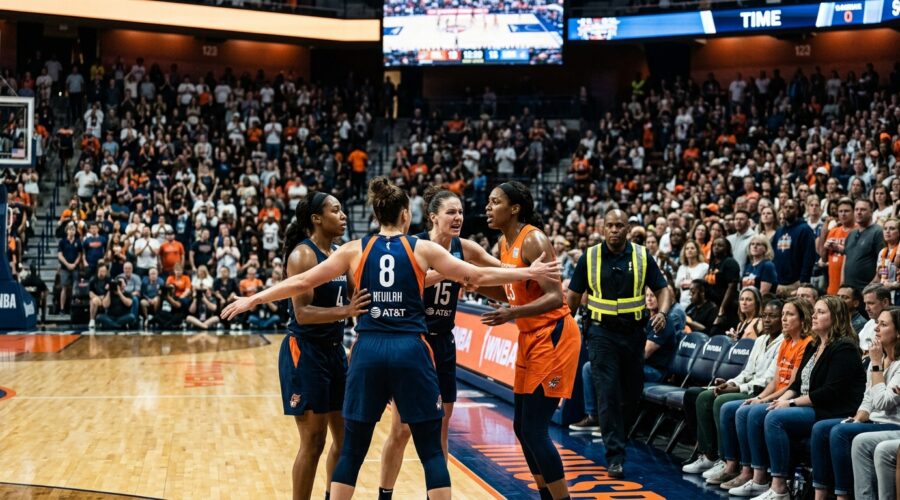
Late in the third quarter of a blowout loss, with 1:22 remaining and the score long since decided, Natasha Cloud did something that had nothing to do with basketball. She had just scored on a tough drive. The Indiana Fever called a timeout. Players began drifting toward their benches. And Cloud veered toward a courtside seat at Wintrust Arena, pointed, and shouted directly at the man sitting there in a shirt reading WOMAN noun. adult human female.
Enes Kanter Freedom rose to meet her. Security intervened. A referee stepped in. Sky players converged. Freedom was escorted from the building to a chorus of boos, pausing near the basket to hold the text of his shirt toward the crowd before disappearing into the lobby. Cloud did not speak to the media after the game. She posted on Threads instead, her message addressed not to Freedom, not to journalists, not to the political machine that had turned her league into a battleground. She wrote it to trans kids.
“To every trans kid/person, You are a part of MY community and tribe. You belong. You’re loved. You’re seen. You’re perfect as you are. And you will always be protected by me.”
What happened at Wintrust Arena on August 23, 2026, was not a basketball incident. It was the most vivid single moment in a summer-long confrontation over what the WNBA is, who it is for, and whether the most commercially successful era in the league’s 30-year history can survive being turned into the front lines of a culture war it did not choose and cannot easily escape.
The Setup: A Policy Gap Wide Enough to Drive a Stunt Through
Every conflict has a pressure point, and this one is hiding in plain sight inside a 409-page collective bargaining agreement ratified in March 2026. The WNBA’s landmark seven-year CBA — a genuine watershed moment that raised average player salaries to roughly $583,000 and introduced the first revenue-sharing model in women’s professional sports history — contains exactly one line on gender eligibility. It lives in Article XIII, Section 1(a), and it reads, in its entirety: “Only players who are women are eligible to play in the WNBA.”
That is it. Full stop. The word “women” is never defined. The word “transgender” does not appear. No eligibility framework exists. No governing body is designated to adjudicate eligibility disputes. The league spent years negotiating a transformative deal that changed the financial landscape of women’s professional sports and left a one-sentence gap that anyone with bad faith and a social media account could exploit.
The exploit came on August 7, when Freedom, a 34-year-old, 6-foot-10 former NBA center who last played in the league in 2022, declared for the 2027 WNBA Draft. He posted a video of himself signing a document asking the league to accept his entry into the player pool. “Welp, it’s officially official,” he said. The following day, former NBA player and Republican Senate candidate Royce White followed suit, declaring himself transgender “for the purpose of professional basketball” and enlisting former Congressman Matt Gaetz as his legal counsel. Sports legal analyst Michael McCann of Sportico weighed in on both declarations, noting that “whether they actually identify as women is questionable” and that “there would likely be skepticism about how genuine their identity claims are.” Teams are not required to draft anyone. No antitrust claim survives without evidence of a secret agreement. The WNBA faces no genuine legal crisis.
What it faces is a political one. And that is considerably harder to defend against.
The Spark: Sophie Cunningham Says the Quiet Part Out Loud
Before Freedom’s draft declaration, before the courtside confrontation, before the dueling protests that broke out from Seattle to Brooklyn, there was a magazine profile. In July 2026, ESPN published a wide-ranging feature on Indiana Fever guard Sophie Cunningham that quickly became the loudest thing in women’s sports. Cunningham, who had spoken on the subject of transgender athletes as far back as 2022 following the Lia Thomas controversy at the NCAA level, told the magazine that she wanted to “protect young girls in a locker room, or young girls in sport who shouldn’t have to go against biological men.”
The quote ignited everything. Cunningham doubled down immediately, posting on Instagram that she had “said what she said” and would “never falter.” President Trump endorsed her position publicly. Vice President Vance called her “inspiring.” Protest organizers began coordinating outside Fever road games across the country. In Seattle, Portland, Minneapolis, Chicago, and Atlanta, demonstrators appeared on opposing sides of NYPD barricades and arena entry points. The most dramatic flashpoint came on August 22, the night before the Wintrust confrontation, when more than 100 pro-trans supporters and “Save Women’s Sports” advocates faced each other outside Barclays Center in Brooklyn before an Indiana-New York Liberty game.
Minnesota Lynx coach Cheryl Reeve responded with her own silent statement, wearing a “Trans Kids Belong” shirt during an August 2 game. Fever coach Stephanie White, Cunningham’s own head coach, called the broader controversy “fearmongering and divisiveness.” Gabby Williams said she would “welcome a transgender athlete on my team or against my team, anytime.” Breanna Stewart urged the WNBA to be a “safe space” and clarify its rules. The WNBPA, led by President Nneka Ogwumike, released a statement affirming the union’s commitment to inclusion and drawing a clear line: “We will not be used as political pawns.”
WNBA Commissioner Cathy Engelbert acknowledged the policy gap in a memo to team executives in early August, calling the issue “complex and nuanced” and pledging further dialogue. A league task force convened on August 12. It reached no new policy. It released a statement denouncing “bad-faith efforts” to demean or marginalize others and noted, accurately, that “there are no immediate eligibility matters affecting the WNBA.” Then Freedom showed up courtside in Chicago wearing a dictionary definition on his chest.
The Numbers That Put the Night in Context
Before the confrontation became the story, there was a basketball game. Indiana won it 113-90, and it was not particularly close. But Natasha Cloud’s individual performance deserves the attention it will not get in most accounts of the evening: 16 points on 7-of-9 shooting, 4 rebounds, 7 assists, and a steal in 30 minutes of work. Those numbers slot comfortably above her already-strong 2026 season averages of 11.5 points, 3.6 rebounds, 5.0 assists, 1.1 steals, and 48.5 percent from the floor on a one-year deal worth $550,000 with the Sky.
Cloud is 34 years old, born in Broomall, Pennsylvania, and has been playing professional basketball for a decade. She won a championship with the Washington Mystics in 2019. She holds the Mystics’ franchise record for career assists. She has been named to the All-Defensive team four times. In 2020, she opted out of the entire WNBA season — forfeiting $117,000 in salary — to focus on voting rights and racial justice work through Chris Paul’s Social Change Fund, the Malcolm Jenkins Coalition, and More Than a Vote. She came out as bisexual in 2021 and married her wife, Aleshia Ocasio, that same year. If you are searching for context that explains why this particular player, on this particular night, reached her limit with a courtside provocateur in a political slogan shirt, the context is sitting in plain view across a decade of public record.
She could face a fine for vulgar language and for skipping mandatory post-game media availability. As of August 24, no disciplinary action had been announced. Her coach, Tyler Marsh, did not hedge: “Tash is always going to stand on that, and then we stand for Tash.”
The Stunt, the Martyr Narrative, and What It Obscures
Freedom’s account of the altercation holds that he was celebrating a Sophie Cunningham three-pointer when Cloud approached him and shouted, “She’s not gonna sleep with you.” His post-game messaging on X was immediate and polished: “I just got kicked out of a @WNBA game for supporting WOMEN! Let that sink in, AMERICA!” He granted an interview to OutKick and characterized his ejection as politically motivated. He told the outlet, “The WNBA has no idea what they’re about to face.”
The martyrdom framing is deliberate and effective in its intended ecosystem. Freedom, who spent years as a genuine political dissident — a Swiss-born NBA center who publicly criticized Erdogan, had his passport revoked, was placed on an Interpol watchlist, and was briefly detained in Romania before becoming an American citizen in 2021 — has in recent years pivoted from international human rights advocacy to domestic culture war commentary. His draft declaration, his courtside appearance, his X post, his cable news tour: all of it follows the script of a bad-faith stunt executed for maximum political visibility.
Jemele Hill compared the draft declarations of Freedom and Royce White to Michael Scott in The Office, the episode where Michael announces “I declare bankruptcy” believing the act of saying it aloud makes it legally real. The analogy is precise. Declaring for the WNBA Draft confers no rights, triggers no process, and creates no legal exposure for the league. Sports attorneys have been unequivocal on this point. Teams do not have to draft anyone. The league does not have to accommodate the declarations. The stunt’s power is entirely rhetorical.
And yet the rhetorical power is real. Because the WNBA’s policy gap is also real. The league now has a hard deadline: the 2027 draft takes place in April. Before that date, it must either define “women” within its eligibility framework or continue operating with a single-sentence standard that every provocateur in the country can point to as an invitation. That is not the consequence of a failing institution. It is the consequence of a drafting oversight inside an otherwise landmark labor agreement, being exploited by people who understand that process and ambiguity are the raw material of culture war.
A Hypothetical Built Into a National Crisis
Here is the fact that sits at the bottom of all of this: No transgender woman assigned male at birth has ever played in the WNBA. Not one. The only openly transgender and nonbinary players in the league’s history — Layshia Clarendon and AD Durr — were both assigned female at birth. The entire policy debate, the summer of protests, the congressional commentary, the dueling T-shirts, the courtside confrontation at Wintrust Arena, is predicated on a hypothetical that has never materialized.
This does not mean the policy question is unimportant. The legal landscape is shifting rapidly and in consequential directions. Trump signed Executive Order 14201, titled “Keeping Men Out of Women’s Sports,” in February 2025. The Supreme Court upheld state bans on transgender girls and women in public school and college women’s sports in June 2026, in West Virginia v. B.P.J. Twenty-seven states have enacted such restrictions. The International Olympic Committee announced in March 2026 that it would require an SRY gene test for women’s Olympic events starting in 2028. FIBA announced it would follow the IOC’s lead. A new league called Project B announced it would adopt the same guidelines.
The WNBA is a professional league, not a school or a government body, and it operates under a collectively bargained agreement with its players. Its pathway to a transgender eligibility policy is different from the IOC’s, different from a state legislature’s, different from a public university’s. It will require negotiation with the WNBPA, whose membership has already made clear it views inclusion as a core value and bad-faith political exploitation as an attack. Any policy that emerges will need to balance genuine competitive fairness considerations — which the scientific literature on transgender athletes in elite sport continues to show are more complex and context-specific than culture war rhetoric allows — against the equally genuine principle that the league should not become a vehicle for the exclusion and stigmatization of trans people, the overwhelming majority of whom are never in contention to play professional basketball at any level.
Geno Auriemma, who has coached more women’s basketball than perhaps any person alive, urged the league to stop giving “oxygen” to the debate. “Nobody’s coming to watch another political statement,” he said. Dallas Wings coach Jose Fernandez was more blunt: “This is not happening in the NFL, MLB, or NBA.”
He is right that it is not happening in those leagues, but not because those leagues have better policies. It is not happening there because no one is trying to make it happen there. The WNBA was chosen as the target precisely because it is the institution most visibly associated with progressive values, LGBTQ+ inclusion, and Black women’s labor. Attacking it is not incidental to the culture war. It is the point of the culture war.
What the League Is Actually Protecting
The WNBA enters its 30th season as the most commercially successful version of itself that has ever existed. The 2026 All-Star Game at the United Center in Chicago drew 19,783 fans, the largest crowd in the event’s history, outpacing the 2026 NBA All-Star Game. Commissioner Engelbert announced at the midpoint of the season that it was already “the most-watched WNBA season of all time,” with 73 million unique viewers through 117 national broadcasts. The league features a record 216 nationally televised games across ABC, ESPN, NBC, Peacock, CBS, Prime Video, ION, and NBA TV. Sponsorship revenue increased 40 percent from 2024 to 2025. The Golden State Valkyries became the first women’s sports franchise valued at more than one billion dollars.
This is the institution being targeted. This is the moment being disrupted. And the disruption is succeeding, at least in terms of attention, because the WNBA’s greatest commercial asset — its players, and the authenticity of what they represent — is also its greatest cultural liability in an era when authenticity has become a political weapon. Players who actually believe the things they say, who have always believed them, who sacrificed money and comfort to demonstrate that they believed them long before anyone was watching, are now a liability to the institutional caution of a league trying to protect a landmark commercial moment.
Natasha Cloud opted out of a full WNBA season in 2020 and forfeited over a hundred thousand dollars in salary to work on voting rights and racial justice. She married her wife three years ago. She walked off the court and confronted a man who showed up to her arena wearing a political provocation on his chest. Then she wrote a message to trans kids telling them she would protect them.
She did not do any of this for the first time on August 23, 2026. She has been doing versions of it for her entire professional career. The difference is that this time, the cameras were rolling on a Thursday night national broadcast in the league’s most-watched season in history, and Enes Kanter Freedom had already booked his cable news hits.
The Real Question the WNBA Must Answer
The league has until April to define “women” in a way that is legally defensible, scientifically grounded, inclusive of the trans community that has existed within and around WNBA culture for the entirety of the league’s existence, and resistant to the bad-faith exploitation that has turned a hypothetical policy question into a summer-long national circus. That is a genuinely difficult policy challenge, and it deserves serious treatment from serious people.
What it does not deserve is the framing that has dominated the coverage: that the WNBA is in crisis because its players believe what they say they believe, that Natasha Cloud caused a problem by reacting to a provocation rather than ignoring it, that the league’s progressive values are a vulnerability to be managed rather than a foundation to be defended.
The WNBA has always been a safe harbor. For Black women. For queer women. For athletes who wanted their labor taken seriously and their whole selves acknowledged. That is not a side effect of the league’s culture. It is the reason the league has any culture worth protecting at all. The unprecedented commercial growth of 2026 did not happen in spite of those values. It happened, in no small part, because of them, because audiences found something real in an institution where authenticity had not been entirely consumed by corporate caution.
Protecting that institution from bad-faith political exploitation is not a distraction from the WNBA’s mission. It is the mission. And on the night of August 23, while the score was 113-90 and the third quarter was winding down and a man in a slogan shirt sat courtside waiting to become a martyr, one player with 16 points and a decade of receipts walked over and made that plain.
Natasha Cloud did not start this fight. But she has never been the kind of person who pretends a fight is not happening just because looking away would be easier.