On July 6, 2026, the Milwaukee Bucks officially ended the most consequential era in franchise history. Thirteen seasons. Two MVPs. One championship. One 50-point clincher in Game 6 that made an entire city weep into their cheese curds. And just like that, Giannis Antetokounmpo was traded to the Miami Heat — the kid from Sepolia, gone south to South Beach.
So what do the Bucks actually have now? Is this a calculated long-game rebuild or an accidental mess dressed up in optimistic press releases? Let’s rip the tape, crunch the numbers, and figure out exactly what kind of team is going to tip off October 21 in Washington.
Spoiler: it is messy, it is fascinating, and it might be more watchable than you think.
The Trade That Shook Wisconsin
Let’s be real about what happened here. Jon Horst had a choice: hand Giannis a $275 million max extension while running back a 32-50 roster, or rip the bandage off and rebuild with youth and future capital. He chose the bandage.
In exchange for Giannis and Bobby Portis Jr., the Bucks received Tyler Herro, Kel’el Ware, Jaime Jaquez Jr., Kasparas Jakučionis, the No. 13 pick in the 2026 Draft (used on Tennessee forward Nate Ament), unprotected first-round picks in 2031 and 2033, a 2030 first-round pick swap, a 2033 second-round pick, and a $25.5 million trade exception.
CBS Sports gave Miami a B+. The Bucks? A measured, patient grade. Which is analyst-speak for: this is smart, but it is going to hurt for a while.
And it will. But the bones of that haul are genuinely interesting. Here is why.
Giannis: A Legacy That Cannot Be Boxed Up
Before we talk about Tyler Herro’s jump shots and Kel’el Ware’s wingspan, we owe it to history to sit with what just walked out the door.
Giannis Antetokounmpo came to Milwaukee in 2013 as a raw 18-year-old from Athens — No. 15 overall, a pick most fans shrugged at. He left as the greatest Buck who ever lived. Two MVPs. A Defensive Player of the Year. Ten All-Star appearances. Nine All-NBA selections. Five All-Defensive nods. The 2016-17 Most Improved Player. The NBA 75th Anniversary Team. And, most importantly, a 2021 NBA Championship — Milwaukee’s first since Kareem Abdul-Jabbar’s 1971 squad — capped by a 50-point Game 6 performance against the Phoenix Suns that absolutely no one who watched it will ever forget.
His final Milwaukee season produced 27.6 PPG, 9.8 RPG, and 5.4 APG on an outrageous 62.4% from the field — on a 32-50 team that missed the playoffs. That is the cruelest footnote. The greatest player in franchise history, still elite, running in quicksand.
The franchise said it best: “You came to Milwaukee 13 years ago as a kid from Sepolia with an impossible dream. Over the past 13 years, we have witnessed you grow into one of the greatest players the game has ever seen, the greatest Buck of all time.”
First-ballot Hall of Famer. No debate. Now, moving on.
How Everything Collapsed Before the Trade
The Giannis trade did not happen in a vacuum. It was the ending of a slow-motion collapse that started with one catastrophic injury and snowballed from there.
In May 2025, Damian Lillard tore his left Achilles tendon in Game 4 of a first-round playoff loss to the Indiana Pacers. Not a sprain. Not a strain. A full Achilles tear — the kind of injury that rewrites timelines and organizational philosophies overnight. Lillard missed the entire 2025-26 season and was ultimately waived. The three-team blockbuster that brought Lillard from Portland to Milwaukee on September 27, 2023 — which sent Jrue Holiday and a 2029 first-round pick to Portland and Grayson Allen to Phoenix, with Holiday then separately traded to Boston four days later — stripped Milwaukee’s pick cupboard bare and never got its chance to pay off at full value.
The Bucks went 32-50 under Doc Rivers. Doc stepped down. Milwaukee had officially bottomed out.
Giannis played through it all, gutting out 36 games with a minutes restriction, still producing at an elite level. But the math was clear: committing $275 million to a 31-year-old on a rebuilding roster made zero sense. So Horst pulled the trigger, spurned a Jaylen Brown package from Boston, and bet on youth.
The New Sheriff in Town: Taylor Jenkins
If there is one hire in this entire rebuild that makes you genuinely excited, it is the head coaching search. Jon Horst did not reach for a retread. He went and got Taylor Jenkins — 41 years old, 250-214 in Memphis, three playoff appearances in 2021, 2023, and 2025, and a reputation as one of the premier developmental coaches in the entire league.
Jenkins turned Ja Morant into a perennial All-Star. He coaxed Desmond Bane into one of the league’s best wing scorers. He watched Jaren Jackson Jr. grow from lottery promise into a Defensive Player of the Year. The man knows how to build players, which is precisely the job description in Milwaukee right now.
He also has a connection to this franchise that matters. Jenkins was a Bucks assistant under Mike Budenholzer during the 2018-19 season — Giannis’s first MVP campaign, when Milwaukee went 60-22. He knows the city. He knows the culture. And he is being paid accordingly: over $10 million per year on a long-term deal, making him one of the highest-paid coaches in the NBA.
The coaching staff he assembled is deep. Darvin Ham, Pat St. Andrews, T.J. Ford, Schuyler Rimmer, and a dedicated player development crew including Jack Herum and Isaiah Wilkins. This is a staff built for one thing: growing young players into NBA contributors.
Jenkins put it plainly: “I know this season was one that everyone’s ready to come back from and get right back to it. These guys know I’m going to be on them from the get-go, figuring out how we’re going to build this together.”
That energy? That is exactly what a rebuild needs on the sideline.
Roster Breakdown: Who Is Actually Running It Back?
The Projected Starters
The starting five — Ryan Rollins at point guard, Tyler Herro at shooting guard, Jaime Jaquez Jr. at small forward, Kyle Kuzma at power forward, and Myles Turner at center — is functional without being dangerous. It is a roster that can win some games, lose some games, and theoretically compete for the eight or nine seed in a packed Eastern Conference. Emphasis on theoretically.
Tyler Herro: Milwaukee’s Hometown Bet
The most fascinating player on this entire roster is Tyler Herro, and not necessarily because of basketball reasons. Herro is 26, he carries a career NBA average of 19.5 points per game, and he is from Whitnall High School in Greenfield, Wisconsin. Coming home carries real emotional weight — and one NBA agent publicly suggested Herro could blossom into a top-five scorer in the league as a primary option.
The data is encouraging. Herro has averaged 20-plus PPG in each of his last four healthy seasons. His shooting profile — elite pull-up creation, above-average three-point shooting — fits the modern game. The question that has followed him his entire career is simple: can he run a team? In Miami, he played behind Jimmy Butler and then in a Giannis era trade package. He has never been The Guy.
In Milwaukee, he is The Guy. At least for now.
The complication: Herro played only 33 games in 2025-26 due to a foot injury. He enters this season on the final year of his roughly $33 million per year deal, which means extension negotiations are already the elephant in every Bucks front office meeting. He was refreshingly loose about it publicly — “It’s a new slate for me, for the coaches, really for the organization as a whole” — but the organization needs answers before February.
Ryan Rollins: The League’s Best Kept Secret (Not Anymore)
If you slept on Ryan Rollins last year, you are forgiven. He was the No. 44 pick in 2022 — buried on Golden State’s roster — until the Lillard injury and a Kevin Porter Jr. ankle injury on Opening Night 2025 suddenly catapulted him into a starting role. What happened next was one of the most legitimate breakout seasons in recent memory.
17.3 PPG. 4.6 RPG. 5.6 APG. 1.5 SPG. 47.2/40.6/79.6 shooting splits across 74 games. He was the only player in the entire NBA to average 17-plus points, five-plus assists, and 1.5-plus steals while shooting 40-plus percent from three. That is not a small-sample curiosity. That is a legitimate two-way guard putting together a legitimate season.
Rollins led the league in deflections, ranked second in steals early in the year, and hit a career-high 32 points against his former team, Golden State, on October 30. His three-year, $12 million contract is one of the most team-friendly deals in basketball. Extension talks are coming, and Milwaukee better lock him up before the rest of the league figures out what they already know.
Kel’el Ware: The Crown Jewel
Here is where this rebuild gets genuinely exciting. Kel’el Ware is 22 years old, seven feet tall, averaged 11.1 PPG and 9.0 RPG in just 22.1 minutes per game for Miami last season, and is shooting 39.5 percent from three as a center. As The Ringer noted, his per-possession numbers are outstanding, his wingspan is gargantuan, and his open-court mobility is extraordinary for a player of his size.
He finished last season with a 24-point, 19-rebound, seven-block line in a playoff game. As a backup. In 36 minutes. That is not normal big-man production. That is franchise-center production from a player who has yet to fully unlock.
The question for Taylor Jenkins heading into camp is whether to start Ware immediately alongside Myles Turner — twin towers with modern shooting range — or keep him in a development role while waiting for the inevitable Turner trade. Given that Turner is actively being shopped and Ware’s long-term upside dwarfs anything Turner offers at 30 on a massive contract, the math points to Ware eventually inheriting the starting job sooner rather than later.
Multiple analysts project him as a franchise-level asset within two to three seasons. At 22, on a rookie-scale contract, in a Jenkins developmental system? The ceiling here is legitimately high.
Jaime Jaquez Jr.: The Connective Tissue
Jaquez put together career highs across the board in 2025-26 — 15.4 PPG, 5.0 RPG, 4.7 APG — and finished as the runner-up for Sixth Man of the Year. He can initiate offense from the wing, post-create, and defend multiple positions. On a young team that needs players who can do multiple things without the ball stopping in their hands, Jaquez is exactly the connective tissue Jenkins needs. The 4.7 APG number is particularly underrated — that is legitimate secondary playmaking that takes real pressure off Rollins and Herro.
The Future in Uniform: Brayden Burries and the Draft Picks
The Bucks used the No. 10 overall pick in the 2026 Draft on Arizona guard Brayden Burries, and his Summer League performance bordered on absurd. 22.3 PPG. 50 percent from the field. 44 percent from three. A 12-to-1 assist-to-turnover ratio. Six ESPN insider votes as the draft’s biggest potential steal. For reference: that ratio is not a rounding error. That is the decision-making of a player who has already figured something out that most rookies spend three years learning.
Burries is not starting immediately. Jenkins will bring him along properly, targeting 20-plus developmental minutes per game. But the Summer League tape suggests he could impact winning faster than expected.
With the Heat’s No. 13 pick, Milwaukee took Tennessee forward Nate Ament — a 19-year-old, 6’10” developmental project that requires genuine multi-year patience. Long runway. High ceiling. Put him in the “check back in 2029” file.
Lithuanian combo guard Kasparas Jakučionis, 20, and wing Ousmane Dieng, 23, round out a young core that gives Jenkins plenty of clay to work with.
The Awkward Fits: Turner and Kuzma
Let’s not pretend the roster is clean. Myles Turner is 30 years old on a four-year, $108.9 million deal, posting 11.9 PPG and 5.3 RPG with 1.6 blocks per game. He was brought in to play alongside Giannis. That plan is now obsolete. The Bucks are actively shopping him, and getting a contender to absorb that contract before the February 11 trade deadline is a priority.
Kyle Kuzma at $20.5 million per year is a similar story — a volume scorer who does not fit the timeline and is getting shopped alongside Turner. Moving both would open minutes for Ware and Burries, potentially add draft capital, and dramatically clean up the luxury tax picture. ESPN’s Adrian Wojnarowski confirmed the Bucks are working the market hard on all three of Herro, Turner, and Kuzma — though no deals materialized this summer.
The Financial Picture: Actually Not That Bad
The Bucks carry approximately $22 million in dead cap — second-highest in the NBA — primarily from Damian Lillard’s waived-and-stretched contract, with the remaining $113 million spread over five seasons at approximately $22.5 million annually through 2029-30. That stings. But it does not define the financial situation.
Milwaukee enters 2026-27 approximately $38.5 million below the luxury tax line and armed with a $25.5 million trade exception from the Giannis deal. That trade exception is a golden ticket — the ability to absorb salary in future trades without sending back matching money. It is a serious tool for a front office that wants to be opportunistic at the deadline.
The goal is staying out of repeater tax territory to preserve long-term flexibility. If Turner and Kuzma get moved, the books get even cleaner. This is a franchise that could be genuinely aggressive by the 2027 or 2028 offseason if the young core develops on schedule.
The Draft Capital Problem
Here is the cold bucket of water: Milwaukee does not own a first-round pick outright until 2031.
That is the bill coming due on the Jrue Holiday deal (2020) and the Damian Lillard deal (2023). Two blockbuster trades, two championship windows, and a price tag that is still being paid in stripped draft capital. The 2031 and 2033 unprotected first-rounders received from Miami are real long-term assets — but there is a meaningful pipeline gap in 2027 and 2029 that limits flexibility in the near term.
This is the part of the rebuild that does not feel great. If Rollins regresses, Ware stalls, and Herro leaves in free agency, Milwaukee has limited ability to restock quickly from the draft. The pressure on the young core to develop is real.
The Schedule: Buckle Up Early
The season opens October 21 in Washington — a manageable get-right game — followed by the home opener October 23 against Chicago. After that, things get steep fast. Philadelphia, Indiana, Houston, Cleveland, Minnesota, Boston, and New York are all on the early schedule, and most of those teams are legitimate Eastern Conference contenders. Getting through November healthy will be an achievement in itself.
National TV? Just two games all year. Both are tied to Giannis return matchups. November 18 in Miami on ESPN. January 28 at Fiserv Forum on Prime Video. The league has spoken: outside of the Giannis storyline, Milwaukee is not a marquee product in 2026-27. That is the honest reality of a rebuild.
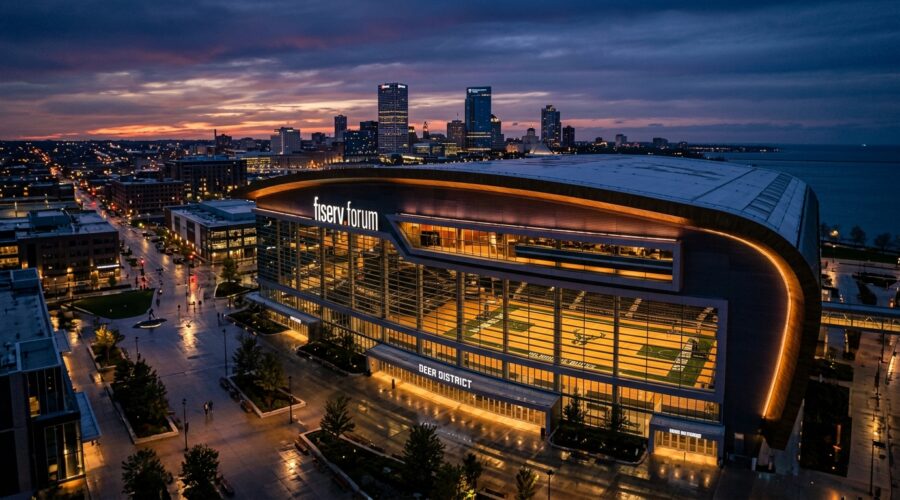
January 28, though — that game is going to be something else entirely. Giannis returning to Fiserv Forum as a Miami Heat player. The ovation. The video tribute. The emotions from a city that watched him grow from a teenage kid into a legend. As The Athletic put it: “He flew 1,260 miles to Miami, but for one night in January, home will always be Milwaukee.” Get your tickets early.
The Win Total Debate
The range of projections here tells you everything you need to know about how uncertain this roster is. Bleacher Report projects 18 wins — worst team in the NBA. Yahoo Sports is at 35 wins. ESPN’s summer forecast lands at 25-57, projecting Milwaukee 14th in the East, ahead of only Brooklyn.
Here is the honest projection: 28-54, 13th in the East.
This team is not as bad as Bleacher Report thinks. Rollins is genuinely good. Herro is genuinely good when healthy. Jaquez is a real NBA player. Jenkins will have them competing hard every night — Memphis teams under Jenkins were almost always tougher than their talent suggested.
But this team is also not going anywhere near the playoff picture in 2026-27. The East is loaded, the schedule is brutal early, and there is no single player on this roster who can carry a team through adversity the way Giannis could. The best-case scenario this season is real development from Ware and Burries, a successful Turner-Kuzma trade by the deadline, a Herro extension, and a lottery pick that lands Milwaukee in the top six of the 2027 Draft.
That would be a winning season in rebuild terms. Even if the record does not show it.
Three X-Factors That Define Everything
1. Herro’s health and willingness to lead. He has never been the primary option on a real NBA team. This is his chance to prove he can be. If he plays 65-plus games and averages 22-plus points, Milwaukee has a foundation to build around. If the foot flares up again, or if the spotlight proves too bright, the entire rebuild stalls before it starts.
2. Kel’el Ware’s development under Jenkins. The Ringer’s framing is accurate: Ware’s fresh start in Milwaukee is fundamentally a question of scale. He is producing elite numbers per possession in limited minutes. Give him 28 minutes per game under a developmental coach who knows exactly how to unlock players of his archetype, and you could be looking at an All-Star within two years. That would change everything about the trajectory of this rebuild.
3. The Turner and Kuzma trade market. If Horst can move one or both of those contracts before February 11 and net real draft capital in return, this rebuild accelerates significantly. If he cannot, Milwaukee is paying $47 million per year to two players who do not fit the timeline and clogging the development runway for players who actually matter long-term.
The Bottom Line
The Milwaukee Bucks are rebuilding. That sentence used to be unthinkable. It is now just true.
But here is what makes this rebuild different from the bottom-of-the-barrel teardowns we have seen around the league: Milwaukee actually got back interesting assets. Ware has legitimate star potential. Rollins might already be a top-60 player in the NBA on a rookie-scale deal. Jaquez is a real two-way wing. Burries showed elite decision-making and shooting efficiency before playing a regular-season minute. And Taylor Jenkins is an A-minus coaching hire on any ranking system you want to use.
BrewHoop put it clearly: the most pressing task over the coming years is finding The Guy — the centerpiece around whom a contending team can be built. Right now, that player is not on the roster. Ware has the highest ceiling, but he is not there yet. Rollins is the most proven, but his profile reads more as excellent complementary piece than franchise anchor. Herro has the name value, but a history of injuries and questions about his ability to carry a team.
This is not a playoff team in 2026-27. It is a lottery team with a fascinating young core, a brilliant developmental coach, $25.5 million in trade exception ammunition, and a front office that is not panicking. That is actually a reasonable place to be one year into a rebuild from which there was no clean escape.
28-54. 13th in the East. A lottery pick. Real development. And one unforgettable night in late January when a packed Fiserv Forum watches Giannis Antetokounmpo walk back through the door in the wrong uniform.
The era is over. The rebuild begins now. And honestly? It is worth watching.