There is a particular kind of afternoon in September that reminds you why football, at its most elemental, resists every attempt to reduce it to a spreadsheet. The Stadium of Light, roaring with just over forty-eight thousand souls who have waited an eternity to be back among the elite, a penalty that threatened to rewrite the day entirely, a goalkeeper who had other ideas, and then — arriving like a plot twist even a novelist would have hesitated to put on the page — the Brazilian midfielder who had spent two beloved years captaining the other half of the north east, stepping off the bench to settle matters with a long-range screamer. Arsenal left Wearside with twelve points from four games, and yet somehow found a way to make it all feel like it had been the most precarious kind of comfortable.
That is what reigning champions do. They win the ones they are not supposed to lose, and they manufacture the moments when the occasion demands them.
A Cauldron That Deserved Better Weather
Let it be said plainly: Régis Le Bris’s Sunderland are not here to make up the numbers. The club placed their trust in the squad that earned seventh place and a Europa League place in their debut top-flight season, adding Thomas Meunier on a free transfer from Lille among their summer business. The philosophy is clear and it is not remotely timid. Le Bris had the candour to call Arsenal “the best team in Europe” in the build-up, but that read less as flattery than honest intelligence assessment before a particularly difficult chess match. He was not raising the white flag. He was acknowledging the terrain.
Sunderland set up with genuine defensive discipline and a pressing structure designed to force Arsenal into hurried decisions. Granit Xhaka, whose move to Wearside was arguably the defining signing of last season, pulled the midfield strings with the authority of a man who has, by now, passed through enough top-flight footballing cultures to read the spaces before they appear. Enzo Le Fée operated ahead of him with a creativity that kept Arsenal’s defensive line honest. Brian Brobbey offered a physical reference point up top for Sunderland. This was not a side that had come to park the team bus and sing songs about a point well earned. They came for something.
Arsenal, for their part, were navigating a fixture with several variables stacked against the kind of fluent performance that had dismantled Coventry, outfoxed Aston Villa, and seen off Chelsea in the opening three weeks. William Saliba — the defensive cornerstone of this squad’s identity — remains sidelined with a back problem until mid-October. Jurriën Timber’s ankle kept him out alongside him. Ezri Konsa, the £51 million summer arrival from Villa (with a potential £4 million in add-ons), deputised in what was, in context, still a relatively fresh central defensive partnership alongside Gabriel Magalhães. There is no shame in acknowledging that the Sunderland penalty decision, when it came, arrived at the kind of moment that exposes the anxiety behind even the most composed exterior.
The Penalty That Nearly Changed Everything — and the One That Did Not
Around the fifty-sixth minute, referee John Brooks pointed to the spot. A long throw into Arsenal’s area, a coming-together between Konsa and Sunderland’s Dan Ballard, and a decision that — if you believe the evidence of Mikel Arteta’s post-match testimony, the ESPN VAR analyst’s subsequent assessment, and the basic geometry of replays — had no business being given. VAR official James Bell reviewed the incident and saw no grounds to recommend a pitchside review. The on-field decision stood.
Arteta, in what has become something of an annual ritual by this point, was quite magnificently furious afterwards. “I watched it twenty times,” he said, “and I cannot find a way to understand how you even think to give a penalty in that situation, or the way the VAR has to intervene. That changes the course of the season and it can cost you the championship.” He added, with the measured tone of a man choosing his words very carefully indeed, that it was “not acceptable at this level.” ESPN’s own VAR analyst concluded it was a clear penalty that should not have been awarded and that Bell’s failure to intervene was indefensible. Arteta, for once, had company.
Yet here is where sport, magnificently and infuriatingly, refuses to follow the script of grievance. Enzo Le Fée stepped up to take the penalty. Le Fée, whose chequered relationship with the twelve-yard spot at Brentford — a wretched Panenka that barely threatened the corner flag back in January 2026 — had been partially, triumphantly redeemed in Matchweek 3 of this very season, at the same Brentford ground, when he converted to earn Sunderland a one-all draw. He had his nerve back. The Stadium of Light held its breath.
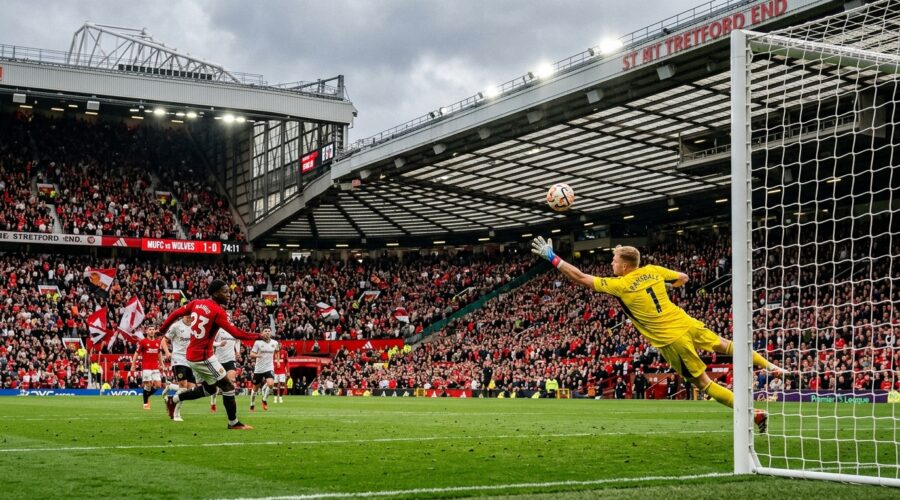
David Raya did not.
The Spaniard, three-time Premier League Golden Glove winner — nineteen clean sheets in thirty-seven appearances last season alone — flung himself to his left with the economy of movement that defines truly great goalkeepers and turned the ball onto the post. It was, at that moment, the save of the season, and the season was barely four matches old. Whether it ultimately earns that title remains to be seen, but there are saves that change matches and saves that change seasons, and the distinction is rarely clear in September. This had the feel of the latter.
Bruno Guimarães Makes His Introduction
Two minutes after Raya’s save, Bruno Guimarães arrived at the match.
That sentence deserves to sit alone. He had been on the pitch longer than two minutes, of course — brought on to replace Myles Lewis-Skelly at halftime — but a footballer does not truly arrive until he does something that announces him. Guimarães, two years Newcastle’s captain, nine league goals in his final season at St James’ Park, sold to Arsenal for £75 million in the summer, had spent the opening weeks of his new life at the club navigating a minor injury and collecting a brief cameo in the Champions League win over Napoli four days prior. Against Sunderland, at the fifty-eighth minute, he arrived.
Long range. Outside the penalty area. A finish that had the quality of instinct and the weight of statement. “A beautiful goal,” he said afterwards, with what was either understatement or the serenity of a man who always knew it was coming. “A beautiful moment.” It was both of those things. It was also the kind of debut goal that renders every question about transfer fees somewhat moot. The south bank of the north east — deeply familiar with Guimarães, and not in the way that breeds warmth — had no answer for it.
Arteta praised him for “grabbing the game” at its most critical moment, which is the sort of phrase that sounds like managerial boilerplate until you consider the timing. Arsenal had just survived a penalty they should not have faced. They were, in terms of atmospheric momentum, at their most vulnerable point of the afternoon. Guimarães settled it within minutes. That is what a £75 million midfielder is supposed to do. It is rather pleasing when they do it so immediately.
Saka Adds the Full Stop
In the ninety-third minute — the seventh minute of stoppage time, to be precise — Sunderland conceded their own penalty at the other end, and Bukayo Saka stepped up with the composure he has made his professional signature. Two-nil. The result secured.
Saka’s conversion was the kind of thing that barely warrants a paragraph when your team is this organised, but it deserves one nonetheless. The pressure of a late penalty, in a match that had been unexpectedly tense, after a week that included a Champions League fixture in Naples — there is a version of this story where it goes wrong. Saka did not entertain that version.
What This Defence Tells You
Four Premier League games. Twelve points. Seven goals scored. One conceded. Manchester City, usually the benchmark against which Arsenal measure their ambitions, sit first on nine points — level on points with where Arsenal stood after three games, but separated by goal difference. Steve Nicol told ESPN he was “convinced Arsenal will be champions” after the final whistle, which is the sort of declarative confidence that can look foolish by November or prophetic by May.
The defensive record is particularly striking given the context. Saliba absent. Timber absent. A new centre-back pairing still finding its rhythm. And yet Arsenal have conceded just once in four matches, with the quiet efficiency of a team that has absorbed a defensive philosophy so deeply that individual absences do not alter the fundamental shape of the thing. Raya is, plainly, a significant reason for this — but a goalkeeper making saves is not the same as a goalkeeper propping up a leaky defence. This Arsenal backline does not require propping. It requires occasional, spectacular rescue, of the penalty-stopping variety, and Raya is more than equipped for that.
Konsa, too, deserves credit for a debut season being conducted under rather testing conditions. A £51 million fee invites scrutiny. A debut Premier League season in which your first four matches include Villa away, Chelsea at home, and the reigning European runners-up’s appetite for a long-throw penalty against you — that invites rather more. He has largely met it.
Sunderland’s Dignity in Defeat
Le Bris, post-match, was philosophical without being resigned. “We are really close,” he said. “We compete, we believe.” He acknowledged that Raya’s save was the turning point — a moment of honesty that his counterpart might have difficulty reciprocating given the fog of his own grievances. There is something genuinely admirable about what Le Bris has built at the Stadium of Light, and the cauldron his team generates there — that noise-above-the-pitch quality that opposition players have been known to visibly wilt beneath — was present and accounted for on a September afternoon that had all the ingredients of an upset.
Sunderland were not poor. They were unlucky, in the specific sense that their best moment of the match was foiled by a goalkeeper at the peak of his powers. That is a different kind of defeat to the one where you simply do not belong in the same conversation, and Le Bris’s squad are right to recognise the distinction. The Europa League beckons. Manchester City away next, which is, as ever, a rather bracing way to spend a September Saturday. They will need Granit Xhaka and Le Fée in good working order.
The Motivation That Refuses to Fade
Behind all of this — the perfect start, the clinical finishing, the penalty controversies and the spectacular saves — there is a specific wound that Arsenal carry with them into every match this season. The Champions League Final in Budapest, last May. One-all after ninety minutes. PSG on penalties. The first European final in seven years, lost in the manner that hurts most.
Arsenal had also won their first league title in twenty-two years in 2025/26. They are, by any measure, no longer the perennial nearly-men. But Budapest has a way of lingering. Arteta referenced “reaching a different level” in European competition — a phrase that says everything necessary about where the ambition currently sits. The Napoli win in the Champions League four days before this fixture was the opening statement of that campaign. There will be bumps — there always are — but the hunger is self-evidently real, and a team that starts a title defence by conceding just once in four games is a team that has not allowed success to soften it.
Verdict
Arsenal go to Brighton next. Sunderland go to the Etihad. The table flatters no one for long.
But on a September afternoon on Wearside, when a wrongly-awarded penalty might have been the moment an otherwise perfect season developed its first visible crack, a thirty-three-year-old Spaniard dove to his left with the assurance of someone who had already decided the outcome, and a Brazilian who used to captain the other half of the north east settled the matter with a finish of the sort that makes transfer committees look briefly like visionaries. Arsenal are, as yet, near-flawless in this league. The VAR controversy is real, the grievance is legitimate, and Arteta is right to name it clearly. But the result is the result, and the result says twelve points, one conceded across four games, and a squad that finds the decisive moment when the occasion insists on one.
That is what champions look like. Even when they are angry about it.