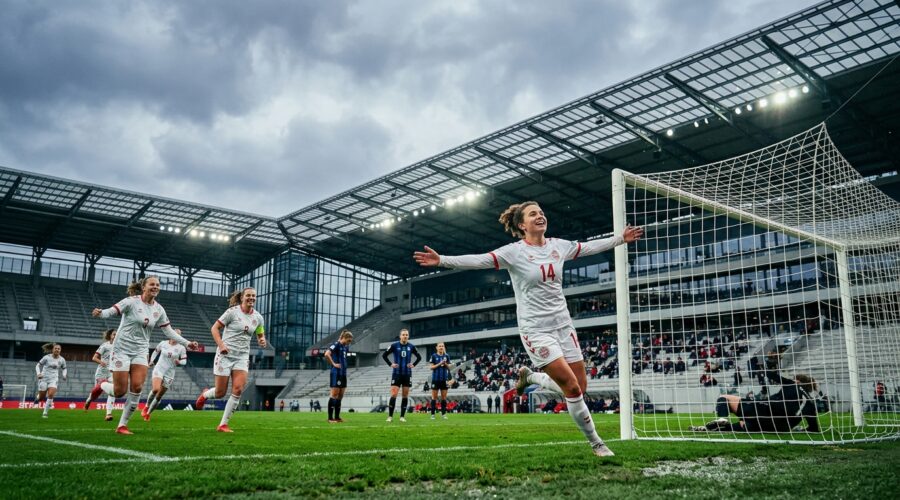
There is a particular cruelty in how football distributes its rewards. You can play the most dominant ninety minutes of your tournament career, score nine goals against an opponent who barely remembered to bring a second shot attempt, and still spend the evening nervously checking other groups’ results to confirm you have actually made it through. That was the predicament of the United States U-20 Women’s National Team on the evening of September 12th in Sosnowiec, Poland — triumphant, record-breaking, and structurally dependent on third-place arithmetic for their tournament survival. They passed the test with considerable panache. Whether the group stage as a whole represents a genuine statement of intent is a more complicated question.
The Shape of a Rout
Arena Sosnowiec holds just over eleven thousand people. On a cloudy, 61-degree afternoon, 375 of them showed up. In that cavernous near-silence, the U.S. went about their business with the focused efficiency of a team that had something to prove and a goal difference ledger that needed urgent attention.
The tone was set inside four minutes. Emeri Adames drew a cross from the goalkeeper, the clearance fell to Hope Munson — making her first World Cup start — and the right back drove to the endline with the composure of someone who had been doing this for years rather than ninety seconds. Her cross found Alex Buck, who required approximately three yards of space and a clean contact to open the scoring. Simple. Precise. Ruthless.
Two minutes later, Kennedy Fuller seized on a scramble in the New Zealand area and fired home to make it two. The captain’s positioning in that moment told you something about her football intelligence — she was in the right place not by accident but by design, anticipating chaos rather than waiting for order.
By half-time, it was four. Micayla Johnson headed in from an Adames delivery at 38 minutes, and then Hope Munson — already announcing herself as the afternoon’s most industrious architect — whipped in the cross that allowed Linda Ullmark to finish composedly with her left foot. Four-nil at the break. The second period would prove even less forgiving.
The Fuller Masterclass
If this match belonged to anyone, it belonged to Kennedy Fuller, and not merely because she ended the afternoon clutching a match ball.
The Bay FC midfielder — 19 years old, from Southlake, Texas, a player who had been acquired by Bay FC from Angel City FC with the move announced in June, though she joined the club only after the June international window — wore the captain’s armband with the kind of calm authority that tends to make a coaching staff exhale slowly. She had arrived in Poland as one of the squad’s more recognizable names, having earned a Silver Boot at the 2024 U-17 Women’s World Cup, but a single goal in the Italy opener and a quiet performance against Japan had not quite established her as the tournament’s dominant force. Against New Zealand, she claimed that status comprehensively.
Her second goal at 83 minutes was perhaps the more telling of the three — not a tap-in but a sharp rebound finish after Munson had orchestrated a give-and-go with Lily Joseph and the goalkeeper had parried the resulting cross. Fuller had tracked the play all the way to its chaotic conclusion, converting into the wide-open left side with the sort of instinct that cannot be coached. The ninth goal, a penalty driven into the bottom right corner deep in stoppage time after Nyanya Touray was brought down by the goalkeeper, was less artistically ambitious but entirely necessary. Hat trick complete. Tournament record established. Visa Player of the Match confirmed.
Fuller became the sixth American to score a hat trick at the U-19 or U-20 Women’s World Cup, joining a list that reads as a roll-call of significant careers: Kelly Wilson in 2002, Sydney Leroux in 2010, Maya Hayes in 2012, Savannah DeMelo in 2018, and Pietra Tordin just two years ago in Poland. To be in that company at 19 is not a trivial thing.
The Supporting Cast
Fuller’s hat trick naturally draws the eye, but the afternoon produced several subsidiary stories worth examining.
Hope Munson, recalled to the starting eleven with Ainsley McCammon sidelined through injury, played the game of her young career. Two assists — on Buck’s opener and Ullmark’s composed fourth — in a first World Cup start is the sort of debut that demands longer-term recognition. The UNC defender had been waiting in the wings through the Italy and Japan matches, and the evidence here suggests the wait was enforced by circumstance rather than coaching preference.
Alex Buck, the oldest player on the roster and a University of Washington forward who only made her FIFA World Cup debut in the Italy opener, added a brace to bring her tournament total to three. Her second, at 58 minutes, was the simplest possible finish from the simplest possible position — Adames played it to her feet at the doorstep, and Buck was not the sort of player to make that complicated.
Emeri Adames claimed the sixth goal with a powerful left-footed drive to the far post after a neat return exchange with Ullmark. It was her first World Cup goal of the 2026 cycle, and in a sense the most overdue — she had been the most experienced FIFA Women’s World Cup player in the squad, having competed at the 2022 U-17 World Cup in India and every single match of the 2024 U-20 World Cup in Colombia, and had arrived in Poland without the goal return that her tournament pedigree suggested she warranted.
Substitute Sealey Strawn, who had seen a perfectly good equalizer ruled out by VAR against Italy on a margin of inches, had the small satisfaction of a one-touch right-footed finish at 87 minutes to make it eight. Football has its own quiet justice system, even if it operates rather slowly.
The Numbers Behind the Annihilation
The USA outshot New Zealand 41-1. Their expected goals figure of 8.94 in a match they won 9-0 represents the rare occasion where reality and the model are in near-perfect agreement. New Zealand managed one shot in ninety-two minutes of football. One. The absence of the number zero in that statistic is, if you are a New Zealand supporter, something of a moral victory — and if you are not, something of a statistical outlier.
The 9-0 scoreline is the largest margin of victory in U.S. history at the FIFA U-20 Women’s World Cup, surpassing the 7-0 defeat of Paraguay at the 2024 edition. It is the kind of record that feels definitive until you examine the context of who was on the receiving end, and then it becomes slightly more measured. New Zealand finished with zero points, zero wins, and a goal difference of -13. They were not a measuring stick for much beyond the Americans’ efficiency in front of goal.
What the numbers do reveal, more usefully, is the breadth of the U.S. attacking options. Seven different players scored in the group stage — Fuller and Buck with three each, Micayla Johnson with two, and McCammon, Ullmark, Adames and Strawn with one apiece. Twelve goals from seven scorers across three matches tells you this is not a team that funnels everything through a single creative channel. It also tells you that the defensive frailties exposed by Italy and Japan were not matched by any equivalent vulnerability in front of goal.
The Uncomfortable Context: A Third-Place Qualifier
And yet. The U.S. finished third in Group D. That requires acknowledging plainly, because nine goals and a record victory are genuinely impressive, but they arrived after a 1-2 defeat to Italy in the opener and a 2-2 draw with Japan in which the Americans led before conceding twice in the final seventeen minutes. Both of those results were played in Lodz. Both carried the particular sting of a team that showed enough to know better.
The Italy defeat was, by the account of the match, unlucky in the specific sense that Sealey Strawn’s stoppage-time equalizer was ruled out by VAR for an offside that could only be measured by the margins of a freeze-frame. The Japan draw was luckier in a different direction — the U.S. had a 16-8 shot advantage but were punished for defensive lapses late in the game that the numbers alone do not fully capture. Japan, it should be noted, were the 2024 U-20 World Cup finalists. These were not humiliations. But nor were they the results of a team moving with the authority of a genuine title contender.
The group standings offer a certain clarity. Italy won Group D with seven points. Japan finished second with five. The USA, with four points and a goal difference inflated by the New Zealand result, advanced as the best third-place finisher in the tournament. They made it through. They made it through because they scored nine goals when they needed to, and because the arithmetic of the expanded 24-team format provided the exit route. The pragmatist notes that progression is progression. The analyst notes the precise margin by which it was achieved.
The Jepson Project
Vicky Jepson arrived at U.S. Soccer in May 2025 — British, 38 years old, a UEFA Pro Licence holder who had managed Liverpool FC Women in the Women’s Super League, spent time as senior assistant at Tottenham Hotspur, and worked with the England FA as a coach educator and U-17 Women’s head coach. She was appointed, in some sense, as part of the broader structural ambition that Emma Hayes brought to the senior program — a coherent coaching philosophy filtering down through the age groups.
Jepson has had approximately sixteen months and six documented camps to shape this squad, and the 4-3-3 she deployed against New Zealand — with Fuller at the base of a three-person midfield, Ullmark in the advanced role, and Adames and Micayla Johnson flanking Buck in attack — showed genuine attacking intent and reasonable structural clarity. What the group stage also revealed is that the system carries identifiable vulnerabilities when opponents have the quality to exploit the spaces behind a high defensive line, as both Italy and Japan demonstrated in different ways.
Her frustration with the roster situation was palpable and entirely understandable. Claire Hutton, Lily Yohannes, Kimmi Ascanio, and Alex Pfeiffer — all age-eligible, all arguably among the more mature and experienced talents available — could not be released by their NWSL clubs. Jepson did not mask her feelings: “I worked with players for 10 months and prepared them for a World Cup and they’re not released. That is upsetting for me.” It is a familiar tension in the women’s game between club and country, and it is not one that the coach can resolve from the touchline. What she has done, with the players available, is build a team that has scored twelve goals in three group stage matches. That is, under the circumstances, a reasonable return.
What Brazil Represents
The Round of 16 brings Brazil, and Brazil are a different proposition entirely from New Zealand.
Camila Orlando’s side won Group B with a perfect record — beating Tanzania 4-1, defeating Canada 3-0 in a match that saw Canada reduced to ten men, and coming from behind to beat England 2-1 in their final group game. They are a team with genuine depth: Vitorinha, wearing the number ten in conscious tribute to Marta, scored in multiple group stage matches and brings the kind of directness that unsettles high defensive lines. Clarinha operates as the creative fulcrum, and their ability to absorb pressure and transition with speed speaks to a team that has been well-organized across all three phases.
The encounter is scheduled for September 16th. The USA and Brazil met in a preparation friendly in April 2026, though the significance of that result — whatever it was — is inevitably diluted by the competitive weight of a knockout match. There is no second chance from here. No goal difference calculation. No best third-place arithmetic to fall back upon.
This is, in one sense, exactly where Jepson’s side needs to be. A knockout match against a genuine tournament contender, in which the margin for defensive error is considerably smaller than it was in Sosnowiec. Fuller will need to be the version of herself that chased every rebound in the 83rd minute, not the version that required time to locate her best form. Buck and Adames will need to press from the front with the same relentlessness they showed against a New Zealand side that was simply overwhelmed. And Jepson will need her defensive structure to hold against forwards who will make rather more than one shot attempt.
Nine Goals and a Caveat
The U.S. Under-20s produced a historic result in Arena Sosnowiec on September 12th. Kennedy Fuller’s hat trick was legitimate and deserved. Alex Buck’s brace demonstrated the kind of predatory finishing that coaches spend years trying to develop. Hope Munson’s performance in her first World Cup start was the sort of announcement that should change the conversation about the squad’s defensive options. The 9-0 scoreline is a record. The twelve tournament goals from seven different scorers represent genuine attacking variety.
All of that is true, and all of it deserves to be said clearly.
But this is also a team that finished third in their group, that leaked late goals to Japan, and that required a goalkeeping error and a referee’s VAR screen to define the shape of their Italy defeat. They have won the FIFA U-20 Women’s World Cup three times — in 2002, 2008, and 2012 — and the ambition, plainly stated, is a fourth. The path to that fourth title runs through Brazil in four days’ time, in a match where no amount of goal difference arithmetic will cushion the consequences of a poor performance.
The nine goals were necessary. They were also, against New Zealand, achievable. What comes next is the harder work — and whether this particular group, talented and broad as it clearly is, has what is required to do it, remains the only question that genuinely matters now.