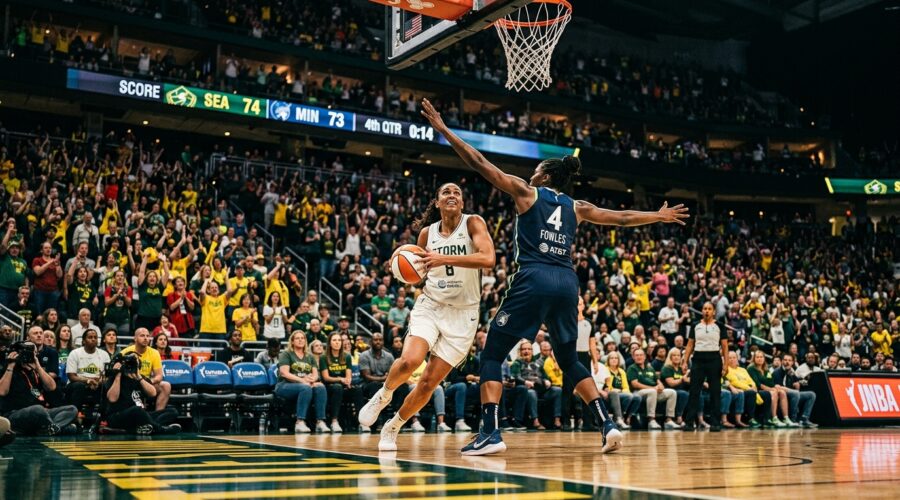
The Minnesota Lynx have not yet clinched the No. 1 overall seed — but at 31-9, they are 96% likely to secure it, and barring a historic collapse in the final week, it is effectively theirs. Everything else about the 2026 WNBA postseason picture — seeding battles, tiebreaker nightmares, injury question marks, a historic MVP race — is still magnificently, gloriously unresolved as the league returns from its FIBA Women’s World Cup break on September 17 with one final week of regular season basketball before the playoffs tip off on September 27.
What has unfolded over the past 40 games is not just a compelling basketball story. It is a referendum on how deep, how global, and how captivating this league has become. There are three teams locked in a dead heat at 24-16. There are two teams fighting for a pivotal seed in the Eastern Conference by the thinnest possible margin. There is a franchise player returning from double ankle surgery, an MVP candidate who may be the most dominant individual performer the league has seen in a decade, and a second-year guard who just joined a group of only three players — one of whom achieved the feat twice — in the most exclusive statistical company in WNBA history.
Let us break all of it down.
The Minnesota Lynx: Best Team in the League, With an Asterisk the Size of an Ankle Brace
At 31-9 and a .775 winning percentage, the Minnesota Lynx are, by any reasonable measure, the class of the 2026 WNBA. Head coach Cheryl Reeve has built the most balanced roster in the league — one that absorbed the loss of its best player for the first 10 weeks of the season and still climbed to the top of the overall standings with a two-game cushion over the Golden State Valkyries, needing only to hold on through the final week to lock up the No. 1 overall seed.
That best player is Napheesa Collier, and she is the biggest X-factor in the entire postseason.
Collier underwent reconstructive surgery on both ankles in the offseason following a nightmarish 2025 campaign defined by repeated lower leg trauma. She sat out the first 10 weeks of 2026, finally returning in mid-July. In 12 games since, she has averaged 18.0 points, 7.3 rebounds, and an eye-opening 46.7% from three-point range. Her own words ahead of the playoffs say everything about her mindset: “Maybe this is the break I needed to propel us all the way and win this thing.”
Whether Collier is at full capacity when the games count in late September is, as ESPN has noted, the question that could determine the championship. Minnesota’s depth — anchored by Olivia Miles, Kayla McBride, Dorka Juhász, Antonia Delaere, and a remarkably international supporting cast — is already the best in the league. A healthy Collier does not just add a star. She adds a 46.7% three-point-shooting, elite defensive forward who fundamentally changes Minnesota’s ceiling from “very good” to “virtually unbeatable.”
The Lynx were already good enough to beat Atlanta on the road on August 30 — that result almost does not matter to their seeding. What matters enormously is how Collier’s ankles feel three weeks from now.
The MVP Race: A’ja Wilson Is Running Away With It, and It Is Not Even Close
The conversation around the 2026 Kia WNBA MVP award is instructive for what it reveals about the sheer level of individual brilliance in this league. Kelsey Mitchell is shooting 45.5% from three-point range on high volume. Olivia Miles owns the second-best plus/minus rating among all guards in the entire WNBA at +275. Caitlin Clark is on pace to become the first player in league history to average at least 20 points and 8 assists in the same season.
And yet A’ja Wilson is still a -1200 favorite at sportsbooks to win her third straight MVP.
The numbers explain why. Wilson leads the WNBA in scoring at 26.0 points per game. She leads the league in blocks at 2.0 per game — with Brittney Griner second at 1.8. She is pulling down 9.4 rebounds. She is shooting 52.3% from the field. Her player efficiency rating of 30.1 is the highest in the league by a significant margin. Perhaps most staggering: she has personally accounted for over 26% of the Las Vegas Aces’ total scoring this season, and when she is off the court, the Aces post a net rating of -16.3 — a figure so catastrophic it makes her on/off split one of the most lopsided in modern WNBA history.
Wilson is not just the MVP. She is the argument for what a truly singular player looks like in a league that is, by all other evidence, deeper than it has ever been.
Atlanta vs. Indiana: The East’s Most Important Tiebreaker
Two teams. One seed. Zero margin for error.
The Atlanta Dream and Indiana Fever share an identical 26-14 record entering the final week, deadlocked for the Eastern Conference’s fourth seed. The Dream currently hold the No. 4 spot while the Fever sit fifth — and the implications of that tiebreaker are enormous: the higher seed receives home court advantage in the first round, and in a best-of-five format, that edge can define a series.
The critical data point is a single overtime game on August 16 at State Farm Arena in Atlanta. Indiana traveled to face the Dream and came away with a 95-91 victory in OT, a result that left the season series tied at 2-2 — meaning neither team holds a head-to-head tiebreaker advantage. Every game in the final week, then, is magnified: the tiebreaker between these two teams will ultimately come down to conference record, and neither team can afford a slip.
The Dream also own what may be the single most impressive result of any team this side of the Lynx: a road win at Minnesota on August 30, 89-81, against a Lynx squad that was 31-8 at the time and playing on their home floor. That game did nothing for Atlanta’s seeding chances — it was mostly meaningless in a standings context — but it announced something. It announced that a team with Angel Reese leading the league in rebounding at 12.4 per game, Rhyne Howard leading the league in perimeter steals, Allisha Gray at 19.3 points per game, and Jordin Canada at 7.4 assists per game is capable of beating anybody, anywhere.
Indiana’s counter-argument is Caitlin Clark, Kelsey Mitchell, and the most explosive offense in the Eastern Conference. The Fever are averaging 97.0 points per game — best in the East — and their backcourt of Clark (8.4 APG) and Mitchell (25.0 PPG, 45.5% from three) is one of the most elite offensive combinations in the conference. Mitchell ranks second in the league in scoring at 25.0 PPG, and Clark third at 22.5 PPG — though it bears noting that A’ja Wilson’s league-leading 26.0 PPG means the Fever’s duo, as dazzling as it is, cannot quite claim the title of most dangerous in the league by the numbers alone. Still, Indiana’s offense is a genuine weapon. But the Fever’s resume carries a troubling entry: a road loss at Toronto on August 18, a game they dropped to a team that finished well outside the playoff picture. Atlanta has its own black mark — a stunning 101-83 home loss to Portland on August 28 — but with the season series level at 2-2, neither team has a clear tiebreaker cushion to fall back on.
With no head-to-head edge to separate them, the final week of conference play becomes the entire ballgame for both franchises.
The Three-Way Jam at 24-16: New York, Washington, and Dallas
There is a statistical oddity lurking inside the 2026 WNBA standings that deserves more attention than it has received. Three franchises — the New York Liberty (East), Washington Mystics (East), and Dallas Wings (West) — are all 24-16, all sitting at a .600 winning percentage, all confirmed playoff participants, all racing each other to a better seed within their respective conferences.
It is worth pausing on what that parity means. The Dallas Wings, entering the postseason as the West’s fourth seed, have the same record as the team that will enter the East bracket as the third seed. Cross-conference balance at this level is unusual, and it raises a quiet but legitimate question: has the Western Conference become structurally deeper than the East at the middle tier?
Within the Eastern bracket, the Liberty versus Mystics battle for the No. 3 seed is almost entirely a health story. Washington boasts one of the most formidable interior frontcourts in the league — Shakira Austin and Kiki Iriafen are both averaging 9.4 rebounds per game, a pairing that is almost unprecedented — but New York has a tiebreaker edge from their head-to-head meeting in May (98-93). The bigger question is what version of the Liberty shows up in October.
Sabrina Ionescu has played only 27 games this season, shooting well below her career norms. Satou Sabally has played just 13 games — effectively a lost season. Breanna Stewart has carried an enormous and sometimes unfair load at 20.4 points and 8.1 rebounds per game across all 39 of her appearances, serving as New York’s offense, defense, closer, and identity simultaneously. If both Ionescu and Sabally return to health for the postseason, the Liberty transform overnight into a genuine championship contender. If they do not, Stewart is fighting a nearly impossible battle alone.
Dallas Wings: The Dangerous Afterthought Nobody Should Ignore
When the Wings clinched their playoff spot with a win over Portland on August 25, streamers fell from the rafters of College Park Center. That celebration was earned — and it was a signal.
Dallas enters the final week having won five consecutive games, led by Paige Bueckers in what has become a fully arrived superstar season. The second-year guard is averaging 20.5 points, 5.9 assists, and shooting 50.6% from the field. During the playoff-clinching win over Portland, Bueckers joined an extraordinarily exclusive club: she became one of only three players in WNBA history to record at least 750 points and 200 assists in a single season — a threshold that measures both volume and elite playmaking. The company is rarefied: Kelsey Plum achieved it once, and Caitlin Clark achieved it twice across two different seasons, accounting for three of the four total instances of the milestone ever being reached.
Jessica Shepard has been the league’s most efficient center outside of A’ja Wilson, shooting 58.7% from the field while grabbing 11.1 rebounds per game — second only to Angel Reese in the entire league. Arike Ogunbowale (15.2 PPG) provides veteran scoring punch. And Azzi Fudd, who has been limited by injury during the regular season, is a potential playoff weapon whose 39.7% three-point shooting could alter series outcomes if she is healthy enough to contribute meaningful minutes.
Dallas opens the postseason on the road at Golden State — a Valkyries team that beat them by 18 on August 7. On paper, it is a mismatch. But this Wings team is playing its best basketball of the season right now, and Bueckers has shown enough in Year 2 to make that series worth watching very closely.
The Veronica Burton Revelation
There is a player sitting third in the entire WNBA in plus/minus at +297 — just behind A’ja Wilson’s +298 and Natasha Howard’s league-leading +316 — who has played in all 40 of Golden State’s games, who averages 5.8 assists and 1.5 steals per contest, and who has been the quiet engine behind a 29-11 team that has built a legitimate case as the second-best roster in the league.
That player is Veronica Burton, and she is criminally underappreciated in the national MVP and All-WNBA conversation.
Burton does not fill a box score in the way that Wilson, Clark, or Mitchell do. She averages 12.3 points per game. She is not a highlight reel waiting to happen. What she does instead is make every lineup she plays in significantly better — better defensively, better in transition, better in ball movement — in a way that the plus/minus number captures perfectly and that basic statistics obscure entirely. Golden State’s identity as a team is deeply international, deeply connected, and deeply hard to beat. Veronica Burton is the thread that holds it all together.
The Caitlin Clark Effect: A Business Story That Has Become Bigger Than Basketball
No single factor has driven the 2026 WNBA’s record-breaking attendance numbers more than the continued presence of Caitlin Clark in Indiana’s backcourt. According to Sports Business Journal, the Fever have averaged 16,580 fans on road trips — over 3,000 more than any other franchise in the league. Arenas that have historically struggled to fill their lower bowls have been selling out weeks in advance when Indiana comes to town.
This is not a novelty anymore. It is a structural reality. Clark’s effect on league revenue, visibility, and arena economics is now two seasons deep and showing no signs of slowing. When she averages 8.4 assists per game and 22.5 points per game — potentially historic numbers by any standard — the basketball itself has matched the hype. The question for the postseason is whether those numbers translate into a deep playoff run, or whether the Fever’s inability to secure the head-to-head edge over Atlanta and their reliance on Mitchell’s scoring become vulnerabilities in a best-of-five format against a deeper roster.
The Numbers You Cannot Ignore Heading Into Playoff Week
- 26.0 PPG — A’ja Wilson’s scoring average, best in the WNBA, en route to her third scoring title
- 12.4 RPG — Angel Reese, leading the league in rebounds and anchoring one of the most well-rounded defenses in the East
- 8.4 APG — Caitlin Clark and Alyssa Thomas, co-leading the league in assists; Clark would be the first player in WNBA history to average 20 points and 8 assists in the same season
- +316 / +298 / +297 — The top three plus/minus figures in the league: Natasha Howard (Minnesota), A’ja Wilson (Las Vegas), and Veronica Burton (Golden State); the most impactful under-the-radar numbers in the entire sport right now
- 12 games — The number of games Napheesa Collier has played in 2026; her playoff health remains the single biggest unknown in the entire postseason
- 111-71 — New York’s August 9 demolition of Las Vegas at home, a reminder of how dangerous the Liberty can be at full strength
- 5 straight wins — Dallas’s current streak entering the final week, the hottest team in the league regardless of conference
What to Watch in the Final Week
The seedings are nearly locked. Minnesota holds the No. 1 overall seed with a 96% probability and a two-game cushion — but has not yet mathematically clinched it. Golden State is No. 2 in the West. Las Vegas is No. 3. Dallas is No. 4, and entering on a wave. In the East, Atlanta currently holds the No. 4 seed over Indiana’s No. 5 by the thinnest of margins, with no head-to-head tiebreaker separating them. New York holds a head-to-head advantage over Washington for No. 3.
But nearly is doing a lot of work in that sentence. The final week of games — beginning September 17, running through September 24 — could still scramble seeds if results fall the right way. More importantly, teams are playing for rhythm, health, and psychological momentum heading into a postseason where five-game series can turn on a single ankle, a single shooting slump, or a single tactical adjustment from a veteran coach.
Napheesa Collier’s status will be watched obsessively. Sabrina Ionescu’s health timeline will dominate New York’s playoff preparation. Azzi Fudd’s availability could quietly reshape Dallas’s ceiling. The East’s No. 4 seed battle between Atlanta and Indiana, with no head-to-head edge for either side, needs to be resolved cleanly — and a surprise result in the final days could still flip it entirely.
A League That Has Never Been More Alive
The 2026 WNBA season has not been defined by one story. It has been defined by dozens of them simultaneously — expansion teams adding competitive intrigue to the league (Portland Fire finishing a respectable 16-24, even as Toronto Tempo struggled to 11-29), international rosters on Minnesota and Golden State rewriting assumptions about where WNBA talent comes from, a player in Caitlin Clark who has become a cultural force larger than the sport itself, and an MVP in A’ja Wilson who keeps answering every challenge by putting up numbers that belong in a different era.
The playoffs begin September 27. Eight teams. Four first-round series. A championship picture that remains genuinely, thrillingly open. The only thing that is certain is that Minnesota’s 31-9 record means the Lynx begin as the team everyone has to beat — and that somewhere in the back of every opponent’s mind is a single question: how healthy is Napheesa Collier, and what does this team look like if the answer is “fully healthy”?
One week left to find out. Then the real season begins.