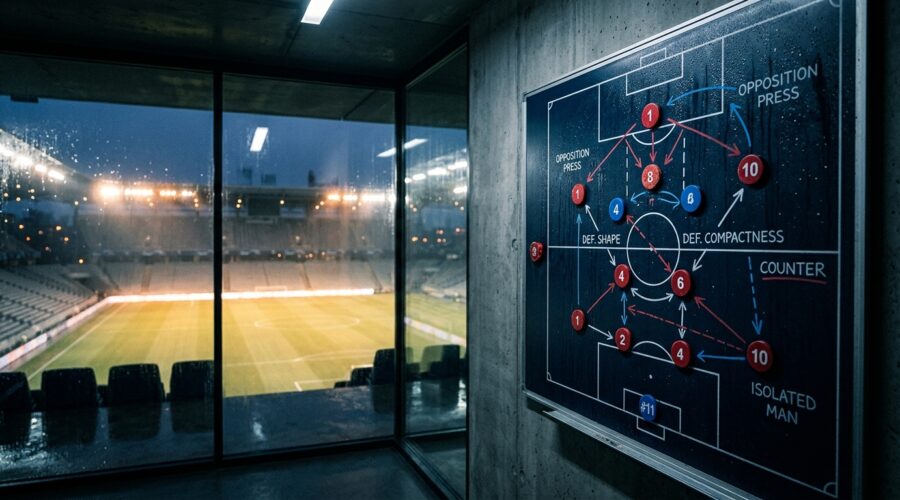
There is a particular kind of defeat that is worse than merely losing. It is the defeat that teaches your enemies something. The defeat that circulates through opposition video rooms like a dossier, annotated and highlighted, forwarded with the subject line: this is how you do it. Brighton 3-0 Arsenal on September 19, 2026 was that kind of defeat. Not a crisis, precisely — but something more insidious. A publicly broadcast instruction manual for dismantling the reigning Premier League champions.
Arsenal had gone seven games unbeaten to open 2026/27. They had won the title the previous May with 85 points, 19 clean sheets, and a defensive record so ludicrously stingy it prompted the sort of superlatives that make football statisticians reach for another coffee. They had just come from a composed, Ødegaard-guided 1-0 victory over Napoli at the Emirates Stadium in the Champions League. They were second in the Premier League table. And then Fabian Hürzeler’s Brighton walked through them at the American Express Stadium like a man strolling through an unlocked door he had been studying for weeks.
Three goals. One of them from a corner. And with it, the broader question of how much of what made Arsenal so formidable last season remains intact — and for how long.
So: crisis, or warning? The answer matters enormously, because the consequences of misreading it run all the way to the Allianz Arena on October 21.
How Brighton Picked the Lock
Hürzeler’s gameplan was not subtle, but then the best tactical blueprints rarely are. Brighton pressed man-to-man from the first whistle — every Arsenal player in possession immediately caged, every passing lane occupied, every second ball contested with the aggression of a side playing for their lives. This is not a new concept in football, but it requires an almost fanatical organisational commitment to execute, and Brighton have developed it into something approaching an art form.
The results were predictable, once you understood the context. Without William Saliba marshalling the defensive line, Arsenal’s build-up from the back is structurally less assured. With Bruno Guimarães and Declan Rice having played “a few minutes” together before kick-off — a fact Mikel Arteta acknowledged with the quiet admission that the partnership was “in early stages” — the double pivot had no established pattern for rotating out of a high press. When the press was beaten, Arsenal’s technical quality in their own half deserted them. Loose passes. Hesitant decisions. Gifts presented to a Brighton side ready to collect them.
The goals told the story with brutal clarity. Pascal Gross opened the account on 31 minutes with a low right-footed shot that struck the inside of the near post directly and flew into the bottom right corner of the goal. Just before the break, Charalampos Kostoulas struck from 25 yards, low, finding the bottom corner, with Riccardo Calafiori caught hopelessly out of position. Then, 57 minutes in, Chema Andres headed in from a Gross corner — a set-piece goal against a team that had scored 19 from corners in a single Premier League record-breaking season twelve months earlier. The irony was not lost on anyone with a dark sense of humour about football.
Arteta’s post-match verdict was not the language of a manager managing expectations. “We didn’t respect any principle of play,” he said. “When we did regain the ball, especially in our own half, we were extremely poor technically.” This is a man who has built an entire footballing identity around those principles. When he says his team violated them comprehensively, you should believe him.
Alan Shearer, never one to undersell a drubbing, observed that Brighton could have won six or seven. The underlying numbers offer him partial support: Arsenal generated 1.58 xG and produced just two shots on target from eleven attempts. Brighton created 1.30 xG from 17 total attempts, with 5 shots on target, and converted three of them. The match was, in its own perverse way, simultaneously more comfortable than the scoreline suggested for Arsenal in terms of possession and territory, and more concerning in terms of what the goals actually revealed.
The Raya Problem Nobody Wants to Say Out Loud
David Raya is a very good goalkeeper. His distribution is elite. His sweeping is elite. His contribution to Arsenal’s title-winning season — 19 clean sheets, the best goalkeeper in the Premier League for long stretches — is not in dispute. But there is a number attached to his name that is now circulating through opposition coaching departments with the enthusiasm of a leaked team sheet, and it will not go away simply because we would prefer it to.
Raya has conceded 20.6% of his Premier League goals from outside the penalty area — 33 of 160. Among goalkeepers in Premier League history who have conceded more than 100 goals, only Hans Segers sits above him. Segers, who played for Nottingham Forest and Wimbledon in the 1990s and beyond, conceded 36 of his 164 total Premier League goals from outside the box — a figure of 22%, though it is worth noting that this relates specifically to that proportion of goals conceded from range, rather than being a broader performance metric. The principle, however, stands: Raya’s vulnerability from distance is a statistically documented pattern, and it is not distinguished company for a goalkeeper at a club that considers itself a Champions League contender.
Two of Brighton’s three goals came from distance. Both are logged in the Opta database. Both will feature in the pre-match preparations of every serious opponent Arsenal face between now and Christmas.
The most alarming contextual figure: seven of Arsenal’s last 18 Premier League goals conceded have arrived from outside the 18-yard box. That is 39%. Bayern Munich’s analysts will have noted this. Real Madrid’s will have filed it. The question is whether Arteta’s coaching staff can find, in the 3.5 weeks of the international break, a specific remedy — better communication between Raya and his defensive line, clearer protocols for blocking shooting lanes, targeted positioning work in training — that closes the gap before the Allianz Arena visit on October 21.
Raya is not being dropped. He should not be dropped. But the coaching around his specific vulnerability needs to become surgical.
The Saliba-Shaped Hole in Everything
William Saliba aggravated his back complaint during France’s World Cup semi-final against Spain on July 14. He is not expected back until around November 21, when Arsenal face Newcastle. Between now and then, the reigning Premier League champions must navigate the meat of their UCL group stage — including Bayern Munich away — with a centre-back pairing of Ezri Konsa and Gabriel Magalhães.
This is the core structural problem, and it cannot be solved by any tactical adjustment Arteta makes in training this month. Konsa is experienced, versatile, Premier League-proven. He was signed precisely to provide cover for a scenario like this one. But there is a canyon of difference between being a solid Premier League centre-back and being William Saliba, and the data stretching across three seasons confirms it. From the 2023/24 campaign through to 2025/26, Arsenal conceded 65 Premier League goals with Saliba in the side. Manchester City, in the same period, conceded 83. Liverpool conceded 87. The Saliba-Gabriel axis was not merely the best defensive partnership in England — it was arguably the best in Europe.
Gabriel at Brighton was directly implicated in defensive shape failures. He is a world-class centre-back who, without his partner, appears less commanding, less certain of the defensive line’s collective behaviour. This is not a character failing. It is what happens when you remove one half of a pairing built over years from a system engineered around their specific chemistry. The Konsa-Gabriel axis is functional. The Saliba-Gabriel axis was exceptional. Arsenal must endure the gap.
Set Pieces: When Your Greatest Weapon Is Confiscated
Arsenal scored 19 goals from corners in 2025/26 — a Premier League record for a single season — and 25 set-piece goals in total across the campaign, excluding penalties. Nicolas Jover’s set-piece system was the kind of structural advantage that opponents could identify, discuss at length, and still fail to prevent.
In the first five gameweeks of 2026/27, Arsenal have created four set-piece chances. They have attempted one long throw. The reason is specific and unglamorous: Premier League referees have adopted a more aggressive posture toward holding in the penalty box this season, directly targeting the mechanisms Arsenal’s system exploited so comprehensively. The rulebook has been quietly adjusted, and Arsenal’s most reliable attacking weapon has been effectively neutralised before a ball has been kicked in anger in the Champions League proper.
The corner goal Arsenal conceded at Brighton — from a Gross delivery, unmarked runner at the back post — read, against this backdrop, as almost cosmically unjust. But sport is not interested in irony. Jover and Arteta must now reinvent an attacking formula that has been rendered largely inoperable, and they must do it before Lille arrive at the Emirates on October 13.
The Historical Warning Buried in This Defeat
Brighton have now beaten the reigning Premier League champions at home in three consecutive seasons. Manchester City in 2024/25. Liverpool in 2025/26. Arsenal in 2026/27. This is either remarkable consistency or a very specific kind of tactical intelligence being applied each summer to identify the vulnerabilities of whoever is sitting at the top of English football’s food chain.
The more uncomfortable historical parallel is closer to home. After Arsenal lost the 2026 Carabao Cup Final, a cascade of defeats followed — touching the FA Cup, a loss at Bournemouth, and a painful reversal at Manchester City — four consecutive defeats in total. Uncomfortable, certainly; but they proved no more than a stumbling block. Arteta recalibrated, the side adapted, and Arsenal went on to win the Premier League title for the first time in 22 years, securing it on May 20, 2026. The same manager who identified and corrected those problems is still in the dugout. That matters.
But the pattern, as Sky Sports noted in the aftermath of the Brighton defeat, is recognisable. A team gets publicly beaten in a way that reveals something structural. That something gets studied, replicated, and industrialised across the division. The three-week international break buys Arteta time. It does not buy him certainty.
What Is Not Broken (And This Matters)
Arsenal are second in the Premier League with 12 points from five games. They have beaten Napoli 1-0 at the Emirates in the Champions League. Their squad, in terms of raw depth and talent, is the strongest in the club’s history — eight international-calibre defenders, three elite central midfielders, and a forward line anchored by Saka, Ødegaard and a striker in Viktor Gyökeres who scored with an almost mechanical regularity at Sporting CP.
Ødegaard, after the injury struggles that blighted portions of 2025/26, appears sharp and assertive. Saka has three Premier League goals. Havertz, often the subject of impatient criticism, continues to provide the kind of relentless pressing and positional intelligence that makes Arteta’s high line function. The attacking core, when not being pressed into submission by a superbly organised Brighton side, remains genuinely frightening.
Shaka Hislop, assessing the wreckage on ESPN, kept his counsel admirably: “Arsenal have lost one game. There’s no need to panic. They’ll get it right.” This is the proportionate response, even if it lacks the dramatic urgency that the scoreline invites.
The 3.5 Weeks That Decide Everything
The international break runs until October 12. Arsenal’s next Champions League game is Lille at the Emirates on October 13. Their next genuinely dangerous fixture is Bayern Munich away on October 21 — at the Allianz Arena, without Saliba, with Raya’s known vulnerability documented and distributed, and with a Rice-Guimarães partnership that has barely had time to develop a vocabulary, let alone a language.
What Arteta can accomplish in the intervening weeks is limited but meaningful. He can drill Konsa and Gabriel in the specific positioning demands of the system until they approximate the intuitive communication Saliba provides. He can work specific near-post positioning protocols with Raya in training until blocking shooting lanes becomes automatic. He can give Rice and Guimarães the extended sessions together that a grinding Premier League schedule denies them. He can find new open-play attacking combinations to replace the set-piece formula that referees have largely disabled. And he can do what he has always done after heavy defeats — sit in front of the footage, forensically, and identify every moment where the identity of his team was abandoned.
Lille on October 13 should be navigable. The Emirates is not a comfortable place to press man-to-man for ninety minutes when you are not Brighton. Bayern Munich on October 21 is something else entirely — a fixture that, even at full strength, would concentrate the mind. Without Saliba, with Raya’s weakness freshly publicised, it is the most genuinely dangerous moment on the horizon.
Crisis or Warning?
This is a warning. A serious, statistically-documented, tactically-legible warning, but a warning nonetheless.
Arsenal were exposed at Brighton not because they are a broken side, but because Hürzeler had correctly identified the precise combination of circumstances — Saliba absent, Rice-Guimarães embryonic, Raya vulnerable from distance, set-piece formula disrupted — that made the reigning champions temporarily brittle. He attacked those vulnerabilities with a thoroughness and intensity that was, in its way, admirable. Brighton have done this three years running now to the best team in England, and they deserve substantial credit for it.
The template is now written. The reigning champions were shown, in high definition, what their weaknesses look like when exploited by a brave and well-prepared opponent. Every coaching staff in the Champions League group stage will have studied the footage. The next six weeks, before Saliba returns and before the Rice-Guimarães partnership has had time to breathe and develop, represent the period of maximum structural vulnerability in Arsenal’s season.
After the 2026 Carabao Cup Final, when a similar cascade threatened to unsettle them, Arteta adapted and his side won the league. That is the hope that sits at the bottom of what feels, on a bad day, like a very deep pit. The question is not whether Arsenal are in crisis. They are not. The question is whether the manager who rebuilt them once can recalibrate fast enough to ensure that the blueprint Hürzeler has written for European opponents never quite gets used against them again.
The clock started the moment the full-time whistle blew in Brighton. It runs to October 21 in Munich. And the deepest fix — the one that actually restores the defensive architecture to its championship-winning shape — will not arrive until November.
In the meantime, Arsenal have 3.5 weeks, a squad of considerable quality, a manager of proven adaptability, and a very uncomfortable conversation to have with their goalkeeper about his near post. That will have to be enough.