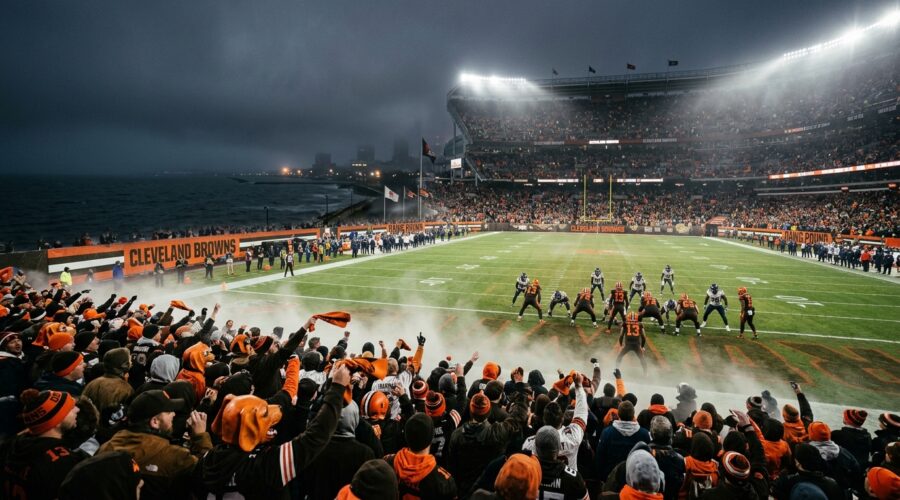
Thursday Night Football in Cleveland has a very specific energy. The lake wind whips off Lake Erie, the Dawg Pound gets loud enough to rattle your molars, and for the better part of two decades, the Pittsburgh Steelers have flown into Huntington Bank Field and found a way to lose. They are 0-4 all-time on Thursday nights in that building. They are 0-9 in road Thursday night games against divisional opponents. Zero wins. Nine games. That is not a slump — that is a haunting.
Into this specific corner of football purgatory steps Mike McCarthy, 62-year-old Pittsburgh native, newly minted Steelers head coach, and a man who has apparently decided his first year on the job should include as many impossible situations as possible. He brings with him a 42-year-old Aaron Rodgers, a Week 3 passing offense that finally looked functional, and a road record that reads 3-6 against the spread since the start of 2025. Ideal conditions for a division-defining Thursday night game in early October. Totally fine.
The Cleveland Browns, meanwhile, are sitting at 2-1 and operating with the peculiar confidence of a franchise that just traded away its best player, watched a second-year defensive tackle explode into one of the best pass rushers in football, and now has Deshaun Watson quietly putting together the best statistical stretch of his career. Week 4 of the 2026 NFL season kicks off on October 1st at 8:15 PM ET on Amazon Prime Video. Both teams are 2-1. The winner takes outright first place in the AFC North. The loser has to go explain to their fan base what happened. Let’s break this down properly.
The Standings Nobody Predicted and Everyone Somehow Got
As of September 30th, 2026, the AFC North looks like a traffic jam. The Pittsburgh Steelers are 2-1. The Cleveland Browns are 2-1. The Baltimore Ravens are 2-1. The Cincinnati Bengals are 2-1. All four teams, identical records, all knotted together in the kind of early-season four-way tie that sounds exciting in theory and causes genuine existential stress for anyone running division tiebreaker scenarios in a spreadsheet.
Pittsburgh holds the fourth AFC seed on conference record. Cleveland is eighth. Those details are temporary and irrelevant the moment one team climbs to 3-1. Thursday night is the first crack in the dam, and both franchises know it. Win, and you spend the next three weeks with a half-game cushion and legitimate first-place bragging rights in one of the most balanced divisions in football. Lose, and you spend those same weeks watching the scoreboard ticker every Sunday afternoon like a man checking his retirement account during a market correction.
The stakes are real. The games are rarely clean. That is exactly what the NFL ordered for prime time.
The Historic Curse Pittsburgh Cannot Seem to Shake
Let’s spend a moment on the historical record, because it is genuinely remarkable in the worst possible way for Steelers fans. Pittsburgh is 0-4 on Thursday Night Football in Cleveland. The losses: 6-13 on December 10, 2009. 7-21 on November 14, 2019, which was the game where Myles Garrett ripped Mason Rudolph’s helmet off and used it as an impromptu weapon — Pittsburgh lost that one by 14 and also somehow ended up being the team that people felt bad for, which is an achievement. 17-29 on September 22, 2022. 19-24 on November 21, 2024.
That last one stings particularly because it was competitive. The Steelers had opportunities. They still lost. That is kind of the theme.
Expand the sample slightly: Pittsburgh is 0-9 in road Thursday night games against division opponents. Nine games. Not one win. At some point you stop calling it a trend and start calling it a structural condition. Mike McCarthy has inherited a team that is historically allergic to winning in this exact scenario, and to his credit, he has not publicly acknowledged this as a problem. That might be wisdom or it might be willful ignorance. The sample is too small to determine which.
Cleveland, for contrast, is 10-2 all-time at home on Thursday Night Football and has won nine consecutive such games. Their home Thursday night record against Pittsburgh specifically is 4-0. The Browns have literally never lost a home Thursday night game to the Steelers. If you squint at this the right way, you could argue Thursday night Huntington Bank Field is actually the safest environment in professional football — at least if you are wearing brown and orange.
The Coaching Subplot That Makes This Game Genuinely Interesting
Both of these franchises are running new head coaches in 2026, and the contrast between the two hires tells you a lot about where each organization thinks it is.
Pittsburgh hired McCarthy on January 27, 2026, ending the Mike Tomlin era after 19 seasons. Tomlin went 28-8-1 against Cleveland in his career. He is also 0-4 on Thursday nights in Cleveland. Those two facts exist simultaneously and are both true. McCarthy comes in with a career record of 174-112-2, a Super Bowl ring from Green Bay, and a very specific familiarity with his new quarterback, having coached Aaron Rodgers for 13 seasons with the Packers. He is a Pittsburgh native. He runs the city. He has the cultural credentials. He also went 49-35 in five seasons with the Dallas Cowboys, a fact that tends to show up in the footnotes whenever someone argues this hiring was an obvious slam dunk.
The early returns have been mixed. Pittsburgh scored a combined 23 points in the first two weeks of the season, including a 20-3 disaster at New England in Week 2 that read like a McCarthy Cowboys flashback for anyone who squinted hard enough. Then Week 3 happened: 30-27 over Cincinnati, 411 total yards, Rodgers threw three touchdowns, Jaylen Warren ran for 127 yards, and suddenly the offense looked like a functional NFL unit rather than an elaborate performance art piece about offensive ineptitude. One breakthrough game. Three weeks of sample. The range of outcomes here is still enormous.
Todd Monken took the Cleveland job in January 2026 and has spent three weeks trying to convince everyone that trading away Myles Garrett — a man who set the all-time single-season sacks record with 23 in 2025 — was actually a smart organizational decision. His prior head coaching experience is Southern Mississippi from 2013 to 2015. His prior coordinator experience includes running Baltimore’s offense from 2023 to 2025, where the Ravens ranked first in rushing yards per game in 2023 and 2024, though they slipped to third in 2025. He is a run-first guy operating a team built around an athletic quarterback who adds a rushing dimension, a bruising second-year running back, and a defensive line that is suddenly getting pressure without its franchise cornerstone.
It is McCarthy’s first career meeting with Monken as head coaches. Neither man has any historical data on the other. Both are improvising in real time. That uncertainty is, oddly, one of the most interesting aspects of Thursday’s game.
Aaron Rodgers, 42, Playing His Last Season, Going Somewhere He Has Never Been
Aaron Rodgers confirmed in May 2026 that this is his final NFL season. He signed a one-year deal with Pittsburgh to reunite with McCarthy, the coach who watched him win two MVP awards in Green Bay — in 2011 and 2014. It is a very cinematic final chapter — quarterback and coach, together again, one last run. The NFL loves this kind of narrative and so do television networks, which is probably not a coincidence that this game is in Week 4 and not Week 14.
The 2026 statistics through three games: 58.4 completion percentage, 700 yards, four touchdowns, two interceptions, 81.0 passer rating, a PFF grade of 68.4 (19th among 36 qualified quarterbacks). These are not Hall of Fame numbers. They are also not catastrophic numbers. They are the numbers of a quarterback who had an opening week that looked functional, a second week that looked like a man playing against five defensive linemen, and a third week that looked like Aaron Rodgers actually remembered how to play football. The 292-yard, three-touchdown performance against Cincinnati featured an average intended air yards of 10.8, which ranked top-five in the league that week. He threw a 38-yard touchdown to Roman Wilson and a 60-yard wheel route touchdown that was a reminder that even at 42, Rodgers can still stress a defense vertically.
PFF projects him for 222.8 passing yards and 1.8 touchdowns Thursday — a QB-30 ranking reflecting the low-scoring, defensive-dominant environment the market is pricing in. He has never played at Huntington Bank Field on a Thursday night. That is not necessarily meaningful on its own, but when you layer it on top of Pittsburgh’s 0-9 road Thursday divisional record, it becomes another data point in the pile that suggests this is not Rodgers’ ideal setting.
The other complicating factor is the defensive line waiting for him on the other sideline, which we will get to momentarily.
Deshaun Watson Is Playing the Best Football of His Cleveland Career and Nobody Is Really Talking About It
Deshaun Watson, 31 years old, through three games in 2026: 68.3 completion percentage, 587 yards, five touchdowns, one interception, 104.1 passer rating. His Week 2 performance at Tampa Bay — 24 of 30, 80 percent, 238 yards, two touchdowns, zero interceptions, 121.9 passer rating — was one of the cleaner statistical performances by any quarterback in the league that week. He also adds 35 rushing yards per game as an average, giving the Cleveland offense a dimension that makes it genuinely difficult to scheme against on a short week.
His career record against Pittsburgh is 0-3. All three losses were in Pittsburgh. He has never beaten them at home. He has never played them at home on a Thursday night. Those are separate facts, and separating them matters, because the environment Thursday is dramatically different from anything Watson has faced against Pittsburgh before.
His fourth-quarter QBR has been among the best in the NFL through three weeks, highlighted by an eight-play, 55-yard game-winning drive against Carolina in Week 3 that culminated in his second touchdown pass to tight end Harold Fannin Jr. Watson is a guy who has historically been criticized for wilting in critical moments. His 2026 data, small as the sample is, suggests something different is happening. Whether Thursday night against Pittsburgh’s pass rush is where that evolution continues or cracks under pressure is the central question of the game.
Mason Graham’s Breakout and the Interesting Economics of Trading Away a Record-Setter
The Myles Garrett trade is one of the defining roster moves of the 2026 offseason. Cleveland sent the two-time Defensive Player of the Year — the man with the most sacks in a single season in NFL history — to the Los Angeles Rams for Jared Verse, a 2027 first-round pick, a 2028 second-round pick, and a conditional 2029 third-round pick that would be elevated to a first-round pick if Garrett is traded to another AFC North team before 2029. Verse was the 2024 Defensive Rookie of the Year. He is 25 years old. He has 2.5 sacks through three games with Cleveland and is developing as the team’s primary edge rusher.
The more immediately interesting consequence of the Garrett trade, though, is what it did for Mason Graham.
Graham was drafted fifth overall in 2025 out of Michigan. He started all 17 games as a rookie. He finished with 0.5 sacks. That number looked damning in isolation, but the context explains it: playing alongside Myles Garrett, who was posting 23 sacks and drawing double teams every single week, meant that Graham was rarely seeing one-on-one blocking. Every interior offensive lineman’s attention was split between managing Garrett off the edge and whatever Graham was doing in the middle. Graham was never the centerpiece. He was the supporting character in someone else’s movie.
In 2026, Graham is the movie. Through three games: 15 tackles, six tackles for loss, five quarterback hits, and 4.0 sacks. ESPN’s extrapolated full-season projection at that pace is 17 sacks, which is All-Pro conversation territory. He is tied for second in the NFL in sacks entering Week 4, behind only Greg Rousseau’s six. His quick hands, added offseason muscle, and comfort in his second year have combined to make him one of the most disruptive interior defenders in football. And on Thursday night, his primary assignment is to make Aaron Rodgers’ life miserable by collapsing the pocket through a Pittsburgh interior offensive line that is already dealing with their own injury concerns.
This is the part of the Garrett trade that Cleveland’s front office was counting on. It took three games to validate it, but the early evidence is compelling.
The Pass Rush Arms Race: Watt, Highsmith, Graham, and a Cleveland O-Line That Is Very Much Not Healthy
The most analytically interesting dimension of this game is what happens when you have two of the NFL’s most dangerous pass rush units going against two offensive lines dealing with significant health issues.
Pittsburgh’s side of the equation is T.J. Watt and Alex Highsmith. Watt enters Thursday with 3.5 sacks through three games. After a 2025 season where a collapsed lung limited him to seven sacks in 14 games — a below-standard number by his considerable historical standards — he appears to be healthy and motivated in 2026. Defensive coordinator Patrick Graham has moved him around formations rather than stationing him exclusively at left edge, creating the kind of unpredictability that makes offensive coordinators lose sleep on Wednesday nights. Highsmith has 3.0 sacks, ranking third in the NFL, making this arguably the best edge tandem in the AFC.
They are facing a Cleveland offensive line that is missing Elgton Jenkins (concussion, DNP) and has Teven Jenkins (back, DNP to limited) as a significant question mark. Dawand Jones — 6-foot-8, 374 pounds, operating as a human wall at right tackle — will likely draw primary Watt assignments. Rookie Spencer Fano is in just his third career NFL game on the other side. These are not ideal conditions for protecting a quarterback against the best pass rush duo in the conference.
Cleveland’s side features Graham inside, Verse on the edge, and a Pittsburgh offensive line protecting a 42-year-old quarterback on a short week. The Steelers are missing Rico Dowdle (toe) at running back, which limits their ability to keep extra blockers in the backfield without sacrificing the run threat. Jaylen Warren, the clear lead back with Dowdle out, is averaging 5.7 yards per carry and coming off a 127-yard Week 3 performance. He can be a chip blocker and a check-down option, but with Graham lined up against the center-guard tandem of Dan Feeney and Mason Cole, the interior matchup is one Graham should be able to win on a consistent basis.
The SportsLine model projects both quarterbacks under 200 passing yards and neither rusher over 70 yards. That projection is built around both pass rush units doing meaningful damage. If that model is right, this game will be decided by who makes fewer unforced errors in the fourth quarter — which brings us back to Watson.
The Wildcard: DK Metcalf vs. a Concussed Denzel Ward
DK Metcalf is averaging 15.2 yards per catch through three games, has 261 yards, and has scored three touchdowns. He is Pittsburgh’s most explosive weapon and the one receiver who can flip a defensive game plan with a single play. If Rodgers can get him in a one-on-one situation downfield, the math changes significantly.
The problem for Cleveland is that their best answer for Metcalf — cornerback Denzel Ward — is listed as limited with a concussion heading into Thursday. Ward is the kind of shutdown corner who can neutralize what Metcalf does on the outside. A limited version of him, or a replacement option, changes the defensive calculus considerably. If Ward cannot go or plays at reduced capacity, Cleveland is essentially asking whoever lines up opposite Metcalf to handle one of the best wide receivers in the game without their top resource.
This is the matchup that could blow the low over/under (38.5, the lowest of any Week 4 game) out of the water. One Metcalf downfield touchdown against a compromised corner changes the entire scoring narrative. This is also the matchup that could completely evaporate if Ward is healthy enough to lock him down. The injury update on Ward between now and kickoff is arguably the single most important piece of injury information to track.
Quinshon Judkins and the Invitation Pittsburgh’s Run Defense Just Extended
While everyone focuses on the pass rush matchup, there is a running back on the Cleveland roster who has been quietly underperforming and is about to face a run defense that has been among the most generous in the league.
Quinshon Judkins, second-year back out of Ohio State, is averaging 3.0 yards per carry through three games (124 yards, zero touchdowns). His first two opponents were Jacksonville and Tampa Bay — both top-five run defenses from 2025. He managed a combined 54 yards in those games. Week 3 against Carolina was better: 70 yards on 18 carries at 3.9 yards per carry, a number that looks modest but at least suggested the wheels were functional.
Pittsburgh’s run defense is ranked 24th in the NFL through three weeks, allowing an average of 128 rushing yards per game. In a league with 32 teams, Pittsburgh is a bottom-third unit against the run. Judkins coming off two games against stout run defenses and now facing one of the league’s softer matchups is the kind of setup that makes fantasy analysts and betting syndicates both sit up and pay attention. If Cleveland’s run game gets going Thursday — Watson keeping it with his legs, Judkins finding lanes, Raheim Sanders rotating through — it will open up play-action opportunities that could make Watson’s night considerably easier.
The 247Sports headline practically wrote itself: “Perfect Opportunity to Unleash Quinshon Judkins on Thursday Night.” That framing is not wrong, but it does assume Cleveland’s offensive line can create lanes despite being significantly banged up. That tension — great matchup on paper versus real injury concern — is the exact kind of nuance that separates a clean prediction from a realistic one.
Harold Fannin Jr. and the Tight End Nobody Was Watching Until Week 3
One more name that deserves attention: Harold Fannin Jr. The Browns tight end has 14 catches, 126 yards, and two touchdowns through three games, with a PFF receiving grade of 74.2 (10th among all tight ends in football). He caught the game-winning touchdown against Carolina in Week 3 — the second of his two scores in that game — and has run up target shares of 20 percent and 30 percent in Weeks 2 and 3 respectively. Watson trusts him. The design of the Cleveland offense clearly involves getting him in space against linebackers and between zones.
Pittsburgh’s linebacker corps is capable, but tight ends who can function as a reliable third-down option and red zone weapon tend to find soft spots. If Cleveland is dealing with a compromised offensive line and needs Watson to get the ball out quickly, Fannin Jr. is the most likely pressure relief valve. Expect his target share to remain high Thursday night, especially in the second half if the game is close.
The Numbers That Actually Matter for Betting
Pittsburgh is a 2.5-point road favorite. The moneyline is Pittsburgh -146, Cleveland +123. The over/under is 38.5 — the lowest of any game in Week 4 of the 2026 season, which is the market telling you everything you need to know about what oddsmakers think happens when these defenses get going.
Cleveland is 7-2 against the spread at home since the start of 2025 and 6-1 as a home underdog. Pittsburgh is 3-6 against the spread on the road in the same window. The SportsLine model has the Under hitting in 55 percent of simulations. When you layer the ATS data on top of the TNF historical records on top of the injury context on Cleveland’s offensive line, there is a reasonable case for the Browns as the sharp play here even with Pittsburgh getting the better of the quarterback matchup on paper.
However — and this matters — Pittsburgh’s 2.5-point favorite status is not absurd. Rodgers was functional in Week 3. Watt and Highsmith are healthy. Metcalf is a problem for any secondary, particularly a compromised one. The Steelers are not some decrepit franchise limping into Cleveland on a short week. They are a 2-1 team with real weapons and a motivated defensive unit. The 3-6 ATS road record is a trend, not a guarantee.
Final Analysis: Two New Coaches, One Old Curse, and a Division That Cannot Afford Either Team to Blink
The cleanest way to frame Thursday night is this: Pittsburgh brings the better quarterback on paper, the better edge duo on paper, and the worse historical record in this specific building on this specific night of the week. Cleveland brings the better statistical quarterback over three games, a defensive tackle who has emerged as one of the most disruptive players in football, a home crowd that has never lost a Thursday night game to Pittsburgh, and a Watson who has never had the chance to prove he can beat Pittsburgh when they come to him.
McCarthy needs to prove his team can win in environments where Mike Tomlin could not. Monken needs to prove that trading Myles Garrett was defensible, which is a thing he will have to prove every week until Mason Graham either sustains the breakout or does not. Rodgers is in the final chapter of a career that will end in the Hall of Fame regardless of what happens in Cleveland on October 1st. Watson is in the first chapter of whatever version of himself he becomes once the narrative finally stops defining him by everything that went wrong before 2026.
The historical record favors Cleveland. The injury report favors Pittsburgh’s pass rush. The ATS data favors Cleveland at home as an underdog. The momentum favors Pittsburgh after Week 3. The over/under at 38.5 means both units have to fail for the total to cash, which is plausible and not certain.
Browns 20, Steelers 17. Under 38.5. Watson hits Fannin Jr. in the fourth quarter with the game on the line, Watt gets a sack but Pittsburgh does not score in the final drive, and the 0-5 all-time Thursday night record in Cleveland becomes the most statistically absurd number in Aaron Rodgers’ final season. Graham finishes with two sacks and a quarterback hit. Nobody in Pittsburgh feels good about it. The AFC North, somehow, remains a mess.
At the very least, it will be worth watching. Even if you are streaming it on Amazon Prime, which is just something we all do now, apparently.