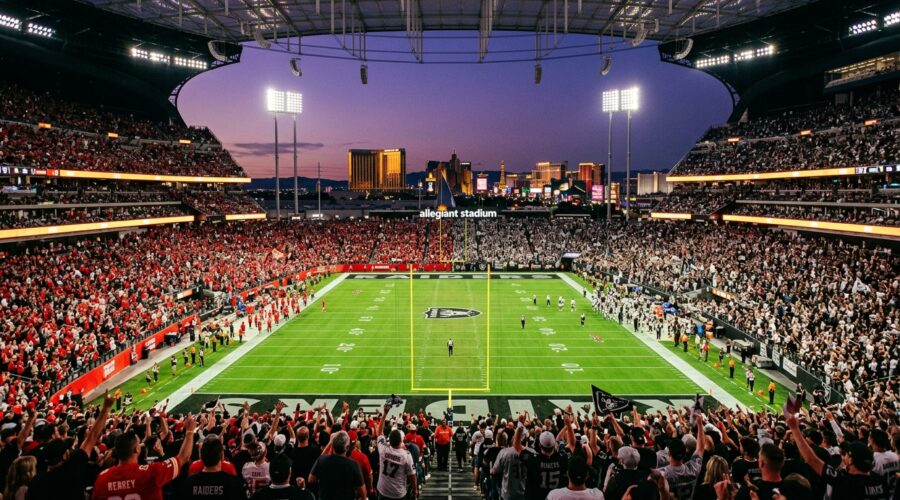
Two teams. Zero losses. One game that could set the tone for the entire AFC West pecking order before October has finished introducing itself. When the Kansas City Chiefs (3-0) roll into Allegiant Stadium to face the Las Vegas Raiders (3-0) on Sunday, October 4th, the NFL is handing us the kind of early-season collision that playoff bracket nerds have been circling since the schedule dropped. The Chiefs are the AFC’s number one seed. The Raiders are somehow sitting at number five despite also being undefeated — which tells you everything you need to know about how ridiculous this division has become in 2026.
One of these teams goes home at 4-0. The other drops to 3-1, loses the head-to-head tiebreaker, and spends the next twelve weeks trying to claw its way back into the conversation. No pressure.
Let’s break this thing down properly — every angle, every matchup, every number that actually matters. Buckle in.
The Stakes, Because Context is Everything
The AFC West entering Week 4 looks like this: Chiefs at 3-0 (AFC’s top seed), Raiders at 3-0 (AFC’s fifth seed), Broncos at 2-1, and the Chargers at 0-3, which is a whole different article nobody wants to write. The winner of Sunday’s game takes sole possession of the division lead and owns the head-to-head tiebreaker over the loser — which, in a tight division race, is the kind of thing that decides playoff positioning in January.
The Chiefs lead the all-time series 76-56-2. Kansas City has dominated this rivalry through most of the Patrick Mahomes era. But the Raiders did steal a 14-12 win in the season finale back in January of 2026 — a result that still lives in Raider Nation’s collective memory like a rare and treasured heirloom. That game, it should be noted, featured Chris Oladokun and Shane Buechele at quarterback for Kansas City. The version of the Chiefs showing up Sunday will be slightly different.
The Quarterback Matchup: Numbers Don’t Lie, But They Do Argue
This is where Sunday gets genuinely interesting, because you have two legitimately efficient quarterbacks operating at a high level — which is not something you could say about this game five years ago when the Raiders’ quarterback situation was, to put it generously, experimental.
Patrick Mahomes
Through three games: 67-of-98 (68.4%), 812 yards, 7 touchdowns, 2 interceptions, 8.3 yards per attempt, 108.9 passer rating, and a +0.236 EPA per pass play — the best passing efficiency number in this matchup by a meaningful margin. He also has 10 carries for 41 yards and a rushing touchdown, because apparently sitting in the pocket the entire time would be too boring.
The more important number, though, is not the box score — it is the clutch play EPA log. Mahomes has produced four separate plays this season with an EPA above +2.50, all in critical moments. The headliner: a 30-yard strike to Tyquan Thornton on 3rd-and-12 in overtime against Indianapolis — EPA of +3.30 — that set up Harrison Butker’s game-winning field goal. He also hit Travis Kelce for an 11-yard touchdown with 3:01 left against Miami on 3rd-and-6 (EPA: +3.13) to ice a road win. The pattern is consistent: Mahomes does not just play well in big moments, he elevates. According to historical playoff data, Kansas City’s conversion rate on potential game-tying or go-ahead drives in the fourth quarter or overtime under Mahomes is 71 percent — a figure that makes every other quarterback in the league look like they are playing a different sport.
Kirk Cousins
Here is the part of the article where Kirk Cousins deserves more credit than he is probably going to receive: the man leads the NFL with 9 touchdown passes and carries a 107.2 passer rating through three weeks. He is completing 67.4 percent of his throws for 7.2 yards per attempt and posting a +0.155 EPA per pass play. That EPA figure ranks second in this game, and second is not first, but it is also genuinely good.
Cousins’ signature moment of 2026 came in Week 3 against New Orleans. The Raiders trailed 27-22 entering the fourth quarter. Cousins orchestrated a comeback, capped by a 4-yard walk-off touchdown to Brock Bowers with 6:22 remaining. The defense did its part, but Cousins made the throws when the game was on the line. The narrative around Cousins has always been that he wilts in big games — Sunday will be the largest regular-season game of his Raiders tenure, and the answer to that question has significant implications for how seriously we take Las Vegas as a legitimate contender.
The gap between Mahomes (+0.236 EPA) and Cousins (+0.155 EPA) is real. It is about 0.08 EPA per pass play — which sounds small until you run 35 passing plays and suddenly realize Mahomes has created roughly three additional expected points of value over the course of a game just from his arm. That is not nothing. That is, in fact, a field goal.
The Rushing Game: A Tale of Two Situations
Kenneth Walker III vs. the Raiders’ Run Defense
Kenneth Walker III is the NFL’s leading rusher through three weeks with 360 yards on 65 carries — a 5.5 yards-per-carry average that is built on consistency rather than flukes. He broke a 60-yard touchdown run against Denver on a 4th-and-1 call that Andy Reid apparently decided was a perfectly reasonable gamble, and he has been the ground-game engine Kansas City has needed since the Kareem Hunt days. He also has 11 receptions for 82 yards and two receiving touchdowns, making him a genuine dual threat out of the backfield.
The Raiders allow 4.47 yards per carry — which is the weakest statistical link in their defensive profile. Las Vegas’ run defense EPA allowed is -0.202 per rush, which looks excellent on paper, but that number has been inflated by the quality of opponents faced. Walker, running behind an offensive line averaging 5.21 yards per carry in run blocking, is the best rushing attack Las Vegas has faced all season. If Walker gets going early, play-action becomes a weapon. If play-action becomes a weapon, Mahomes carves up a secondary that, despite its strengths, is not built to handle a suddenly two-dimensional offense operating in space.
Ashton Jeanty vs. the Chiefs’ Run Defense
The counter-narrative here is that Jeanty’s rushing numbers (206 yards, 3.3 YPC, zero rushing touchdowns) look underwhelming for a player who was supposed to be a generational ground threat. The honest explanation: defenses have schemed against him with extra bodies in the box, and the Raiders have not always had the offensive line execution to open consistent lanes. His -0.197 team run EPA per play is a glaring number.
Against Kansas City’s run defense — which holds opponents to 3.90 yards per carry and -0.048 EPA per rush — the run game faces its toughest test of the season. The Chiefs’ front, anchored by Chris Jones and Peter Woods, with Felix Anudike-Uzomah and George Karlaftis providing edge pressure, is built to make exactly this kind of game miserable for opposing running backs.
However. And this is an important however. Jeanty’s receiving production is where the real conversation lives. He has 13 catches for 97 yards and two receiving touchdowns, and his 22-yard catch-and-run against New Orleans set up the game-winning drive in the fourth quarter. The Chiefs’ linebackers — Nick Bolton and Drue Tranquill — are excellent against the run but become more exploitable in space. If Klint Kubiak designs a game plan that gets Jeanty isolated on linebackers as a receiving option rather than asking him to bull through the Chiefs’ defensive line, the Raiders open up a legitimate window. The question is whether the Las Vegas coaching staff is disciplined enough to stick to that plan when the crowd wants to see Jeanty run up the gut.
The Weapons: Kelce, Bowers, Rice, and the Slot Battle That Defines the Game
Travis Kelce
Fourteen receptions, 231 yards, 16.5 yards per reception, two touchdowns. Kelce is operating with the effortlessness of someone who has been doing this for over a decade, because he has been doing this for over a decade. His 59-yard catch-and-run against Denver on a Mahomes dump-off — turning a short pass into a chunk play through sheer elusiveness — is the kind of play that defensive coordinators watch on film and then stare blankly at a wall for a while.
The Raiders will likely bracket Kelce with a safety over the top and a linebacker underneath, which is the standard solution that Kelce and Reid have been solving since approximately 2013. Andy Reid’s pre-snap motion packages and varied Kelce alignments — splitting him wide, flexing him in the slot, hiding him in the backfield — create identification problems that cascade into coverage errors. The Raiders’ defensive coaching staff has a week of prep. Reid has been installing counters to these exact looks for fifteen years. This is not an even chess match.
Brock Bowers: The X-Factor That Could Break This Game Open
Brock Bowers played one game this season — Week 3 against New Orleans — after returning from injury. He posted 10 catches on 13 targets for 116 yards and a touchdown. In one game. That production line is not a misprint. If Bowers is healthy and on the field Sunday, the Raiders’ offense transforms from a functional unit into something legitimately dangerous. He creates linebacker-versus-tight-end mismatches in the passing game that simply do not have clean answers. Nick Bolton and Drue Tranquill are good. They are not built to run with Brock Bowers for 60 snaps.
His health status is the single most important piece of injury information heading into this game. A healthy Bowers plus a healthy Cousins gives the Raiders a passing attack capable of hanging with anyone in the AFC.
Rashee Rice vs. Hezekiah Masses: The Slot Battle of the Week
This is the individual matchup that deserves its own film session. Rashee Rice has 13 receptions for 190 yards at 14.6 yards per reception — the most consistent and dangerous receiving option Mahomes has outside of Kelce. He works primarily from the slot, runs precise routes at full speed, and turns routine completions into chunk gains with regularity.
Hezekiah Masses is having one of the most statistically absurd three-week starts for a cornerback in recent memory. He is tied for the NFL lead with three interceptions, along with Jevon Holland who also has three through Week 3, adds four pass deflections, and has 11 tackles. He is the hottest defensive back in football right now, and he has earned every bit of that reputation. The problem — and this is the structural challenge for Las Vegas — is that Masses being excellent means Mahomes will test him early, repeatedly, and in ways designed to exploit the first moment of overconfidence. Mahomes does not back down from good cornerbacks. He treats them as puzzles.
If Masses blankets Rice and forces Mahomes to find other answers, Las Vegas wins this individual battle. If Rice exploits a single coverage tendency — a shade too much inside leverage, a step late out of the break — Mahomes will find it, exploit it, and Rice will go for 80 yards before anyone adjusts. The margin here is razor-thin and will likely determine which offense operates at full efficiency.
The Pass Rush: Crosby, Paye, and Whether Mahomes Has Time to Think
Maxx Crosby has 1.5 sacks and a forced fumble this season. Kwity Paye has two sacks and one stop for loss — he has been the Raiders’ most disruptive individual defender in 2026. Together, they form the best edge-rushing tandem Mahomes will have faced this season.
The Chiefs’ offensive line — Humphrey, Smith, Ezeudu, Simmons, and Moore — has been excellent in pass protection. Mahomes has shown clean pocket presence all season, which is part of why that 108.9 passer rating is legitimate rather than inflated by clean coverage situations. Getting consistent pressure on Mahomes is both the most important thing Las Vegas can do and also one of the harder tasks in professional football. When the pocket breaks down, Mahomes extends plays, finds third options, and occasionally does something that makes the broadcast crew involuntarily gasp. The Raiders need Crosby and Paye to be disciplined in their rush lanes while still generating heat. That is easier said than executed.
The Advanced Metrics Picture: A Clear Edge With Legitimate Caveats
Here is the complete side-by-side, because the numbers tell most of the story:
- Pass EPA per play (offense): Chiefs +0.236, Raiders +0.155 — Kansas City advantage
- Rush EPA per play (offense): Chiefs +0.125, Raiders -0.197 — Kansas City significant advantage
- Pass EPA per play allowed (defense): Raiders -0.159, Chiefs -0.127 — Las Vegas advantage
- Rush EPA per play allowed (defense): Raiders -0.202, Chiefs -0.048 — Las Vegas advantage
- Third-down conversion rate: Chiefs 47.2%, Raiders 43.2% — Kansas City advantage
- Red zone TDs: Chiefs 9, Raiders 8 — Chiefs slight advantage
- Red zone EPA: Chiefs +0.063, Raiders -0.059 — Kansas City advantage
- Turnover differential: Chiefs -2 total turnovers, Raiders -4 total turnovers — Kansas City significant advantage
The Raiders’ defense has outperformed the Chiefs’ defense in both EPA categories. Las Vegas bends but does not break in a way that has produced real wins. That is genuinely impressive and should not be dismissed.
But Kansas City’s offense is better — by a meaningful margin — in every metric that directly correlates with scoring points. The Chiefs convert third downs at a higher rate, finish in the red zone more efficiently, and have turned the ball over half as often. Four turnovers in three games is a pace that does not survive playoff-level competition, and Mahomes facing a ball-hawk secondary like Las Vegas’ is precisely the kind of game where turnover differential becomes decisive.
Allegiant Stadium: Where the Narrative Gets Complicated
Allegiant Stadium is a fully enclosed dome with a capacity of 65,000. The stadium’s low roof and reflective design amplify crowd noise in ways that make it legitimately uncomfortable for visiting offenses at peak volume. For a Raiders team that has not had this much energy behind a home game in years, Sunday’s crowd will be loud, engaged, and emotionally invested in a way that Allegiant Stadium has rarely experienced during the franchise’s Las Vegas tenure.
Here is the honest counterpoint: the Raiders’ all-time home record at Allegiant Stadium through the 2026 season is 22-30 — a .423 winning percentage that is historically poor for a home venue. The stadium has not always been the fortress the Raiders needed it to be. The 2026 team, at 3-0 and energized by its best start in years, has the best shot at changing that narrative. A massive crowd showing up for a genuine division showdown is exactly the scenario that can flip the home-field equation.
The Chiefs went to Miami in Week 3 and won 24-10. They have proven they can operate efficiently in hostile road environments. But there is a difference between Hard Rock Stadium in September and Allegiant Stadium in October with both teams undefeated and the AFC West on the line. If the Raiders score early and that dome gets truly loud, third-down communication and snap counts become legitimate factors for Kansas City’s offense.
The Coaching Angle: Reid’s Creativity vs. Las Vegas’ Structure
Andy Reid’s offense is not just play-calling — it is a pre-snap information war. The motion packages, varied personnel groupings, play-action sequences built off Kenneth Walker’s run volume, and Travis Kelce’s alignment versatility combine to create a system that forces opposing defenses to make decisions before the ball is snapped. Every decision has a counter. Every counter has a counter-counter. It is the reason Reid has been one of the most dangerous offensive minds in football for over three decades — with approximately 34 years in professional football since 1992, and 44 years in coaching overall — and shows no meaningful signs of slowing down.
The Las Vegas defensive staff, under first-year head coach Klint Kubiak, has been reasonably effective through three games. But none of those three opponents were Andy Reid. The jump in opponent quality Sunday is significant, and how the Raiders’ defensive gameplan holds up under Reid’s pre-snap pressure — particularly in the second half when adjustments become critical — will tell us a great deal about how seriously to take this Las Vegas team going forward.
The Prediction: Chiefs 30, Raiders 27
The turnover differential is the number that keeps pulling this prediction back toward Kansas City. The Raiders have lost four turnovers through three games facing three opponents who were not Patrick Mahomes. Hezekiah Masses is the NFL’s hottest defensive back, and a Mahomes interception in a tight game — particularly with a crowd that loud — could be the play that swings everything. Mahomes has been careful with the ball this season (2 interceptions, 0 fumbles lost), but he will be tested.
The red zone efficiency gap is the second number. Kansas City has a positive EPA in the red zone (+0.063). Las Vegas has a negative EPA in the red zone (-0.059). In a one-score game decided in the final minutes, the team that converts its scoring opportunities into touchdowns rather than field goals almost always wins.
The historical clutch data on Mahomes is simply overwhelming. A 71 percent conversion rate on game-tying or go-ahead drives in the fourth quarter and overtime is not a streak — it is a superpower. Kirk Cousins had his own fourth-quarter moment against New Orleans, but that was against a Saints defense. Sunday is a different category of challenge entirely.
The scenario that makes sense: the Raiders play well enough to lead or be tied late, the Allegiant Stadium crowd reaches full detonation level, and Mahomes responds with exactly the kind of methodical, ice-in-the-veins drive he has been running since 2018. A field goal or a short touchdown in the final minutes. Chiefs 30, Raiders 27. Kansas City goes to 4-0 and asserts itself as the legitimate AFC number one seed. Las Vegas drops to 3-1 but remains very much in contention — this is not a burial, it is a measuring stick game that tells the Raiders what they need to fix.
The counter-scenario — the one that keeps Raider fans reading until the final snap — involves Brock Bowers being healthy and dominant, Hezekiah Masses picking off Mahomes in the fourth quarter, and Cousins doing the thing doubters have told him he cannot do: delivering in the biggest game of his Raiders tenure on the largest stage his team has played on at home. That scenario is not absurd. It is around a 38 percent probability if you are running honest numbers. In a sport played by humans in an indoor stadium with 65,000 people screaming, 38 percent is plenty close enough to stay on the edge of your seat for sixty minutes.
This is the game of Week 4. Watch it like it matters, because it absolutely does.
Kansas City Chiefs 30, Las Vegas Raiders 27. Final. Mahomes, as always, gets the last word.