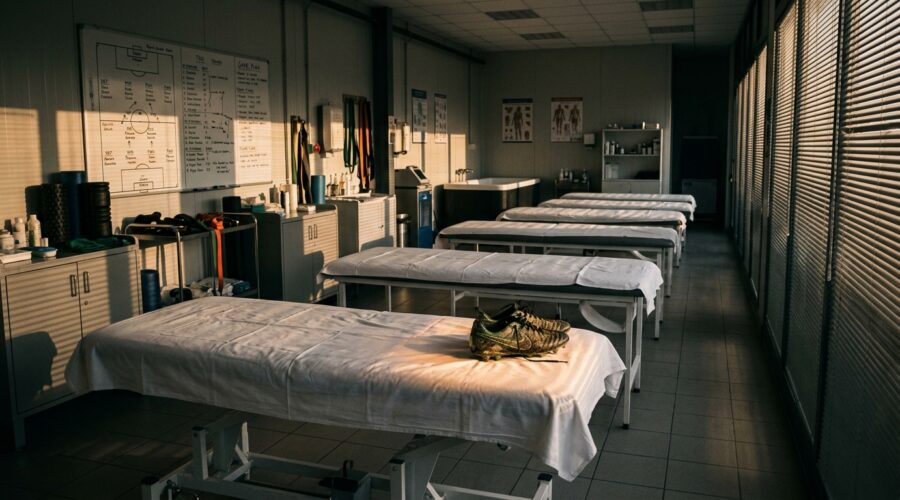
There is a particular cruelty to the modern football calendar that reveals itself not in the fixture list, but in the treatment tables. This weekend, as Real Madrid stole a 2-1 win at Camp Nou without their first-choice goalkeeper, PSG counted the cost of a Champions League victory that claimed three of their finest players in a single evening, and Tottenham Hotspur held their collective breath over the fitness of a man who had waited 526 days for his first start. All of it happened within five days. None of it was especially surprising. And that, more than anything, is the story.
Courtois: The Flu, the Clásico, and the Man Who Keeps Having to Replace Him
Thibaut Courtois, 34, did not miss El Clásico because of a torn muscle or a ruptured ligament. He missed it because of the flu. After eighteen months of rectus femoris tears, adductor strains, and a quad injury that ended his 2026 World Cup quarterfinal against Spain before the seventy-first minute, a virus is almost a punchline — the football gods settling their account with dark comedy.
Real Madrid confirmed the news in a brief club statement, with Reuters carrying the wire: Courtois was ruled out of the side’s LaLiga fixture at Barcelona on Sunday due to illness. In his place: Andriy Lunin, the quietly capable Ukrainian who has spent four years at the Bernabéu existing in the strange professional purgatory of the second-choice goalkeeper — never quite trusted, never quite released, always waiting.
The context made Courtois’s absence feel still heavier. José Mourinho’s Real Madrid arrived at Camp Nou seven points behind an unbeaten Barcelona, without Vinícius Júnior through suspension, without Rodrygo, Raúl Asencio, and Ferland Mendy through injury. Their injury list had already stripped the attacking threat and defensive cover from what was supposed to be a squad capable of mounting a title challenge. Losing their goalkeeper to influenza, the week of a Clásico, felt less like misfortune and more like a punchline someone had left in the script by accident.
Courtois’s recent medical record reads like a physiotherapist’s working nightmare. An adductor injury against Atlético in late September 2025 cost him three to four weeks and ruled him out of the previous El Clásico. A rectus femoris tear in March 2026, suffered midway through a Champions League tie against Manchester City, cost him a further six weeks and his place in Real Madrid’s UCL quarterfinal against Bayern. Then the World Cup quarterfinal, when Belgium met Spain at SoFi Stadium and Courtois was withdrawn in the seventy-first minute with a quad complaint — replaced by Senne Lammens — before being cleared by Real Madrid’s medical staff and reintroduced into the squad on a staggered basis from late July. Now the flu. A short-term absence, in theory. The timing, as ever, immaculate in its inconvenience.
Lunin, to his considerable credit, delivered when the stage was biggest. His miraculous save on Anthony Gordon in the first half — the Englishman breaking alone into the box after stealing possession — was the kind of intervention that shifts matches. Real Madrid won 2-1. Mourinho praised his goalkeeper in terms that suggested genuine admiration, the old manager apparently unwilling to let the occasion pass without credit where it was due. It was Lunin’s moment, and he took it. Whether Courtois’s next injury will give him another one is, at this point, a question the football calendar will answer in its own time.
PSG: The Pyrrhic Four-Two
On Tuesday evening at the Parc des Princes, Paris Saint-Germain beat FC Barcelona 4-2 in the Champions League. By any surface reading, this was a dominant performance from the European champions — fluid, ruthless, a statement of continental intent from Luis Enrique’s side. Look beneath the scoreline, however, and the victory begins to feel less like a triumph and more like a transaction, with PSG paying for three points in a currency they cannot easily recover.
In the nineteenth minute, Ousmane Dembélé — the 2025 Ballon d’Or winner, the best player on the planet by the sport’s own reckoning — accelerated after a poorly controlled ball that had run into space behind the Barcelona defence. He reached for it, felt something in the back of his left leg, and stopped. The substitution board came up soon after. The diagnosis confirmed the following day: a left thigh muscle tear. Estimated return timelines diverged between outlets: Le Parisien reported a recovery of “up to three weeks,” pointing to a return around November 10–14, while RMC Sport put the figure at “around six weeks,” which would extend his absence into late November or early December.
Dembélé at twenty-nine is a player whose career has been defined as much by its interruptions as its brilliance. A right hamstring tear against Ukraine in September 2025. Two separate calf injuries across the 2025/26 season. His first ever fifty-plus appearance campaign, the one that won him the Ballon d’Or, was the exception — the rarity that made the award feel more poignant than celebratory. Luis Enrique had been managing his minutes carefully this season, resting him twice in Ligue 1. The nineteenth minute of a Champions League tie against Barcelona was not supposed to be where the management unravelled.
In the sixtieth minute, the damage deepened. Marquinhos — captain, Brazilian, thirty-two, a man who has been the organisational bedrock of this PSG project through multiple iterations — came off with a right thigh muscle tear. PSG have confirmed he will miss several weeks. Yahoo Sports noted his absence leaves a “leadership void that Luis Enrique will struggle to fill,” which is the kind of sentence that reads like diplomatic understatement. Marquinhos does not just defend; he communicates, organises, and sets the defensive tempo from the centre. Without him, PSG’s back line does not merely lose a body. It loses its voice.
Then there was Kvaratskhelia. The twenty-five-year-old Georgian landed awkwardly while sprinting back to challenge Xavi Espart in the early second half. He could not put weight on his right knee. He was helped from the pitch. The next day, PSG published a statement that contained the words nobody in world football ever wishes to read: rupture of the anterior cruciate ligament. Surgery scheduled in the coming days, in Doha. Return: May or June 2027, at the earliest. Season over.
Kvaratskhelia had been nominated for the 2026 Ballon d’Or after helping PSG to back-to-back Champions League titles. He was their creativity, their unpredictability, the player most likely to do something the opposition had not prepared for. That he will now watch the remainder of this season from a rehabilitation suite is a loss that extends far beyond Luis Enrique’s tactical planning. It is the kind of injury that recalibrates a player’s entire career trajectory, and the kind that supporters of a club tend to remember for years.
Meanwhile, Nuno Mendes — already injured in a separate incident against Strasbourg on October 17 — remains weeks away from fitness. Alessandro Longoni continues in individual recovery. PSG enter their Ligue 1 fixture against Lyon with at least eight players unavailable. They won 4-2 against Barcelona. Whether that result was worth the cost is a question for the coming months, though football rarely waits for an honest answer.
Maddison: The Cruelty Distilled
Of the three stories this week, James Maddison’s is the one that defies the usual clinical language of injury reports. It is not, on the face of it, as severe as a ruptured ACL or as dramatically timed as Courtois’s flu. But there is a particular kind of sadness in the Maddison situation that the numbers carry better than any tactical analysis can.
On October 19, 2026 — a Monday — Maddison started for Tottenham against Coventry. It was his first start in five hundred and twenty-six days. He scored. The kind of return a scriptwriter might have rejected as too neat, too obvious. Tottenham won 3-1. Roberto De Zerbi called him a special player. The terraces at Spurs would have exhaled something approaching relief.
Four days later, at Stamford Bridge, Maddison started again. Tottenham’s second Premier League game of the week, a 2-0 win at Chelsea in GW8. He was bright in the first half, threading passes, connecting lines, looking every inch the player who had shown in previous seasons what an elite Spurs midfield could look like when functioning properly. Then, in the fifty-first minute, he went down unchallenged. He got up, limped to the touchline, and was replaced by Conor Gallagher. Even some of those on the pitch stopped to check he was alright — Maddison, a Tottenham player, drawing concern from those around him as he made his way off.
The provisional diagnosis, per FPL data, is a groin problem. De Zerbi’s post-match assessment was careful in the way managers learn to be: “I think it’s not a very important problem. We need to do the medical check. I hope it’s not a big problem because he’s a special player for us.” Full medical checks were scheduled for October 25. No official club diagnosis has been issued at time of writing.
The context is what makes measured optimism feel fragile. Maddison tore his ACL in May 2025, at the Europa League semi-final against Bodø/Glimt — an injury that, per The Athletic, “destroyed him on the inside.” He missed nearly twelve months. He returned late in the 2025/26 season in cameo appearances, helping Tottenham avoid the unthinkable. Then a shoulder fracture in early September 2026 kept him out for two further weeks. His injury record in 2025 alone: 57 games missed, 323 days lost. He has missed exactly 112 matches through injury since 2018 across his career.
Before the Chelsea match, De Zerbi had acknowledged that Maddison had not trained with the squad for the first three days after the Coventry game. Starting him in a London derby in his second start back, with that kind of training load, raised questions the manager will now have to answer. De Zerbi himself addressed it: “I don’t want to take risks because if you analyse this period of football you can see many injuries, not just for Tottenham.” And yet there he was, in the fifty-first minute, limping toward the touchline.
Tottenham sit twelfth in the Premier League after eight matches, nine points accumulated, a Crystal Palace fixture on October 31 on the immediate horizon. Xavi Simons remains out with an ACL injury of his own. Wilson Odobert is recovering. A squad that was already thin in the creative department has now potentially lost its most technically gifted operator again, having only just recovered him. The football calendar, indifferent as ever, rolls on.
The Dashboard: Where Things Stand on October 25, 2026
- Thibaut Courtois (Real Madrid, GK): Flu. Missed El Clásico. Short-term absence. Lunin deputised brilliantly in a 2-1 Real Madrid win at Camp Nou.
- Ousmane Dembélé (PSG, FW): Left thigh muscle tear, suffered October 20 vs Barcelona (19′). Estimated return: circa November 10–14 per Le Parisien (up to three weeks); late November to early December per RMC Sport (around six weeks).
- Marquinhos (PSG, CB/Captain): Right thigh muscle tear, suffered October 20 vs Barcelona (60′). Expected return: mid-November 2026.
- Khvicha Kvaratskhelia (PSG, FW): Ruptured ACL, right knee, suffered October 20 vs Barcelona. Surgery in Doha. Return: May/June 2027. Season over.
- Nuno Mendes (PSG, LB): Left thigh injury vs Strasbourg, October 17. Return aligned with Dembélé and Marquinhos window.
- James Maddison (Tottenham, MF): Limped off 51st minute vs Chelsea, October 24. Provisional groin problem. Medical assessment pending. Severity unknown.
The Calendar Will Not Wait
These three stories — a goalkeeper felled by the flu, a Champions League winner watching three of his best players depart on stretchers after a famous victory, a midfielder whose brief return lasted just 32 minutes of competitive football before his body gave way again — are not anomalies. They are the rhythm of elite football in 2026, the predictable consequence of a schedule that has not been designed with the human body in mind.
The clubs will adapt. Lunin has already shown he is capable of answering when the call comes. Luis Enrique will reorganise, reshuffle, find interim solutions for the weeks ahead. De Zerbi will be cautious with Maddison’s next return, or at least more cautious than he managed this time. The fixtures will continue. The next round of Champions League matches, the next Premier League gameweek, the next Clásico — they are all already in the diary, immovable, waiting.
What the treatment table cannot absorb, the calendar simply ignores. That has always been football’s particular indifference to its own participants. But it is worth noting it, plainly, in a week like this one, before the next set of injury notifications arrive and everyone moves on.