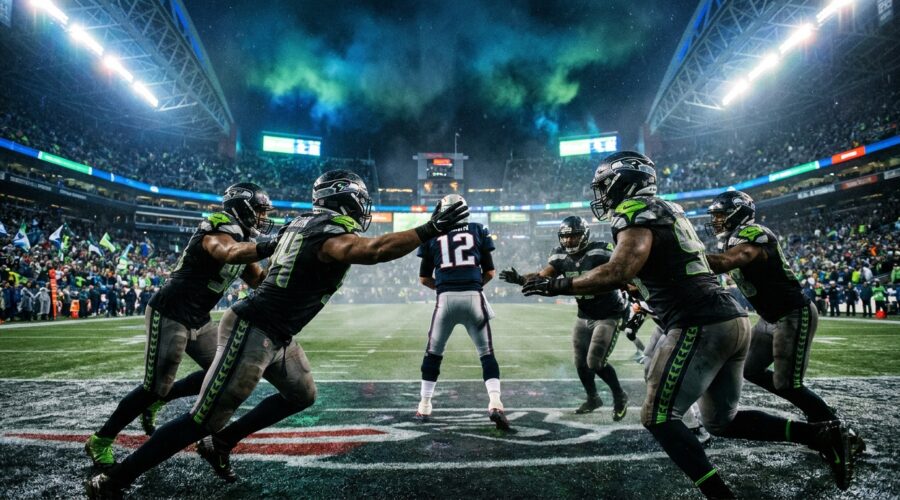
There is a version of this story where you lead with Travis Kelce making history, or with Kenneth Walker III’s awkward homecoming, or with the replay official overturning an incompletion into the touchdown that put this game away. Any of those angles would be fine. But the real story of Sunday night at Lumen Field — the one that will show up in film rooms and coordinator PowerPoints for the next decade — is what Mike Macdonald’s defense did to the most decorated quarterback of his generation over the course of sixty minutes.
The Seattle Seahawks defeated the Kansas City Chiefs 20-3 on Sunday Night Football in Week 7, improving to 4-3 on the season. The Chiefs fell to 5-1. On paper, that is a minor upset. In practice, it was a methodical, almost clinical dismantling. Mahomes finished 19-of-33 for 165 yards, zero touchdowns, one interception, a 58.3 passer rating, and — here is the number that breaks your brain — zero red zone trips. Across his previous 152 combined regular-season and playoff starts, Patrick Mahomes had never once failed to cross the opponent’s 20-yard line. He did it for the first time on Sunday. Seattle also held him without a single explosive play, defined as 20-plus yards. That had never happened to him in a regular-season game, either.
You can talk about missing Rashee Rice (hamstring), Tyquan Thornton (IR, dislocated ankle), and two starting right tackles (Jaylon Moore, concussion; Josh Simmons, IR, herniated disc). Those are real absences. But the Seahawks’ defense does not negotiate with personnel excuses. They ranked first in the NFL entering Week 7 in yards allowed per game at 237.3. They had not allowed a 100-yard rusher in 35 consecutive games, the longest active streak in the league. This is what they do, and they do it with a level of schematic precision that is genuinely uncommon in the modern NFL.
The Scheme: 87.2% Nickel and a Chess Piece Named Emmanwori
Macdonald’s defense ran Nickel personnel on 87.2% of snaps this season, the highest rate in the NFL. That number alone does not tell you much. Plenty of teams play Nickel. The difference is what Macdonald does inside it. The Seahawks deploy split-safety structures that look identical pre-snap regardless of what they are actually doing post-snap — sometimes two-high zone, sometimes single-high, sometimes a pressed man coverage with a free rover. The resolution only happens after the ball is snapped. By then, it is too late for Mahomes to check out of anything.
The linchpin is Nick Emmanwori. The second-year safety lines up everywhere — slot corner, box linebacker, centerfield, and as a delayed blitzer — which makes it structurally impossible to declare him as a fixed coverage player in pre-snap reads. On the game-turning interception in the second quarter, Emmanwori blitzed from the right, forcing Mahomes to step left and abandon his first read. The throw to Jalen Royals was a reflex decision made under pressure, and Ty Okada was already sitting in the throwing lane. The interception put Seattle at their own 34, and they needed just under two minutes to score a touchdown and go up 10-0. The game was effectively over at that point.
Mike Tomlin, working the NBC booth, said Seattle’s defense “destroyed the natural rhythm” of Kansas City’s offense. That is the most precise single sentence you could write about what happened. Rhythm is the currency of the Chiefs’ offense. They live on second-and-short, quick completions to manufactured space, and the threat of Mahomes escaping the pocket. Seattle took all of it away. The interior defensive line — Leonard Williams and Byron Murphy II — controlled the A-gaps against a Kansas City offensive line that was already operating short-handed, limiting Kenneth Walker III to 36 yards on 14 carries at 2.6 yards per attempt. Derick Hall added the exclamation point in the third quarter with a strip-sack on third-and-seven. Mahomes self-recovered, which told you everything about how the Chiefs’ night was going: their best play in the third quarter was a fumble recovery by their own quarterback.
Jaxon Smith-Njigba Is Already the Best Receiver in the NFL, and the Argument Is Getting Embarrassing
While Macdonald was running a masterclass on the defensive side, Jaxon Smith-Njigba was doing what he has been doing all season: being quietly, relentlessly, statistically dominant in a way that the national conversation keeps struggling to fully process.
JSN caught 9 passes for 150 yards and a touchdown against a Kansas City secondary that, even shorthanded, is not a group you want to test. His season line through seven games now reads 58 receptions, 867 yards, and 8 touchdowns. He is averaging 123.9 yards per game. His PFF receiving grade of 92.3 ranks first among all wide receivers. He led the NFL in receiving yards before Sunday and extended that lead Sunday night. He won the NFL Offensive Player of the Year award last season after posting 1,793 receiving yards, the eighth-most in a single season in league history. He is 24 years old.
The touchdown itself was a sequence worth walking through slowly. Darnold hit JSN at the pylon on a 28-yard strike, the receiver getting one foot down while fully extended. The field official called it incomplete. The replay official reversed it to a touchdown. It was the right call, and it made the score 10-0. JSN described the game preparation in terms that made the Chiefs sound like a playoff opponent rather than a Week 7 regular-season matchup: “Playing a team like Kansas City and all the killers that they got on that side, we knew how big this game was, and we wanted this one badly. We saw it as a playoff game.” That framing is not accidental. When you are 3-3 and you get a primetime chance against the defending AFC’s best, you treat it accordingly.
Sam Darnold, Efficient to a Fault (With One Exception)
Sam Darnold’s line — 20-of-28, 257 yards, one touchdown, one interception, 71.4 completion percentage — was his most efficient performance of the season. He managed the game with clean footwork, converted third downs with scrambles at the right moments (a seven-yarder in the second quarter, a ten-yarder in the third), and trusted JSN in man coverage repeatedly, which is about the easiest decision a quarterback can make this season.
The interception was a red-zone end-zone throw at the end of the first half that Nohl Williams read perfectly and returned 64 yards. Darnold acknowledged it after the game. Harrison Butker then attempted a 58-yard field goal as time expired, which fell short. Had that interception not happened and had Butker hit the field goal, the halftime score would have been 10-6 instead of 10-0, which would have been a legitimately different game. Credit the Seahawks for forcing the turnover. Dock Darnold a decision point. Move on.
Emanuel Wilson was the other critical offensive contributor. He carried 24 times for somewhere between 100 and 115 yards depending on the source and scored the game-sealing touchdown — a 21-yard run off left tackle with 3:47 remaining that required him to physically run through Drue Tranquill to get into the end zone. Wilson has been asked to carry a backfield that lost Zach Charbonnet to a torn ACL, and he has done it without complaint or a decline in production. His 4 catches for 25 yards out of the backfield added another dimension to what is increasingly a well-functioning offense.
Kenneth Walker III’s Homecoming Goes Exactly as Well as You’d Expect
There was a lot of pregame theater built around Kenneth Walker III returning to Lumen Field as a Kansas City Chief — the reigning Super Bowl LX MVP, a title he won on February 8, 2026, while playing for the very Seahawks team he was now facing, before signing with Kansas City after the 2025 season. NBC did the full pregame package. Mahomes spoke about how emotional it would be for Walker to return to the place where he built his career. Drue Tranquill, who himself played in Seattle, offered perspective on returning to a former city.
What actually happened: Walker carried 14 times for 36 yards at 2.6 per carry. Leonard Williams and Byron Murphy II spent the evening making him remember exactly why Seattle’s run defense had not allowed a 100-yard rusher in 35 consecutive games. He also added 5 catches for 26 yards in the passing game, which is the sort of floor a player like Walker can always provide but was not going to change the score.
After the game, Walker bypassed the postgame handshakes and went directly to the locker room. His postgame quote: “S—, we lost. I was frustrated. That’s about it. I saw them over there celebrating and s—.” That is an honest answer from a competitor who came back to a place that loved him and got held to 2.6 yards per carry. There is nothing to dress up there. He was frustrated, and he said so, and you cannot really argue with any part of it.
Travis Kelce Makes History in a 3-Point Loss (Which Is Somehow Very On-Brand)
In the middle of all this, Travis Kelce went out and made two separate NFL records, which is the kind of thing that becomes a footnote when your team loses by 17.
His third reception of the game moved him past both Cris Carter (1,101 career receptions) and Marvin Harrison (1,102) into fifth place on the all-time receptions list, with Marvin Harrison now sixth and Cris Carter seventh. He finished the game with 1,104 career catches. He also surpassed Tony Gonzalez for the most receiving yards ever by a tight end in NFL history, including postseason games — a 19-yard catch in the fourth quarter put him over the 15,413-yard mark Gonzalez had set across a Hall of Fame career.
Kelce is 37 years old, averaging 14.9 yards per catch on the season — well above his career average of 12.1 yards per reception, even if not the best per-reception mark of his career. He is functionally not slowing down as a route runner or a receiving threat even as his age climbs into territory where most tight ends have been retired for four or five years. On National Tight End Day, no less, which is either a perfect symmetry or a league office scheduling coincidence. Probably both.
Harrison Butker, 1-for-3, and the Points That Weren’t
Kansas City’s only points came from a Harrison Butker 50-yard field goal in the third quarter, which he converted cleanly. He then missed a 58-yarder at the end of the first half (fell short) and a 45-yarder in the fourth quarter (wide right). The 45-yard miss in the fourth quarter came with Kansas City trailing 13-3. Had it gone through, the Chiefs would have been within a touchdown and a two-point conversion. Instead, they stayed at 10 and Seattle drove for the Wilson touchdown that made it 20-3.
In a game where Kansas City’s offense generated zero red zone trips, field goals were effectively their entire scoring pathway. Butker converting two of those three would not have changed the outcome, but it would have made the final 13-6 with Kansas City having a possession. He did not. That is part of why it ended 20-3.
What This Means Going Forward
The Chiefs, at 5-1, still control their own AFC West destiny with a Week 8 road game at Denver against a Broncos team sitting at 5-2. A loss there would create real pressure in what is shaping up as a legitimately competitive AFC West. Their offensive line health is a genuine concern entering that game, and the receiver room needs Rice back to function at the level you expect from Kansas City.
For Seattle, the win moves them to 4-3 in an NFC West where the 49ers are 6-1 and pulling away. The Seahawks host Chicago on Monday Night Football in Week 8, and the Zach Charbonnet ACL return timeline is the key internal storyline. If Charbonnet comes back and Seattle can pair him with Wilson behind Darnold and JSN, this offense becomes considerably more dangerous. The defense, as established, does not need fixing.
Macdonald’s comment after the game — “That’s Seahawk Football!” — sounds like a coach’s cliche until you look at the box score and realize that the Seahawks just held the best quarterback of his generation to his worst statistical performance across 152 career starts. No red zone trips. No explosive plays. A 58.3 passer rating. 213 total yards against a defense allowing 237.3 per game. The math does not lie, and neither does the scoreboard.
Twenty to three. On Sunday Night Football. Against Patrick Mahomes. That is not a footnote. That is a statement.