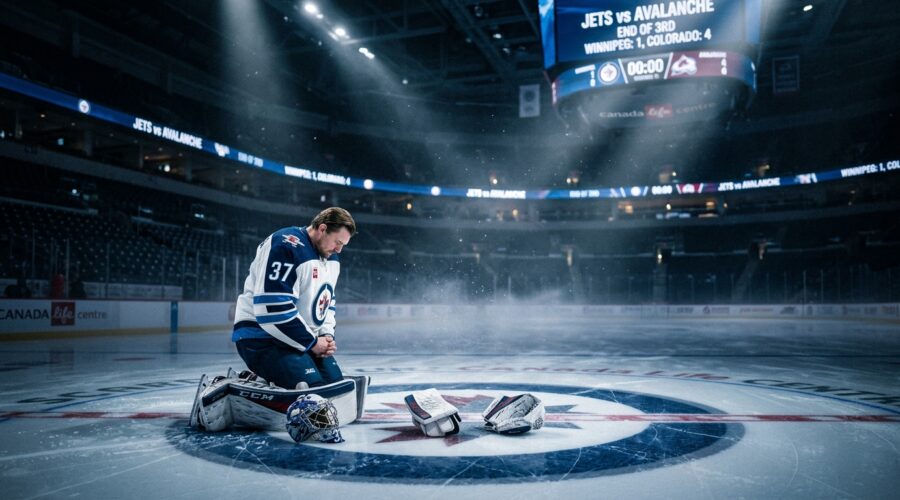
Seven seconds of silence. That is how long Connor Hellebuyck paused before answering a reporter’s question about re-evaluating his future with the Winnipeg Jets. Seven seconds that roared louder than any end-of-season press conference statement ever could. When one of the NHL’s three best goaltenders — a man who just led Team USA to Olympic gold in Milano-Cortina with a 1.18 goals-against average — sits in front of a microphone after a 35-35-12 season and calls the performance “unacceptable,” the organization on the other end of that statement needs to understand something clearly: the clock is running.
The Jets enter the 2026 offseason with $20,188,335 in projected cap space against a new $104 million ceiling — the 14th most in the NHL. That is real money. That is transformational money, if spent correctly. But cap space is not a strategy. It is a tool. And the difference between Winnipeg re-emerging as a contender and sleepwalking into another wasted season of a generational goaltender’s prime comes down entirely to how Kevin Cheveldayoff chooses to wield it over the next six weeks.
Understanding the Collapse: 69 Goals and a Season That Should Never Have Happened
Before the Jets can fix anything, they need to honestly reckon with what broke. And the numbers are not ambiguous.
In 2024–25, Winnipeg’s defensive structure was the best in the NHL. The Jets allowed only 191 goals — winning back-to-back Jennings Trophies — while Hellebuyck posted a .925 save percentage and a 2.00 GAA. In 2025–26, that same franchise allowed 260 goals. That is 69 additional goals surrendered in a single season. No team in the league regressed more dramatically between the pipes and in front of them, and it is the single clearest reason the Jets finished last among competitive Central Division teams with 82 points — a regression of 21 wins from the previous year.
What makes the collapse so disorienting is what happened simultaneously at the other end of the ice. Mark Scheifele set a franchise record with 103 points, ranking fifth in NHL scoring. The Jets had one of the best offensive centers in hockey producing at a historic rate, and they still missed the playoffs by a country mile. That paradox tells you everything about where this team broke down.
The departure of Nikolaj Ehlers to the Carolina Hurricanes the prior summer was never adequately addressed. Ehlers’ speed, creativity, and ability to change a game’s tempo left a void that no depth signing could fill. Cheveldayoff acknowledged this publicly at his end-of-season availability, and his language — cautious, philosophical, almost resigned — suggested a GM who understands the structural constraints of his market better than fans might like.
“With the salary cap continuing its steep ascent, free agency has become less fruitful,” Cheveldayoff said. “Teams are increasingly able to retain their own players, leaving fewer external options available.”
That is true. It is also, in this specific offseason, not entirely the case. Because one genuinely special player is about to hit the open market, and his name changes the entire calculus for Winnipeg.
The Priority That Towers Above Everything Else: Alex Tuch
Alex Tuch is the best unrestricted free agent available in 2026. That is not a local opinion — Daily Faceoff, Sportsnet, and The Athletic all rank him first among pending UFAs. At 30 years old, 6-foot-4 and 220 pounds, the Syracuse native posted 33 goals, 33 assists, 66 points, and a plus-24 rating in 79 games for the Buffalo Sabres in 2025–26 before Buffalo was eliminated by Montreal in Game 7 of Round 2 on May 18.
Contract talks between Tuch and the Sabres have stalled. Tuch’s camp has been consistent in seeking north of $10 million per season — a number justified by the Adrian Kempe comparable ($10.63 million AAV) and a cap ceiling that just jumped $8.5 million in a single year, one of the largest increases in recent NHL history. Buffalo, under new GM Jarmo Kekalainen, has “budged a bit” per Elliotte Friedman of Sportsnet, but the two sides remain meaningfully apart.
For Winnipeg, Tuch solves the most persistent wound on the roster. He is a power forward with a net-front presence the Jets have lacked since the early Dustin Byfuglien era. He has Stanley Cup Final experience from his time with Vegas in 2018. He can play on Scheifele’s wing, immediately forming one of the more imposing top lines in the Western Conference. And critically, he is the kind of player — a proven winner, a respected leader, a physical presence — who sends a direct message to Hellebuyck that the organization is serious.
Winnipeg’s realistic target is a five-year deal around $9 to $9.5 million AAV. The Jets have the cap space to absorb it. The competition — New York, Edmonton, Pittsburgh — is real, but Winnipeg has the flexibility to be aggressive from day one of free agency.
This is not a “nice to have.” In the context of Hellebuyck’s end-of-season comments, signing Tuch is an organizational statement. Not signing him is a statement too.
The Most Obvious Value Play in the Entire Market: Darren Raddysh
While Tuch is the splashy name, arguably the most important signing Winnipeg can make this summer costs far less and addresses a need that has quietly undermined the team for years: a right-shot offensive defenseman who can quarterback the power play.
Darren Raddysh of the Tampa Bay Lightning is 30 years old, undrafted, and just posted 22 goals and 70 points in 73 games at a $975,000 cap hit — making him the most productive pending free agent in the entire NHL relative to his salary. He averaged nearly 23 minutes per night, drew down-ballot Norris Trophy consideration, and turned in what Tampa’s Jon Cooper described as a performance marked by “a lot of confidence, a lot of swag.” The Lightning have expressed interest in retaining him, but Raddysh has never earned so much as a $1 million salary in his career. He is going to test the open market, and whoever lands him will have acquired something close to a steal.
Even at a market-rate new contract of $5 to $6 million AAV, Raddysh represents enormous value. He fills the exact gap on the Jets’ blue line — a right-shot partner for Josh Morrissey on the first power play unit — that has limited Winnipeg’s offensive production from the back end for multiple seasons. His hometown is Toronto, which means there will be competition. But with $20 million in space and a desperate need at the position, the Jets can and should be first in line.
Locking Up Cole Perfetti Before Someone Else Does
Before Cheveldayoff spends a single dollar externally, he must address an in-house emergency. Cole Perfetti is 22 years old, a restricted free agent, and one of the most coveted offer-sheet targets in the entire league heading into July 1.
Murat Ates of The Athletic named Perfetti explicitly in a May 15 analysis of players rival GMs are already circling. His 2025–26 season — 32 points in 68 games — was a step back from his 50-point breakout, and that regression has lowered his price ceiling enough to make him vulnerable. A team with cap space and ambition can submit an offer sheet at $5 to $6.5 million AAV, forcing the Jets to either match within seven days or forfeit him for draft pick compensation.
Given Winnipeg’s cap situation, they can match. But the Jets should not be playing defense here. Perfetti needs to be signed before the noise starts. Get the deal done early, take him off the board, and send a signal about organizational priorities. He is young, he is talented, and his best hockey is still ahead of him. At 22, the down year is noise. Letting him walk — or worse, losing him to an offer sheet — would be a multi-year organizational error.
The Second-Line Center Problem That Never Goes Away
Here is the conversation Winnipeg has been having, in various forms, for the better part of a decade: where does the second-line center come from?
The names have cycled through — Paul Stastny, Sean Monahan, Kevin Hayes, Vladislav Namestnikov, Jonathan Toews, and now Toews approaching retirement. Cole Perfetti and Gabe Vilardi, both center-trained, have migrated permanently to the wing. The 2026 UFA market offers Ryan O’Reilly ($4.5M through 2027 in Nashville) as an experienced, 74-point two-way option, though at 35 his runway is limited.
The more aggressive solution involves the trade market. Robert Thomas in St. Louis is 26, earns $8.125 million per year through 2031, and is a genuine point-per-game center with a two-way game that would slot perfectly behind Scheifele. The cost — a first-round pick, a top prospect, and potentially a roster player — is substantial, and Thomas carries a full no-trade clause that requires his cooperation. But the Blues are in a precarious Central Division position, and the right package at the right time could unlock a deal that solves a decade-long organizational void in one move.
If the trade route is unavailable, the offer-sheet avenue deserves serious consideration. Jack Drury of the Colorado Avalanche is a 24-year-old center at a $1.73 million cap hit. Colorado enters the offseason with roughly $3 million in projected cap space and must sign Drury alongside multiple other RFAs and roster spots. An offer sheet in the $6 million AAV range would cost Winnipeg a first- and third-round pick — compensation that Colorado, given their cap constraints, may be physically unable to match. Drury is not Scheifele. But he is a detail-oriented two-way center who can drive a second line defensively and grow into offensive responsibility with proper deployment. Chris Peters of FloHockey used “MacKinnon-style two-way game” as a reference point in his scouting profile of the player — the kind of description that should immediately attract the attention of a team that has watched Nathan MacKinnon’s Colorado win the Central Division title at 121 points while Winnipeg finished seventh.
The 8th Overall Pick: A Rare Asset, Handled Correctly
On June 26 in Buffalo, the Winnipeg Jets will make their highest draft selection since Cole Perfetti 10th overall in 2020 — and their first top-10 pick since Patrik Laine second overall in 2016. The 8th overall pick in the 2026 Draft is a genuine asset, and how the Jets use it will depend substantially on what they accomplish in free agency first.
If the second-line center void is addressed via trade or UFA, the most compelling option at 8 is Tynan Lawrence — a 6-foot-1 two-way center from Boston University via Fredericton, New Brunswick, ranked as high as fourth among North American skaters by multiple scouting services. Peters of FloHockey, whose prospect analysis has proven consistently reliable, described Lawrence as “a future 2C your coach loves more than a true No. 1” and cited a MacKinnon-comparable two-way intelligence. For a franchise that has never truly solved its second-line center problem, drafting the player most likely to become that solution — even if it takes three or four years — is sound organizational thinking.
If the defensive corps remains the more urgent need — particularly given Elias Salomonsson’s concussion, which may keep him from training camp — the board at 8 also includes Alberts Smits, a Latvian defenseman who showed out at the Olympics and could push for NHL ice time in 2026–27; Keaton Verhoeff from North Dakota; and Daxon Rudolph, who led WHL playoff scoring from the Prince Albert Raiders blue line.
The key principle is simple: do not reach. The 8th pick is valuable precisely because the player available there will be good. The Jets should not manufacture a fit where one does not exist.
The Landmines: Neal Pionk and the Analytics Gap
No honest assessment of this offseason can ignore the two structural problems that roster moves alone cannot fully solve.
Neal Pionk is owed $7 million per year through 2031. He is 30 years old. His production fell from 39 points in 69 games in 2024–25 to 12 points in 51 games in 2025–26, with multiple injury interruptions. That is a contract that was dubious when it was signed and looks increasingly like an albatross at the current trajectory. Moving it requires retaining salary, attaching picks, or both — which means it is not moving unless Cheveldayoff is willing to eat cost. The Jets will likely carry this contract into next season, which means the $20.2 million in available space is not as clean as it appears on paper once the full roster is constructed.
The second problem is less visible but arguably more consequential in the long run. The Athletic’s reporting has flagged a meaningful gap between Winnipeg’s analytics infrastructure and that of its competitors. Colorado employs director-level analytics executives supported by multiple engineers. Winnipeg reportedly relies on a single staff member handling both video and analytics responsibilities simultaneously. In an era where the difference between a good decision and a great decision often lives in the data — shot quality differentials, zone-entry rates, defensive-zone breakout efficiency — that organizational disadvantage compounds across every roster decision the front office makes. No single free-agent signing fixes a broken decision-making process. Cheveldayoff should use this offseason to address both the roster and the infrastructure simultaneously.
What the Conference Finalists Understand That Winnipeg Must Learn
Before anyone interprets $20.2 million in cap space as a reason for optimism by itself, consider the following: Colorado entered this offseason with approximately $3 million in cap space. Vegas had $4.6 million. Montreal had $9.2 million. All three franchises are Conference Finalists. Pittsburgh leads the NHL with $42.7 million in available cap space. Pittsburgh did not win the Stanley Cup.
Cap space is not a competitive advantage. Spending cap space wisely is. The teams competing in June are the ones who spent to the limit on the right players at the right time. The teams with the most offseason flexibility, more often than not, are the ones who failed to retain talent or are in the middle of a rebuild.
Winnipeg is neither rebuilding nor fully competitive. It is a franchise with a world-class goaltender, a franchise-record-setting center, a legitimate top defenseman in Josh Morrissey, and Kyle Connor entering his age-30 season at $12 million per year. This core is real. But it is also aging — Hellebuyck turns 33 in May, Scheifele is 33, Morrissey just turned 31. The window that once seemed vast is visibly narrowing.
Cheveldayoff said it himself: “The biggest mistake in this game is not trying.”
The Bottom Line: What a Successful Offseason Actually Looks Like
A successful 2026 offseason for the Winnipeg Jets does not require perfection. It requires decisive action in the right areas, starting immediately.
Re-sign Cole Perfetti before a rival GM makes the decision for you. Sign Darren Raddysh before Tampa Bay or Toronto does. Go all-in on Alex Tuch — accept the $9 to $9.5 million number, structure the deal to fit, and move Nino Niederreiter or Dylan DeMelo if you must to make the math work. Address the second-line center need through whatever avenue — trade, offer sheet, or patient draft selection — produces the best outcome. And invest in the infrastructure that makes every subsequent decision smarter.
None of that is guaranteed to produce a Stanley Cup. But it is the kind of offseason that sends a message to a franchise goaltender who spent seven seconds in silence deciding how honest to be with his employers. It is the kind of offseason that says: we heard you.
Hellebuyck made clear what he wants: “The only thing left for me is a Stanley Cup. That is what I want on my resume more than anything.” He also acknowledged, with characteristic honesty, that Winnipeg is a hard sell for free agents — that the majority of the league does not share his affection for the city he has made his home.
That is exactly why the Jets cannot afford to be passive this summer. They cannot out-glamour Toronto or New York. They cannot out-market Las Vegas. What they can do is out-execute everyone else in the room on draft day, at the negotiating table, and in the analytical infrastructure that separates good organizations from great ones.
The cap space is there. The need is urgent. The franchise cornerstone has made his feelings known. The only question left is whether Kevin Cheveldayoff will answer the silence with action — or let it stretch another seven seconds into another season the organization cannot afford to waste.