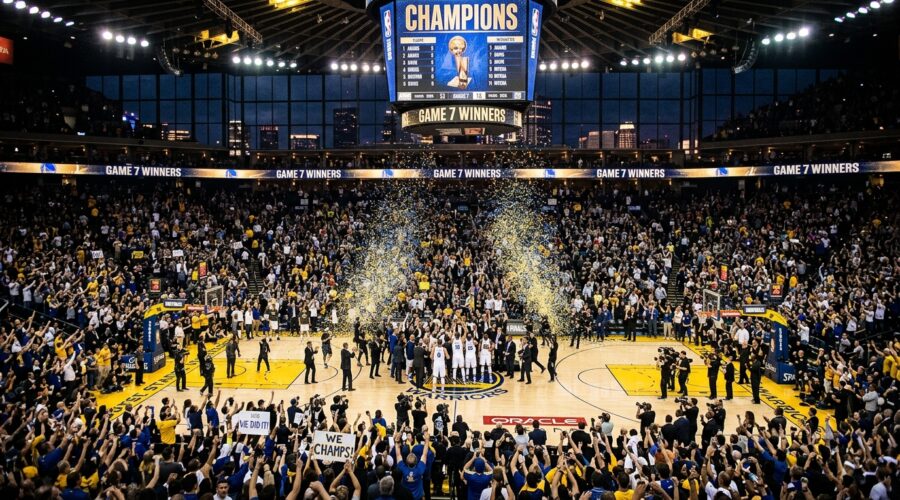
Tens of thousands of fans were dressed as vampires and superheroes on the night of October 31, 2026, but the most spellbinding thing happening in America was a basketball game. While trick-or-treaters made their rounds, 3.3 million viewers were locked to their screens watching the Golden State Valkyries and Atlanta Dream trade punches in a winner-take-all Game 7 of the 2026 WNBA Finals. It was Halloween night. It was cable television. And it was the most-watched WNBA playoff game in the history of the league — a record that had stood, untouched, for 27 years.
What unfolded at Chase Center in San Francisco that night was not just a basketball game. It was a cultural declaration. The WNBA did not just break a record. It rewrote its own story.
The Record That Seemed Untouchable
To understand what Game 7 meant, you have to go back to September 5, 1999. The New York Liberty and Houston Comets were playing Game 3 of the WNBA Finals on NBC, in an era when the league was young, the novelty was fresh, and NBC was spending big to put women’s basketball in front of a mass audience. That game drew 3.25 million viewers. Cynthia Cooper’s Houston Comets won their third consecutive title. And that number — 3.25 million — went on to outlast every WNBA game, every milestone, every star who came and went, for more than a quarter century.
When the 2024 WNBA Finals between the New York Liberty and Minnesota Lynx closed with 3.3 million viewers for its title-clinching Game 5 — the most-watched WNBA Finals game in 25 years at the time — it felt like the sport was finally closing in on the 1999 record. And yet the 1999 mark had already been matched. What remained to be broken was history itself.
Game 7 did not just match it. It cleared the 1999 record of 3.25 million, airing not on a major broadcast network, but across USA Network, CNBC, and Peacock — a cable and streaming combination that would have been considered a massive disadvantage just a few years prior.
A Second-Year Team Accomplishes the Near-Impossible
The story of the 2026 WNBA Finals cannot be told without understanding just how extraordinary the Golden State Valkyries are as a franchise. Officially announced in October 2023, the team began play in 2025 with a 23–21 record — remarkable in its own right, as they became the first expansion franchise in WNBA history to make the playoffs in their debut season. In Year 2, they went 32–12 and won a championship.
In doing so, the Valkyries became the fastest expansion team among all major North American professional sports leagues — the NBA, WNBA, NHL, MLB, and NFL — to win a title. The last expansion team to claim a major sports championship before them was the Las Vegas Golden Knights, who won the Stanley Cup in the 2022–23 season. The Milwaukee Bucks, often cited as a close comparison, needed three NBA seasons to win a title. The Valkyries did it in two WNBA seasons.
Owned by Joe Lacob and Peter Guber, who also own the Golden State Warriors, the Valkyries operated out of Chase Center from day one and immediately became the first WNBA franchise to average over 18,000 fans per game. They sold out every single home game in each of their first two seasons, welcoming a combined 794,816 fans through the doors. When they won the title on Halloween night, an estimated 400,000 people poured into the streets of San Francisco for a championship parade.
This was not a franchise that survived. It thrived, almost immediately, in a way that no professional sports expansion team has in living memory.
Gabby Williams and One of the Greatest Halves in Postseason History
The Valkyries trailed 30–24 at halftime of Game 7. The Dream, fueled by a desperate season-or-go-home energy, had controlled large stretches of the first half. Gabby Williams, the Valkyries’ star forward, had managed just 2 points on 25% shooting in the opening 20 minutes.
What happened next belongs in a chapter of its own.
At halftime, head coach Natalie Nakase delivered a message that was simple and calm: be patient. The game will open up. Williams listened, and then she took over in a way that the WNBA postseason had never seen before.
In the second half alone, Williams scored 28 points — a WNBA postseason record for points in a single half. By the final buzzer, she had finished with 30 points, 4 blocks, 4 three-pointers, 2 assists, and 2 steals in 38 minutes. The Valkyries won 68–63. Williams was named 2026 WNBA Finals MVP, capping a postseason in which she led all players with 19.6 points per game and scored in double figures in 6 of 7 Finals games.
It was the kind of performance that becomes the defining image of an era — the moment a sport points back to years later and says, that is when we knew.
The Series That Delivered at Every Turn
The 2026 WNBA Finals was itself historic before Game 7 was ever played. This was the first-ever best-of-seven WNBA Finals, a format the league adopted starting in 2025 after years of playing a best-of-five. It was the first Finals series to reach a seventh game. And the drama that unfolded over two weeks was exactly the kind of narrative that turns casual observers into committed fans.
The Valkyries took Games 1 and 2 at home, then dropped Games 3 and 4 as Atlanta clawed back. Golden State retook control with a Game 5 win at Chase Center, before a genuinely bizarre scheduling conflict handed the Dream a critical home opportunity — and they made the most of it.
Game 6 became its own story. The Atlanta Dream, who play their regular season at the 3,500-seat Gateway Center Arena, had relocated Finals home games to State Farm Arena. But on October 29, the Atlanta Hawks had a previously scheduled NBA game against the Cleveland Cavaliers at State Farm Arena that evening. The WNBA was forced to tip off a WNBA Finals game at 12:30 p.m. ET on a Thursday afternoon — a timeslot that ignited immediate and justifiable backlash.
ESPN analyst and former WNBA player Chiney Ogwumike called it plainly: “The players, the fans deserve this being in primetime. The fact that this was dealt with so last-minute is an epic fail.” A fan TikTok that went viral captured the broader sentiment: “Game 6 for the WNBA Finals being at 12:30 EST is quite literally insane.”
Yet even with the scheduling embarrassment, more than 10,000 tickets sold in the first 90 minutes. The game sold out. The Dream won to force Game 7. And the WNBA, to its credit, subsequently announced a multi-year agreement for the Dream to play all future home games at State Farm Arena — a structural fix born from an operational failure.
The seven-game series averaged 1.89 million viewers per game, surpassing the 2024 Liberty-Lynx series average of 1.5 million to become the most-watched WNBA Finals series in league history.
Angel Reese and the Weight of a Finals Record
Not every record set in the 2026 Finals was one to celebrate. Atlanta Dream forward Angel Reese averaged 14.7 points and 12.9 rebounds across the series, recording four double-doubles — the second-most in a single WNBA Finals. She was a force throughout. But she also set a WNBA Finals record for turnovers with 27, and in the decisive Game 7, she managed just 8 points on 3-of-7 shooting.
Reese had won her first Defensive Player of the Year award in the 2026 regular season and set season records for rebounds and double-doubles. She arrived at the Finals as a legitimate star. That the burden of a Game 7 did not fall in her favor does not diminish the arc of a player who has become one of the faces of this league’s renaissance — but it does underscore just how dominant the Valkyries were when it mattered most.
A League That No Longer Needs Saving
The story of WNBA viewership growth is frequently and accurately traced back to April 2024, when Caitlin Clark was selected first overall by the Indiana Fever in a draft that averaged 2.4 million viewers — up 328% from the year prior. The 2024 All-Star Game drew 3.4 million viewers. The 2024 season saw 32 broadcasts cross the 1 million viewer threshold. Clark was a catalyst, and no honest accounting of the WNBA’s current moment omits her name.
But here is what makes the 2026 WNBA Finals so significant from a structural standpoint: Caitlin Clark’s Indiana Fever were eliminated in the first round of the playoffs. She was not in the Finals. And yet the Finals averaged 1.89 million viewers per game, a record. Game 7 drew 3.3 million on Halloween night on cable television, beating all college football programming airing that day.
The 2026 regular season saw over 90 million unique viewers across all national networks — more than double the previous season. Fifty-one telecasts averaged at least 1 million viewers, up from 19 in 2025. Nine telecasts averaged 2 million or more, up from 4. Total hours of WNBA coverage watched exceeded 320 million, the highest regular-season total ever. Average game attendance rose 21% year-over-year to 11,474 fans per game.
This is not one player’s audience. This is a sport finding its mass audience, one season at a time.
A $3.1 Billion League
The business transformation underpinning all of this is staggering. In July 2024, the WNBA secured an 11-year media rights deal with Disney (ABC/ESPN), NBCUniversal, and Amazon Prime Video valued at approximately $2.2 billion — a foundational agreement that represented a seismic leap from the league’s prior deal. With subsequent additions from USA Sports (which houses USA Network, CNBC, E!, and SYFY), Paramount (CBS), and Scripps (ION), the WNBA’s total media rights package reached approximately $3.1 billion over 11 years, with an average annual value of roughly $281 million — more than six times the previous deal’s annual value.
USA Sports was a first-year WNBA broadcast partner in 2026, and Game 7 put an unmistakable stamp on that debut season. As Matt Hong, President of USA Sports, put it: “Game 7 put an exclamation point on USA Sports’ incredible first season as a WNBA media partner, as our coverage set new viewership records and connected more fans with the game.”
Across the 2026 playoffs, USA Network alone averaged 1.6 million viewers over eight games — the highest playoff viewership in league history for the network. The 2026 WNBA Finals will return to ESPN in 2027, meaning the audiences waiting there have never been part of this particular chapter.
A Note on the Numbers
It is worth acknowledging, as responsible analysis demands, that raw viewership figures across different decades are not perfectly comparable. Nielsen gained accreditation for its Big Data + Panel methodology in January 2025 and adopted it as the system of record beginning in September 2025, integrating data from smart televisions, set-top boxes, and 45 million households alongside its traditional panel. Historical figures — including the 1999 record and even the 2024 Finals numbers — were measured under older methodologies that captured different slices of the audience.
Some critics have pointed to these methodological shifts as reason for caution in declaring records. It is a fair caveat. But it is equally fair to note that the direction of WNBA viewership growth — the trajectory, the acceleration, the cultural presence — is broadly genuine and impossible to explain away through measurement differences alone.
The game is bigger. The audience is real. The momentum is structural.
What Comes Next
The 2027 WNBA season arrives with remarkable intrigue and genuine uncertainty. The Valkyries are champions with 90%-plus season ticket renewal rates and a roster built around a Finals MVP in the prime of her career. The Atlanta Dream, stung by Game 7, will play all future home games at State Farm Arena and will return hungrier. A’ja Wilson won her fifth MVP award in 2026. Olivia Miles of the Minnesota Lynx won unanimous Rookie of the Year. The Indiana Fever, with Caitlin Clark and a first-round playoff exit on her record, have something to prove.
The question hanging over all of it is whether the WNBA can sustain viewership at this level — or push further — without Clark appearing in a Finals. Game 7 of the 2026 WNBA Finals went a long way toward answering that. The best women’s basketball league in the world no longer needs a singular hero to hold the audience’s attention. It has stars. It has drama. It has storylines that extend beyond any one player.
What it had on Halloween night, with 3.3 million people watching a cable channel on the one night of the year when television is supposed to lose to candy, was proof that something has fundamentally changed in American sports culture.
The 1999 record lasted 27 years. If the WNBA’s current trajectory holds, it may not survive another decade.