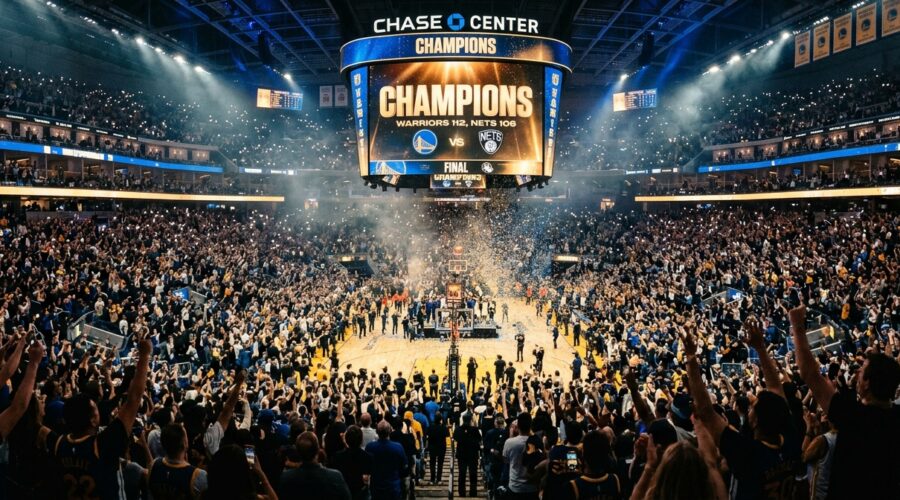
Sometime around 10 p.m. Eastern on October 31, 2026, Gabby Williams launched a 31-foot three-pointer at Chase Center with the score tied 57-57 and roughly two minutes left in a winner-take-all Game 7 of the WNBA Finals. Deep. Late in the shot clock. Well beyond the top of the key. She fired. It went in.
At that moment, 3.3 million people were watching on USA Network, CNBC, and Peacock. It was Halloween night. There was no NFL game to compete with. There was only this — the Golden State Valkyries against the Atlanta Dream, with the Valkyries — a second-year expansion franchise — on the verge of doing something no team in WNBA history, and no major American professional sports franchise of any kind, had ever done quite this fast.
The Valkyries won, 68-63. Williams finished with 30 points, 4 blocks, 3 three-pointers, 2 assists, and 2 steals in 38 minutes — the only player in WNBA Finals history to accomplish that combination in a single game. She was named Finals MVP. Coach Natalie Nakase’s postgame speech about “defense” went viral by morning.
And somewhere in the glow of that confetti, a league that had spent nearly three decades fighting for primetime respect crossed a threshold it hadn’t touched since 1999.
The Records, Plainly Stated
The 2026 WNBA postseason didn’t just set records — it obliterated a benchmark that had stood since the Houston Comets were still a dynasty and the WNBA was airing on NBC as a novelty spectacle.
Game 7 drew 3.3 million viewers, making it the most-watched WNBA postseason game in league history and the fourth most-watched WNBA game of all time. It was the most-watched cable program on all of October 31, 2026, beating every college football game on cable that day — on Halloween.
The 2026 WNBA Finals series averaged 1.88 million viewers — the most-watched Finals since 1999, breaking a nearly 30-year record. That figure represents approximately a 25.3% increase over the 2025 Finals average of 1.5 million viewers. The full postseason averaged 1.49 million viewers, the most since the WNBA’s inaugural 1997 season, up 27% from 2025.
For historical context: when analysts say “not since 1999,” they mean the Houston Comets-New York Liberty era on NBC, when the league was brand new and broadcasting novelty drove massive audiences. The 1999 WNBA Finals produced viewership numbers that the 2026 series now matches and in some cases surpasses — the highest single game in 1999 was 3.25 million for Game 3 — and then the league didn’t come close to those heights again for twenty-seven years. What happened in between tells the entire story of professional women’s basketball in America.
The Lean Years Are Not a Footnote
To appreciate the magnitude of 2026, you need to sit with what the numbers looked like in between.
When NBC dropped the WNBA after the 2002 season, the league’s broadcasting rights moved to ABC, ESPN, and ESPN2 — with ABC’s broadcast network presence supplemented by cable-only outlets that reached a significantly smaller potential audience. Finals viewership fell into the hundreds of thousands. For years, entire championship series averaged under 500,000 viewers. These weren’t catastrophic ratings by cable standards, but they were a sharp and demoralizing descent from the NBC-era highs, and they made the mainstream sports conversation resistant to taking the league seriously as a television property.
The recovery was gradual, then sudden. CBS Sports and ION joined the broadcast mix. Attendance crept upward. The league added teams. And then, in 2024, Caitlin Clark arrived as a rookie and the WNBA experienced what can only be described as a cultural rupture — a moment when casual sports fans who had never watched a WNBA game began paying attention.
By 2026, the league was ready to harvest what that rupture had planted.
The Game, the Series, and the Cinematic Expansion Story
The Golden State Valkyries joined the WNBA in 2025. In their first season, they finished 23-21 and exited in the first round of the playoffs. Reasonable. Respectable. Exactly what you’d expect from a franchise in its first year.
In their second season, they won the championship.
That makes the Valkyries the fastest expansion team in WNBA history — and among any major North American professional sports league, men’s or women’s — to win a title, surpassing the previous benchmark set by the Milwaukee Bucks, who won in their third season. Owned by Joe Lacob and Peter Guber, the same Warriors ownership group that won an NBA championship at Chase Center in 2022, the Valkyries went 32-12 in the 2026 regular season, swept the Las Vegas Aces in the semifinals, and then pushed to a seven-game series against an Atlanta Dream team powered by Angel Reese’s historic rebounding season.
The 2026 WNBA Finals were also the first-ever best-of-seven series to reach Game 7. The format had been introduced in 2025, but the Aces swept the Phoenix Mercury 4-0 in that inaugural year. This time, the two teams split six games perfectly before converging on Chase Center — nicknamed “Ballhalla” by the Valkyries’ fanbase — on the night of October 31.
What followed was exactly what professional sports rarely delivers on demand: genuine drama. Williams scored just 2 points in the first half, then erupted for 28 in the second — the most points in any half in WNBA Finals history. Jordin Canada kept the Dream alive with 18 points. Angel Reese fought for 12 rebounds despite being bottled up offensively. The score was tied in the final minutes before Williams’ clutch three broke it open.
“I wasn’t gonna lose on Halloween,” Williams said in her Finals MVP speech on USA Network. They don’t call her “Spooky G” for nothing.
The Game-by-Game Viewership Story
What makes the 2026 Finals viewership data truly remarkable is not just the Game 7 peak — it’s the consistency across all seven games.
Game 1 on NBC and Peacock drew 2.1 million viewers, the most-watched WNBA Finals opener in history. Game 3, carried by USA Network and CNBC, drew 1.71 million — the largest audience for a Finals Game 3 since the 1999 Liberty-Comets series drew 3.25 million. Game 4 on NBC drew 1.9 million, the most-watched Game 4 in WNBA Finals history. Even Game 6, which was scheduled at the controversial time of 12:30 p.m. ET on a Thursday — a slot that drew public criticism from at least one player’s family — still delivered 1.5 million viewers, good for the fifth-largest cable Finals audience in league history.
The series then peaked with 3.3 million for Game 7, an increase of roughly 128% over the 2025 Finals clincher, which drew 1.44 million for the Aces’ sweep of the Phoenix Mercury.
From opener to finale, game after game held its audience. That is not what a fluke looks like.
The Broadcast Architecture That Made It Possible
None of this happened in a vacuum. The 2026 WNBA season was the first full season under a restructured, massively expanded media rights ecosystem that amounted to a structural transformation of how the league reaches fans.
The WNBA’s total media rights package is worth an estimated $3.1 billion over 11 years, with an average annual value of approximately $281 million — roughly 6.5 times the annual value of the previous deal. The partners: Disney (ABC/ESPN), NBCUniversal (NBC/Peacock), Amazon Prime Video, Paramount (CBS/Paramount+), Scripps (ION), USA Sports (USA Network/CNBC), and NBA TV.
The practical result was 216 nationally distributed games in 2026 — the most in WNBA history, covering more than 65% of the league’s 330-game regular season. For the first time since 2003, when Disney/ESPN took over exclusive rights to the WNBA Finals, a single entity did not hold those exclusive rights; instead, the championship rotated among partners, with NBC airing Games 1 and 4, while USA Network and CNBC carried Games 2, 3, 5, 6, and 7.
USA Sports, the newly spun-off NBCUniversal cable group encompassing USA Network and CNBC, debuted as a WNBA partner in 2026 and immediately set records. USA Network averaged 1.6 million viewers across 8 playoff games — a record for the WNBA on that cable network. Matt Hong, President of USA Sports, called Game 7 “an exclamation point on USA Sports’ incredible first season as a WNBA media partner.”
More platforms means more access. More access means more viewers. This is not a complicated equation, but it took decades and the right confluence of talent and momentum to make the investment worth making.
The Stars Who Drove the Season
A record-breaking postseason does not exist without the players who make it worth watching. The 2026 WNBA season was, by almost any measure, the most individually spectacular in league history.
Caitlin Clark returned from the injury-ravaged 2025 season — in which she played just 13 of 44 games — to have one of the most statistically dominant individual seasons in professional basketball history, men’s or women’s. She averaged 22.3 points and 8.3 assists per game, shooting 44.5% from the field, and became the first player ever to record 800-plus points and 300-plus assists in a single WNBA season. Her six games with 30-plus points and 10-plus assists far exceeded any other player in league history. She won AP Comeback Player of the Year and was named All-WNBA First Team. The Indiana Fever reached the playoffs as the No. 5 seed before losing to the Las Vegas Aces in the first round.
A’ja Wilson won her fifth MVP award, continuing her run as one of the most decorated players in league history with the Las Vegas Aces.
Angel Reese set WNBA season records with 32 double-doubles and 521 rebounds, won Defensive Player of the Year, and was named All-WNBA Second Team. Her performance in the Finals — anchoring an Atlanta Dream team that pushed the Valkyries to Game 7 — cemented her status as the second great individual star capable of moving audiences and ticket markets independent of Clark’s gravitational pull.
Kelsey Mitchell of the Indiana Fever set WNBA season records for most points in a single season (1,086) and most three-pointers (135), averaging 24.7 points per game. She was named All-WNBA First Team alongside Clark, Wilson, and Minnesota Lynx rookie Olivia Miles, who won Unanimous Rookie of the Year honors.
Gabby Williams, the Finals MVP, averaged 19.6 points, 3.6 rebounds, and 2.7 assists across the seven-game series. Her Game 7 performance — ascending from 2 first-half points to 28 second-half points and a clutch championship-winning three-pointer — was the kind of moment that defines careers.
The Clark Paradox: The Most Important Proof Point
Caitlin Clark was eliminated in the first round. She was not in the WNBA Finals. She was not in the semifinals. And yet the Finals averaged 1.88 million viewers and Game 7 drew 3.3 million.
This is worth sitting with carefully, because it is the most important data point in the entire 2026 viewership story.
Clark is demonstrably the single biggest individual viewership driver in WNBA history. The first-round playoff series between the Indiana Fever and Las Vegas Aces was a television event: Game 1 on ABC drew 2.11 million, the largest WNBA playoff audience in ABC history. Game 3 — Clark’s last game — drew 2.25 million on USA Network, peaking at 2.7 million. When the Fever were eliminated, the semifinal round experienced a reported 44 to 47% viewership decline.
That drop is real, documented, and significant. Clark’s audience is enormous and genuinely devoted.
But here is what the 2026 Finals proved: when that audience cleared out, there was a substantial, durable base of WNBA fans underneath it. The Finals climbed back from Clark-less semifinal averages to 1.88 million for the series and 3.3 million for Game 7. That rebound did not happen because Clark’s fans suddenly converted to Valkyries fans. It happened because the WNBA had spent the past two years building a fundamentally larger audience — an audience that cares about the league, not just about one player.
Critics, including some at outlets like OutKick, have been fair to point out the methodological complexity here. Nielsen’s Big Data + Panel standard, adopted in 2025, expanded out-of-home measurement to 100% coverage, added wearable-device co-viewing tracking in August 2026, and blended traditional panel data with set-top box data from tens of millions of smart TVs. These changes make direct comparisons to pre-2025 figures imprecise at best. The 1999 Finals numbers and the 2026 Finals numbers were not counted the same way.
That caveat matters. It is worth stating. And it does not change the directional conclusion: the WNBA is achieving its highest sustained viewership in roughly 30 years, by any reasonable measure, under any reasonable methodology.
The People in the Seats
Television ratings tell one story. Arena attendance tells another. In 2026, both told the same story.
The WNBA’s regular season drew 3.8 million total fans across a record 330 games, with an average attendance of 11,474 per game — a 21% increase over the previous high. There were 212 regular-season sellouts, accounting for 64% of all games.
The Golden State Valkyries sold out every home game in team history. All 44 — 22 in the 2025 season and 22 in the 2026 season. Every single one. They averaged approximately 18,000 fans per game at Chase Center, the highest average in WNBA history. Floor seats for Finals Games 1 and 2 at Chase Center had a get-in price of roughly $204 — compared to approximately $34 for 2025 Finals Game 1.
The 2026 WNBA Finals drew 123,553 total fans across 7 games — a Finals record. The average attendance per game was 17,650 — a Finals record. All 7 games sold out, including Games 3 and 4, which remained at the Atlanta Dream’s home arena, Gateway Center (capacity: approximately 3,500), despite the logistical challenges of hosting a Finals game in a smaller venue. The Dream officially announced their permanent relocation to State Farm Arena, home of the Atlanta Hawks, for the 2027 season — a move that felt both practical and symbolic given the growing demand the Finals had made so visible.
The 2026 All-Star Game, held at the United Center in Chicago, drew 19,783 fans — an all-time WNBA All-Star record — and 3.16 million television viewers, the second most-watched All-Star Game in league history, up 44% from 2025.
Beyond the Borders
The 2026 season was also the first with a Canadian franchise in the WNBA. The Toronto Tempo, backed by Bell Media, joined the league and immediately generated international momentum — Canadian WNBA Draft viewership surged 172% year-over-year. The WNBA, which spent most of its existence as a domestic American league, is now genuinely a continental one, with the infrastructure and media partnerships to become something larger.
Meanwhile, the WNBA’s regular-season viewership averaged 771,000 viewers per game in 2026, comfortably exceeding the NHL’s 546,000 viewers per game on comparable cable and broadcast windows. That comparison requires the same methodological caveats as any cross-sport viewership comparison, but as a broad signal of market positioning, it is striking.
The merchandise market responded accordingly. Within 48 hours of the Valkyries’ Game 7 win, sales through WNBAStore.com and league-owned stores exceeded the entire 30-day post-championship window following the 2025 Aces title by 42%. The Golden State Valkyries became the best-selling WNBA champion of all time in the fastest timeframe on record.
What Comes Next
The 2026 season’s most watched regular-season game, technically, was not Game 7 of the Finals. It was the Indiana Fever versus Chicago Sky on August 23, 2026, which drew 3.31 million viewers — just barely edging the 3.3 million for Game 7 to hold the top spot in the full calendar year. That a regular-season game came within 10,000 viewers of the most-watched postseason game in league history speaks to where the floor of WNBA interest now sits.
The WNBA’s $3.1 billion media deal includes reset provisions after the 2028 season, allowing renegotiation of terms. If the growth trajectory of 2026 continues at anything approaching its current rate — and there are structural reasons to believe it will — the league will enter those negotiations in an entirely different position than it has ever occupied before.
The league’s regular-season expansion to 50 games is on the schedule for 2027. Additional expansion franchises — Cleveland, Detroit, Philadelphia — are on the horizon. The question of whether Caitlin Clark and a team built around her can go deeper in the postseason looms large. The question of whether the Valkyries-Dream rivalry will generate a rematch looms equally large. The question of whether a Finals including Clark might push Game 7 viewership past 4 million is not outlandish.
The League That Arrived
On Halloween night, 2026, Gabby Williams sank a 31-foot three-pointer in a tied Game 7, the Golden State Valkyries won their first championship, and 3.3 million people watched it happen on cable television.
They did not watch because they were told to. They did not watch because a single player compelled them to. They watched because, over the course of a season that produced historic individual performances, record attendance, a record media footprint, and an expansion story that felt scripted by Hollywood, the WNBA had become something worth watching.
The nearly 30-year record that fell in 2026 was not broken by accident. It was broken by a league that finally had the infrastructure, the talent, the media presence, and the cultural moment to do what generations of players, coaches, and executives had been building toward for decades.
The lean years are real history. So is what just happened. And right now, those two facts are standing in the same arena, and one of them is raising a championship trophy.