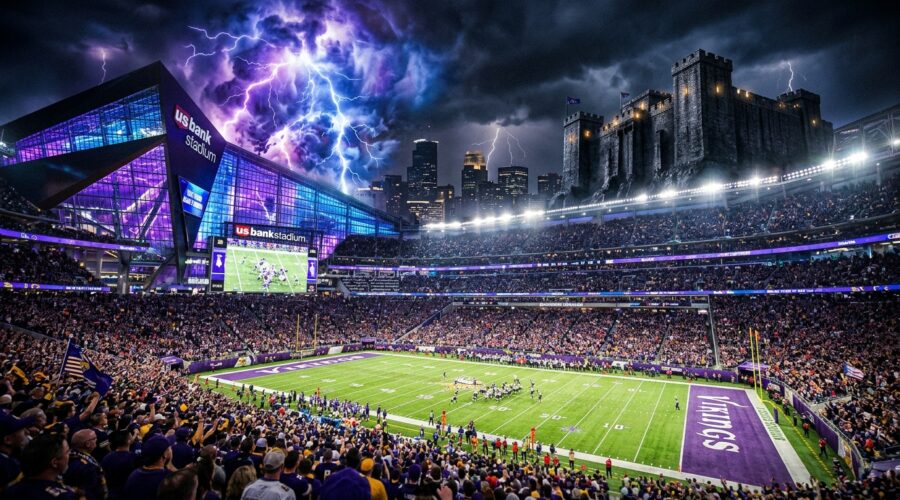
Every so often the NFL schedule gods, apparently bored of handing us Thursday night games between two 3-5 teams, decide to actually do their jobs. Monday Night Football in Week 9 is one of those rare, genuine gifts. The Buffalo Bills (6-1, NFL’s best offense) travel to U.S. Bank Stadium to face the Minnesota Vikings (6-1, arguably the most statistically dominant defense in modern NFL history). Both teams are legitimate Super Bowl LXI contenders. One will walk out of Minneapolis with a half-game lead in the conference standings. The other will spend Tuesday doing a lot of uncomfortable film study.
Bills -3.5. Over/under 44.5. And approximately one billion subplots. Let’s work through all of them.
The Setup: Two Very Different Kinds of 6-1
The Bills are 6-1 the way you would draw it up on a whiteboard. Josh Allen is posting 20 total touchdowns through seven games, their offense ranks first in the NFL at 33.3 points per game, and they just dismantled the Baltimore Ravens 36-10 in Week 8. This is a team that is comfortably, comprehensively good on both sides of the ball — they are the AFC’s number one seed for a reason, and their Super Bowl odds at +550 reflect a squad that actually looks the part.
The Vikings are 6-1 the way a chess player beats you in 22 moves while you thought you were doing fine. Their offense ranks 27th in points per game, 29th in passing yards per game, and 31st in touchdown rate per drive. Their turnover differential sits at 30th in the NFL. By almost every traditional offensive metric, the Vikings have the profile of a 3-4 team. They are 6-1 entirely because Brian Flores has constructed, without exaggeration, the most statistically dominant defense the NFL has seen in over a decade.
So yes: an unstoppable force is about to meet what the data insists is a historically immovable object. This one matters.
Brian Flores Is Breaking Math
Let’s spend some time here, because if you watch Monday’s game without understanding what Flores is doing, it will look like organized chaos. It is organized chaos, but there is a critical distinction.
The Vikings blitz on approximately 71% of dropbacks in 2026. The next-closest team in the NFL is Tampa Bay, blitzing at 46%. That is not a gap — that is a canyon. As CBS Sports put it: “It all amounts to by far the highest blitz rate in the league this year at 71% with the Buccaneers a very distant second at 46%.” In a single game against the Indianapolis Colts in Week 7, Flores sent extra rushers on 85.2% of dropbacks — the second-highest single-game blitz rate in the past 20 years of NFL football and the highest in the Next Gen Stats era. His base alignment — two edge rushers, three defensive linemen, two inside linebackers, two corners, two safeties — is deployed on 56.9% of snaps, the highest rate in the NFL. And yet Minnesota runs zone coverage 77% of the time.
That combination — relentless blitzing paired with zone behind it — is what offensive coordinators like Matt Nagy mean when they say Flores keeps them up at night. Most aggressive blitz-heavy defenses play man coverage to compensate for the extra rushers they’re sending. Flores does not. He is essentially daring quarterbacks to find the open receiver quickly, then rotating zone coverage to take away the reads they think they have.
The results are historic. Minnesota’s defensive EPA per play this season sits at +0.195, which ranks as the third-best defensive EPA per play of any defense since 2011, trailing only the 2019 New England Patriots (+0.227) and the 2020 Rams (+0.198). For context: the 2015 Denver Broncos — the defense that throttled Cam Newton in Super Bowl 50 and is widely considered the gold standard for recent championship defenses — posted a defensive EPA per play of -0.16, the best mark in the league that season. Opponents are converting third downs at a 22.2% rate, the best in the NFL. The red zone touchdown rate against is 25.0%, also first. Opposing quarterbacks are posting a 62.9 passer rating collectively, a mark that appears to best any seven-game defensive stretch in recent memory.
This is not a good defense. This is an event.
Andrew Van Ginkel and the Most Important Injury Update of the Week
The primary individual weapon in Flores’ scheme is linebacker Andrew Van Ginkel, who has 6.5 sacks and 7 tackles for loss through seven games, ranking sixth in the NFL in sacks. Van Ginkel is Flores’ designated blitzer — the linebacker who arrives at a quarterback’s face from angles that offensive linemen spend entire weeks preparing for and still cannot consistently account for.
Van Ginkel is listed as limited with a chest injury heading into Monday. His availability, and more importantly his explosiveness off the snap, is arguably the most significant game-within-the-game subplot this week. A healthy Van Ginkel and a diminished Van Ginkel are very different players, and the Bills’ offensive line — which is already dealing with significant attrition — does not need any help from the injury report on the other sideline.
The Bills’ Injury Situation Is a Genuine Problem
Speaking of that offensive line: left tackle Dion Dawkins is out with a rib injury. Alec Anderson is out with an ankle. Spencer Brown is questionable with a back issue. Buffalo is walking into the loudest dome environment in the NFL, against the most pressure-generating defense in the NFL, with a patchwork offensive line. The crowd noise at U.S. Bank Stadium is not incidental — snap-count communication between Josh Allen and center Connor McGovern is a legitimate operational concern in that building, and a free blitzing linebacker jumping early off a misheard count is exactly how a drive dies before it starts.
The skill position group is similarly depleted. Joshua Palmer is out. Ty Johnson is out. DJ Moore is questionable. Keon Coleman is questionable. Dalton Kincaid is questionable. If you are running a depth chart exercise this week, you are going to need a lot of pencil.
What Buffalo does have is Khalil Shakir (27 receptions, 354 yards), who is likely to draw significant coverage from Byron Murphy Jr. — Minnesota’s slot corner with three interceptions on the season — and James Cook III, who may quietly be the most important player in this game.
James Cook III and the Lions Blueprint
Last week, Jahmyr Gibbs and Sione Vaki combined for 218 of Detroit’s 230 rushing yards in a 19-15 Lions victory over Minnesota. It was the second-highest rushing total the Vikings have allowed this season, and it exposed something Flores has quietly been living with as the price of his aggressive scheme: when you are blitzing 71% of the time and your linebackers and safeties are committed to pass rush lanes, the gaps against the run become wider than you would like.
The Vikings’ run-stop rate ranks fifth in the NFL at 27.7%, which sounds excellent — and in isolation, it is. But Gibbs looked very much like a man who had been shown exactly where to run all week, and the Lions’ offensive staff clearly diagnosed the scheme. Buffalo’s coaching staff, almost certainly, has watched that film roughly 400 times since Sunday evening.
Enter James Cook III. The fifth-year back is averaging 5.1 yards per carry on 138 attempts, ranks fifth in the NFL in rushing yards with 707, and is producing a 10-plus yard carry rate of 16.7% — second in the NFL and a career high. He has seven rushing touchdowns. He is, in every sense, the operative template for how the Lions beat Flores on the ground. If Buffalo’s battered offensive line can open even modest creases, Cook has the burst to make them look enormous.
The strategic read here is fairly clear: the Bills will want to establish the run early, force Flores to adjust his blitz packaging to account for Cook, and open up the passing windows Allen needs to operate. Whether a depleted offensive line can hold its blocks long enough to execute that plan is the central tension of the game.
Josh Allen vs. the Blitz: The Most Interesting Statistical Argument of the Week
Here is where this matchup becomes genuinely fascinating rather than just structurally compelling.
The prevailing assumption going into this game is that Minnesota’s historic blitz rate is the existential threat to Buffalo’s offense. And it is a real threat. But Josh Allen against the blitz is not a soft target. He is completing 66.7% of his passes when blitzed, averaging 8.6 yards per attempt, and posting an 88.2 passer rating in those situations. Those numbers are not elite — they rank 20th among qualifying quarterbacks — but they are not the profile of a quarterback who is going to panic and throw a pick-six into a zone on second-and-eight, either.
More importantly, Allen’s scrambling ability represents a structural problem for Flores that no amount of blitz design fully solves. When you send a sixth rusher and that rusher gets reached, or the pocket collapses in a direction Allen can escape to, you are trading a failed pressure for a chunk gain and a first down. Flores knows this. As one unnamed analyst succinctly put it this week: “Brian Flores is going to draw up blitzes for this game, then realize he can’t use half of them because of what Josh Allen does with his legs.”
That said — and this is the part Bills fans should acknowledge rather than dismiss — Allen has thrown five interceptions and committed a fumble in seven games. His turnover tendencies, specifically the late-game, tight-window throws that have always been the shadow side of his aggressive play style, are exactly what Chris Simms was gesturing at when he noted that Wentz might “just stand there and throw the ball down the field into coverage.” Allen does that too. The difference is that Allen’s arm talent means those throws sometimes work. Against this defense, in this dome, the ones that do not will be very costly.
Carson Wentz, Justin Jefferson, and an Unexpected Subplot
Kyler Murray — who was averaging a respectable 86.6 passer rating before aggravating his hamstring — is out. Carson Wentz, 33 years old and making his 101st career start, will play quarterback for Minnesota. The conventional wisdom says this is bad news for a Vikings team that needs to do just enough offensively to keep pace with the Bills.
The data says it is more complicated than that.
In Wentz’s five starts for Minnesota in 2025, Justin Jefferson averaged 95.4 receiving yards per game — essentially double the 47.6 yards per game she averaged when other quarterbacks started those remaining games that season. Jefferson had his best game of the 2026 season in Week 1, when he caught 8 passes for 92 yards and two touchdowns from Wentz after Murray left with a concussion. Through seven games this season with Murray under center, Jefferson has just 335 total yards — on pace for a career low by a wide margin, well below his previous career low of 1,048 yards set in 2025.
Whatever the schematic or chemistry reason, Wentz finds Jefferson in ways Murray has not this season. The Bills, who have allowed the most receiving touchdowns to opposing wide receivers of any team in the NFL, are not exactly the ideal opponent to face Jefferson in a game where he is likely to see 10 targets. PFF projects Jefferson for 75.2 receiving yards in Week 9. If Wentz activates the version of Jefferson that was showing up in those 2025 starts, Minnesota’s offense is suddenly a great deal more functional than its 29th-ranked passing offense would suggest.
The cautionary footnote — always with Wentz — is turnovers. He has taken six sacks in just two starts, and his late-game decision-making under pressure has historically been where drives and seasons go to die. If Buffalo’s defense, which is averaging 25.9 points allowed per game but can generate stops, creates even one or two turnovers off a Wentz misread in the fourth quarter, the game is likely over.
Greg Rousseau is Playing Like a Man Possessed
While most of the defensive conversation this week will, correctly, center on Flores and the Vikings’ unit, it would be a significant oversight to ignore what Greg Rousseau is doing for Buffalo. The edge rusher has seven sacks and 22 quarterback hits through seven games — an NFL-wide record since 2006. He also has seven pass breakups. By any reasonable standard, Rousseau is having a top-five edge-rusher season in the NFL, and he will be tested against a Vikings offensive line that is itself dealing with a limited Christian Darrisaw at left tackle.
If Rousseau can get to Wentz early and disrupt his rhythm, the Vikings’ offense — which has been surviving on defensive excellence and Aaron Jones Sr.’s 458-yard ground campaign — will have very limited margin for error.
The Dome Factor
It is worth spending one paragraph on venue, because it is not trivial. U.S. Bank Stadium is consistently among the loudest indoor venues in professional football. Allen and McGovern will be working through snap counts in a road environment with the crowd actively trying to create offsides penalties and disrupt communication. Minnesota’s pass rushers get to time snaps they can hear better than the visitors can. This is a real edge, it is not dramatic, and it has contributed to multiple defensive performance inflations for the Vikings over the course of the season. Buffalo has played in hostile road environments this year — their overtime win in Los Angeles qualifies — but this is a different category of crowd.
The Matchup Breakdown: Where Each Side Has an Edge
- Bills offense vs. Vikings defense: Minnesota holds the edge in nearly every passing category, pressure rate, and third-down conversion rate. The ground game is roughly even on paper, though the Lions blueprint suggests Buffalo can exploit run gaps if the line holds up. The blitz creates problems but Allen’s scrambling is a genuine equalizer. Slight Vikings advantage.
- Vikings offense vs. Bills defense: Buffalo’s defense is middle-of-the-pack by most metrics and has been generous to opposing wide receivers. Wentz-to-Jefferson is a legitimate threat. But Minnesota’s offense has been so anemic all season that it is difficult to project them moving the ball consistently against even an average defense. Rousseau and Terrel Bernard (51 tackles) will be active. Slight Bills advantage.
- Turnover battle: Both quarterbacks are turnover risks. Allen has six in seven games; Wentz has historically cracked under fourth-quarter pressure. The team that escapes with one fewer turnover will almost certainly win. Coin flip with a slight edge to Wentz given the game script Minnesota will want to play.
- Coaching: Kevin O’Connell against Joe Brady, with Flores and Brady’s defensive coordinator Jim Leonhard as the real chess match. Flores has the more historically validated scheme. Brady has the more explosive personnel. This is the most interesting coaching matchup of the NFL week. Push.
The Prediction
Expert consensus has converged on Bills 24, Vikings 20, and the logic is sound. Allen outduels Flores’ scheme through a combination of pre-snap reads, scrambles, and the kind of impossible third-down throw that makes Bills fans simultaneously age fifteen years and scream with joy. Cook replicates enough of the Lions’ blueprint to keep the chains moving on the ground. Wentz does feed Jefferson — probably to the tune of 70-80 yards and a touchdown — but the Vikings’ offense cannot sustain enough drives against a Bills defense that knows Wentz’s tendencies and will sell out for the turnover in the fourth quarter.
The Bills win a genuinely competitive, low-scoring game that will be decided by one or two possessions, improve to 7-1, and retain their AFC number one seed. The Vikings fall to 6-2 but — given that their defense is functionally operating at a level that ranks third-best all-time since 2011 — remain on a credible Super Bowl trajectory. Their current +5,000 odds reflect the market’s skepticism toward any offense that ranks 31st in touchdown rate per drive, and while that may feel steep, the defensive performance alone keeps this team in the conversation.
Final: Buffalo Bills 24, Minnesota Vikings 20.
Watch this game. Even if you do not care about either team, you are watching a potential Super Bowl preview between two of the most interesting teams in football, playing out a strategic argument — elite offense versus historically elite defense — that the sport does not often serve up this cleanly. The blitzes will be beautiful. Allen’s scrambles will be infuriating and incredible in equal measure. Jefferson will remind you, at least once, why he was the best receiver in the NFL two years ago. And Brian Flores will draw up something in the third quarter that makes Matt Nagy want to throw his headset into Lake Minnetonka.
Set an alarm. This one is worth staying up for.