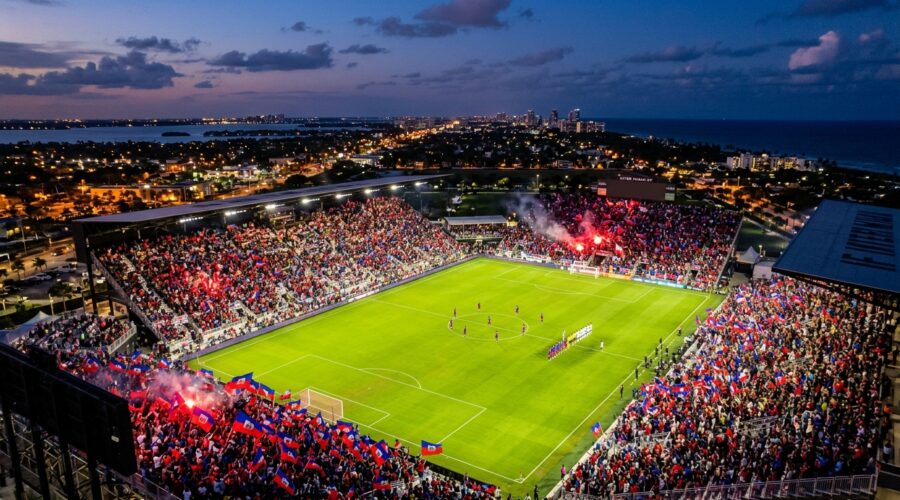
There is a football match on Saturday afternoon in Miami that is, depending on where you stand, four completely different events. For U.S. Soccer, it is the ceremonial opening of the 2030 World Cup cycle — a Concacaf Nations League quarterfinal, first leg, against a team ranked seventy-two places below them in the FIFA standings. For the USMNT’s coaching staff, it is the beginning of the end: Mauricio Pochettino’s final act in an American jersey before Manchester United triggers a reported ten-million-dollar buyout clause and flies him back to the Premier League. For the city of Miami, it is a homecoming of a particular and aching kind. And for Haiti — a nation that cannot legally play a home international match on its own soil, in its own stadium, in front of its own people — it is simply everything.
Kick-off at Nu Stadium is 4:30 PM Eastern on November 14th. The capacity is 26,700. The crowd will be overwhelmingly, defiantly Haitian. And the United States, ranked sixteenth in the world and unbeaten against these opponents since 1973, will walk out into something that feels considerably less like a home game than the fixture sheet would have you believe.
A Stadium That Cannot Be Used
To understand why this match is being played in Miami — why Haiti’s designated home leg has ended up in the opponent’s country, in the opponent’s most glamorous city — you have to understand what has been done to Haiti. Not what has happened to it. What has been done.
Since the assassination of President Jovenel Moïse in July 2021, Haiti has had no sitting head of state and a transitional government scrambling for basic legitimacy. Into that vacuum, armed gangs have moved with a thoroughness that would be almost impressive if the human cost were not so catastrophic. By mid-2025, gangs controlled approximately eighty-five percent of Port-au-Prince and its metropolitan area. Over 1.3 million Haitians had been internally displaced. More than half the population faced acute food insecurity. The United Nations recorded at least 5,601 people killed by criminal groups in 2024 alone — in a country of eleven and a half million people.
In February 2024, gangs overran Stade Sylvio Cator, Haiti’s national football stadium in Port-au-Prince. For two years, the place where a nation was supposed to gather and believe in something sat occupied by armed men. Human remains were reportedly discovered inside when Haitian and Salvadoran security forces finally retook the facility on November 12th — just two days before this match. The stadium still cannot host international football. The timing, if you are inclined to find meaning in it, is brutal.
So Haiti has been playing its “home” matches in exile since July 2021. During World Cup qualifying, they hosted in Curaçao, some five hundred miles from Port-au-Prince. For the 2026/27 Concacaf Nations League group stage, they set up in Sabina Park in Kingston, Jamaica. For this quarterfinal, the Haitian Football Federation submitted a formal request to Concacaf to do something that had no obvious precedent: stage their home leg inside their opponent’s territory. Concacaf’s Council approved it. And so Miami, home to the largest Haitian expat population in the United States, with its vibrant Creole-language businesses, its churches and cultural institutions and its famous Little Haiti neighbourhood, becomes the improbable venue for a Haitian home match against the United States of America.
When Haiti played Peru at Nu Stadium on June 5th — the new ground’s first international fixture, though the stadium itself had already been inaugurated by Inter Miami’s 2–2 draw with Austin FC on April 4th — the crowd was so passionately Haitian that the result almost became secondary. On Saturday, with the stakes considerably higher and the entire diaspora community mobilised around it, Nu Stadium will not feel like a U.S. home ground. It will feel like Port-au-Prince, transplanted and electric and heartbroken and defiant, all at once.
Pochettino’s Strange Farewell Tour
Mauricio Pochettino deserves better than the circumstances in which he finds himself this week, and it would be churlish to deny him that. He arrived in September 2024 after Gregg Berhalter’s undignified departure following Copa América, took a squad that had embarrassed itself and rebuilt it methodically. At the 2026 World Cup, the United States beat Paraguay 4–1, beat Australia 2–0, lost narrowly to Türkiye 3–2, then beat Bosnia and Herzegovina in the Round of 32 — the program’s first knockout-stage victory since 2002, making Pochettino the first USMNT manager to win three matches at a single World Cup. They were then beaten 4–1 by Belgium in the Round of 16. For a team hosting the tournament on home soil, the exit stung. For the program’s trajectory, there was genuine foundation being laid.
He re-signed in August. He called up thirteen previously uncapped players for September and October’s friendly window and won all four matches. He was, by every available measure, in it for the long haul through to 2030.
And then Manchester United sacked Michael Carrick after one Premier League win from ten matches — their worst start to a season in forty years — and the machinery of English football did what it always does. It found someone else’s project and decided it wanted him. By November 12th, with the buyout clause confirmed at around ten million dollars, Pochettino’s departure for United was essentially settled. He will manage both legs of the Haiti series before leaving. His first match in charge of Manchester United will be an away fixture at Anfield against Liverpool on November 22nd, with his first home game at Old Trafford coming against Brentford on November 28th. The timing, again, is not subtle.
What is quietly remarkable, in the way that genuinely good managers often produce quietly remarkable things, is what Pochettino has built around him. His captain, Tyler Adams, confirmed Pochettino had not addressed the Manchester United situation directly with the squad. Defender Sebastian Berhalter offered something that sounded more generous than the moment required: “Him leaving, him staying, he’s just created a great foundation and a great base for this team. Even though he’s an Argentinian coach, he made us even more proud to be American.” Folarin Balogun, perhaps the form forward of the Pochettino era, said simply: “If I had a vote, I would like to keep things the way they are.”
Christian Pulisic, ninety caps and thirty-three goals into his national team career, returned from injury to rejoin the squad only to find his manager’s imminent departure dominating the press conferences. That is the kind of subplot that could quietly unpick a camp. The professionals in this squad — Adams, Pulisic, Weston McKennie back from his World Cup, Antonee Robinson, the irrepressible Gio Reyna — are experienced enough to compartmentalise it. The younger players will take their cue from them. But the distraction is real, however tidily everyone insists it is not.
Pochettino himself described this as “a tough, tough, tough two games.” There is a world in which that assessment proves prescient for reasons that have nothing to do with Manchester United.
The Squad: A New Generation Announces Itself
The twenty-five-man roster Pochettino has assembled for this series contains the scaffolding of something interesting. The familiar names are present — Pulisic, Adams, McKennie, Robinson, Balogun, Chris Richards, Malik Tillman, who scored a free kick against Bosnia at the World Cup. Alex Freeman of Villarreal, who leads all USMNT players in 2026 with 880 minutes played and twenty-five consecutive appearances, is the kind of quietly indispensable figure that every good squad needs and none of the television analysts ever quite get round to discussing.
But the names that matter for the next four years are younger. Cavan Sullivan, seventeen years old and already carrying more expectation than most teenagers should have to hold. Julian Hall, eighteen, who scored in the fall window. Justin Ellis, Mathis Albert at Borussia Dortmund, Adri Mehmeti. First call-ups for Reed Baker-Whiting and Santiago Castañeda. This is a squad in genuine transition — world cup veterans sharing a dressing room with teenagers who were in school when the last cycle began.
Pochettino had described the September-October window as a process of shaping the next four years. That work now falls, prematurely, to whoever comes next. Reports suggest Pep Guardiola, recently departed from Manchester City, is U.S. Soccer’s primary target. That is a name that generates excitement and scepticism in roughly equal measure, and the conversation will dominate American football discourse for months regardless of what happens on the pitch this weekend.
Neil Pierre and the Match Within the Match
Somewhere inside the larger drama, there is a smaller and considerably more human one. Neil Pierre is nineteen years old, a defender out of the Philadelphia Union, the product of one of MLS’s most reliable academies. He earned his first three senior caps in the September-October window and has earned his place in this squad on merit — thirty-three appearances for club and country this calendar year, a loan spell that helped Lyngby win promotion to the Danish top flight, the kind of precocious maturity that makes veteran centre-backs offer unsolicited praise in press conferences.
His parents were both born in Port-au-Prince. They emigrated to the United States at seventeen, settled in New York, and eventually raised Neil in Lebanon, Pennsylvania. The family moved later to Blue Bell so his older brother Nelson could join the Philadelphia Union academy. Neil followed. His entire football journey has been through the American system, from U-15 national teams upward, and he has never been in any doubt about which flag he represents.
Nelson Pierre has represented Haiti at youth level and could feature for Les Grenadiers in this very series.
At a press conference on November 9th, Neil Pierre was asked about all of this and handled it with a composure that would have done credit to a player twice his age. “I’ve always been focused on the United States and representing the U.S. from the U-15 level all the way up to now. I’m just happy to represent my nation.” His parents, he said, were “very, very happy and excited to have the country they were born from, and then having their son play against that country at the highest level.” When asked how much family he had in Haiti, he said he couldn’t count them on his hands. He would need his Philadelphia Union teammate Mark McKenzie’s hands and feet too.
His brother’s message was characteristically fraternal: “I want you to win. I want you to be the best. But I do also hope Haiti does a little thing.”
If both brothers take the pitch at Nu Stadium on Saturday afternoon, it will be one of those small, private stories that the sport occasionally produces to remind you it is not simply about systems and shapes and expected goals. The Pierre family’s story contains, in miniature, the entire complicated history between these two nations and their football teams.
Haiti: A Nation of Exiles, Playing with Everything
When Haiti qualified for the 2026 FIFA World Cup on November 18th, 2025 — their first qualification since 1974, fifty-two years — the reaction was not merely celebration. It was release. Fireworks lit Port-au-Prince. Gangs, reportedly, paused. People danced in streets that for years had been too dangerous to walk after dark. Schools called for a national holiday. The date itself carried its own meaning: it fell on the anniversary of the Battle of Vertières, the defining engagement in which revolutionary hero Jean-Jacques Dessalines had fought the French on the path to Haitian independence — a battle that would reach its full 222-year mark on November 18, 2026.
At the World Cup itself, in Group C alongside Brazil, Morocco, and Scotland, Haiti took zero points. They lost to Scotland in Foxborough, lost to Brazil in Philadelphia, lost to Morocco in Atlanta in a match they made competitive enough to score twice and briefly threaten the upset. The BBC noted that Haiti had inspired young fans despite their elimination. That is the sort of diplomatic consolation that sometimes obscures genuine progress, but in this case there was something real in it. Twenty-five of their twenty-six World Cup squad players were developed outside Haiti — primarily in France, Belgium, England, and North America. Jean-Ricner Bellegarde of Wolverhampton Wanderers left the French youth system to wear the Haitian jersey. That is not an administrative choice. It is a declaration.
Their new manager is Spain’s David Badía, who replaced Sébastien Migné after the World Cup. The squad’s average age is twenty-four. Captain and goalkeeper Johny Placide carries the particular weight of representing a country that cannot watch his team play at home. Nou la — we are here — is the phrase that travels with this group. It has rarely been more apt than on Saturday, when Haiti’s home match takes place inside their opponent’s stadium, in a city that has kept their culture alive while their country burned.
The Tactical Picture: A Comfortable Favourite in Uncomfortable Surroundings
The numbers, taken in isolation, tell a lopsided story. The United States are ranked sixteenth globally; Haiti are eighty-eighth. The USMNT has not lost to Haiti since November 5th, 1973 — a ten-match unbeaten run spanning more than five decades. The last five meetings have all been decided by a single goal, which suggests the gap has never been quite as wide as the rankings imply, but it also suggests the United States has consistently found a way to close it out when it matters.
What the numbers cannot capture is the atmospheric weight of Nu Stadium on Saturday afternoon. Miami’s Haitian community will make this venue theirs. The Haitian Consulate has officially promoted the match. Television channel Télépam USA has announced a kickoff party featuring a live performance by T-Vice. Organised watch parties are running through Little Haiti. If Haiti score first — and David Badía will have them set up to press for exactly that — the psychological pressure on a United States side already managing one distraction too many could become significant.
Pochettino will know this. The tactical priority for the USMNT in the opening exchanges is obvious: get an early goal, control the tempo, do not allow Nu Stadium to become what it is threatening to become. Pulisic’s return from injury adds creative thrust at exactly the right moment. Balogun’s movement in behind and McKennie’s box-to-box presence should give the midfield enough to work with against a Haiti side that, for all their spirit and their considerable diaspora talent, are operating at a different resource level entirely.
The two-leg format, with the decisive second leg at TQL Stadium in Cincinnati on November 17th in front of a firmly American crowd, provides the United States with a structural safety net. But safety nets have a way of encouraging complacency, and complacency in front of a hostile pro-Haiti crowd in Miami is not a luxury this group can afford — particularly not with the management situation casting its shadow over camp and a new World Cup cycle needing to begin with something that actually resembles conviction.
The winners of this quarterfinal advance automatically to the 2027 Concacaf Gold Cup. The losers drop to the preliminary rounds. The CNL Finals are scheduled for March 25-28, 2027, at SoFi Stadium in Inglewood, California. There is a path being drawn here that leads, eventually, to 2030 — and U.S. Soccer needs to know, with reasonable urgency, what that path looks like without Pochettino walking it.
What Saturday Is Really About
The United States will almost certainly win this tie. They should win both legs comfortably if they perform to anything close to their potential. This is not false modesty dressed up as analysis — it is simply what the disparity in resources, playing environments, club football quality, and historical record suggests will happen. The USMNT is the heavy favourite, and the prediction is unremarkable: a narrow Haitian lead or slight U.S. advantage after the Miami leg, resolved more convincingly in Cincinnati three days later.
But that is the least interesting thing about Saturday afternoon.
What is interesting — genuinely, unusually interesting, in a way that football rarely manages — is everything that surrounds the ninety minutes. A manager saying goodbye to a squad he shaped and is leaving behind. A nineteen-year-old defender whose parents were born in Port-au-Prince lining up against the country his parents fled. A national team playing its “home” match in another country because their national stadium was occupied by armed gangs until forty-eight hours ago and their capital city is still approximately ninety-percent controlled by criminal federations. A diaspora community turning a 26,700-seat arena in Miami into something as close to Port-au-Prince as they can make it, because that is the only Port-au-Prince that is currently safe enough to inhabit.
Stade Sylvio Cator was retaken on November 12th. Human remains were found inside. The stadium cannot yet host football. Haiti is playing in Miami.
Nou la.
Whatever the scoreline says at full-time, that is what Saturday is about.