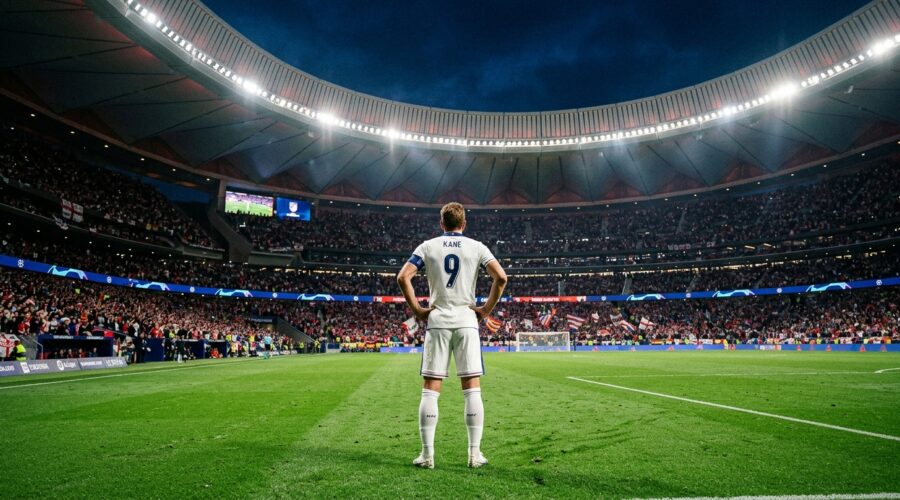
Three weeks ago, Harry Kane stood on the stage of the London Palladium and held a golden trophy that no Englishman had touched in a quarter of a century. The ceremony had not left Paris since 2019 — the first time it had done so in seven years — and neither, it felt, had the deep, unspoken assumption that England footballers exist mainly to be impressive in group stages before crumbling at a moment of consequence. Kane did not crumble. He scored seventy-three goals in sixty-three appearances, helped drag England to a World Cup semi-final, and edged Kylian Mbappé by twenty-eight points in the most consequential popularity contest in sport. On Sunday evening at the Riyadh Air Metropolitano, he walks out to face the world champions needing a win — by any margin, by any method — to send England top of Nations League Group A3. The backdrop is extraordinary. The occasion is simply a football match. The two things are not in contradiction.
This is what a golden week looks like when it has actual consequences attached.
The Table Does Not Care About Your Ceremony
The standings heading into Matchday 6 are stark and unambiguous. Spain sit first on twelve points — four wins from four, goal difference of plus nine. England sit second on nine points — three wins, one defeat, goal difference of plus twelve. England’s superior goal difference is the only lever available to them. A win, any win, sees England leapfrog Spain into first place and all the structural advantages that come with it: a seeded quarter-final draw, a home second leg in March — almost certainly at Wembley — against a runner-up rather than a group winner. Second place means an away second leg against Italy, the Netherlands, or Portugal. The difference between first and second in this group is, in short, the difference between a conceivably navigable route to the final four and a genuinely gruelling one.
Spain, by contrast, need only a draw. They are the world champions. They have been unbeaten for forty-three matches — a run that began on March 26, 2024, in the wake of a friendly defeat to Colombia four days earlier, and has since swallowed a European Championship, a FIFA World Cup, and five consecutive Nations League group-stage victories. They broke Italy’s previous international unbeaten record of thirty-seven by winning the World Cup final against Argentina in New Jersey. The record now belongs to them, stretching back across three major tournaments, through Berlin and beyond. Luis de la Fuente has never lost a home game as Spain manager. The Metropolitano has never hosted a Spain defeat. These are the kinds of facts that do not decide football matches, but they do describe the weight of what England are walking into.
Kane’s Week, in Full
It is worth pausing on what has happened to Harry Kane in the past twenty days, because the accumulation of it is almost surreal. On October 26th, he became the fifth Englishman to win the Ballon d’Or — following Stanley Matthews, Bobby Charlton, Kevin Keegan, and Michael Owen — picking up the award presented by the Brazilian Ronaldo in a ceremony held in London for the first time since 2019, when the event returned to Paris after earlier stints in Zurich and beyond. He beat Mbappé by twenty-eight points, one of the smallest winning margins in the award’s history, and cited Luka Modrić’s longevity as an inspiration, which tells you something about where Kane’s ambitions currently reside. He thanked Tottenham Hotspur. He said being in London had felt like a good omen. The room presumably agreed.
Then, on November 12th at Wembley, he earned his 126th England cap, breaking Peter Shilton’s appearance record — which had stood for thirty-six years and four months, from July 1990 to that evening — in a 2-1 win over Croatia. Shilton was on the pitch for the presentation. Prince William was in attendance. A banner reading England’s Finest was unfurled in the stands. And then, because the occasion demanded it and because Kane has never quite understood that he is supposed to be sentimental rather than lethal at these moments, he converted a penalty for his ninety-second international goal — thirty-nine clear of Wayne Rooney in second place — and walked off having done both things simultaneously: honoured the past and advanced the present.
The full catalogue of his international records now reads like a document somebody invented to win an argument: 126 caps, 92 goals, 13 international braces (outright England record), 5 hat-tricks (joint second, alongside Gary Lineker), and 14 World Cup goals across his career — a new individual England record, from a summer in which England as a team scored 20 goals at the tournament, their own record for a single World Cup, and reached the semi-finals for the first time since 1966, a gap of sixty years. He is chasing one hundred international goals. He is 3/1 for a knighthood by 2030 with the bookmakers, which is the sort of thing that is funny until it is not. Prime Minister Andy Burnham sent public congratulations. The golden week, in its totality, is unprecedented in English football history.
All of which makes Sunday evening in Madrid a peculiarly fitting final act. If England win, Kane adds another chapter. If they do not, the week still stands. But footballers of Kane’s disposition tend to prefer the chapter.
The Bellingham Question, Finally Settled
It is worth revisiting, briefly and without mockery, the hysteria of October 2025. Thomas Tuchel excluded Jude Bellingham from the England squad, citing a lack of rhythm following shoulder surgery in August. Marca reported that Bellingham had himself requested the exclusion, preferring a structured mini pre-season at Real Madrid’s training ground over an international window in which he was not yet fully fit. This is, in retrospect, a reasonable sporting decision taken by two professionals with the collective interest in mind.
At the time, it was treated as a constitutional crisis. Roy Keane and Ian Wright debated it on ITV. Fabrizio Romano’s Facebook post resurfaces periodically, noting — with what can only be described as performative astonishment — that English newspapers once framed Bellingham as a problem for the national team. He was not a problem. He was a player recovering from surgery whose manager had the rare backbone to treat him as such.
Tuchel’s formulation bears repeating: “Are we a better team with Jude? Yes. But I told you before — what do we do if Jude is injured before the World Cup? Do we just cancel? We are not collecting the most talented players. We are trying to build a team. Teams win trophies, no-one else.” That philosophy, once a flashpoint of criticism, now reads as blueprint. Bellingham returned for the World Cup, finished as England’s top scorer with seven goals — the most by any midfielder in a single World Cup tournament — won the Bronze Boot, and had the terraces of Miami and Atlanta singing his name. The exclusion story ended exactly where Tuchel needed it to: in vindication.
For Sunday evening, Bellingham is back in the squad and expected to start in the number ten role. His relationship with Kane in the final third — Kane the fulcrum, Bellingham the arriving runner, the two of them having already demonstrated an intuitive understanding built across a World Cup campaign — is England’s single greatest tactical asset against a Spanish midfield that remains, even without Rodri, the best-organised in the world.
The Brothers, and What They Mean
Jobe Bellingham, twenty years old, currently doing quiet and excellent things in central midfield at Borussia Dortmund, has received his first senior England call-up for the November window. If he makes his debut in Madrid — which is by no means guaranteed, but which Tuchel has done nothing to discourage — the Bellingham brothers would become the twenty-second set of siblings to represent England at senior level, and the first since Gary and Phil Neville played together in 2007.
Jude described the prospect as “the highlight of my career.” This is a remarkable thing to say from a man who has won a Champions League, a Ballon d’Or nomination, a World Cup bronze boot, and scored an overhead kick against Slovakia in a European Championship that brought an entire nation to its feet. That he frames a potential shared cap with his younger brother in those terms tells you something worth knowing about both of them.
Harry Kane, as England captain, will present any debutant with their legacy cap — a tradition Tuchel introduced, red velvet caps embroidered with legacy numbers. If Jobe walks out in Madrid, it will be Kane handing it to him. It is a small detail, but it is the kind of small detail that accumulates into something that matters.
The Opposition, and Why This Is Not Simple
It would be convenient, and also wrong, to frame this as England’s moment and Spain merely the obstacle. Spain are the world champions. They have Lamine Yamal, who is nineteen years old and who, across 105 appearances for club and country through the end of last season, contributed 25 goals and 24 assists — numbers that belong to a player several years his senior. He missed the win over Czechia with minor knee pain and returns for Sunday’s finale. His performance in Spain’s first group match — which served as a reminder of the kind of game-defining threat he carries into every ninety minutes — underlined that he remains the most instinctively dangerous attacking player in world football at this particular moment. That he is nineteen and plays with the economy of someone who has seen everything twice is, frankly, unsettling.
Spain’s midfield structure under De la Fuente operates with a kind of collective intelligence that makes individual attribution difficult. Mikel Merino has five Nations League goals. Dani Olmo has four assists. Álex Baena, Mikel Oyarzabal — the man who scored Spain’s decisive third at Wembley in September — all present solutions to problems England have not yet fully solved. And Spain only need a draw. The tactical reality of that asymmetry cannot be overstated: De la Fuente can defend what he has. Tuchel must attack.
England’s probable shape, a 4-2-3-1 with Declan Rice and Elliot Anderson screening, Trent Alexander-Arnold at right-back, and Morgan Rogers and Anthony Gordon providing width behind Kane, suits an open game. If Spain defend their draw, England will have space to exploit. If Spain play their natural game — high press, quick transitions, Yamal drifting inside to devastating effect — England will need discipline they have not always shown against top-tier opposition. The 7-0 destruction of Croatia in Rijeka was magnificent and psychologically important and entirely irrelevant as a predictor of what happens on Sunday evening. Croatia are not Spain.
It is also worth noting: England have won two of their last fourteen meetings with Spain. The last victory on Spanish soil was Raheem Sterling’s evening in Seville in October 2018 — a 3-2 win in the previous Nations League era that remains one of the more improbable results in England’s recent away history. These things happen. They are not regular.
The Tuchel Doctrine, and What It Has Built
The Cole Palmer omission deserves a sentence. Palmer is reportedly fully fit. He is not in the squad. Neither is Phil Foden. Neither is Kobbie Mainoo. This is not a manager who is confused about squad selection; it is a manager applying a coherent, consistent philosophy that has already delivered a World Cup semi-final and a Ballon d’Or-winning captain. His critics — and they remain vocal — have notably fewer specific objections than they once did.
What Tuchel has built, over eighteen months of unfashionable decisions and collective insistence, is an England squad that functions as a team rather than a constellation. The Bellingham exclusion, the Palmer omissions, the insistence on legacy caps and collective identity — these are not accidents of personality. They are architecture. “We are not collecting the most talented players,” he said. The results suggest he was right, though the most talented players keep ending up in the squad anyway, which is perhaps the most elegant vindication of all.
Eighty-Eight Minutes of Consequence
At 7:45 PM GMT on Sunday evening, before 68,000 people at the Riyadh Air Metropolitano, the most-capped England player of all time will lead out a team that has scored sixteen goals in five Nations League matches against a team that has not been beaten in forty-three. The stakes are real but contained: both sides are already through to the quarter-finals. What is on the table is seeding, home advantage, and something harder to quantify — the question of whether this England side, in this form, in this moment, can beat the best team in the world when it matters.
Pre-match consensus leans toward Spain, as it reasonably should. TNT Sports forecast a 3-2 Spain win. Rotowire predict 2-1. The betting has Spain as clear favourites at minus-200. None of that is irrational. Spain are the world champions, they play at home, and they need a point. The logic is sound.
But Kane has spent this week doing things that logic said were unlikely. He accepted a Ballon d’Or on a London stage. He broke a thirty-six-year record and scored his ninety-second international goal in the same evening. He will walk out in Madrid as the finest English footballer of his generation, in the form of his life, with Bellingham beside him and an entire nation’s unreasonable optimism distributed somewhere in the Madrid night air.
England have not won in Spain since 2018. The forty-three-game unbeaten run is a genuinely extraordinary achievement. The Metropolitano has never seen a Spain defeat. All of this is true.
So was everything about Harry Kane, once, until it was not.