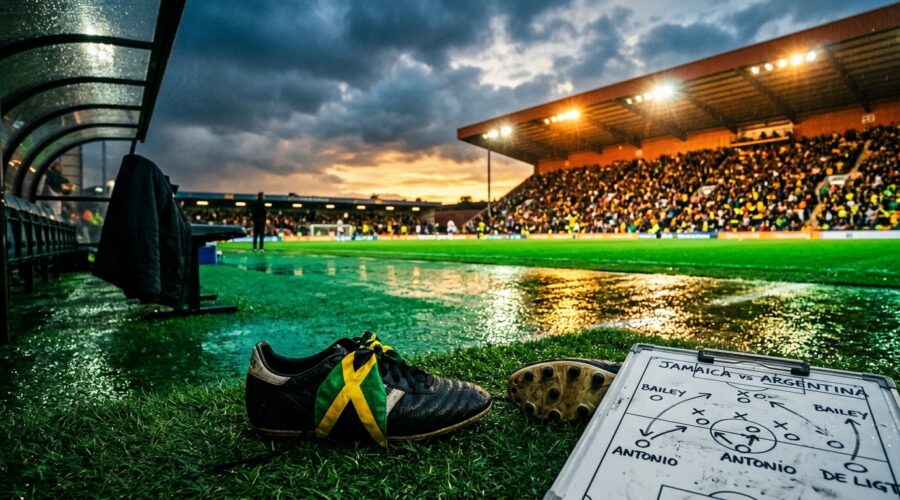
In the space of seventy-two hours in mid-November 2026, CONCACAF managed to produce a coaching departure of genuine soap-opera drama, the most consequential giant-killing in Jamaican football history, and a glimpse of a young American core that looked, in flashes, like it might genuinely matter on the world stage. The November international window had no business being this eventful. And yet.
Start where the earthquake started: at a press conference in Atlanta on the morning of Friday, November 13th, twenty-four hours before the USMNT were due to kick off their CONCACAF Nations League quarterfinal against Haiti at Nu Stadium in Miami.
The Departure That Stung
Mauricio Pochettino stood at a podium and wept. Not performatively, not with the practiced solemnity of a man reading from a script, but with the genuine, slightly undignified emotion of someone who had not entirely resolved the conflict between what he was doing and what he felt about doing it. “It’s difficult to talk now,” he said. “I’m a very emotional guy. It’s a very sad decision. But we are professionals and we are trying to make our dreams come true.”
The bare facts were these: Manchester United had reached a verbal agreement in principle to trigger a reported $10 million release clause in Pochettino’s USMNT contract — a sum United would pay to U.S. Soccer to release him from his national team obligations — and the Argentine had accepted. As of mid-November, the clause had not yet been formally triggered. This was, in itself, unsurprising. Pochettino had always been, on some level, an Old Trafford project deferred. What was remarkable, and what gave the whole episode a particular sting, was the timing. Three months earlier, U.S. Soccer had handed him a new deal running through the 2030 World Cup — a statement of faith in a coach who had just delivered what may stand forever as the USMNT’s finest World Cup: a 4-1 victory over Paraguay, a 2-0 victory over Australia, then a 3-2 group-stage loss to Turkey, before recovering with a 2-0 victory over Bosnia and Herzegovina in the Round of 32, and finally a 1-4 defeat to Belgium in the Round of 16 that ended the American dream on home soil. The ink was barely dry. And then Old Trafford called.
What Pochettino’s representatives had apparently done — sources confirmed to ESPN that it was his camp who first alerted United to the existence of the clause — has a certain mercenary quality to it that sits uncomfortably alongside the tearful farewell. But football rarely offers clean moral narratives, and in fairness, the man honored his commitment to see out the Haiti tie before flying to Manchester. His overall record with the USMNT stood at 23 wins, 12 losses, and 2 draws across 37 matches, and his most lasting contribution may well prove to be the generation he dragged into the light: Julian Hall, Sebastian Berhalter, Cavan Sullivan, Alex Freeman, Adri Mehmeti — a cohort of young players who barely existed in the national team conversation when he arrived.
“The opportunity to represent the USA crest was one of the greatest honors of my career,” Pochettino said in a written farewell statement. It read with considerably more dignity than the manner of his exit warranted. That is probably to his credit.
Haiti and the Formality of Annihilation
If the circumstances surrounding the USMNT’s opener against Haiti were awkward — the outgoing manager, the diaspora crowd at Nu Stadium roaring for the opposition, the whole occasion wearing the air of a farewell party nobody had quite organized — the football itself was anything but complicated.
The Americans were simply, thoroughly better. Haiti 0 – 6 United States.
Auston Trusty headed home a Sebastian Berhalter free kick in the 10th minute, and from that point the evening had the quality of a controlled demolition. Julian Hall, eighteen years old and barely five senior international appearances into his career, scored his fourth international goal after a sharp counter-attack move. Then came Pulisic.
Christian Pulisic had not played in a USMNT shirt since suffering a microfracture to his tibia and fibula against Belgium at the World Cup. His return, in the 62nd minute, took the form of a penalty dispatched down the middle with quiet authority. What followed one minute and forty-one seconds later — a clinical finish into the bottom-left corner from outside the box — completed a brace that told you, without a word of statistical context, that he had not forgotten how to do this. Weston McKennie headed in a Malik Tillman corner in the 68th, and Folarin Balogun collected a Tillman through-ball to roll home in the 82nd. Tillman, it should be noted, became the first USMNT player to record multiple assists in a CNL match since Giovanni Reyna in 2024, which feels like a footnote but is worth filing away for later.
The 71% possession and 90% passing accuracy tell one part of the story. The more instructive detail was Haiti’s conversion of zero of their three shots on target despite being granted a pro-Haiti atmosphere by a Miami crowd heavy with the Haitian diaspora. A Lenny Joseph goal was correctly chalked off by VAR, which provoked the kind of furious response from the stands that reminded you this was, technically, Haiti’s home match, played in Miami only because ongoing gang violence in Port-au-Prince had made staging football there unconscionable.
The second leg at TQL Stadium in Cincinnati four days later was what it needed to be: a rotation exercise dressed as a football match. Pochettino’s final night on the touchline. Pulisic scored a bicycle kick of genuine technical audacity in the 25th minute — the kind of goal that would have been the talking point of a more consequential occasion — and Hall added a second before half-time. 2-0. 8-0 on aggregate. Cincinnati gave Pochettino a standing ovation at full-time, which was the least they could do, and perhaps the most anyone could offer a man who had already mentally moved on to the Premier League’s relegation scrap.
Kingston, Where History Was Made
While the United States were doing what the United States were expected to do, 1,100 miles southeast in Kingston, Jamaica, something genuinely extraordinary was unfolding.
Mexico arrived at the National Stadium ranked 10th in the world — 59 places above Jamaica, who sat 69th — as defending CONCACAF Nations League champions, and with the air of a team that expected to manage a professional result before wrapping things up comfortably in Monterrey. Rafael Márquez, the former Barcelona and Mexico legend now enduring the most humbling introduction to management in El Tri history, set up in his now-familiar attacking 4-3-3 and watched as his side conceded the first goal in the 27th minute through a comical own goal: Jesús Gallardo deflecting a Ronaldo Webster corner into his own net under no discernible pressure.
Renaldo Cephas drove in a second goal one minute into the second half — a composed left-to-right run, a grounded right-footed finish, the kind of goal that freezes a stadium into silence — and Richard King converted a penalty in the 63rd to make it 3-0. At that point, the mathematics were simply being confirmed: Jamaica had, for the first time in their history, scored three goals against Mexico in a single match.
Mexico, to their credit, pulled two back through the emerging 18-year-old Gilberto Mora and a Julián Quiñones penalty in the 81st minute. Final score: Jamaica 3 – 2 Mexico. Those two away goals, scored in Kingston — not Monterrey — would become the fulcrum on which the entire tie pivoted.
At Estadio BBVA four days later, before a sold-out partisan crowd in Monterrey that willed El Tri forward with the kind of intensity that tends to intimidate visiting sides into paralysis, Jamaica defended with structure, pace, and conviction in a deep 5-4-1 block. Goalkeeper Jahmali Waite was magnificent. Márquez committed to his attacking shape from the first whistle, Jesús Corona scored a first-half goal to make it 1-0 on the night, and then — nothing. Mexico’s 67% possession, five shots on goal, and all the pressure a home crowd can generate could not produce the second goal that would have forced a shootout.
The final whistle at Estadio BBVA triggered scenes of bewildered deflation on the pitch and scenes of unbridled chaos, one would presume, in Kingston. 3-3 on aggregate. Jamaica through on away goals. Interim Jamaican head coach Rudolph Speid, who had stewarded his side through the kind of defensive performance that requires not just organisation but nerve, was precise in his post-match framing: “It wasn’t for us, really. It was always for the country. I know that Jamaica was almost disappearing in football and from being relevant. I think this brought us back.”
It did more than that. It sent the Reggae Boyz — ranked 69th in the world — through to a CONCACAF Nations League Final Four at the expense of the defending champions. Caribbean football has been trying to announce itself for years. Consider this its loudest announcement yet.
Rafael Márquez and the Weight of a Number
Spare a moment, if you can, for the specific humiliation of Rafael Márquez’s predicament. The man is one of the most decorated footballers in Mexican history — five World Cups as a player, Champions League pedigree at Barcelona, 147 senior international caps. He took over from Javier Aguirre in July 2026 following Mexico’s Round of 16 elimination by England at the World Cup, and has since recorded three losses and two draws in five matches: no wins, two goals scored in four previous outings, and a defensive record suggesting a team that has not yet discovered what it wants to be.
The historical context is not kind. Only Raúl Cárdenas, whose 1978-79 tenure produced an eight-match winless opening, has started worse as Mexico head coach. Márquez has already surpassed the bleak openings of Ricardo La Volpe and Ignacio Trelles. The elimination in Kingston means Mexico must now navigate the Gold Cup preliminary round to reach the 2027 tournament — a fate so embarrassing for a program of El Tri’s resources and expectations that the murmuring around Márquez’s future will now become a sustained, unavoidable roar.
One suspects the former number five would have preferred a less statistically precise form of immortality.
The Search Begins
Back in the United States, U.S. Soccer President Cindy Parlow Cone has signalled that the search for Pochettino’s replacement will involve Emma Hayes, CEO JT Batson, COO Dan Helfrich, and Assistant Sporting Director Oguchi Onyewu — a committee that tells you they are approaching this with institutional seriousness rather than reactive panic. Steve Cherundolo, the 87-capped USMNT legend who has been coaching the under-23 side, will take charge of a December camp built around an MLS-based roster, including a friendly against Jamaica on December 13th at Inter Miami CF Stadium. It is a sensible bridge. It is not a solution.
The names being circulated carry a range of plausibility. Pep Guardiola, unattached since leaving Manchester City and apparently subject to exploratory contact from U.S. Soccer, would be the dreamboat appointment — but The Telegraph has reported he intends to honor a sabbatical and reject any approach, and the structural realities of international football (the lack of daily training, the multinational club diaspora, the impossibility of a true pre-season) sit awkwardly with everything Guardiola’s methods require. The odds are long. The appeal is obvious.
Julian Nagelsmann, 39 and unattached since stepping down following Germany’s World Cup exit in a round-of-32 penalty shootout loss to Paraguay on July 3, 2026, is among the names in circulation — young, tactically literate, with a proven track record at RB Leipzig, Bayern Munich, and the German national team. His stock dipped after an underwhelming World Cup campaign with Die Mannschaft, but that may simply make the price of acquisition more reasonable for a federation that knows what it needs to do before the 2030 World Cup. Roberto Martínez, who attended the United Soccer Coaches Convention in Philadelphia in January, brings comfort with American football culture and elite international experience, though his post-2018 trajectory has not been uniformly convincing.
Marcelo Bielsa offers philosophical continuity — he coached Pochettino at Newell’s Old Boys (1990-1992) and with the Argentine national team, and the high-intensity pressing DNA that the younger generation has been educated in traces its lineage directly to El Loco. His recent departure from Uruguay complicates the picture. Pellegrino Matarazzo, the New Jersey-born American coaching Real Sociedad — who delivered a remarkable Copa del Rey triumph in April 2026 — represents the dark horse candidate who would, in many ways, make the most coherent long-term sense. B.J. Callaghan, who won the 2023 CNL title as interim head coach of this very squad and now manages Nashville SC with the 2025 U.S. Open Cup among his honours, is the institutional knowledge option — and not to be dismissed as one.
Los Angeles, March 2027
What is not in doubt is that the 2026-27 CONCACAF Nations League Final Four at SoFi Stadium in Los Angeles — March 25-28, 2027 — will be extraordinary. USA, Jamaica, Canada, and Panama. The United States are the overwhelming favorites. Jamaica are the story of the whole tournament. Canada, under Jesse Marsch, remain a team built for exactly this kind of compressed high-stakes environment. Panama are quietly dangerous and will not be anyone’s easy match.
Whoever walks into the USMNT dugout at SoFi Stadium will inherit a team that has just gone 8-0 on aggregate over two legs, boasts a 23-year-old captain in Pulisic who still scores bicycle kicks in dead-rubber second legs for the sheer pleasure of it, and carries in its ranks an 18-year-old forward named Julian Hall who has already scored four international goals as though the whole exercise simply seems natural to him. That is not a bad inheritance.
The question is who is ready to claim it — and whether the USSF, faced for the second time in three years with an unexpected vacancy at the top of the men’s program, can resist the pressure of a name and find the right fit instead.
Pochettino gave American football something tangible and something harder to quantify. The tangible thing was a Round of 16 at a home World Cup — the best run in USMNT history by wins accumulated, however it ended. The harder thing to quantify is a culture, a standard, a generation of players who know what it feels like to prepare professionally and compete seriously at the highest level. Those players will still be there in March at SoFi. They will still be there in 2030, wherever that tournament is held.
What they need now is a manager who understands that the work has already begun, and that the job is to continue it rather than reinvent it. That is a more difficult brief than it sounds. Football, as a rule, prefers the clean slate to the careful continuation. It is usually wrong about that.