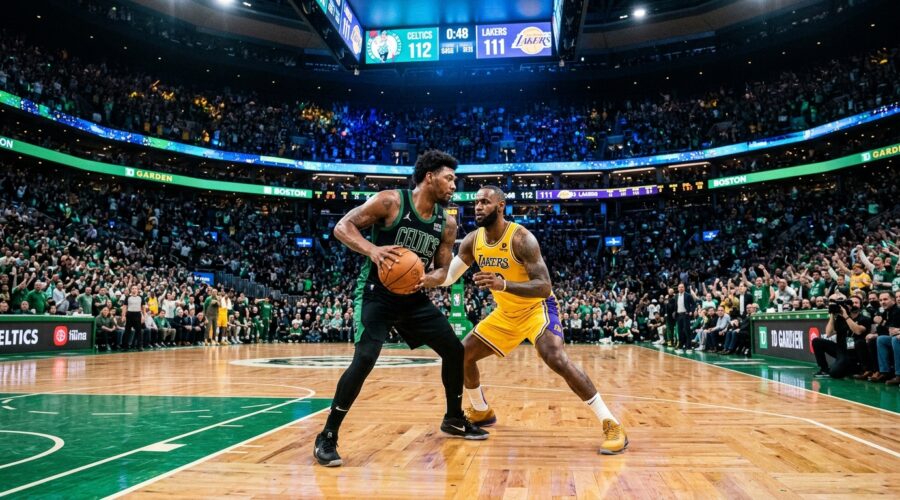
Somewhere in Bristol, Connecticut, an ESPN scheduling executive looked at the November 18 doubleheader card, saw Golden State Warriors vs. Dallas Mavericks in the 9:30 p.m. ET slot, and thought: we can do better than this. They were right. Boston Celtics vs. Denver Nuggets just got flexed into the building, and the Warriors and Mavericks — two historic franchises with their own mountains of national TV equity — got bumped to make room. That is not a minor programming tweak. That is a declaration.
So what exactly did ESPN see when they made that call? Let’s break it down piece by piece, because the answer is more layered and more interesting than a simple “big stars, big game” headline suggests.
1. The Greatest Individual Season Nobody Talked About Enough
Start with Nikola Jokic, because you always have to start with Nikola Jokic. What the man did in 2025-26 belongs in a museum. Twenty-seven point seven points per game. Twelve-point-nine rebounds per game — led the entire NBA. Ten-point-seven assists per game — also led the entire NBA. Fifty-six point nine percent from the field. Thirty-four triple-doubles.
Read that again: Jokic simultaneously led the league in both rebounds and assists. No player in NBA history had ever done that before. Not Oscar Robertson. Not Magic Johnson. Not even Russell Westbrook at the absolute apex of his statistical dominance. Jokic did it, and he did it in year two of back-to-back triple-double seasons, joining Westbrook as the only players in the modern era to average double figures in all three categories for two consecutive years.
ESPN had Jokic ranked No. 1 in NBA Rank for the third straight year entering that season. The Athletic’s insiders, when pressed on the best player in the world debate, kept landing in the same place: “The skill set for his position is too amazing, the possibilities with other players too fantastic, for the choice to be anyone else.” Shai Gilgeous-Alexander won the MVP that year. Jokic finished second. He posted a 56-point Christmas Day masterpiece against San Antonio. He dropped 40 points, 13 rebounds, 8 assists, and 3 blocks on Victor Wembanyama in April in what Denver’s own media called the best individual game of the entire regular season.
And entering November 18, 2026, Jokic is still operating at a level that defies easy description: 23.5 points, 10.8 rebounds, 9.1 assists per game in year two of his thirties. The efficiency is intact. The vision is intact. The whole terrifying package is still running at full capacity. His most recent game before the showcase? Twenty-eight points, 15 rebounds, 7 assists — in a loss to Phoenix, because the supporting cast couldn’t stay out of its own way. That detail matters, and we’ll come back to it.
2. The Comeback Story That Rewired the Entire NBA Hierarchy
Now flip to Boston. Because if Jokic is the settled verdict on greatness, Jayson Tatum is the challenge brief filed in response.
In May 2025, late in Game 4 of the Eastern Conference Semifinals at Madison Square Garden, Tatum planted his right foot and something gave way. Ruptured Achilles. The kind of injury that has historically redefined careers, stolen prime years, and permanently altered the conversation around a player’s ceiling. Tatum, to his credit, did not wait around to feel sorry about it. He had surgery the following morning — the morning after, before swelling could set in and cost him an extra month — a decision he attributed to studying how Kobe Bryant handled the same injury years earlier.
What followed was 298 days of daily work, uncertainty, a January report suggesting he might shut it down entirely, and then a March 6, 2026 return in Boston against the Dallas Mavericks: 15 points, 12 rebounds, 7 assists. The arena erupted. The NBA exhaled. And then, quietly, the Celtics — who had somehow gone 35-19 without him, with Jaylen Brown running a career-high 28.7 points per game — absorbed their guy back into the lineup and kept rolling.
Fast forward to the 2026-27 season opener. Tatum, now 28 years old, fully healthy for the first time in seventeen months, dropped 36 on the Knicks in the season’s opening weekend. Then 40 in overtime against Brooklyn. Then a franchise-record 21 points in a single quarter against Dallas. Through twelve games he is averaging between 26.3 and 27.8 points, 7.5 to 7.9 assists, and 6.1 to 6.4 rebounds per night. The assist numbers, notably, have spiked well above his pre-injury averages — a sign that the injury changed how Tatum thinks about the game, forcing him to evolve as a playmaker in ways that actually made him more dangerous.
This is the narrative ESPN is packaging for 9:30 p.m. on a Wednesday in November: not just a basketball game, but a question. Is the restored champion better than the man who has been historically dominant the entire time?
3. The Age Arithmetic Is Getting Urgent
Here’s where the game gets philosophical. Jokic turned 31 entering 2026-27. Tatum is 28. And while Jokic remains the most efficient version of himself, the structural reality around him in Denver is sobering. The Nuggets lost to the Minnesota Timberwolves in the first round of the 2026 playoffs — a first-round exit after a historically great regular season — because Aaron Gordon only played 36 games, the second unit never stabilized, and Jokic could not win three-on-five every night. The offseason addressed that modestly at best: Marvin Bagley III, Trevon Brazile, Tyus Jones, and Lonnie Walker IV came in; Tim Hardaway Jr. and Jonas Valanciunas went out. It is fundamentally still the Jokic-Jamal Murray machine, rebuilt around hope rather than certainty.
Meanwhile, Tatum is entering what should be the absolute prime of his career. He already has the championship pedigree — the 2024 banner belongs to Boston, where Tatum led the Celtics in points (22.2 PPG), rebounds (7.8 RPG), and assists (7.2 APG) during their Finals run en route to defeating the Dallas Mavericks 4-1. He joins Jokic and LeBron James as the rare players in NBA history to lead their team in all three categories during a Finals run. He has the scar tissue from the Achilles. He has the chip on his shoulder from missing essentially all of a season while his team held it down without him. Boston sits at approximately 10-2 entering this game, with the second-best defensive rating in the NBA at 107.6 and a net rating of plus-11.7 — and they are doing this on a brutal road-heavy November schedule where 12 of their first 16 games are away from TD Garden.
The window-of-opportunity subtext here is not subtle. Jokic is running out of time to get back to the Western Conference Finals, let alone the championship. Tatum is just entering the years when players of his profile tend to do their most dominant work. The November 18 matchup is not a Finals. But it is a preview of a question the NBA is going to be asking itself for the next three to four years.
4. The NBA Cup Stakes Are Real Now
Four years into the Emirates NBA Cup’s existence, the tournament finally has genuine institutional weight — and the reason is the 2025 New York Knicks, who became the first team in league history to win both the NBA Cup and the NBA Championship in the same season. That double changed everything about how elite teams approach November group play. The Cup is no longer a novelty or a marketing vehicle. It is a preview tournament with legitimate trophy implications and meaningful chemistry-building stakes.
So when Boston walks into Ball Arena on November 18 sitting 2-0 in East Group C with a plus-53 point differential — the largest in the entire Eastern Conference after two rounds — that number matters. The Celtics opened Cup play with a 125-111 win over Chicago, then went full throttle and hung a 39-point beatdown on Charlotte. Bleacher Report, analyzing the group standings after November 13, was blunt: Boston and Orlando were on track to cruise into the knockout rounds, with the Celtics expected to handle Washington on November 24 and Atlanta on November 27 without meaningful difficulty.
Denver is in a tighter spot. The Nuggets sit 1-0 in West Group A — a single October win over Phoenix — but they are trailing Dallas’s 2-0 start, with critical games against Houston on November 20 and Dallas on November 24 looming immediately after the Boston showcase. The November 18 game is not a Cup fixture itself, but it feeds directly into team morale and momentum entering those must-win group matches. For Denver, the internal stakes are enormous: a strong showing against an elite team is exactly the kind of psychological data point a roster searching for its identity needs entering a defining stretch.
5. The Bump Itself Was the Biggest Statement
Let’s not glide past what actually got displaced here. The Warriors vs. Mavericks was not a throwaway game. Golden State and Dallas are historically proven national television commodities — both franchises have double-digit scheduled national appearances per season, both pull significant ratings, and both carry enough legacy brand recognition that their matchups basically sell themselves. ESPN did not flex out a mediocre product to make room for a premium one. They flexed out a genuinely good product to make room for something they believed was exceptional.
That is an editorial statement. And the math behind it is not complicated. Consider: in 2024-25, the Lakers-Nuggets Saturday Primetime on ABC drew a 29-percent viewership spike and became the most-watched program of the night across all of television — not just sports, all of television. The 2025-26 season’s opening night, the first broadcast under the NBA’s landmark new media deals with NBC, Peacock, and Prime Video joining ESPN and ABC, averaged 5.6 million viewers — the largest tip-off audience since 2010. The NBA’s national television audience is growing, the competitive landscape between broadcast platforms is fierce, and Wednesday night’s doubleheader slot is ESPN’s most reliable midweek real estate.
ESPN is also navigating a milestone — this is the network’s 25th consecutive NBA season, which carries its own institutional significance. NBA Countdown presented by Eli Lilly is making its season debut ahead of this doubleheader, a full pregame show treatment that is explicitly not standard for a mid-November Wednesday. That is event-level production investment, and you do not roll that out for a game you are not confident in.
When you stack the factors side by side, the analysis is not close. Celtics-Nuggets wins on superstar narrative richness, season record stakes, the best player in the world debate, NBA Cup institutional momentum, cross-conference intrigue as a possible Finals preview, head-to-head history that consistently goes to the wire, and ESPN’s own milestone season context. The Warriors-Mavericks matchup wins on legacy branding and habit. That’s it.
The Bottom Line
Flex scheduling exists precisely for the confluence that November 18 represents: a historically dominant player who hasn’t gotten his team back to the top of the mountain meeting a fully healthy champion who spent ten months relearning how to walk before relearning how to be the best version of himself. Jokic at 31, running out of runway. Tatum at 28, entering the years where everything is supposed to click. A team at 10-2 with the second-best defense in basketball against a team at 7-5 that is fundamentally one person trying to hold gravity together.
Wednesday night, 9:30 p.m. ET, Ball Arena. The NBA knew exactly what it was doing when it made this call. Now go watch it.