Colts at Texans, TNF Week 11 (November 20, 2026): The DPOY Race, a Division Already Decided, and Two Teams Desperately Fighting for Relevance
Let’s set the stage. It is Thursday Night Football, Week 11, and Amazon Prime Video has handed us a 3-7 team visiting a 3-6 team in a matchup that, on paper, sounds like a good time to reorganize your refrigerator. But dig one layer deeper and you find something genuinely fascinating: a potential Defensive Player of the Year crowning performance, a quarterback situation so catastrophically broken it deserves its own case study, a division race that is mathematically over for everyone except the team currently winning it, and a Texans franchise that might be the most confounding collection of talent in the AFC. Thursday, November 20th, NRG Stadium. Houston, Texas. Let’s get into it.
The AFC South Standings: A Study in Extremes
Through Week 10, the AFC South looks like this:
- Jacksonville Jaguars: 7-2 (.778), 1st
- Houston Texans: 3-6 (.333), 2nd
- Indianapolis Colts: 3-7 (.300), 3rd
- Tennessee Titans: 1-8 (.111), 4th
The Jacksonville Jaguars are running away with this division at a pace that makes the AFC South feel less like a four-team competition and more like a charitable exhibition. Their magic number to clinch is 5. The gap between Jacksonville and second-place Houston is 4 full games, which means the Texans would need to go 8-0 while the Jaguars simultaneously collapse to 0-8 for the race to even get interesting. Trevor Lawrence is operating at a 112.8 passer rating with a 21:5 TD/INT ratio and a road win over the Ravens in Week 9 by the score of 33-10. That is not a team that is about to go 0-8. Jacksonville could clinch the AFC South as early as Week 15, and their remaining schedule is the softest of any contender in the conference.
Yes, Houston holds the head-to-head tiebreaker after their Week 6 road win at Jacksonville — a dramatic 34-31 final where Ka’imi Fairbairn made a game-winning 49-yard field goal as time expired and C.J. Stroud threw a 50-yard laser to Jaylin Noel to set it up. That win was legitimate. Genuinely impressive. And also almost entirely irrelevant now. A 4-game gap in the standings does not care about your tiebreaker. The Jaguars feature Travis Hunter — the 2024 Heisman winner — logging dual WR/CB snaps, Foyesade Oluokun patrolling the middle with 68 tackles, and a defensive EPA of -0.091 per play, the best number in the entire division. Jacksonville is a legitimate AFC contender. Everybody else in the division is playing a different game.
Will Anderson Jr. and the Most Compelling DPOY Case in the NFL
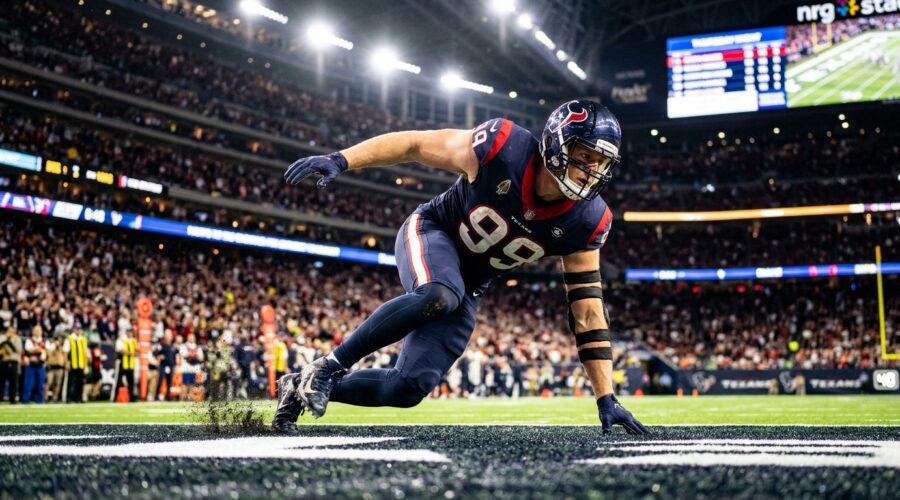
Now here is what actually makes Thursday night worth watching. Will Anderson Jr. leads the NFL in sacks with 10.5 through nine games. The next closest pursuers are Carl Granderson and Andrew Van Ginkel, tied at 8.5 sacks, followed by Greg Rousseau, Chase Young, and Dallas Turner at 8.0, with T.J. Watt at 7.5. Anderson’s margin over the field is at minimum 2.0 sacks, and his lead over a player of Watt’s caliber is 3.0 sacks. At his current rate of 1.17 sacks per game, he is on pace for approximately 21 sacks on the season. The historical parallel here is loud and unavoidable: T.J. Watt won the 2021 DPOY with 22.5 sacks regardless of whether the Steelers were a Super Bowl favorite. Dominant individual production overwhelmed every other narrative.
Anderson also carries 14.5 tackles for loss, which is the detail that separates him from a one-trick pass rush specialist. He is disrupting run games, collapsing pockets, and forcing offensive coordinators to devote double-team resources to one edge on every single snap. His DPOY odds have shifted from +230 to +175 in a single week. He is the clear favorite, and Thursday night is both a stage and an opportunity.
His week-by-week breakdown tells a story of consistent, escalating chaos:
- Week 1 vs. Buffalo: Split sack of Josh Allen with Mario Edwards Jr. — opened his account against one of the NFL’s most elusive QBs.
- Week 2 vs. Cincinnati: Clean sack of Joe Burrow in Q2. Part of a 5-sack team performance that still ended in a 6-20 loss because the Texans offense generated zero points with any of that field position.
- Week 3 at Indianapolis: The masterpiece. Strip-sack of Daniel Jones in Q1. Recovered his own fumble. Additional half-sack in Q3. Solo sack in Q4. His Q4 strip-sack registered an EPA impact of -4.33 — the most damaging individual defensive play of his entire season. The Texans still lost 19-17 because their offense held the ball long enough for Indianapolis to find a walk-off field goal. Anderson played the game of his life and went home 0-1.
- Week 5 at Tennessee: Four sacks in the fourth quarter alone, including a 14-yard sack and a 13-yard sack. The blowout conditions provided the opportunity, but the motor and execution were unmistakable.
- Week 9 at LA Chargers: Two sacks of Justin Herbert in a 44-22 blowout win.
- Week 10 at Cleveland: One sack of Deshaun Watson in Q4, with Houston holding a 24-20 lead. Cleveland found a way to win anyway. Anderson continues to do his job in games his team refuses to close.
The voters-favor-winning-teams argument is real but historically manageable. Watt won in 2021 on pure statistical dominance. Anderson is building that same case, and Thursday night — in primetime, against a quarterback who has thrown 12 interceptions and sports a 67.0 passer rating — is precisely the kind of setup where highlight reels get made and award narratives get cemented. If Anderson reaches 12-plus sacks this week, the DPOY race is functionally over.
C.J. Stroud Is Not Getting Enough Credit for Being This Good
While we are on the subject of things people are not paying enough attention to, let’s talk about C.J. Stroud. His 2026 numbers read like this: 102.4 passer rating (6th in the NFL), 19:3 TD/INT ratio, 2,462 passing yards, and a 62.8 completion percentage. He is the 18th quarterback in NFL history to throw at least 19 touchdowns with three or fewer interceptions through his team’s first nine games of a season. Six of the previous 17 on that list went on to win MVP. That is not a trivia question. That is a data point about how good this quarterback is relative to the history of the position.
When Stroud posts a positive EPA in a game, the Texans are 3-0. The problem is not Stroud. The problem is that Houston has blown fourth-quarter leads in four games this season, leading the entire NFL in that category. They turned a 17-3 lead against Cleveland into a 24-27 loss. Their offensive coordinator has faced pointed questions about in-game adjustments after the offense produced six three-and-outs in their last eight possessions against the Browns. This team is not losing because Stroud is bad. It is losing because the architecture around him keeps caving at the worst moments, and because the IR list reads like a first-round receiver draft pick bonanza: Tank Dell gone, Jayden Higgins gone, Marvin Harrison Jr. playing in only 7 games all year with 11 receptions and 145 yards to show for it.
Speaking of Harrison Jr. — he is the single biggest offensive wildcard heading into Thursday night. If he is healthy and DeMeco Ryans deploys him aggressively, Houston’s receiver corps goes from functional to genuinely dangerous alongside Nico Collins, who leads the team with 37 receptions, 478 yards, and 5 touchdowns.
Daniel Jones and the Indianapolis Colts: A Cautionary Tale in Four Acts
On the other side of this matchup, Indianapolis rolls out Daniel Jones, who has thrown 12 interceptions on the season — among the highest totals in the NFL — logging a 67.0 passer rating, a 7:12 TD/INT ratio, and a 5.6 yards per attempt average that suggests the word “efficiency” has been banned from the Colts’ vocabulary. For reference purposes, a 67.0 passer rating is the kind of number that gets a quarterback benched on most rosters. Shane Steichen has kept Jones as the starter because, apparently, the other option is Anthony Richardson Sr., who has played exactly one game this season for a grand total of two completions, eight passing yards, and four rushing yards. The Colts are caught between two quarterbacks and have somehow managed to field neither of them with any confidence.
What makes this matchup specifically troubling for Indianapolis is that Anderson’s Week 3 blueprint against Jones already exists on film. Anderson attacked tight splits and first-down rushing situations, forced Jones to roll out, and Jones responded by scrambling for one yard. The strip-sack sequence in that game — Q1 fumble forced, fumble recovered, continuous pocket pressure all afternoon — was not a fluke. It was a systematic deconstruction of a quarterback who panics under sustained edge pressure. With Micheal Clemons on IR and the Colts’ edge protection showing patchwork seams, Thursday could look very similar to that Week 3 film.
The one man standing between total Colts offensive dysfunction and something resembling a competitive performance is Jonathan Taylor. Through Week 10, Taylor has 739 rushing yards, 4.2 yards per carry, and 8 rushing touchdowns — elite red zone production. He has also added 28 receptions for 240 yards in the passing game. Taylor is not just the Colts’ best offensive player; he is their entire offense. If Houston can hold him under 80 yards — which they nearly did in Week 3 by sequencing early-down runs for 1, 2, 0, 1, and 2 yards against their interior — Jones will be forced to throw the ball against a Will Anderson-led pass rush. That does not end well for the Colts.
Indianapolis, playing spoiler football at 3-7, needs seven wins in their final eight games to reach a Wild Card target that is essentially already off the table. They are not winning seven of eight. They are hoping Taylor can carry them to respectability, that Jones can avoid catastrophic errors in enough games to stay competitive, and that Sauce Gardner and Cam Bynum can generate turnovers in the secondary to keep things close. That is a slim framework for an upset.
The Playoff Picture for Houston: Running the Table or Going Home
Houston’s remaining schedule after this game is not particularly forgiving. Baltimore, Pittsburgh, Washington, Jacksonville again, Philadelphia, Green Bay, and Tennessee sit between now and the final whistle of the regular season. The current AFC Wild Card eighth seed is held by New England at 5-5. Houston is 2 games back. To reach the 10-win threshold they likely need for a Wild Card spot, they would need to go 7-1 over their final eight games. That is an extraordinary ask for a team that has lost four games in which they held a fourth-quarter lead.
But the AFC is chaotic enough to keep the door cracked. Baltimore is 3-6 without Lamar Jackson. Cleveland is competitive but not dominant. The Raiders sit at 4-6. If Houston can rattle off a few consecutive wins and those fringe AFC teams continue to stumble, the math shifts just enough to matter. Thursday is not an optional game for the Texans. It is a mandatory win, the kind that separates teams that are fighting from teams that are simply finishing the schedule.
The Matchup Breakdown: Where This Game Gets Decided
Three individual battles will determine the final score on Thursday night.
Anderson vs. Jones’ pocket presence is the headliner. Anderson attacks primarily from the right defensive end position, targeting the left tackle situation that Indianapolis is protecting with patchwork personnel. Jones’ inability to process pressure quickly — evidenced by his 12 interceptions and league-worst turnovers including three lost fumbles — creates a feedback loop. Early pressure forces hurried reads. Hurried reads produce interceptions. Interceptions produce a negative psychological cascade for a quarterback whose confidence is already running on fumes. This is where Anderson makes his money on Thursday.
Stroud vs. the Indianapolis secondary is more nuanced. Sauce Gardner is legitimately one of the best corners in the NFL, and Stroud will likely scheme away from his side, funneling targets to Nico Collins and wherever Harrison Jr. lines up against Ward or Harris. Collins posting a 5-touchdown season against secondary corners is a matchup Houston will attack all evening. The Texans’ turnover rate on offense ranks first in the NFL — meaning Stroud holds onto the ball, makes smart decisions, and avoids the unforced errors that have occasionally derailed him. If he does that Thursday, Houston wins comfortably.
Taylor vs. Houston’s interior run defense is the upset variable. The Texans are allowing the ninth-highest rushing success rate in the league despite ranking 11th in yards allowed per game, which means teams can move the chains against them on the ground if the gameplan is disciplined enough. Taylor getting 25-plus carries and 110-plus yards would transform this into a one-score game and keep Jones’ incompetencies largely quarantined. Houston’s interior — Tommy Togiai, Sheldon Rankins, and Naquan Jones — will need to hold, because if they cannot, the Colts have a path.
Five Things to Watch Thursday Night
- Anderson’s sack counter against Jones. If he reaches 12-plus on the season Thursday night, the DPOY conversation is essentially over. He already has the blueprint from Week 3. Jones has not improved since then.
- Stroud-to-Collins as the primary connection. With Tank Dell and Jayden Higgins on IR and Harrison Jr.’s availability uncertain, Collins is the go-to target. His performance directly determines whether Houston’s offense operates or sputters.
- Marvin Harrison Jr.’s usage. Eleven receptions in seven games is not a production profile that justifies a first-round draft investment. If Ryans deploys him aggressively Thursday, the entire offensive ceiling for Houston shifts upward.
- Jones’ turnover discipline. He has 15 total turnovers on the season including fumbles. Anderson is specifically designed to strip the ball from quarterbacks who hold it too long. This is a collision course.
- Whether Houston can close a lead. The Texans have blown four fourth-quarter leads this season. That trend is a larger organizational problem than any single game, and it will not fix itself in one week. But at some point, the talent on this roster has to close a game. Thursday night is as good a time as any to start.
Prediction: Houston Texans 27, Indianapolis Colts 17
The formula here is not complicated. Anderson projects for 2.5 sacks, 1 tackle for loss, and a forced fumble in a performance that makes national highlight reels and builds his DPOY case into something essentially unanswerable. Stroud connects with Collins as his primary option, avoids the unforced turnovers, and manages the game efficiently enough that Houston does not need to be brilliant — just competent. Taylor runs for somewhere in the 85-95 yard range, good enough to keep things honest but not enough to fully compensate for Jones’ inevitable errors under pressure. The Colts make it interesting in the third quarter and then Jones throws the interception that kills the drive, the momentum, and whatever remained of Indianapolis’ already-remote playoff hopes.
Houston wins at home by 10. Anderson probably strips Jones twice and recovers one of them. Stroud throws for somewhere around 260 yards and two touchdowns. And the AFC South race continues to be the most one-sided division story in the conference, with Jacksonville already halfway to the airport for the postseason while everyone else files paperwork on what went wrong.
The larger takeaway from Thursday night is this: Will Anderson Jr. is having the most statistically dominant individual defensive season in the NFL right now, he is doing it on a team that keeps losing games he personally wins, and he is about to face the quarterback who has been his most productive single-game target all year. The stage is set. The opposition is cooperative. And 2.5 more sacks on a cold Thursday night in Houston might just be the most efficient path to a trophy that the NFL has to offer in 2026.
Some players wait for the moment. Anderson is the moment.