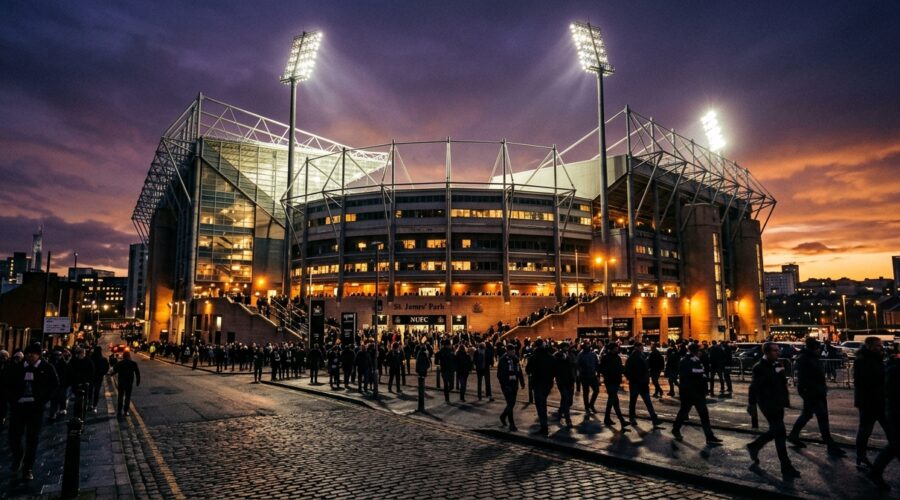
There is a particular kind of quiet that descends on a title race when one team starts pulling clear before the clocks have changed. Not the silence of certainty — football is constitutionally allergic to that — but something closer to the hush of a chess match where one player has established a commanding positional advantage and the other is still searching the board for the resource that does not exist. That is roughly where the 2026-27 Premier League stands on the evening of Saturday 21 November, as Arsenal travel to St. James’ Park for a match that is, technically, Matchweek 11. In practice it feels closer to a coronation procession.
The occasion carries its own weight independent of the table. This is the 200th all-time meeting between these two clubs — a rivalry that stretches back over a century of English football, through the Highbury years, the Geordie Entertainers, the Invincibles, the Pardew era, the Howe renaissance. Arsenal lead the head-to-head with 88 wins to Newcastle’s 72 across 199 previous encounters. The 200th could hardly arrive at a more loaded moment.
Where Things Stand: A Five-Point Lead and a Supercomputer With a Verdict
Arsenal arrive at Tyneside with 27 points from 10 games — nine wins, one defeat — and a five-point lead over Manchester City in third, and a five-point lead over Brighton in second. The Matchweek 10 standings read: 1. Arsenal — 27 points, 2. Brighton & Hove Albion — 22 points, 3. Manchester City — 21 points. The Opta supercomputer, which ran 10,000 season simulations following Matchweek 10, has Arsenal at 76.29% title probability. That is a figure you typically encounter in late March when a team is wrapping up the loose ends, not in the third week of November. It is a number that carries the quiet authority of a closed argument.
The trigger for the latest surge in that probability came on the same November weekend: Arsenal beat Hull City 1-0 at the Emirates whilst Manchester City, three-time Premier League winners under their previous regime, lost 3-1 at Nottingham Forest — their third consecutive defeat. City’s title probability, which had climbed as high as 39.8% after Matchweek 5 when Arsenal were reeling from Brighton’s 3-0 dismantling of them, has now collapsed to 10.77%. The Opta model projects Arsenal finishing the season on 82.50 points — which means, with 28 games remaining, they can afford to drop approximately 11 or 12 more points and still be lifting the trophy in May. That is the mathematical equivalent of being handed the keys to the building before the final inspection.
Brighton, improbably, sit in second place on 22 points with the best goal difference in the league at plus-19. Fabian Hürzeler’s side have scored 26 goals in 10 games, handed Arsenal their only defeat of the campaign, and beaten City at the Etihad. They deserve their moment in the conversation. Opta gives them roughly 6.5% title probability, which is not so much a closed door as a very heavy one. The machine does not rate them as long-term challengers, and historically, neither does the fixture list.
The Curse With Exactly 27 Points
Before we proceed to the matter at hand, there is a small piece of historical furniture that every Arsenal supporter knows is in the room and nobody wants to trip over. At least seven teams in Premier League history have taken 27 points or more from their first 10 games: Chelsea (2005-06, 28 points), Manchester City (2011-12, 28 points), Newcastle United (1995-96, 27 points), Manchester City (2017-18, 28 points), Liverpool (2019-20, 28 points), Arsenal (2022-23, 27 points), and Arsenal (2025-26, 27 points). The four clubs to reach 28 points at this stage — Manchester City 2017-18 and 2011-12, Chelsea 2005-06, Liverpool 2019-20 — all went on to win the title. The two teams to collect exactly 27 points at this stage both finished second. One was Kevin Keegan’s Newcastle in 1995-96, the most spectacular title capitulation in Premier League memory. The other was Arsenal themselves in 2022-23, the season that remains a wound that only the 2025-26 championship fully closed.
The obvious counter-argument — and it is a good one — is that Arsenal in 2026-27 are not Arsenal in 2022-23. They are reigning champions. They have been to the edge of collapse and found their way back. When Brighton put three past them in September this year, the response was five consecutive wins, including a 1-0 victory at Anfield on 1 November that became instantly historic: the first Premier League win at Liverpool’s ground in 14 years, and the first time Liverpool had failed to register a single shot on target at Anfield in a Premier League match since data collection began in 2003/04. That is the response of a team that does not panic. It is also the response of a team with considerably more Premier League experience than the side that crumbled when Pep Guardiola turned the screw four years ago.
The ghost of 2022-23 is real but it is growing faint. This Arsenal squad has Bruno Guimarães, Viktor Gyökeres, Ezri Konsa, and the institutional knowledge of what it feels like to actually win it. The difference between attempting your first summit and knowing your legs can carry you to the top is not easily quantified, but the Opta supercomputer has had a go, and it arrived at 76.29%.
The Shadow Over City
It would be remiss not to acknowledge the other dimension to City’s decline, because the 25th of September 2026 was not merely a bad Saturday for Enzo Maresca’s men — that was the day reports emerged that a Premier League independent commission had reached a verdict. The official findings were formally released on the 29th of September 2026, confirming that Manchester City had been found guilty on 114 of 115 financial regulation charges relating to the period from 2009-10 to 2017-18. City have filed a formal appeal and sanctions remain unresolved, but the verdict has cast a legal shadow over both the current season and over three league titles won during those years. The atmosphere at every away ground City visit has reportedly curdled. Whether a points deduction follows, or something more severe, nobody currently knows — which may actually be worse for a squad trying to concentrate on football. The uncertainty is its own punishment, and it has arrived at precisely the moment City needed composure after three straight defeats.
All of this benefits Arsenal without Arsenal having done anything except keep winning.
Newcastle’s Summer of Disassembly
To understand what Newcastle are attempting to do on Saturday evening at St. James’ Park, you need to appreciate the scale of what happened to them between May and August 2026. Eddie Howe, who had won the club’s first domestic trophy in 56 years with the 2025 EFL Cup and taken them to the Champions League in consecutive seasons, departed in July following a 12th-place league finish and a European exit to Barcelona. His replacement was Matthias Jaissle — 38 years old, German, two-time Austrian Bundesliga champion with RB Salzburg, two-time AFC Champions League winner with Al-Ahli — appointed two weeks before the season began. The PIF connection between Newcastle’s ownership and Al-Ahli was noted by those inclined to note such things. The lack of experience at the summit of a major European league was noted by everyone.
Then the players left. Bruno Guimarães joined Arsenal for £75 million. Anthony Gordon went to Barcelona. Sandro Tonali moved to Tottenham. Kieran Trippier, that canny operator on the right flank, departed to Wolves. In the space of a single summer transfer window, the spine of everything Howe had constructed was dismantled and scattered to rival clubs. The Athletic described the situation with appropriate gravity: without Guimarães, Newcastle have no talisman. The club spent approximately £265 million on eight new arrivals, most of them aged 20 or younger, and recouped around £240 million — a net spend that looks bold on a spreadsheet and chaotic on a football pitch.
Newcastle currently sit 12th with 12 points. They have won once in their last six games across all competitions. They have suffered back-to-back home defeats going into this fixture and have conceded in every single home game this season — seven goals in five St. James’ Park appearances. Joelinton, their most combative pressing midfielder, is a likely absentee. Goal.com captured the prevailing mood with the kind of headline that reads as a demand rather than a question: “Nightmare season looms for Newcastle — and Magpies must make Matthias Jaissle call fast or risk relegation.”
Jaissle, to his credit, has not entirely lost the plot in his press conferences. When asked about his job security this week he said: “I try not to follow the things that are written, but of course here and there you get some comments. The nice part is that I got even more the feeling from within the club how committed they are, and that’s something really important in a week where there is speculation or rumours.” It is the statement of a man keeping his head above water by sheer force of professional dignity. The Express has reported that the club’s hierarchy have reached a collective agreement on his future — which, given the financial outlay to extract him from Al-Ahli (reportedly around £8-9 million) and the fact he is under a five-year deal, appears to involve patience rather than the sack. For now.
Bruno Guimarães Returns
It would be a lesser sort of football occasion if it did not arrive draped in some personal narrative, and this one has a particularly fine one. Bruno Guimarães, perhaps the most important player in Newcastle’s modern history, the man who captained them to their first major trophy in 56 years, returns to St. James’ Park for the first time since joining Arsenal in the summer. He arrives in the opposing shirt, in the opposing dugout’s confidence, and with two Premier League goals to his name so far this season.
The reception is likely to be complicated. Newcastle supporters are not, by disposition, a forgiving crowd when they feel abandoned — and the manner of Guimarães’ departure, to a direct title rival, still stings. The Brazilian has been characteristically thoughtful about it. “I think I was one of the most beloved players during my time there, so it was a difficult decision,” he told ESPN this week. “But in my mind, deep down, I felt I needed a new challenge. After almost five years at Newcastle, I think I’m driven by challenges and wanted a new one.” Arteta was asked whether he hoped his midfielder would receive a good reception and confirmed that he did. The St. James’ Park faithful may have a different view.
Tactically, the Guimarães factor is not merely sentimental. He knows this club’s pressing triggers, their set-piece vulnerabilities, their structural tendencies under Jaissle’s system. Arsenal paid £75 million for a midfield engine and simultaneously removed Newcastle’s midfield engine. It was the transfer of the summer in both directions simultaneously — the rare deal that makes perfect analytical sense for one club while constituting something close to sporting self-harm for the other.
Team News: Absences, Returns, and the Question of Saliba
Arsenal’s most significant absentee remains Bukayo Saka, out since the 21st of October after picking up a quad injury within ten minutes of the Champions League draw against Bayern Munich. He has now missed five consecutive Arsenal games. His realistic return date is the 2nd of December against Brentford, which means Saturday’s fixture is too soon regardless of the temptation. Martin Zubimendi, who sustained a hamstring problem during Spain’s Nations League game against England in the international break, is also out.
The compensating news is William Saliba. The French centre-back has been absent since a back injury sustained during France’s World Cup semi-final loss to Spain in July — a long rehabilitation that brought him to an unused substitute appearance in Arsenal’s Champions League win at Slavia Prague, then to 45 minutes for the Under-21s in a 5-2 win over Aston Villa, and now, apparently, to readiness. Arteta confirmed at his pre-match press conference: “He’s ready. He’s in a good condition. He played two games, one behind closed doors and one more official and he did really well.” Whether he starts alongside Gabriel or eases in from the bench at some point in the second half is the kind of pleasant dilemma Arteta will relish after months of managing without him.
The expected XI lines up as a 4-2-3-1: Raya; Timber, Konsa, Gabriel, Calafiori; Guimarães, Rice; Madueke, Ødegaard, Tzolis; Havertz. Viktor Gyökeres, whose 14 Premier League goals in his debut season were a decisive contribution to last year’s title, is likely on the bench — either rotated or used as an impact substitute. Max Dowman, the young right-winger who served a red card suspension from the EFL Cup, is now available again.
Newcastle will be without Joelinton and Ewen Jaouen. Lewis Miley is recovering from a knock but pushing for involvement. Matías Fernández-Pardo returns to training after two weeks out with a virus. Jaissle’s most likely XI sets up in a mirrored 4-2-3-1: Hornicek; Dedić, Thiaw, Burn, Hall; Steur, Miley; Murphy, Wissa, Barnes; Osula.
The Tactical Picture: Set-Pieces, Flanks, and One Man Arsenal Cannot Ignore
The tactical story of this match has two dominant threads. The first is Arsenal’s set-piece machinery, which remains the most ruthlessly efficient dead-ball operation in English football. They scored 36 set-piece goals (excluding penalties) across all competitions in 2025-26 — including a new Arsenal record of 19 goals from corners in a single league campaign. Declan Rice has accumulated 33 crosses from midfield in just ten league starts this season and leads Arsenal with five assists. He is the architect of the system: the man who decides when to curl it short and fizz it long, when to drag a runner to the near post and when to drop it at the far. Newcastle have conceded seven goals at home in five games this season, some of them from exactly these situations. Their aerial organisation has been, to put it charitably, inconsistent.
The second thread is Harvey Barnes. The former Leicester and Brentford winger is tied for Newcastle’s leading scorer in the league with two goals, alongside Anthony Elanga and Joe Willock, and has registered at least one shot in all ten of his Premier League appearances this season, averaging 2.3 per game. He will operate on Newcastle’s left, which places him in direct confrontation with Riccardo Calafiori on Arsenal’s right side of defence. Calafiori is an outstanding footballer with a tendency to invert into midfield, which is by design when Arsenal are in possession but can create exposure down that channel when the transition is sudden. Barnes is exactly the kind of direct, single-minded winger capable of exploiting a defensive left behind by an attack-minded full-back caught upfield. Ladbrokes have Barnes at 1.10 to have a shot — which is not so much a betting tip as a statement of statistical probability verging on certainty.
Without Joelinton to anchor the pressing structure, Newcastle’s ability to suffocate Arsenal in the first twenty minutes — the phase of the game where Jaissle’s system has shown most coherence — is significantly reduced. The plan was always to threaten individual defenders with pace through 1v1 situations wide; Newcastle had the third-highest number of such attacking positions in the Premier League in their first seven games. But those situations require the platform of an effective press, and that press requires Joelinton’s energy to function. His absence makes the whole machine quieter.
Arteta will almost certainly set up to control the midfield through Guimarães and Rice — the former bringing his institutional knowledge of the opponent, the latter providing the passing range and dead-ball precision. Ødegaard will operate in pockets between Newcastle’s midfield and defensive lines, looking to find the half-turn pass that unlocks the press. Havertz leads the line in a role that is part centre-forward, part second striker, ghosting into channels that Burn will find difficult to follow without leaving gaps. If Saliba comes on and brings the defensive composure that has been mildly absent in his absence, Arsenal have the personnel to see this out at whatever volume St. James’ Park chooses to operate.
What the Numbers Say
The Statz.ai model, as of Thursday evening, gives Arsenal an expected goals figure of 1.83 against Newcastle’s 0.83. The most likely single scoreline in their simulations is 0-1 to Arsenal at a 12% probability — the nature of football modelling being that no single outcome ever gets much beyond that figure. Arsenal’s clean sheet probability sits at 43%, both teams to score at 48-50%, over 2.5 goals at exactly 50%. Betting markets price Arsenal at approximately 1.53-1.60, implying a 60-64% win probability. The draw is around 3.50, Newcastle at 5.50-6.50.
The historical data is similarly aligned. In the last eight Premier League meetings between these clubs, Arsenal have won five, Newcastle two, with one draw. Newcastle’s two wins in that sequence have both come at St. James’ Park. Arsenal’s last Premier League win at this ground was 28 September 2025, that late drama resolved by Mikel Merino in the 84th minute and Gabriel in the 90th+6. The Gunners, in other words, can win here. They have done it recently. But St. James’ Park remains capable of producing the irrational result that makes football worth following in the first place.
The Bigger Picture: Is It Already Over?
Not mathematically. Not literally. And not by the standard of football’s constitutional refusal to behave sensibly. In the last six Premier League seasons, the team top after ten games failed to win the title on four occasions. The honest answer is that history suggests roughly one-in-three chances that this race reopens.
But the nuances cut differently this year. The 2022-23 Arsenal team that blew a lead they looked certain to convert was on that platform for the first time, carrying the psychological weight of a 19-year drought and no collective experience of what it takes to close out a season. This group has closed out a season. They did it last May, clinching their first title in 22 years: 25 wins and 19 clean sheets in the league, with a set-piece operation — 36 goals across all competitions, 19 from corners alone — that set a new standard for the club and made them the most dangerous dead-ball side in English football. Arteta, now the most successful manager in Arsenal’s history by win percentage at approximately 61%, signed a contract extension through to 2030 in October. The whole operation has the feel of an institution that has found its settled form rather than a team in the middle of its first attempt.
Their only rivals are compromised. City are in legal freefall, three consecutive defeats compounding a verdict that may yet rewrite their recent history. Brighton are genuinely impressive and cannot be entirely dismissed, but they have never sustained a full-season title challenge and their 76-game schedule eventually catches up with smaller squads. Liverpool are in fourth on 18 points and have appointed a new manager. Chelsea, under Xabi Alonso, are on 16 points, having already lost to Arsenal, Brentford, Tottenham, and Sunderland.
The honest assessment is that someone would need to find extraordinary results while Arsenal suffer an injury crisis of the kind that removes two or three first-teamers simultaneously — and even then, with the depth that Guimarães, Konsa, Tzolis, and the full return of Saliba has added to what was already the best squad in the country, the margins required to overhaul them are immense.
Verdict: The 200th Meeting and What It Means
Saturday evening at St. James’ Park is the kind of fixture that generates genuine drama independent of the league table. 52,000 supporters under the floodlights, the return of their most beloved recent player in enemy colours, a manager fighting to save his job against a manager who has essentially already won the argument about where this season is going. The game matters for different reasons to either side. For Arsenal, three points extends their lead to potentially eight points over Brighton, nine over City, and pushes the Opta title probability north of 80% for the first time this season. For Newcastle, a result — even a draw — transforms the narrative around Jaissle at the most precarious moment of his tenure and provides evidence that this dismantled squad can still compete.
Harvey Barnes will have his shot; that much the numbers guarantee. Dan Burn will put himself in front of things in the way Dan Burn does. Rice will find space and use it economically, as he has done in every one of Arsenal’s ten league games. Guimarães will receive a reception that tells you something true about how football communities process loss. And somewhere in the second half, if the first goal has gone to Arsenal as most of the available evidence suggests it will, St. James’ Park will fall into that particular contested quiet that describes a crowd not yet willing to concede the evening but gradually running out of reasons for optimism.
The 200th chapter of this rivalry, then. The prediction — here and in every model from Statz.ai to the betting exchanges — is a narrow Arsenal win, most likely by a single goal, most likely without the expansive flourish of the genuinely comfortable. A 1-0, the score of a team that has learned to take what the game offers rather than demand what it cannot provide. The score of champions who have been here before and know what it costs to win ugly.
The title race is not over. But it is getting there, calmly and without fuss, the way Arsenal do things now.