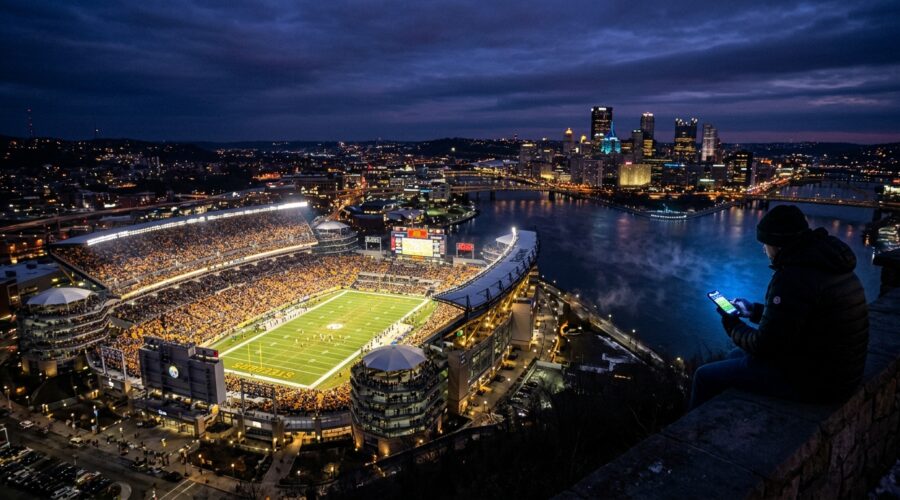
Let’s establish the full scene before we get into X’s and O’s. It is Black Friday, November 27, 2026. Amazon Prime Video has been live since 9 AM. Brooks Koepka is competing for a share of a $4 million Skins Game purse at a golf course in Hobe Sound, Florida. Charissa Thompson is hosting a pregame show from the actual stadium. Al Michaels and Kirk Herbstreit are minutes away from calling what should be a classic AFC showdown between the hottest team in football and the best defense in the AFC North. And Aaron Rodgers, the starting quarterback of the Pittsburgh Steelers just 48 hours ago, is a free agent watching from home.
The Denver Broncos came into Acrisure Stadium as 4.5-point road favorites, riding a 6-game win streak, holding an NFL-record 16 consecutive one-score game victories, and carrying a 79.0 QB rating from Bo Nix that — whatever its aesthetic concerns — was producing wins at an alarming rate. Pittsburgh responded by scoring 27 unanswered points, holding Denver to 5 total, and validating a run-first offensive philosophy that their now-former Hall of Fame quarterback had spent the previous day publicly mocking.
This is that story. All of it.
The Aaron Rodgers Saga: A Compressed Timeline of Spectacular Dysfunction
To understand Black Friday 2026 in Pittsburgh, you need to understand the 18 hours before kickoff, because nothing about this game exists in a vacuum from that context.
On Monday, November 23rd, head coach Mike McCarthy was asked directly whether Rodgers might be benched. His response — “Aaron Rodgers is our quarterback” — was the kind of emphatic denial that, in NFL circles, is basically a soft announcement. Roughly 27 hours later, at 11 PM on Tuesday night, the Steelers’ official spokesperson posted a one-sentence statement to X naming Mason Rudolph the starter for Friday’s game.
Rodgers, 42 years old and in what he had declared would be his final NFL season, found out through teammates. Per his own account, tight end Pat Freiermuth called him while he was already in a conversation with another player. The organization — the same one he had reportedly helped shape by suggesting McCarthy for the head coaching position — did not tell him directly before the announcement went public.
What happened next was entirely predictable if you have followed Aaron Rodgers for more than 15 minutes. He went on The Pat McAfee Show. He alleged that McCarthy fell asleep in team meetings. He said McCarthy skipped team events. He characterized the benching as a betrayal and framed the entire situation as a failure of organizational loyalty.
McCarthy, to his credit, did not flinch. At his Wednesday press conference, he said Rodgers had made “an ultimatum that was outside of his job description” and confirmed the benching was entirely his decision. Art Rooney II backed him without hedging: “I have 100% confidence in Mike McCarthy. Insubordination can’t be tolerated in any organization.”
By Wednesday evening, the Steelers had released Rodgers entirely. He cleared waivers. The man with 542 touchdown passes, 68,288 career yards, one Super Bowl ring, and a first-ballot Hall of Fame jacket already waiting at Canton was a free agent at age 42, two days before a Black Friday game that would go on without him.
Mike Tomlin, who coached the Steelers for 19 years before this whole new era began, described the situation with characteristic efficiency: “It’s a dumpster fire.”
It really was. And the Steelers went out and won by 22 points anyway.
Mason Rudolph and the Supreme Irony of Rodgers’ Critique
Here is the uncomfortable part for anyone who agreed with Rodgers’ broader football philosophy: the game plan Rudolph executed on Black Friday — the one Rodgers had publicly criticized as overly conservative and run-dependent — was the exact game plan that produced Pittsburgh’s most dominant win of the 2026 season.
Rudolph, 31 years old with 38 career games and a brief folk hero chapter in 2023, did not throw for 300 yards. He did not carve Denver’s secondary apart. He managed the game. He avoided turnovers. He handed the ball to Jaylen Warren and let the offensive line do work in cold Pittsburgh weather. The stat line was modest. The result was not.
Pittsburgh also activated Michael Pittman Jr. off injured reserve less than 24 hours before kickoff — Pittman had been placed on IR before Week 5 began after a foot injury (plantar fasciitis) that first surfaced in Week 2 worsened following his return in Weeks 3 and 4 — giving Rudolph an experienced third option alongside DK Metcalf and Germie Bernard. The move was clearly designed to give the game manager enough of a receiving corps that Denver couldn’t simply pin its ears back and dare him to beat them through the air. He didn’t need to. The defense made sure of that.
Rodgers’ 2026 numbers entering Black Friday were not catastrophic: 220 completions on 361 attempts, 2,241 yards, 16 touchdowns, 6 interceptions, ranked 30th in QBR among qualified quarterbacks. That last figure matters. 30th. For a team that is trying to make a playoff run in the AFC. The Steelers went 6-4 in his starts, lost two straight before the benching, and watched their offense hemorrhage 38 points to Cincinnati. Something was going to give. It turned out to be the relationship itself.
What the Rodgers situation ultimately revealed is that McCarthy was willing to blow up a partnership he had partly engineered — the head coach and quarterback reportedly had a Green Bay reunion by design — in order to stabilize a locker room and get back to the kind of football Pittsburgh’s defense was capable of winning. Whether that trade-off was wise will be argued about for the rest of the NFL calendar. On November 27th, it looked extremely wise.
T.J. Watt and a Defense That Turned Bo Nix Into a Stat Line Nobody Wants to Own
Five points. Denver scored five total points. Let’s hold there for a second.
This is a Denver Broncos offense that had scored 26 or more points in four of its last four games. This is a team that Sean Payton had personally reclaimed offensive play-calling duties for in Week 5 and immediately turned into a machine. This is the team that entered with a top-7 turnover margin and only 8 giveaways on the season — tied for fewest in the league. And Acrisure Stadium held them to five points.
The majority of that credit belongs to T.J. Watt and defensive coordinator Patrick Graham’s creative deployment of him. Entering Week 12, Watt had 7.5 sacks, 1 interception returned for a touchdown, 1 forced fumble, and approximately 26 total tackles through 11 games. Graham had been lining him up on both sides of the formation throughout the season — a wrinkle described as unprecedented for the organization — and by Black Friday, the Broncos had no reliable answer for it. You cannot game-plan against someone that versatile when your offensive line is trying to figure out where the edge rush is coming from on any given down.
The full pass rush corps — Watt (7.5 sacks), Alex Highsmith (3.5), Nick Herbig (3.0), Cameron Heyward (2.5), Jack Sawyer (ascending), Yahya Black (providing rotation depth) — was operating as a coherent, rotating threat rather than a one-man band that Denver could scheme around. Graham deserves significant credit for constructing that rotation. Watt deserves credit for being the reason the rotation works at all, because offensive coordinators have to account for him first on every single snap.
Bo Nix entered with a 79.0 QB rating on the season. That is not a number that inspires great confidence against an elite defense in cold weather, and Pittsburgh confirmed every concern. CB Daylen Everette had a key interception for the Pittsburgh secondary. Jalen Ramsey, the veteran anchor on the other side, delivered the secondary’s signature moment of the game: a 36-yard interception return for a touchdown in the second quarter, turning a drive Denver needed into a momentum-killing pick-six that made the five-point final feel almost generous.
Watt’s post-game quote, per Steelers.com, was predictably unsatisfied with a 22-point win: “We can’t continue to live and die by turnovers.” This is a man who returned an interception for a touchdown earlier this season and still thinks the team is leaning too hard on the turnover margin for its wins. That level of internal standard-setting is why he is T.J. Watt and not someone else. Worth noting: Will Anderson Jr. leads the league in sacks entering Week 12 at 11.5. Watt is at 7.5 through 11 games. That gap is not as wide as it looks if you project it out, and Watt has never needed the sack total to be the best defender in a game. Friday was proof of that.
Jaylen Warren also deserves an acknowledgment here. He had been averaging just 3.0 yards per touch over his prior two games — genuinely concerning in a run-first offensive system — and rebounded emphatically against Denver in conditions that favored exactly the kind of physical, downhill running game Pittsburgh wanted to run. The bounce-back was necessary. The timing was perfect.
What This Means for the AFC Standings and the Next Six Weeks
Pittsburgh improved to 7-4 and 5-0 at Acrisure Stadium. Their playoff odds jumped from approximately 57% to 72%. That is a significant swing from a single game, and it reflects just how tightly the AFC bubble is clustered right now.
The AFC picture after Week 13, in brief: Buffalo Bills (10-1, running away with the No. 1 seed), Denver Broncos (8-3, now tied with Kansas City at the top of the AFC West after losing their co-lead footing), Jacksonville Jaguars (7-3), Cincinnati Bengals (7-3), Kansas City Chiefs (8-3), Pittsburgh Steelers (7-4), and Cleveland Browns (6-4). Baltimore Ravens have collapsed to 4-7, which is both surprising and somewhat relevant to Pittsburgh’s path forward.
Denver falls to 8-3 but remains AFC West co-leaders with Kansas City. The Broncos still have six games left and a reasonable schedule: home vs. Miami on December 6th, then Buffalo on Christmas, road games at the Jets and Raiders, then home vs. the Chiefs on December 31st and home vs. the Chargers on January 9th. They are still comfortably positioned for a playoff berth despite absorbing a 22-point loss. The one-score winning streak ending at 16 is ultimately a footnote on a season that still has plenty of runway.
Pittsburgh’s next three are vs. Houston, at Jacksonville, and vs. Baltimore. The AFC North race with Cleveland (6-4) is very much alive. If you are a Steelers fan who was considering writing off this season after back-to-back losses to Cincinnati and Philadelphia, Black Friday just told you to hold on.
The bigger question is what happens to the Rodgers situation as the season continues. He cleared waivers and is a free agent. There will be teams that call. There may be a mid-season signing storyline developing somewhere in the NFL before December is over. His final chapter — if this was his final chapter in Pittsburgh — ended with an 11 PM social media statement and an appearance on McAfee. That is somehow both completely shocking and absolutely on-brand for the most complicated quarterback of the last two decades.
Amazon’s Black Friday Empire: From Experiment to Institution in Four Years
Now let’s zoom out, because the game itself is only part of what happened on November 27th, 2026.
Amazon Prime Video started broadcasting Black Friday sports at 9 AM with the PGA TOUR Farmers Insurance Skins Game — a $4 million purse event featuring Brooks Koepka, Justin Thomas, Wyndham Clark, and Jackson Koivun at Atlantic Fields Club in Hobe Sound, Florida. The Skins Game format, revived after a 17-year hiatus, was specifically designed to capture a morning golf audience that is otherwise watching CBS or NBC during NFL Sunday. Amazon wanted them on Prime Video first.
At 1:30 PM, Charissa Thompson, Tony Gonzalez, Ryan Fitzpatrick, Andrew Whitworth, and Richard Sherman went live from Acrisure Stadium for the pregame show. At 3:00 PM, Al Michaels and Kirk Herbstreit called the Broncos-Steelers blowout with Kaylee Hartung on the sideline. At 7 PM, the Emirates NBA Cup Heat-Knicks game began. At 9:30 PM, the Lakers played the Spurs. The whole thing ran more than 15 hours and was free — no Prime membership required, available globally in 240 countries and territories, with Twitch carrying the NFL game on mobile.
The architecture of this slate is not accidental. Golf captures the morning audience. The NFL locks in mainstream sports fans for the afternoon and early evening. The NBA Cup doubleheader carries the evening and late night. Each sport’s natural audience funnels into the next time slot with minimal dead air in between. Amazon is not broadcasting sports on Black Friday. Amazon is building a sports media holiday from scratch, and the numbers confirm it is working.
The viewership trajectory for the Black Friday NFL game alone is almost absurd in how linear it is upward: 9.61 million viewers for Dolphins-Jets in 2023, the inaugural edition. 13.51 million for Raiders-Chiefs in 2024, a 41% jump. 16.33 million for Bears-Eagles in 2025, another 21% gain — which made it the most-watched Black Friday sporting event since at least 1991, surpassing Fox’s 2022 FIFA World Cup broadcast of USA vs. England (15.49M). The 2025 NBA doubleheader averaged 2.09 million, up 121% year-over-year.
The 2026 viewership numbers for Broncos-Steelers are not yet published as of this writing, but context suggests the ceiling is high. Amazon’s Thursday Night Football averaged 15.33 million viewers per game through the 2025 season — the highest in the 20-year history of the TNF package. Early 2026 TNF numbers are tracking at 17.7 million through the first six games of the season. The drama surrounding the Rodgers release almost certainly pulled casual viewers who otherwise would have skipped a Steelers-Broncos matchup.
The business logic underneath all of this is worth explaining clearly, because Amazon VP Marie Donoghue outlined it at Cannes Lions 2023 as “an opportunity to create a new sports holiday for fans,” and by 2026 that statement reads like a mission accomplished report rather than an aspirational vision.
Amazon’s ad revenue hit $19.8 billion in Q2 2026, up 26% year-over-year, with live sports inventory identified as a primary driver. The TNF, NBA, WNBA, and NASCAR ad inventory sold out during the Q2 2026 earnings period. Interactive video ads during the 2025 Black Friday NFL game drove 27% higher purchase rates than standard formats. CEO Andy Jassy disclosed that viewers who watch multiple Prime Video sports properties spend 12% more on Amazon and place 17% more orders than those who do not.
That last data point is the crux of everything. Amazon is not in the sports broadcasting business the way NBC or ESPN is in the sports broadcasting business. Amazon is in the customer acquisition and retention business, and sports are the most efficient tool it has found to deepen the relationship between a Prime subscriber and the Amazon ecosystem. Amazon ad chief Alan Moss summarized it as cleanly as anyone has: “Prime Video and live sports are now one business.”
The demographic profile of TNF viewers reinforces why this matters strategically. Prime Video’s NFL audience skews nearly 7 years younger than linear NFL audiences — median age 49.4 versus 56.2 on traditional broadcast — and earns 28% higher household income. This is not the existing NFL audience migrating platforms. This is a younger, higher-spending audience that is choosing streaming first, and Amazon is meeting them there.
It is worth noting the structural reason any of this is possible — though the picture is more complicated than a simple loophole story. The Sports Broadcasting Act of 1961 restricts NFL games on both Fridays (at 6 PM or later) and Saturdays during the fall football season, running from the second Friday in September through the second Saturday in December. The Black Friday NFL game exists not because Friday is simply left open, but because the NFL has found technical workarounds: broadcasting exclusively on streaming services like Amazon Prime Video, which some argue fall outside the scope of the 1961 act, and by scheduling kickoff at 3 PM ET so the game concludes before the 6 PM threshold when Friday restrictions take effect. This represents pushing at the edges of an old law rather than slipping through a gap it forgot to close. Someone at the NFL eventually started stress-testing those edges, Amazon was ready, and four years later Charissa Thompson is standing in Pittsburgh at 1:30 PM on the day after Thanksgiving hosting a pregame show with Tony Gonzalez. The power of a well-exploited legal ambiguity is perennially underestimated.
Amazon head of sports partnerships Charlie Neiman put the content hierarchy plainly: “If you look at the video slate and what really matters to customers at the scale we’re operating at, it’s big movies, it’s big TV shows, and it’s big live sports.” The 2026 Black Friday slate had all three represented, though the big live sports carried the day. The Skins Game, the NFL blowout, and two NBA Cup games made for a schedule that any linear broadcaster would have killed to put together. Amazon built it in four years.
The 2026 TNF schedule is also worth noting: 13 of the 16 matchups feature a playoff team from the prior season. This is a deliberate correction from the early TNF era, when the package was widely mocked for fielding mediocre games between teams that had no business being in prime time. Amazon spent years getting leverage with the NFL to improve matchup quality. The improvement is visible in the ratings.
Prime Insights, Amazon’s AI-powered analytics overlay, delivered real-time formation analysis, play tendency breakdowns, and personnel grouping data during the broadcast. The X-Ray second-screen feature provided supplemental stats. Multi-language audio tracks were available for the global audience. For a 27-5 blowout, the technology surrounding the broadcast was arguably more interesting than several of the fourth-quarter possessions.
The Bigger Picture: What Black Friday 2026 Actually Tells Us
The Pittsburgh Steelers beat the Denver Broncos by 22 points on Black Friday 2026, and the simplest version of this story is: T.J. Watt was dominant, Mason Rudolph was adequate, and Mike McCarthy made a chaotic week into a convincing result. All of that is true.
But the fuller version is more interesting. A 42-year-old Hall of Fame quarterback was released two days before a nationally televised game because he gave an ultimatum to a head coach he had helped hire. The backup who replaced him ran an offense the Hall of Famer had criticized, against a record-setting opponent, and produced the team’s best win of the season. The best defender in the AFC — possibly the best in the entire league on a given Sunday — reminded everyone why the Pittsburgh defense is a legitimate playoff contender regardless of what is happening at quarterback. And all of it happened on a streaming platform that is in the middle of reshaping what a sports media day can look like.
Amazon’s Black Friday sports slate is now four years old and already a tradition. The numbers say so. The sell-out ad inventory says so. The 15-plus hours of content says so. What started as an experiment in 2023 with 9.61 million viewers for Dolphins-Jets has become the kind of programming institution that networks spend decades trying to build. Amazon did it in a single NFL contract cycle.
Pittsburgh is at 7-4 with a legitimate path to the playoffs. Denver is at 8-3 and still very much alive in the AFC West despite the blowout loss. Aaron Rodgers is a free agent. T.J. Watt is still T.J. Watt. And next Black Friday, Amazon will do all of this again, probably bigger.
Some traditions take forever to establish. This one arrived already running.