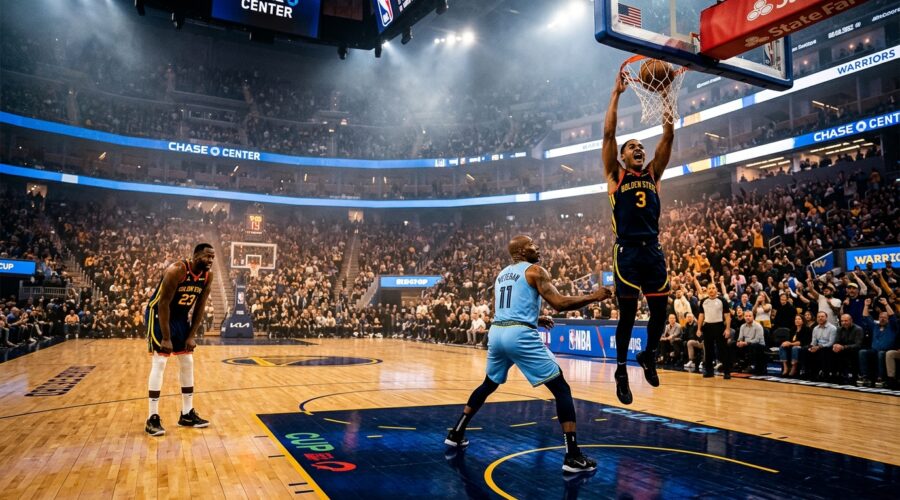
A 19-year-old broke Kevin Durant’s record on a Tuesday night in Denver, a 41-year-old flipped a game by himself on Thanksgiving Eve in Philadelphia, and the greatest center alive is suddenly fighting for a wild card spot while averaging the worst shooting numbers of his career. The Emirates NBA Cup 2026 is four weeks deep and it has already delivered enough material for a full documentary series. Let’s break down everything that happened across the November 24-25 Cup doubleheader — and what Friday’s November 27 group-play finale means for the bracket taking shape at Hinkle Fieldhouse.
Buckle up. There’s a lot.
The Format, Real Quick
This is the fourth edition of the NBA’s in-season tournament, and the structure is tight. All 30 teams split into six groups of five — three per conference — playing dedicated Cup Nights on Tuesdays and Fridays through November 27. Six group winners plus one wild card per conference (best non-group-winning record) punch their tickets to an eight-team single-elimination bracket. Quarterfinals on December 4-5, semifinals December 8-9, and then the whole thing crescendos on December 11 at Hinkle Fieldhouse in Indianapolis — the iconic Butler University arena, a U.S. National Historic Landmark since 1987 and basketball cathedral made globally famous by the movie Hoosiers. First time the Cup final has ever left Las Vegas. The NBA is doing something genuinely cool here.
Tiebreakers go: head-to-head record, then point differential, then total points scored, then regular-season record, then random drawing. That point differential piece? It’s not just a footnote. It’s driving strategy in real time.
Entering the November 24-25 stretch, exactly one team had clinched a knockout-round berth: the Dallas Mavericks. Everything else was still live. And then things got chaotic.
Game 1: Dallas 120, Denver 101 — Cooper Flagg Sends the Ball Arena Home Angry
Tuesday, November 24. Ball Arena, Denver. West Group A. Both Dallas and Denver entered at 2-0. Winner controls the group. This is an elimination game dressed up as a regular season contest.
And Cooper Flagg — 19 years old, coming up on his 20th birthday in December — walked into Nikola Jokic’s house and ran a clinic.
Final: Dallas 120, Denver 101.
Flagg’s line: 24 points, 6 rebounds, 12 assists — a career-high-tying assist total. That’s his 11th career 20-point double-double as a teenager, which ties Dwight Howard for second most all-time. Only LeBron James has more with 18. He also now has 45 career 20-point games as a teen, surpassing Kevin Durant for third most ever, trailing only Carmelo Anthony (49) and LeBron (69). We are genuinely watching a teenager dismantle the all-time record books in real time and barely anyone is freaking out enough about it.
What made the performance so impressive wasn’t just the numbers — it was the scouting. Before the game, Flagg identified Denver as a “heavy gap team” and explained his read: “It’s just about getting organized and getting guys in the right spots.” That’s not a cliche. That’s a 19-year-old point-forward reading a defense at the film level and then executing it perfectly against one of the best rosters in the Western Conference.
The results were surgical. Flagg found Caleb Martin for two early threes off precision passes that exploited exactly the gaps he identified. He dropped a hook shot and an alley-oop to Daniel Gafford. He hit Morez Johnson Jr. for a 26-foot bank shot and a corner three. He lofted a running three-pointer to Zaccharie Risacher that made it 102-88 and effectively ended the game. 31 total assists for the team. 13 steals. 68-38 in points in the paint. 35-7 in fast-break points.
Dallas built a 19-point halftime lead after a 15-0 run to close the second quarter — Denver literally walked off to boos at their own arena. The Nuggets did rally, cutting it to 80-77 with 1:11 left in the third quarter, which made things interesting for about four minutes. Then Dallas outscored them 36-24 in the fourth and that was that.
Kyrie Irving, who has been in a bit of a shooting funk (44.4% on the season, 37% during the current win streak), looked on and called Flagg “another young prodigy.” That’s the dynamic in Dallas right now — a legendary veteran playing complementary basketball to a teenager who was born in 2006. Wild sentence to type. Normal Thursday in the NBA.
P.J. Washington Jr. returned from illness and contributed 14 points. Caleb Martin had five steals. Coach Dusty May’s defensive infrastructure — rangy wings, pressure defense, turnover creation, relentless transition — is becoming a real identity in Dallas.
As for Denver: Jokic finished with 18 points, 11 rebounds, 5 assists. Jamal Murray had 20. Neither was remotely enough. The Jokic who averaged 28.8 points on 60% FG the previous week — the guy who just won his 21st career NBA Player of the Week award — didn’t show up. His three-point shooting (29.9% on the season, 20.8% in his first five games) continues to be the visible crack in his otherwise dominant game. The Denver Post ran a piece on November 23 headlined: “Even Nikola Jokic doubts himself. The Nuggets didn’t.” He admitted to self-doubt. Publicly. Nikola Jokic, three-to-five-time MVP, admitting self-doubt. File that under Things 2026 Has Thrown At Us.
The Luka Shadow Hanging Over Ball Arena
Here’s the thing that makes the Dallas-Denver Cup matchup narratively rich beyond just Flagg’s performance: the ghost of Luka Doncic.
Luka is gone. He’s a Los Angeles Laker now, in his second season with the purple and gold, 27 years old and absolutely obliterating the NBA. Through 16 games he’s averaging 36.4 to 38.6 points per game, leading the league by over eight points ahead of SGA’s 32.1. He’s posted 52 at Utah and 53 at Portland. He joined Wilt Chamberlain as the only players since the ABA merger to average 40-plus points through the first nine games of a season. His three-point percentage has jumped to 36.5-43.2% and his free-throw rate to 86.5-90.2%. Both, simultaneously. It’s not volume, it’s genuine efficiency elevation. The Lakers are a completely different team when he plays — net rating swing of plus-15 to plus-22.5.
So when Dallas walked into Ball Arena on November 24, the matchup everyone would have written three years ago — Luka vs. Jokic, Mavs vs. Nuggets, the rivalry that defined a generation of Western Conference basketball — doesn’t exist anymore in that form. Luka isn’t a Maverick. The face of the franchise is now a teenager who was in middle school the first time Jokic won MVP. That’s not a slight on anyone. That’s just the NBA eating its own history and making something new out of the bones.
The Luka-Jokic rivalry has evolved. Now it’s Luka’s Lakers against Jokic’s Nuggets in one lane, and Flagg’s Mavericks against Jokic’s Nuggets in another. Cooper Flagg isn’t Luka — he’s something different. But watching a 19-year-old phenom go into Denver and dismantle Jokic’s Cup hopes with 12 assists and a defensive game plan that he articulated better than most veterans? That’s the new era arriving with its bags already unpacked.
Game 2: Philadelphia 76ers 111, Miami Heat 104 — LeBron James Is 41 and Still Picking Pockets
Wednesday, November 25. Thanksgiving Eve. Xfinity Mobile Arena, Philadelphia. East Group B.
Miami entered 2-0 in Cup play, riding a seven-game overall winning streak, needing only a win to clinch East Group B. Philadelphia entered 1-1, without Joel Embiid (illness, second straight missed game), and lost Jaylen Brown to a reaggravated left hamstring at halftime. The 76ers were absolutely cooked on paper.
LeBron James is 41 years old. He turns 42 on December 30. He’s averaging 17 points, 6.9 rebounds, and 6.9 assists on the season — solid, not staggering, clearly in a complementary role for a team built around Tyrese Maxey and what was supposed to be Embiid. And then, against Miami on Thanksgiving Eve, without his two co-stars, LeBron James reminded everyone exactly who he is.
Final: Philadelphia 111, Miami 104.
LeBron’s line: 25 points, 10 rebounds, 12 assists. His first triple-double as a 76er. He shot 9-of-15 from the field, 4-of-6 from three, and played 35 minutes.
But the number that matters most isn’t in the box score. It’s the sequence. Miami led 8-2 early and looked like they were going to cruise. Then LeBron personally scored 14 consecutive Philadelphia points: a three-point play, a long three, an even longer three from the top of the arc (fans erupted; LeBron shrugged and licked his lips), and a driving layup. Fourteen straight. By himself. At 41. The game was completely, utterly flipped.
Tyrese Maxey did what Tyrese Maxey does, adding 30 points on 12-of-21 shooting and carrying the load every time LeBron needed a breather. The Sixers are 15-4 overall and they are for real.
Miami’s story is just as fascinating from the other side. Giannis Antetokounmpo — now a Heat, in one of the more surreal roster construction facts of this era — posted 32 points, 14 rebounds, 4 assists with a BPM of plus-11.6. He was dominant. He also lost. Because Klay Thompson went 3-for-12 from the field, 1-for-7 from three, and Miami shot 25.8% from three as a team (8-for-31). They typically make 14 three-pointers a game. They made eight. At one point they’d made only 4-of-16 from deep. Giannis had a plus-11.6 performance and his team lost by seven. That’s how cold Miami’s perimeter shooting was.
Erik Spoelstra, who coached LeBron to back-to-back championships in 2012 and 2013, was asked about James before the game. His answer belongs in a time capsule: “Father Time always wins. But right now, he’s giving Father Time hell.”
Davion Mitchell (20 points, 10 assists) and Bam Adebayo (17 points, 11 rebounds) were excellent for Miami. Didn’t matter. When you can’t make threes in this league, you don’t beat teams with LeBron James operating at that level.
The Group Standings Heading Into Friday’s Finale
West Group A
Dallas Mavericks: 3-0, +36 differential — CLINCHED. Done. Locked. See you in the knockout round.
Denver Nuggets: 2-1, -3 differential — alive but desperate. They need to win Friday against Utah and improve their point differential substantially to chase the West wild card. Houston’s 116-104 win over Phoenix on November 25 clinched Denver’s elimination from West Group A’s top spot, so wild card is the only path.
Houston (2-2), Phoenix (1-2), Utah (0-3): eliminated.
East Group B
This one is delicious. Here’s the standings entering Friday, November 27:
- Philadelphia 76ers: 2-1, -12 differential — holds head-to-head tiebreaker over Miami
- Miami Heat: 2-1, +25 differential — best point differential in the group
- Cleveland Cavaliers: 2-2, +2 differential — mathematically alive
- New York Knicks: 1-2, +12 differential — defending Cup champions, nearly eliminated
- Indiana Pacers: 1-2, -27 differential — effectively done
The critical detail: Philadelphia holds the head-to-head tiebreaker over Miami. If both teams finish 3-1, Philadelphia wins the group outright — Miami’s superior plus-25 differential is irrelevant in that scenario because tiebreakers start with head-to-head record. That’s the structural advantage the Sixers engineered on Thanksgiving Eve.
Friday, November 27: The Group-Play Finale — What You Need to Watch
Eleven games. Multiple groups still unsettled. Here’s the ones that actually matter.
Philadelphia at Indiana (7:30 PM ET) — CONFIRMED RESULT
This one is already in the books. 76ers 111, Pacers 87. LeBron scored 21 points, 7 rebounds, 6 assists. Embiid was out. Brown was out. Didn’t matter. Philadelphia clinched East Group B and advanced to the Emirates NBA Cup knockout round for the first time in franchise history. The 76ers are going to the bracket. That sentence would have sounded absurd eighteen months ago.
Miami at New York Knicks (7:00 PM ET)
Miami’s Cup group fate is settled — Philly clinched. So what are the Heat playing for? East wild card seeding and positioning. Their plus-25 point differential gives them a massive cushion over other East wild card contenders like Detroit and Toronto. Giannis at Madison Square Garden is always a show. Klay Thompson needs to get his shot going after that 1-for-7 performance Wednesday. The Knicks, defending Cup champions sitting at 1-2, need a near-impossible chain of events to advance. This one’s essentially a showcase game.
Denver at Utah (9:30 PM ET, Delta Center)
This is the most tactically interesting game of the night. Denver is a nine-and-a-half-point favorite against a Utah team that is 3-15, ranks 28th in offensive efficiency (105.4 per 100 possessions), and is without Lauri Markkanen — who averages 18.0 points per game — due to a fractured hand.
But here’s the meta-game wrinkle: winning isn’t enough for Denver. They need to win big.
The West wild card race entering Friday: Memphis Grizzlies at plus-18, Trail Blazers at plus-12, the Nuggets at minus-3, Warriors at minus-2, and the Lakers at minus-9. Denver is fifth. They need to pass multiple teams in a single night through margin of victory alone. That’s not impossible — Jokic himself orchestrated deliberate point-piling against Houston on November 20, pressing late with Cam Johnson to improve the differential. He understands the meta-game completely. And he’s coming off his 21st career Player of the Week award, averaging 28 points on 70% true shooting over his last six games per the Denver Post.
The question isn’t whether the Nuggets win. It’s whether Jokic and Jamal Murray — who leads the team in scoring at 25.8 points per game on 50% shooting with a spectacular 45.6% from three — go full scoreboard-awareness mode and run up the score in a way that actually moves the needle in the wild card standings. Murray has been excellent all season. If both are locked in against a depleted Utah team, Denver putting up 125-plus is completely realistic.
They’ll have one eye on the scoreboard all night — specifically what Memphis does against Minnesota and what Portland does against Golden State in the West Group C race.
Dallas at Phoenix (9:00 PM ET, Mortgage Matchup Center)
Dallas has clinched and enters this one playing for momentum and regular-season record (11-7 entering Friday). The Suns have beaten the Mavericks in four straight games — Dallas hasn’t beaten Phoenix since December 27, 2024. That streak will be on the minds of everyone in the building.
Phoenix is dead last in the NBA in rebounds per game, which is a gift for a Dallas team built around transition offense. Kyrie Irving has been in a prolonged shooting dip — 44.4% on the season, 42% over his last ten games, 37% during the current win streak — and a performance against an eliminated Suns team feels like exactly when that correction arrives. Devin Booker (24.5 PPG, 47.1% FG) is their best player and he’s been excellent, but this Dallas defense creates chaos. Prediction: Dallas 115, Suns 104.
The Projected Knockout Bracket
Here’s roughly what the eight-team field looks like shaping up:
Western Conference:
- #1 Minnesota Timberwolves (3-0, +39 differential) — Anthony Edwards’s crew, the West favorite
- #2 Dallas Mavericks (3-0, +36 differential) — Flagg and Kyrie, locked and loaded
- #3 West Group C Winner — San Antonio, Portland, Golden State, or the Lakers — all entered Friday at 2-1
- West Wild Card — Memphis Grizzlies (2-1, +18 diff) lead this race; Denver can leapfrog them with a big enough win
Eastern Conference:
- #1 Boston Celtics (3-0, +68 differential) — the best point differential in basketball, and it’s not close
- #2 Philadelphia 76ers — East Group B winners, confirmed
- #3 East Group A Winner — Orlando Magic, Toronto Raptors, or Detroit Pistons TBD
- East Wild Card — Miami Heat (2-1, +25 diff) are almost certainly locking this up
One more note worth filing: wild card teams have gone 0-for-6 all-time in Cup knockout round games. If Denver scratches their way in, history is not exactly on their side.
The Big Picture: A Changing of the Guard in Real Time
Step back from the standings and bracket math for a second and look at what this Cup run is actually telling us about the NBA landscape in 2026-27.
Nikola Jokic is 31, in his 12th season, locked into Denver through 2028 on a five-year $276 million extension. He’s making $59 million this year. He finished MVP-2 last season at 28.6 points, 13.3 rebounds, 11.1 assists, and 67.0% true shooting. And right now, through 16 games, he’s at 24.0-24.6 points, 10.7-10.9 rebounds, 8.7-9.0 assists, 53.0% field goal, and 29.9% from three. That three-point number is the tell — it was 20.8% in his first five games. He’s publicly admitted self-doubt. The Denver Post wrote a whole piece about it. This is not the narrative anyone expected to be writing about Jokic at age 31.
Meanwhile: Luka Doncic is on the Lakers averaging 37-plus points per game on elite efficiency, joining Wilt Chamberlain in the history books. Cooper Flagg is a 19-year-old already in the conversation with Durant and Carmelo as a teenage scorer, running playbook dissections before Cup games and delivering 12-assist performances in hostile arenas. LeBron James is 41 and still dropping Thanksgiving Eve triple-doubles that flip basketball games by himself.
The question the Emirates NBA Cup 2026 is forcing us to answer ahead of schedule: who’s the dominant force in the Western Conference right now? Edwards’s Wolves? Luka’s Lakers? Flagg’s Mavericks — a team that’s 3-0 in Cup play, 11-7 overall, with a defensive identity and a teenager who is somehow already doing things that veteran All-Stars haven’t done? Or does Jokic recapture his peak form and remind everyone why he’s on a $59 million-a-year contract?
We’re going to Hinkle Fieldhouse to find out. December 11. Indianapolis. The Hoosiers’ cathedral. First time the Cup final has ever left Las Vegas.
The bracket is almost set. The chaos has only just begun.