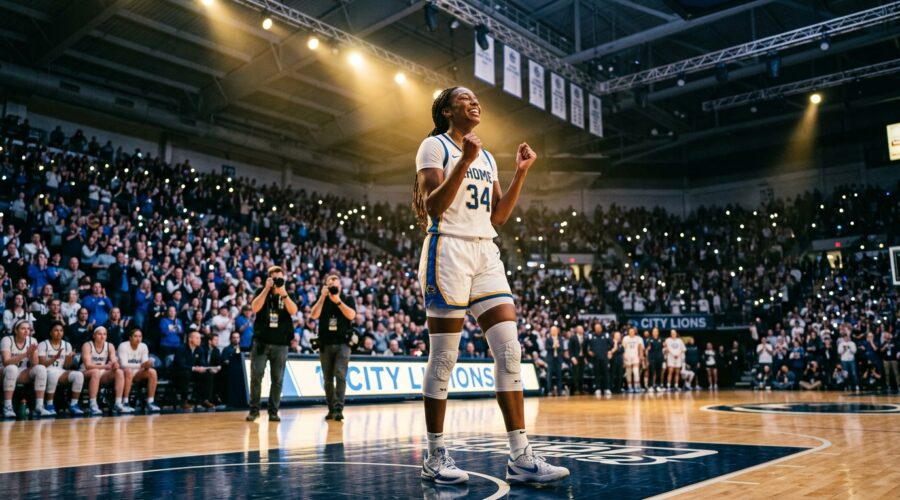
On the evening of May 22, 2026, ESPN’s Alexa Philippou filed a short but electric dispatch: Azurá Stevens was set to make her season debut the following night against the Minnesota Lynx, barring any morning setbacks. For a Chicago Sky fanbase that had watched its most expensive roster in franchise history get picked apart by injuries before June even arrived, those few sentences carried the weight of a championship rally. Stevens herself kept it simple: “I’m so excited to make my return in front of our home crowd. I’m feeling really great thanks to our terrific medical staff.”
Simple words. Massive implications.
Because the team Stevens is returning to is not the team that signed her in April. It is leaner, more desperate, and more dependent on what a 6’6″ stretch big with a silky three-point stroke can provide than anyone anticipated when she inked her landmark three-year, $1 million per year deal at The Metropolitan at Willis Tower. The Chicago Sky need Azurá Stevens. They need her now, they need her healthy, and they need her to be exactly the player she was in 2025 — the most complete version of herself she has ever put on display in eight WNBA seasons.
The question is whether she can get there, and how fast.
Three Months on the Shelf, One Night to Change Everything
The injury that kept Stevens off the floor was deceptive in the worst way. A bone bruise in her left knee — sustained during Unrivaled Season 2 in February 2026 while playing for Hive BC — carries none of the headline drama of a torn ACL, yet it demands the same stubborn patience. Bone bruises are notoriously unpredictable. They do not show up on X-rays. They flare without warning. They punish players who try to rush back. The surgery-free diagnosis is almost a cruelty, because it suggests a faster return than the injury ever actually allows.
Stevens missed every training camp practice starting April 19, both preseason games, and all five regular-season games from May 9 through May 22. The Sky’s medical staff — the largest in franchise history, led by Director of Health and Human Performance Jessica Cohen, head athletic trainer Kendyl Miller, Director of Athletic Performance Calin Butterfield, AT Catherine Lass, and physical therapist Djenne Parris — oversaw each step of her recovery with no public timetable and deliberate silence from GM Jeff Pagliocca, who would offer only that “each player is making progress.”
More than three months after the injury first surfaced, Stevens is finally cleared, with a minutes restriction expected to cap her somewhere in the 15-to-22-minute range for her debut. It is a cautious entry. Given what happened to Rickea Jackson six days before Stevens’ return was announced, caution is not just prudent — it is mandatory.
The Wound Underneath the Comeback Story
There is no way to tell the story of Stevens’ return without confronting what made it urgent in a way no one wanted.
On May 17, with 5:24 left in the first half of Chicago’s 86-79 road win over the Minnesota Lynx, Rickea Jackson planted her left foot to change direction in transition and crumpled to the floor in a non-contact collapse. The arena went quiet in that particular way that every basketball fan has learned to dread. Jackson was helped to the locker room. Two days later, MRI results confirmed a torn ACL in her left knee. Season over. Surgery ahead. Comeback a year away at the earliest.
Jackson had been the story of the Sky’s early season. The 25-year-old former Tennessee standout, acquired from the LA Sparks in a straight-up swap for Ariel Atkins, was averaging between 18 and 22 points per game through four contests and had posted 29 points on 10-of-22 shooting the game before her injury. She was the only player in the league ranking top 10 in both scoring and blocks. The entire offense ran through her. Pagliocca called the loss devastating, noting Jackson “was playing at an All-Star and All-Defensive level early in the season” and “was primed for a career year.”
She was primed for everything the franchise needed her to be. Now she is watching from the sideline in a brace.
Chicago’s full injury ledger heading into Game 6 reads like a medical wing intake sheet: Jackson is out for the season. DiJonai Carrington had hardware removed from her left foot with no return timetable. Courtney Vandersloot, coming back from a June 2025 ACL tear, is not yet cleared for contact. Skylar Diggins missed Game 5 with an eye injury, though she was expected back for Game 6. Stevens is the first of the major returning players to actually suit up — and the weight of that distinction is not lost on anyone inside the organization.
Who Stevens Was Before She Got Hurt
To understand what Chicago is getting back, it helps to understand just how good Stevens became in 2025.
Her season with the LA Sparks was the kind of campaign that quietly rewrites a player’s legacy. In 44 games, she averaged 12.8 points, 8.0 rebounds, 2.1 assists, 1.2 steals, and 1.1 blocks per game on 47.8 percent shooting from the field. She shot 38.1 percent from three-point range. She finished second in WNBA Most Improved Player voting. In a single game, she recorded four blocks and four steals while shooting above 70 percent from the field — a combination that had never been achieved in league history. She averaged 28.4 minutes per game, her most since her rookie year in Dallas.
The number that matters most for what Chicago needs, though, is that 38.1 percent from three. At 6’6″, that figure is not just impressive — it is extraordinary. There are maybe a handful of players in WNBA history at that size who have shot the three at that clip over a full season. It is a cheat code in a modern basketball system, because it forces defenses into impossible choices. Close out on a 6’6″ shooter and you leave driving lanes. Drop off and she punishes you from distance. Collapse the paint and she kicks it out. Stay home and Kamilla Cardoso seals the interior with nobody to help.
Stevens knows exactly what she represents in head coach Tyler Marsh’s system. At her April introductory press conference, she put it plainly about her pairing with Cardoso: “I can stretch the floor, and obviously she’s great down low, so I think we’re going to play off each other very well.”
That is an understatement.
The Cardoso Factor: 13’1″ of Frontcourt the League Cannot Conventionally Guard
While Stevens was rehabbing, Kamilla Cardoso spent the first five games of 2026 announcing herself as one of the premier big players in the WNBA. Through five games, the 6’7″ Brazilian center is averaging 14.4 points, 10.4 rebounds, 2.4 assists, and 1.6 blocks per game on 52.8 percent shooting. She opened the season with 22 points and 14 rebounds against Portland — a career-high eight offensive boards — and has been a relentless presence near the rim in every game since.
Cardoso is currently third in the WNBA in rebounding. She is scoring in the post, running the floor, converting at the rim, and protecting it at the other end. In Tyler Marsh’s positionless, spacing-first system — derived from the coaching philosophy he developed as an assistant under Becky Hammon during back-to-back Las Vegas Aces championships in 2022 and 2023 — Cardoso’s interior dominance becomes even more dangerous when defenses cannot simply pack the paint against her.
They cannot pack the paint when Azurá Stevens is standing at the arc, daring them to leave her open.
The combined dimensions of this pairing — 13 feet and one inch of frontcourt that spreads across the entire half court — are genuinely uncommon in women’s basketball. Cardoso punishes you inside. Stevens punishes you outside. Cardoso draws fouls, crashes offensive glass, and finishes through contact. Stevens finds the open cutter, hits the mid-range pull-up off the elbow, and drills the corner three on the skip pass. Together, they present a coverage dilemma that cannot be resolved with conventional defensive schemes.
Marsh has been explicit about wanting to weaponize versatility and IQ rather than size alone. Diggins captured the spirit of that approach before the season: “We might not be traditional 1, 2, 3, 4, but having guards that can attack from different points — our versatility is going to give us a lot of options this year on both sides of the basketball.” Stevens, with 2.1 assists per game in 2025 and the basketball intelligence built at Duke and UConn, fits that framework as a big who can initiate from the elbow and high post, not just stand in the corner and catch and shoot.
What Stevens Cannot Do — and What She Can
Honesty matters here. No one should confuse Stevens’ return with a solution to the Jackson problem.
Jackson was the engine. She could play every position from two through five. She created off the dribble, shot off movement, defended multiple positions, and drew foul after foul. She was averaging between 18 and 22 points per game on a rebuilt roster that had won just ten games the year before. She was the Sky’s identity and their ceiling. No single player, certainly not one returning from a three-month absence under a minutes restriction, replaces that.
What Stevens can do is redistribute the burden in ways that matter. Her 12.8 PPG in 2025 arrives efficiently, meaning other players — Diggins, Natasha Cloud, Jacy Sheldon — are not forced into overextended scoring roles that flatten shooting percentages and wear down legs. Her rebounding (8.0 per game last season) gives Chicago a second genuine front-court force alongside Cardoso, ending the period when opposing teams could effectively ignore the Sky’s interior once they contained Cardoso. Her defense (1.1 blocks, 1.2 steals in 2025) provides Marsh with matchup flexibility at a position where Chicago has been shorthanded. And her mere presence on the floor reduces the minutes burden on everyone else, keeping a team already managing multiple injuries from burning out its healthiest players before July.
The playoff math is worth noting plainly. ESPN’s preseason BPI gave Chicago just an 18.4 percent chance of making the postseason, projecting 19.1 wins. The Sky sat at 3-2 as of May 22, in a legitimate Eastern Conference race just half a game behind the division-leading Atlanta Dream. They had just beaten the Minnesota Lynx — the same team that lost Jackson five days earlier — by seven points on the road. Their next three games were all at home: Minnesota again on May 23 (Stevens’ debut), Toronto on May 28, and Minnesota a third time on May 29. Back-to-back matchups against a direct standings rival, in a building that has every reason to be loud.
A healthy Azurá Stevens does not just make Chicago better. She makes that 18.4 percent look like it underestimated this team.
She Has Done This Before
The most underrated part of the Stevens return story is that it is not the first time she has written it.
In 2020, Stevens was in the middle of what looked like a genuine breakout — 11.5 points, 5.9 rebounds, 1.8 blocks per game in the league’s COVID bubble in Bradenton — when a knee injury ended her season early. She went back to North Carolina to recover. She worked. She helped her father at his food truck, Same O Dame O’s, grinding through the kind of unglamorous, quiet months that come between who you were and who you are trying to become again. A WNBA.com feature captured her outlook: “The injury forced her to slow down a bit and start to appreciate the smaller things in life.”
She returned in 2021 under a minutes restriction. She gradually reclaimed her form. Then she helped the Chicago Sky win the WNBA championship.
The template is not hypothetical. She has lived it, in this city, with this franchise. The current injury — a bone bruise rather than a structural tear — is structurally less severe than what she overcame in 2020. The medical staff around her is larger and better resourced than anything the Sky have assembled before. And the motivation, returning home on a $1 million per year contract to a team that has staked its rebuild on her presence alongside Cardoso, is about as clear as motivation gets.
What to Watch When She Steps on the Floor
Stevens’ debut will raise more questions than it answers, and that is fine. Here is what actually matters in the early minutes:
- The minutes restriction: Expect somewhere between 15 and 22 minutes. How she looks in that window — movement, lateral quickness, landing mechanics — will tell you more about the trajectory of her season than any box-score line.
- Three-point sharpness: Her stroke is the engine of her value in this system. Is it sharp after months away from game action? One good shooting night is not a trend, but the mechanics will be visible from the first attempt.
- The two-big lineup: How often does Marsh deploy Cardoso and Stevens simultaneously, and how does the spacing function? This is the lineup that could define Chicago’s identity going forward. The first few live reps will be instructive.
- Defensive assignments: With Carrington still out, Stevens may be asked to guard wings and perimeter forwards sooner than ideal. Can her lateral movement hold up at game speed immediately?
- Playmaking flow: How naturally does she fit into Marsh’s positionless offense alongside Diggins and Cloud? Her 2.1 APG in 2025 showed she can do it. The question is whether the timing and chemistry are there in a debut.
Coming Home to Something Worth Saving
When Stevens stood at that podium in April at The Metropolitan at Willis Tower and said “this city means everything to me,” there was context behind every word. She won a championship here. She has close friends here — Vandersloot, whose own comeback from ACL surgery is pending, is one of them. She chose Chicago over other options when she could have gone elsewhere, signed the most expensive contract on the roster, and bet on a rebuilt team and a first-year coaching system to be the right place for the best chapter of her career.
The season has not cooperated. Jackson is gone. Carrington is in a walking boot. Vandersloot has not yet been cleared for contact. The team that was supposed to announce itself as rebuilt and dangerous has been doing it with a rotating cast of available bodies, and doing it well enough to sit at 3-2 and in the race. That, perhaps more than anything else, is the quiet story of the first five games: the Chicago Sky were supposed to fall apart, and they have not.
Now the most important piece of what this team was designed to be is finally available.
Azurá Stevens is 30 years old, eight seasons into a career that has been interrupted by injuries more than once and defined by her refusals to let those interruptions have the final word. She is coming back to a building where the city’s best basketball memory of her ends with a championship. She is coming back to a frontcourt partner in Cardoso who makes everyone around her more dangerous. She is coming back to a system built for exactly what she does.
Whether 15 minutes or 22, whether the shot falls immediately or takes a game or two to find its range, her presence on May 23 changes what the Chicago Sky can be. After everything this roster has absorbed in the last six days, that is not a small thing.
It might be the biggest thing left standing between this team and a playoff berth nobody outside the organization expected them to be chasing.