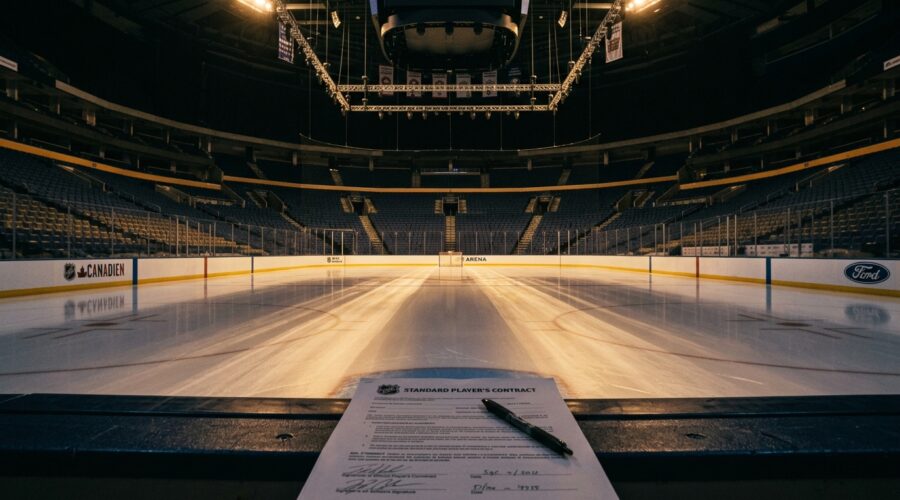
On May 20, 2026, just hours after a Game 7 overtime heartbreaker ended the Buffalo Sabres’ season at home against the Montreal Canadiens, general manager Jarmo Kekäläinen stepped to a podium at KeyBank Center and said four words that would have sounded delusional fourteen months earlier: “This is just the beginning.”
He was not wrong to say it. The Sabres had just completed a 50-23-9 regular season, won the Atlantic Division, snapped an NHL-record 14-year playoff drought, and knocked off the Boston Bruins in six games in Round 1 before falling to a red-hot Montreal squad in seven. By any honest measure, the franchise is not just back. It is legitimately built.
But the real test of any hockey front office is not whether a team can make the playoffs. It is whether a team can stay there — and whether the contracts already on the books, and the ones coming this summer, will allow it to compete for the next five, six, seven years. That is what makes the current state of the Buffalo Sabres’ roster so fascinating and, in some places, so nerve-wracking.
Here is a full accounting of who got paid, who still needs to be paid, what was worth every dollar, and what might keep Kekäläinen up at night as July 1 approaches.
The Foundation: Cornerstone Contracts That Were Already in Place
Rasmus Dahlin — The Franchise Cornerstone
Everything in Buffalo starts and ends with Rasmus Dahlin, and the eight-year, $88 million extension ($11 million AAV) that former GM Kevyn Adams locked up in October 2023 looks like the most important piece of business this franchise has done in a generation. Dahlin posted 74 points in 77 games in 2025-26, won the team MVP award, wore the captain’s C with the kind of poise that made opponents respect him, and logged nearly 24 minutes of ice time per night in the playoffs.
At $11 million against a $104 million cap ceiling, Dahlin is consuming 10.6 percent of the team’s resources. That number will feel increasingly manageable as the cap rises toward a projected $113.5 million in 2027-28 and $123 million the following year. By the back half of his deal, Dahlin may look like one of the most affordable franchise defensemen in the sport. Adams made mistakes in Buffalo. This was not one of them.
Tage Thompson — The Best-Value Contract in the NHL
There are a handful of players whose current contracts make rival general managers physically uncomfortable when they look at them. Tage Thompson’s seven-year, $50 million deal ($7.142 million AAV), signed in August 2022, belongs in a museum.
Thompson put up 40 goals and 81 points in 81 games in 2025-26, his second consecutive 40-goal campaign. He stands 6-foot-6, wins battles in the corners, kills penalties, plays the power play, and has grown into the kind of alternate captain whose presence in the room is as valuable as his presence on the ice. At $7.142 million in 2026-27, he represents 6.87 percent of the salary cap. That is highway robbery for a center of his caliber, and it runs through 2029-30.
Mattias Samuelsson — The Quietly Underrated Deal
In a season where Dahlin earned the headlines and Power attracted the trade rumors, Samuelsson quietly became one of the most important defensive players on the roster. His seven-year, $30 million deal ($4.285 million AAV) — signed by Adams in October 2022 and running through 2029-30 — is among the most team-friendly contracts in the entire NHL. He filled a first-pair role alongside Dahlin in the second half of the season as the Sabres went on one of the most dominant runs in the organization’s modern history, and at his price tag, there is almost no scenario where his value does not dramatically outpace his cost. Buffalo could not have built the back end it has without this contract as a structural pillar.
Ukko-Pekka Luukkonen — The Goaltender Who Finally Arrived
The five-year, $23.75 million deal ($4.75 million AAV) Luukkonen signed in July 2024 was always a bet on potential. In 2025-26, that bet started to pay off. UPL posted a .910 save percentage and a 2.52 GAA in 35 games — his best statistical season by a significant margin — and had moments in Round 2 that ended up in the NHL’s top saves of the playoffs. He is under contract through 2028-29 alongside veteran Alex Lyon and promising rookie Colten Ellis, and Kekäläinen has indicated the three-goalie approach that worked so well this year is likely to continue. Buffalo’s goaltending is not without questions — the Canadiens’ advantage between the pipes was a meaningful factor in the series result — but at under $5 million, Luukkonen’s cap hit is not the problem.
Owen Power — The Contract That Generates Debate
The most complicated entry in the Sabres’ existing contract ledger is Owen Power. The seven-year, $58.45 million deal ($8.35 million AAV) signed two days after Dahlin in October 2023 represented a massive commitment to a 2021 first-overall pick before he had truly established himself as an elite NHL defenseman. Through 2025-26, he has been good — a reliable two-way player who logged 21:39 of ice time per night, contributed to the penalty kill, and finished the regular season at +9 — but he has not yet looked like an $8.35 million defenseman.
Trade rumors swirled all season, and analysts increasingly view Power as the most logical trade chip to create cap space in a roster that needs flexibility. He runs through 2030-31, has real value around the league, and plays a position where Buffalo already has Dahlin, Samuelsson, and Byram. A trade is not certain, but the conversation is becoming impossible to avoid.
Josh Norris — The Calculated Gamble That May Not Have Paid Off
When Adams traded Dylan Cozens to Ottawa for Josh Norris at the 2024-25 deadline, the logic was understandable. Cozens, entering the final year of a seven-year, $49.7 million deal, had struggled to meet expectations. Norris was a proven 35-goal scorer before a shoulder injury robbed him of nearly two full seasons. The bet was on health and upside.
In 2025-26, that bet produced 34 points in 44 games. When Norris was healthy, the flashes were there. But the durability question — which was always the central concern — remained answered with a question mark. His five-year, $7.95 million AAV contract runs through 2030-31, and if he cannot stay in the lineup, it becomes the most burdensome cap hit on the entire roster. Buffalo needs Norris to be the player Ottawa had before the injuries. Right now, that is still an article of faith more than a demonstrated fact.
Kekäläinen’s Era Begins: The Extensions He Made His Own
Josh Doan — The Defining Acquisition, Now Locked Up
When the Peterka trade was announced in late June 2025, most of the hockey world thought Buffalo had lost. They sent away a near-point-per-game winger who was only 23 years old and received back two players — Doan and Michael Kesselring — who had been role players in Utah. The initial reaction was somewhere between bewilderment and outrage.
By January 21, 2026 — the day Kekäläinen signed Doan to a seven-year, $48.65 million extension ($6.95 million AAV) — the calculus had already begun to shift. By the end of the playoffs, it had flipped entirely. Doan led the NHL in takeaways during the regular season, posted 52 points in 82 games, and was among Buffalo’s most dynamic and dangerous players alongside Zach Benson in both playoff rounds. The son of Arizona Coyotes legend Shane Doan has an identifiable combination of skill, compete level, physical edge, and character that the Sabres coveted — and now own at a team-friendly price through 2032-33.
JJ Peterka, for his part, posted 47 points in Utah in 2025-26 on his five-year, $7.7 million AAV deal. Doan at $6.95 million, with a seven-team no-trade list when eligible and locked in through the prime of his career, is the better outcome for Buffalo. This trade, once considered a loss, is now considered a win — and locking Doan up early was Kekäläinen’s first major act as general manager and a clear statement of philosophy.
“Josh is a player that impacts the team both on and off the ice,” Kekäläinen said at the signing. “We believe he will be a core piece of this team moving forward.” So far, there is no reason to doubt him.
Bowen Byram — The Bridge Deal That Creates a Deadline
The two-year, $12.5 million bridge deal ($6.25 million AAV) that kept Byram in Buffalo through 2026-27 was constructed as a placeholder — a fair short-term commitment to a player with legitimate upside who needed time to prove himself in a new organization. In 2025-26, Byram delivered: 42 points in 82 games, a +15 rating, meaningful playoff contributions, and the kind of mobility and puck-movement skill that makes him a genuine asset on a back end already stocked with talent.
Kekäläinen has been direct about his desire to sign Byram long-term. “I’d like to lock him up for a long time,” he said at his end-of-season press conference. “I think the top-four of our defense is our drive, our engine.”
The problem is math. Dahlin at $11 million, Power at $8.35 million, and Samuelsson at $4.285 million already represent over $23.6 million in committed defensive spending. Adding Byram to a long-term deal that would likely cost $7 to $8.5 million annually creates a left-side depth problem and a cap allocation problem simultaneously. A trade remains firmly on the table. The next twelve months will determine whether Kekäläinen can afford to keep what he says he wants to keep.
Jason Zucker — The Productive Re-Sign
Zucker’s two-year, $4.75 million AAV extension, signed around March 2026, is the kind of depth move that does not make headlines but matters enormously on a playoff roster. He posted 24 goals and 45 points in 62 games in 2025-26, led the team’s skaters in on-ice goal share the prior season, and established himself as a reliable net-front power-play presence. At 33 going on 34, with one year remaining after this one, the deal is fair value for both sides. No complaints here.
Jordan Greenway — The Overpay That Did Not Work Out
Not everything Kekäläinen inherited was clean. The two-year, $4 million AAV extension given to Greenway mid-season in 2024-25 was viewed with skepticism at the time and looks worse in hindsight. Greenway missed time with injuries, produced sparingly when available, and became a trade candidate at the deadline. He becomes an unrestricted free agent after this season, and his departure will be addition by subtraction in terms of both cap relief and roster clarity. Some decisions do not work out. This one did not.
Lindy Ruff — The Extension That Signals Everything
The most symbolically important contract signed in the immediate aftermath of the season was not for a player. Within hours of Game 7, before the ice at KeyBank Center had even been cleaned, Lindy Ruff was given a two-year extension to continue as head coach of the Buffalo Sabres.
The timing was deliberate. It was a message to the locker room, to the city, and to the league: there is no reset coming. The culture that produced a 39-9-5 run in the second half of the season and a franchise-first division title is not being reconsidered. Ruff’s philosophy of playing uncomfortably, competing in every zone, eliminating the self-inflicted mistakes he called “the stupid stuff,” had turned a .500 team in November into an Atlantic Division champion by April.
“I’d rather be somewhere else today,” Ruff said at his press conference, referencing the ECF flight he wished he were on. “But I’m humbled by the opportunity to lead this team to a championship.” That is exactly the right thing to say, from exactly the right coach, at exactly the right moment.
The Summer Ahead: The Decisions That Will Define the Next Era
Alex Tuch — The Toughest Call in the Entire NHL
If there is one situation that will define Kekäläinen’s summer, it is Alex Tuch. The 30-year-old alternate captain is the top unrestricted free agent on the entire NHL market as of July 1. He is a three-time 30-goal scorer, one of the league’s most reliable two-way wingers, an elite penalty killer, a power-play contributor, and — perhaps most importantly in an era when franchise identity matters — a player who grew up a two-hour drive east of Buffalo and genuinely cares about this community.
Talks have been complicated since training camp. The Sabres reportedly offered an AAV starting with an “8.” Tuch’s camp has sought closer to Adrian Kempe’s eight-year, $10.625 million benchmark — a gap that feels narrow on paper but translates to tens of millions of dollars in total commitment over the life of a long-term deal. AFP Analytics projected Tuch’s next deal at $10.1 million annually. The market will almost certainly get there regardless of what Buffalo does.
“He’s been an important part of our success,” Kekäläinen said at his end-of-season press conference. “But just like I’ve told him and I tell everybody in the same situation, we make our decisions based on how we can make our team better. We have to come to an agreement that this is the type of contract where we can still make our team better — and hopefully we can do that.”
That is measured, careful language from a GM who understands the cap implications. With approximately $12.9 million in available space heading into 2026-27, signing Tuch at or near market value essentially consumes the entire remaining budget before addressing Benson, Byram, Kesselring, Krebs, McLeod, and Quinn. The arithmetic is brutal. Tuch, for his part, left his locker cleanout interview without a commitment: “I wish I could tell you the future. I really just don’t know how it’s going to unfold.”
The only lever Buffalo can pull that its competitors cannot is an eighth year. That benefit expires when the new CBA kicks in this fall. The window to use it may be shorter than anyone realizes.
Zach Benson — The Non-Negotiable
If Tuch is the most complicated offseason decision, Benson is the most urgent. The 21-year-old winger finished the regular season with 43 points in 65 games and then elevated his game to another level entirely in the playoffs, posting five goals and nine points in 13 games while drawing a league-high 10 penalties across both rounds. He led the Sabres in goals per 60 minutes at 5-on-5 in the postseason and looked, for stretches, like the most dangerous young forward in the entire field.
He is a restricted free agent this summer. His current cap hit is $950,000. And he is, unquestionably, the most coveted RFA on the market in a summer where the UFA class is historically thin.
The offer sheet risk is real. Teams with cap space and few other options to improve quickly will look at Benson’s playoff résumé and see exactly what they should see: a franchise-caliber player available at an artificially low price for one summer only. Kekäläinen’s post-season words about Benson — “I see him as a true core piece that fills all the boxes” — sound like a GM who understands what is at stake. He directly compared the Benson situation to the Doan extension, the single best decision of his tenure so far.
The projected range for Benson’s extension is seven years at $6.95 to $8.5 million AAV, with the upper end of that range reflecting his playoff performance. The Sabres have the cap space to match even an aggressive offer sheet, but doing so while also pursuing Tuch makes the math extremely tight. Buffalo cannot afford to be slow here. Getting Benson signed before July 1 should be the first call Kekäläinen makes every morning.
Michael Kesselring — The Bridge Deal to Come
The other half of the Peterka trade was supposed to make the defensive corps more formidable. Injuries derailed Kesselring’s first season in Buffalo almost completely, limiting his ability to prove himself in meaningful minutes. When healthy, the 6-foot-5 right-shot defenseman has the profile Kekäläinen values — a mobile, physically imposing player with defensive instincts and offensive capability. A bridge deal at moderate cost is expected. It is not a complicated situation, but it is another contract that has to be placed on an already tight cap sheet.
The Ghost in the Machine: Jeff Skinner’s Buyout
Any honest accounting of Buffalo’s cap situation in 2026-27 must include what remains the most expensive reminder of a prior regime’s miscalculation. The Jeff Skinner buyout penalty costs the Sabres $6.444 million in dead cap in 2026-27 — money that buys nothing, earns nothing, and consumes space that could otherwise be used to sign the players described above. That number drops to $2.44 million in 2027-28, a savings of just over $4 million that will feel like a breath of fresh air.
It is the single most consequential financial overhang from the Kevyn Adams era, and until it shrinks, it effectively costs the Sabres somewhere between one mid-tier depth signing and one critical bridge deal every year. It is not a crisis. But it is real, and it matters.
The 2027-28 Horizon: Why the Best Might Still Be Ahead
Here is where the story becomes genuinely exciting for Buffalo fans. The 2026-27 season will require creative cap management, difficult decisions on Tuch and Byram, and potentially a trade of Owen Power to create meaningful flexibility. But 2027-28 projects to be an entirely different landscape.
With the cap ceiling projected to rise to $113.5 million, the Skinner buyout dropping to $2.44 million, multiple bridge deals expiring, and several existing contracts rolling off the books entirely, Buffalo projects to have over $53 million in cap space heading into the summer of 2028. That is not a rebuilding team’s blank check. That is a legitimate contender’s ability to add veterans, pursue premium free agents, and build depth on top of a core that will include Dahlin, Thompson, Doan, Benson, Norris (assuming health), Luukkonen, and the other pieces locked up under team-friendly terms during the Adams and Kekäläinen years.
The Sabres are not a free agency destination yet. But the infrastructure is being built to make them one. The culture Ruff has installed, the young stars Kekäläinen has committed to, the rising cap, and the expiring dead weight will all converge at roughly the same moment. That is not an accident. That is planning.
What It All Means
In the course of one tumultuous season — from a .500 record in November to a division title in April, from a fired general manager in December to a philosophy of identity-building by spring — the Buffalo Sabres became a team that has to be taken seriously. Not just for making the playoffs. For potentially winning something.
The contracts tell the story more clearly than any narrative: Dahlin and Thompson are locked up at values that will only look better with time. Doan is the kind of young cornerstone signing that validates a general manager’s judgment. Samuelsson is a steal. The goaltending is affordable and developing. The coaching staff is stable and motivated.
What remains unresolved — Tuch, Benson, Power, Byram — will define whether the 2026-27 Sabres are a genuine contender or a cap-constrained team that treads water while waiting for the 2028 transformation. Kekäläinen’s stated philosophy, his willingness to act decisively on Doan and Ruff, and his clarity about the franchise’s core identity all suggest he understands the urgency.
The drought is over. The real work is now. And in Buffalo — where the wait lasted 14 years and the city never fully stopped believing — the expectation has officially, irreversibly changed.
“Making the playoffs is now an expectation for this team,” Kekäläinen said.
He means it. The contracts, if managed correctly, will give him the means to back it up.