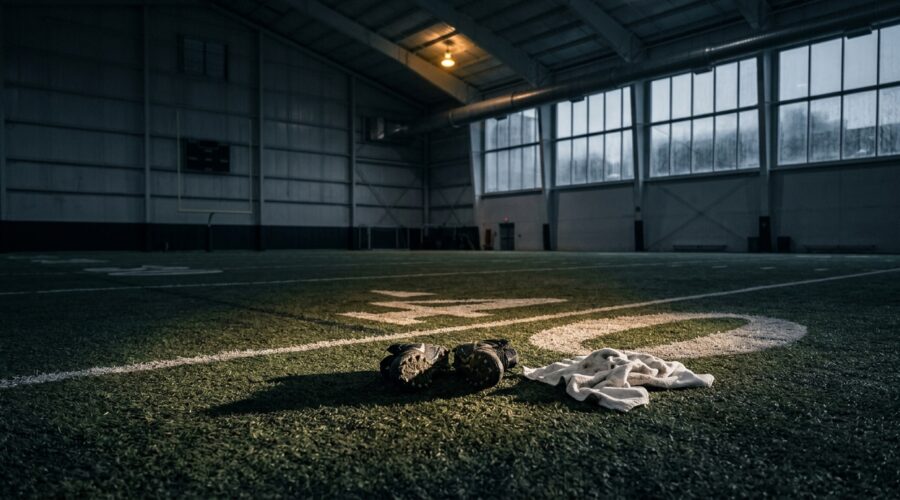
They were supposed to be rebuilding. Instead, they are hemorrhaging.
On a rainy Thursday morning in East Rutherford, with the Giants practicing indoors during the first week of OTAs under a brand-new head coach, veteran defensive tackle Roy Robertson-Harris reached for the back of his right leg and went down. No contact. No dramatic collision. Just the sudden, silent catastrophe of a torn Achilles tendon — the kind of injury that doesn’t merely end a season, but potentially ends a career.
For a New York Giants franchise already navigating the most consequential defensive reconstruction in years, the timing could not be more punishing.
The Wound That Keeps Opening
To understand why this injury cuts so deeply, you have to understand the sequence of events that preceded it. This is not an isolated setback. It is the latest in a chain of structural shocks to a defense that was ranked No. 1 in the entire NFL entering the 2025 season — and then proceeded to allow more runs of 10 or more yards than any team in the league.
On April 18, 2026, the Giants traded three-time Pro Bowl defensive tackle Dexter Lawrence to the Cincinnati Bengals for the No. 10 overall pick. Lawrence, who had reportedly grown disgruntled and requested a move, had been the gravitational center of the entire defensive front. Warren Sharp’s data told a stark story: Lawrence was double-teamed more than any other defensive tackle since 2024, with a 2024 double-team rate that was the highest at the position since 2018. That is not a gap you fill with a free agent signing. That is a structural void that reshapes everything around it.
The Giants used the No. 10 pick on Miami offensive tackle Francis Mauigoa, slotting him immediately into the starting lineup at right guard. The front office had made its calculation: future capital over present defensive dominance. Whether that bet pays off remains to be seen. What is not debatable is what it cost them at the line of scrimmage.
Then, the week before Robertson-Harris went down, undrafted rookie cornerback Thaddeus Dixon tore his own Achilles — the same injury, the same offseason, different position. Back-to-back Achilles tears during voluntary, non-contact practices. The football gods, apparently, are not feeling charitable toward the 2026 New York Giants.
Who Robertson-Harris Was — and Why It Matters
It would be easy to dismiss Robertson-Harris as a journeyman. His career statistics — undrafted out of UTEP in 2016, a practice squad ghost for his first year in Chicago, slowly building a career through four franchises over nine seasons — do not scream irreplaceable. His 2025 PFF overall grade of 22 would not get him invited to any Pro Bowl discussions. And yet.
He started all 17 games last season. He logged 628 snaps — a 54.6 percent snap share — and posted 35 tackles, 3 tackles for loss, and 6 quarterback hits without missing a game. He occupied blockers. He held gaps. He was, in the language of defensive line theory, the kind of unsexy, functionally essential body that allows the players around him to be great.
His value was always contextual: he was the complementary piece to Dexter Lawrence, the player who could handle the double-team spillover and keep the interior honest so the edge rushers could operate freely. Now Lawrence is in Cincinnati, and Robertson-Harris is on injured reserve before the season begins. The complementary piece has lost the star it was complementing — and then been lost itself.
Robertson-Harris, who turns 33 in July, tore his Achilles in May. Per a 2021 study from the American Orthopaedic Foot and Ankle Society examining 333 professional athletes with Achilles ruptures, approximately 24 percent could not return to professional sport at all. The average rehabilitation period was roughly 11 months — nearly double the general population’s recovery timeline. Performance, durability, and career length are all meaningfully reduced post-injury.
Do the math on Robertson-Harris’s timeline: injury in May 2026, potential return in April 2027 at the earliest, meaning the most optimistic scenario has him participating in next year’s OTAs — as a 33-year-old free agent coming off a torn Achilles. His game has always been built more on technique and hand-fighting than on explosion, which may offer a marginally better prognosis than a speed rusher would face. But marginally better than bleak is still a difficult situation. His NFL future is genuinely uncertain, and the Giants will need to plan accordingly.
In the meantime, they owe him a $5.75 million cap hit — 1.9 percent of the 2026 salary cap — for a player who will not take a single regular-season snap. Combined with DJ Reader’s approximately $6.25 million Year 1 cap hit, the Giants are committing roughly $12 million of their interior defensive line budget and receiving production from only one of those two contracts. It is not a cap-breaking number on a team playing with over $303 million in space, but it narrows their flexibility at precisely the moment flexibility is needed most.
The Reconstruction: What New York Actually Has
The good news — and there is genuine good news here — is that General Manager Joe Schoen had already begun systematically overhauling the defensive line before Robertson-Harris ever reached for his leg.
The Athletic’s Dan Duggan described a methodical three-week reconstruction of the DL room. The crown jewel was DJ Reader, signed to a two-year, $12.5 million deal (with incentives reaching $15.5 million) on May 5, 2026. Reader is 31, a 10-year veteran with 128 starts in 138 career games, who spent his final two seasons in Detroit posting 40 pressures and 12 quarterback hits. Critically, he led the entire NFL last year with a 71.7 percent double-team rate — meaning he has demonstrated the ability to draw precisely the kind of attention Lawrence once commanded. He is a 330-pound nose tackle who fits like a glove into the archetype John Harbaugh has built defensive identities around throughout his coaching career: Haloti Ngata in Baltimore, Brandon Williams, Michael Pierce. Reader is not a consolation prize. He is a legitimate anchor.
Alongside him, Shelby Harris brings 12 NFL seasons, 28.5 career sacks, 65 quarterback hits, and 40 pass deflections — the latter figure representing an almost freakish ability for an interior lineman to disrupt the passing lane. At 35 and on a one-year, $3 million deal, Harris was always built as a veteran rotational presence. Post-Robertson-Harris injury, he becomes considerably more than that.
Leki Fotu (one-year, $1.29 million), a former Arizona fourth-round pick at 6-foot-5 and 317 pounds, fills the depth chart as a backup nose tackle — provided he can stay healthy after appearing in only 10 games over the past two seasons. Zacch Pickens, claimed off waivers from Kansas City, is a change-of-scenery candidate: a former Chicago third-round pick who spent most of last year on the Chiefs’ practice squad and appeared in just three games. Big Blue View described Pickens, Fotu, and Sam Roberts collectively as players with “nondescript careers to this point” — honest assessment, if not exactly a rallying cry. Sixth-round rookie Bobby Jamison-Travis out of Auburn (6-foot-3, 328 pounds) is a developmental two-down nose tackle who will need time the Giants may not be able to give him.
The Man the Spotlight Has Found: Darius Alexander
And then there is Darius Alexander, and this is where the Robertson-Harris injury transforms from a personnel setback into something with genuine narrative stakes for the entire 2026 season.
The Giants’ 2025 third-round pick out of Toledo flashed something real as a rookie. In 16 games (two starts), he posted 3.5 sacks, 4 tackles for loss, and 15 total pressures. His final six games were the ones that made the organization take notice: 3.0 sacks, 4 quarterback hits, including a performance against Detroit in which he became the first Giants rookie to record 2.0 sacks in the first half of a game since Jason Pierre-Paul did it in December 2010. That is not a trivial comparison.
The problem is the full-season numbers are considerably less inspiring. PFF graded Alexander 42.9 overall (121st of 134 qualified interior defensive linemen), with a pass rush grade of 54.9 (107th) and a run defense grade of 30.3 — 130th out of 134 players at his position. That run defense grade is not simply concerning in the abstract. It is alarming for a franchise whose new head coach and defensive coordinator have made stopping the run the explicit, stated priority of everything they are building.
John Harbaugh stood at the NFL Scouting Combine in February and said, without ambiguity, that stopping the run is a “must.” Dennard Wilson, the new defensive coordinator, has constructed his entire scheme philosophy around four pillars — “unpredictable, dynamic, decisive, and unapologetic” — built upon a Cover 4 foundation that demands the front four generate pressure organically rather than through blitzing. That system only functions when the interior run defense is sound. In 2025, the Giants allowed 145.3 rushing yards per game (31st in the NFL), 21 rushing touchdowns (second-most), 75 runs of 10 or more yards (the most in the entire league), and a plus-635 rushing yards over expected — the worst mark in football. Former defensive coordinator Shane Bowen was fired with a month left in the season. The problem was that dire.
Alexander’s development in Year 2 is no longer optional. It is critical. And perhaps most telling: Sports Illustrated’s Patricia Traina reported that Alexander saw an immediate increase in practice reps the same Thursday Robertson-Harris went down. The organization did not need to hold a press conference. The message was sent in real time, on the practice field.
He has a full offseason in Wilson’s system. He has the competitive urgency of a depth chart that suddenly has a very visible opening. He has the physical tools — the 34-inch arms, the motor, the pass rush instincts that produced genuine moments of dominance late in his rookie year — to be something special. Whether the 2025 version of Darius Alexander was the real one, or the late-season flash was the real one, is the most important question on the entire 2026 Giants defense.
The Philosophy That Must Now Prove Itself
Wilson’s “positionless” defensive philosophy — detailed by Traina before the Robertson-Harris injury even occurred — was always going to require buy-in over individual production. The committee approach at interior defensive line was a strategic preference before May. Now it is a hard requirement.
The silver linings are real, and they should not be dismissed. Brian Burns recorded 15.5 sacks in his first season in New York. Abdul Carter, the No. 3 overall pick in 2025, arrived and was immediately elite. Kayvon Thibodeaux gives the Giants one of the most dangerous edge-rushing trios in football. In passing situations, those three can mask interior limitations in ways that many defensive fronts simply cannot. Games where the Giants are playing from ahead, where opponents are forced into throwing situations, become much more manageable.
The games that are harder to manage are the ones where opponents run right at them, where a team gets to establish the line of scrimmage and make the Giants play uphill. The 2025 season demonstrated, in excruciating statistical detail, what happens when teams decide to attack the interior of New York’s defense and nobody inside can stop them. The 2026 season, stripped of Lawrence and Robertson-Harris, begins with a thinner margin for error than anyone in East Rutherford would have preferred.
The Uncomfortable Bottom Line
Roy Robertson-Harris was not the star of this defense. He was never going to be. But he was a proven 17-game starter who understood his role, executed it consistently, and provided the kind of dependable interior presence that complementary defenders require to function. When you remove that kind of player, the people around him do not simply absorb the void. The void becomes visible, and opposing offensive coordinators find it.
His contract expires after 2026. He will be a free agent at 33 coming off a torn Achilles. The Giants must now plan for a future without him on the assumption that his return — should it happen at all — will come at a reduced version of what he was. That planning has, in effect, already begun. The increased reps for Alexander on a rainy Thursday morning in OTA Week 1 were not coincidental. They were the organization telling itself the truth.
Harbaugh’s Ravens were never built on individual brilliance at every position. They were built on scheme, discipline, and the relentless refinement of roles. That is the model being imported to the Meadowlands, and it is the right model for a team in transition. But even the best-coached defenses in NFL history needed capable bodies in the middle of the line. The 2026 Giants need DJ Reader to be the anchor his track record suggests he can be. They need Shelby Harris to hold up for 17 games at 35. They need Darius Alexander to find out what he actually is.
And somewhere in a rehabilitation facility, Roy Robertson-Harris is beginning the longest, most grueling journey of his professional life — relearning how to trust a tendon, one step at a time, with no certainty about what waits on the other side.
The Giants are rebuilding. The question is whether the foundation can hold while the walls are still going up.