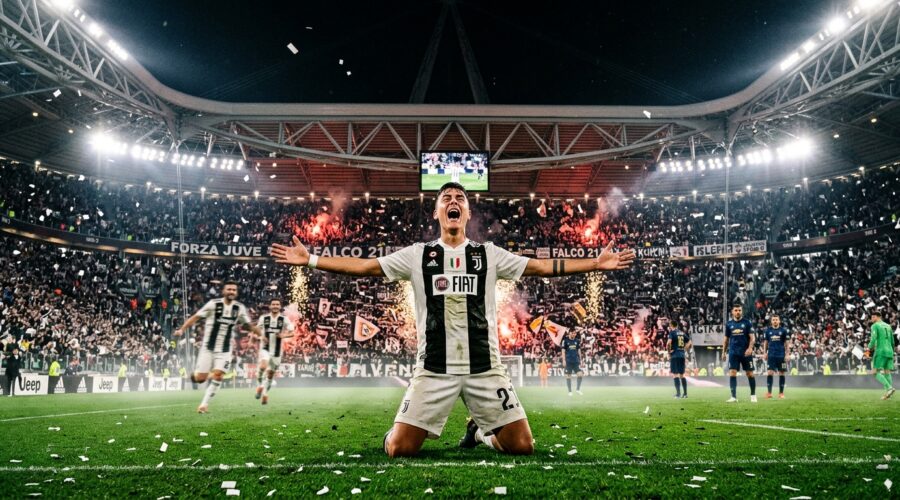
There is something almost too neat about it. On the night of November 1, 2026 — the exact date on which a group of teenage students from the Massimo d’Azeglio high school in Turin founded a football club they chose to call Juventus, Latin for youth — a nineteen-year-old born in Cologne to Bosnian parents stepped into the left half-space at the Allianz Stadium and reminded everyone in Italian football why the word still means something. Kerim-Sam Alajbegović. Shirt number 17. First Serie A goal of his career. The birthday candle lit with a screamer in the seventy-first minute.
Juventus 2, Napoli 0. It is the kind of scoreline that reads like a comfortable evening in Turin, tidy and authoritative. It was neither of those things for long stretches. But results, as Luciano Spalletti has had occasion to remind anyone who will listen, have a stubborn tendency to tell the truth eventually.
The Weight of the Occasion
Before a ball was kicked, this fixture carried more symbolic freight than most. Spalletti, a man who guided Napoli to their first Scudetto in thirty-three years and who has spent the better part of his tenure at Juventus being reminded of that fact, was entering his fiftieth match in charge of the club he now serves. His opposite number, Massimiliano Allegri — long the face of Juventus’ own dominance and now, with a peculiar circularity, at the helm of a Napoli side who finished second in Serie A in 2025-26, replacing Antonio Conte in July 2026 after his own difficult spell at AC Milan ended in the sack — watched the whole thing from the stands, serving the second match of a touchline ban he had collected with characteristic Allegrian flair.
Spalletti, for his part, handled the pregame theatre with the quiet dignity of someone who understands that football occasionally demands you be gracious about the strangest arrangements. “I would be pleased to have Max alongside me on the bench,” he said beforehand. “I will go and find him after the match because he is a great friend and a great coach.” Whether he did go and find him, and what was said if so, remains one of the evening’s more intriguing footnotes.
The league table coming in told its own story. Both clubs sat on fourteen points before kick-off, separated only by goal difference — Napoli seventh, Juventus eighth — which is to say that neither side had shown the kind of consistent conviction the autumn demands of title contenders. But in the context of this fixture, with Lazio already nine points clear at the summit and Inter three behind them, the three points here were less about the Scudetto and more about something older and less easily quantified. Territory. Pride. The record book’s slow correction of a recent H2H that had tilted so dramatically south it had started to look permanent.
Spalletti’s Shape and the Space It Created
The tactical context of this win deserves proper examination, because the goal that broke the match open was not an accident. It was the precise, deliberate consequence of a system designed to produce exactly this kind of moment.
Spalletti’s adoption of the 3-4-2-1 in the weeks prior to this match had been the subject of considered analysis — the Black and White and Read All Over tactical breakdown published the day before the game made the case with admirable clarity. The shape, which in possession resolves into something closer to a 3-1-3-2-1 as the deeper midfielder drops to anchor, was designed specifically around the attacking options available to Spalletti in the absence of Kenan Yıldız, whose foot injury has kept him sidelined since before the summer’s World Cup. With Yıldız gone, Spalletti has had to reimagine his front third around a set of players — Alajbegović, Kolo Muani, Woltemade, Conceição — who do not operate conventionally and who, in a more rigid system, risk being squeezed into shapes that blunt their best qualities.
The 3-4-2-1 gives them room to breathe. The two players operating between the lines and the striker enjoy a fluidity that a flat 4-3-3 or 4-2-3-1 simply does not offer. Most importantly for the purposes of November 1, it gave Alajbegović explicit licence to drift inside from the left flank — which is exactly where he was when he collected the ball in the seventieth minute, set his feet with a single touch of unhurried confidence, and did what nineteen-year-olds of his particular quality tend to do when they find themselves with space and the full weight of the occasion on their shoulders.
He scored. The Italian press reached immediately for prodezza — a feat of brilliance — which is the word the Gazzetta and the Corriere dello Sport tend to reserve for strikes that leave goalkeepers looking as though they were spectating rather than participating. A yellow card followed during the celebrations, earned with the uncontrollable excess of someone who has waited a very long time for a moment he knew was coming.
What Napoli Brought and Why It Wasn’t Quite Enough
It would be wrong to suggest Napoli were poor. They were not. They arrived on the back of a four-match unbeaten run, including a 4-1 dismantling of Monza four days prior, with eleven goals across their three most recent outings and a forward line that, on paper, should have been causing Juve’s back three the kind of sleepless problems that make a manager’s pre-match preparation look hopelessly optimistic.
Kevin De Bruyne, operating as the deep playmaker that Allegri’s system has asked him to be in what may well be the most quietly fascinating tactical reimagining of a world-class midfielder’s late career, had created twenty chances in nine appearances for Napoli coming in. Scott McTominay as a left winger — still, several months into the experiment, the kind of deployment that invites a raised eyebrow before the evidence compels you to lower it — had four goals. Rasmus Højlund offered the kind of centre-forward presence that asks serious questions of any back three in Europe. Matteo Politano had four assists and a pressing intensity that made Juve’s wider defenders work for everything.
And yet. The xG at full time read 0.79 to Juve, 0.52 to Napoli. One shot on target for the visitors across ninety minutes. Thirteen corners to four. Lobotka, carrying a knock from the Monza victory, was never quite the conductor his side needed him to be. De Bruyne was kept quiet in the manner that only a well-organised back three with a genuine defensive midfielder in front of it can manage. And Jhon Lucumí, the summer signing who has quietly become one of the more important pieces of Spalletti’s rebuilt defence, was excellent in the kind of undemonstrative, positionally intelligent way that rarely generates headlines but absolutely generates clean sheets. This was Juventus’ fourth of the season.
There is also something worth noting about Napoli’s seasonal pattern away from Naples. All twelve of their away goals this season had arrived in the second half — a tendency that Juve’s coaching staff would have noted, and which explains why the defensive discipline in the first sixty-five minutes was so disciplined, so deliberately suffocating. Let them believe, and then take the air out of the room.
The Boy from Cologne
You cannot write about this evening without lingering on Alajbegović, and not merely because he scored the goal that won it. There is something in his story that makes the timing feel almost contrived — the kind of narrative a novelist would be advised to tone down for credibility.
Born in Cologne on September 21, 2007, to parents of Bosnian heritage, he started at 1. FC Köln before Bayer Leverkusen’s academy recognised what they were looking at and brought him across in 2021 at the age of thirteen. He never made a senior Bundesliga appearance for Leverkusen — they were, in this respect, cultivating rather than deploying him — but he produced ten goals and seven assists for the U-19 side in 2024-25 with a consistency that made the loan to Red Bull Salzburg feel less like development and more like confirmation. At Salzburg, across forty-four competitive appearances, he scored thirteen or fourteen goals and played in UEFA Champions League qualifying and the Europa League, against opposition whose quality made the numbers mean something.
Then came the 2026 FIFA World Cup in North America and Bosnia and Herzegovina’s 3-1 win over Qatar in Seattle, and the goal that announced him to a global audience. Not a tap-in. Not a penalty. The kind of individual strike — nominated for Goal of the Tournament — that stops commentators mid-sentence and sends scouts into frantic cross-referencing of their notes. He was eighteen years old.
Leverkusen triggered their €8 million buy-back clause from Salzburg in March 2026, bringing Alajbegović back to the club, but did not immediately move him on. He remained at Leverkusen until August 2026, when Juventus purchased him directly for approximately €35 million on August 2, 2026, on a five-year contract. Spalletti, who rarely lavishes praise during pre-season in a manner that sets expectations he cannot subsequently control, made an exception. “I’ve been very impressed by him,” he said on Juventus.com. “I already knew about him and had seen some of the things he can do. I really like players of this type because they’re unpredictable and can do things that others can’t. I think that’s a quality we’re going to need.”
In October 2026, at the Ballon d’Or ceremony in London, Alajbegović was named eighth in the Kopa Trophy — the only Serie A representative on a ten-man shortlist of the world’s finest young players. Lamine Yamal won the trophy for the third consecutive year, which is less a surprise than a settled fact of modern football. But eighth in that company, at nineteen, at the start of his first season in one of the world’s most tactically demanding leagues, is a number that carries genuine weight.
His first Juventus goal in any competition had come in the Europa League against NEC Nijmegen in September, assisted by Weston McKennie — a moment that CBS Sports Golazo noted he finished “in some style.” The Serie A wait lasted until November 1. He chose his occasion well.
Boga, the Seal, and the Silence That Followed
Jérémie Boga’s eighty-seventh minute finish — which put the result beyond any theoretical doubt Napoli’s supporters might still have been clinging to — deserves more than a footnote, even if the evening’s dominant narrative will always belong to the teenager. The Ivorian winger, twenty-nine years old and signed permanently from Nice for the admirably modest sum of €4.8 million in June after a loan spell that had made the case for itself, has become the kind of reliable, experienced wide option that squads attempting to rebuild need more than they usually admit. His finish was described as spectacular. His contribution to the evening was not simply the goal but the manner in which it closed off Napoli’s late urgency before it had a chance to become anything uncomfortable.
The Juventus YouTube caption read: ALAJBEGOVIĆ AND BOGA LIGHT UP THE ALLIANZ STADIUM. Spalletti’s post-match verdict, rendered in the kind of caps-lock economy that press conference titles now traffic in: THE PLAYERS SHOWED HUNGER AGAIN.
The Bigger Picture
After the final whistle, the table made for reading that was simultaneously encouraging and sobering. Juventus on seventeen points, seventh. Napoli on fourteen, eighth. The gap between Juventus and leaders Lazio: eleven points. The gap between Juventus and Inter: eight. The Scudetto race, in other words, is not a race Juventus are currently running. It is a race they are watching from some distance, hoping the leaders tire before the gap becomes unbridgeable.
The ten games since Matchday 1 have produced a W2-D2-L2 run since the international break, a 2-0 defeat at Genoa three days before this fixture, a last home win dating back to September 20, and the persistent shadow of Yıldız’s absence over everything. These are not the foundations of a title challenge. They are the foundations of a squad finding itself.
But there is something different about a club finding itself at nineteen, and something different still about finding it on its own birthday, against a rival managed by its former manager, in the system its current manager spent weeks constructing precisely to give a nineteen-year-old the freedom to do exactly what he did. The mathematics may be unforgiving. The story, however briefly, was something else entirely.
A hundred and twenty-nine years. A prodezza in the seventy-first minute. Spalletti, presumably, went to find his old friend afterwards. What they said in the stands of the Allianz Stadium, with the birthday confetti settling and the defeat already being processed in the Napoli dressing room below, is between the two of them. But Juventus, for one November evening at least, were unmistakably themselves again — and a teenager from Cologne, wearing the number 17, gave them every reason to believe that the wait for something better might not be quite as long as the last few weeks had suggested.