There are days at a World Cup when you simply put down your coffee, lean forward, and let the thing wash over you. June 13, 2026 was one of those days. Three matches across Groups B, C, and D. A host nation detonating in front of its own people. An 18-year-old Moroccan making Brazil’s defence look thoroughly average. And a Qatari team — yes, that Qatar — holding on for a point in the dying seconds of a match they had no business drawing. The 2026 World Cup is, it appears, rather intent on being remembered.
The Night Los Angeles Believed: USA 4–1 Paraguay
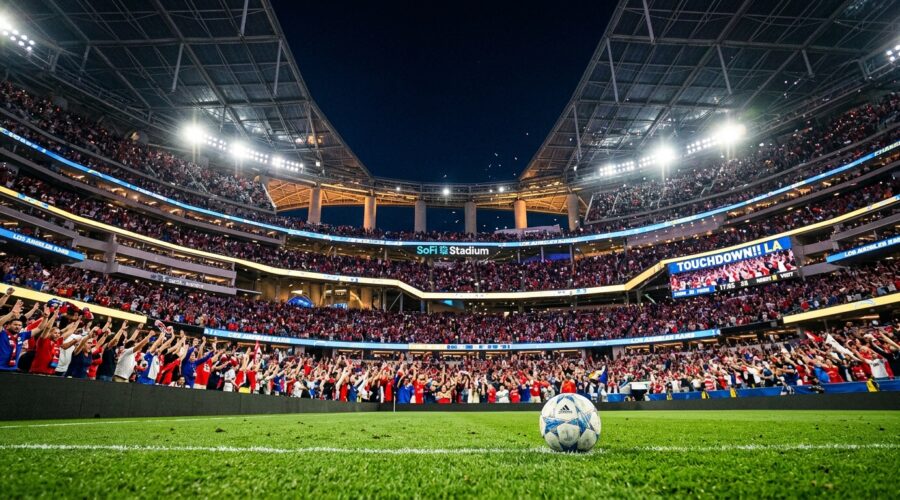
Let us begin in Inglewood, where 70,492 people inside Los Angeles Stadium witnessed something that will be replayed on American highlight reels for a generation. The United States Men’s National Team did not just beat Paraguay. They overwhelmed them, outplayed them, and — in the tournament’s most unlikely individual story — produced a hero with one of the great accidental origin stories in football.
Folarin Balogun was born in Brooklyn in the summer of 2001, though only because his Nigerian parents, living in London, happened to be on holiday in New York when his arrival could no longer be postponed. He was a month old when they flew him back to England, where he grew up, joined Arsenal’s academy, and spent the better part of a decade looking every inch a future England international. He is, in other words, an American only by the most gloriously bureaucratic of margins. On a warm Saturday evening in Los Angeles, that technicality of birthplace became the stuff of national mythology.
His first goal arrived on 31 minutes, a Pulisic assist delivering the ball into a yard of space that Balogun accepted with the composure of a man who had been doing this all his life. His second, on the stroke of half-time, was rather more emphatic: he beat two defenders, shifted the ball onto his left foot, and arrowed it into the top corner with the kind of finish that makes goalkeepers feel briefly philosophical about career choices. A brace. The first time a United States player has scored exactly two goals in a single World Cup match since 1930 — though it bears noting that the American who defined that era, Bert Patenaude, managed something altogether more emphatic: a hat-trick, the first in World Cup history. “It’s a dream,” Balogun said afterwards. “It was a dreamy night.” It was difficult to argue.
The scoresheet had opened earlier, on 7 minutes, when Weston McKennie’s cross ricocheted off Damián Bobadilla and into Paraguay’s own net — a moment that set the tone for an evening in which Mauricio Pochettino’s side managed an expected goals figure of roughly 1.34, nearly triple Paraguay’s anaemic 0.46. This was not a close match wearing close-match clothing. This was a dominant performance from a host nation channelling every ounce of the occasion.
There was, though, a moment of concern. Christian Pulisic, withdrawn at half-time with a calf knock, trudged down the tunnel with the kind of expression that does not invite optimism. His replacement was Sebastian Berhalter — son of Gregg Berhalter, who represented the United States at the 2002 World Cup — making Sebastian only the second son in a father-son pair to play for the USA at a World Cup. History, layered casually atop history.
Paraguay briefly made it 4–1 through Mauricio on 73 minutes, a consolation that deserved nothing more than a polite nod of acknowledgment. What mattered most was what came in the eighth minute of stoppage time, when Gio Reyna — who has spent the better part of three years assembling himself back into something resembling fitness, fighting through injuries and limited club minutes with Borussia Mönchengladbach — received the ball 17 yards from goal and curled it in off the outside of his right boot. A trivela. At a World Cup. In injury time. To make it 4–1. The standing ovation he received was less about the scoreline and more about recognition: recognition of a talent that refused to be buried by misfortune.
The USMNT top Group D with three points and a goal difference of plus three, ahead of Australia on goal difference. For one evening at least, the football sceptics could keep their spreadsheets to themselves.
The Twenty-Sixth Attempt: Qatar 1–1 Switzerland
Meanwhile, at Levi’s Stadium in Santa Clara, a different kind of drama was unfolding — one that required considerably more patience to reach its conclusion, and considerably more charity toward the concept of goalkeeping statistics.
Switzerland arrived here having picked up exactly what was expected of them: a penalty inside the first twenty minutes, dispatched with precision by Breel Embolo into the bottom-left corner in the 17th minute. It was, in a small footnote worth preserving, Switzerland’s first-ever penalty goal in World Cup history, excluding shootouts. They are a nation who have been to a great many tournaments and apparently never been handed the ball at twelve yards before. The things you learn.
Embolo’s presence here carried its own narrative weight. The Monaco striker had spent the weeks before the tournament navigating a visa complication related to a 2018 criminal conviction, an issue not finally resolved until April. That it was resolved at all — and that Embolo then stepped up to score the opening goal — is precisely the kind of subplot that makes tournaments feel lived-in rather than merely administered.
What followed Embolo’s opener was a masterclass in everything except finishing. Switzerland attempted 26 shots. Twenty-six. The number sits there on the page like a quiet reproach to the concept of clinical football. Dan Ndoye was dangerous throughout the right flank, Michel Aebischer had a shot cleared off the line, Granit Xhaka fired narrowly over. Qatar, for their part, were mostly defending — and defending competently — but in the fifth minute, Edmílson Junior found himself one-on-one with Gregor Kobel following a Manuel Akanji error, and Kobel’s magnificent save was perhaps the intervention that preserved what little Switzerland later had to be embarrassed about.
What Qatar had was mentality. Julen Lopetegui — who has managed Wolves, Sevilla, and Spain, among others, and whose career has always carried this air of impending catastrophe that never quite arrives — had organised his side into something resolute and difficult to break. They were not, it should be said, threatening to win the match. But they were threating to make Switzerland profoundly uncomfortable, and in the 94th minute, Homam Ahmed’s cross was met by Swiss substitute Miro Muheim — barely on the pitch, still learning the names of the people around him — who headed it into his own net under pressure from Boualem Khoukhi. Qatar 1–1 Switzerland. Qatar’s first ever World Cup point on foreign soil. Their first ever World Cup point anywhere other than their own back garden.
The Swiss broadcaster RTS captured the moment with admirable economy: “QATARSTROPHE.” Xhaka, for whom mild satisfaction has always been an insufficiently serious emotion, was blunt: “Every draw feels like a loss. We’re looking at ourselves. This performance was not good enough today to win.” Lopetegui was rather more content, as a man whose team has just stolen a point from 26 shots against perhaps has every right to be.
All four teams in Group B — Switzerland, Canada, Qatar, Bosnia-Herzegovina — sit level on one point apiece. The group is, for the moment, a perfectly horizontal surface. Something will have to tilt it.
The Heavyweight Stalemate: Brazil 1–1 Morocco
The evening’s most anticipated fixture arrived at MetLife Stadium in East Rutherford, New Jersey, before an attendance of 80,663 — the kind of crowd that makes the air inside a stadium feel pressurised. The sixth-ranked team in the world against the seventh. The highest-ranked group stage clash in the entire expanded 48-team tournament. Morocco and Brazil, and not a great deal of space between them in quality, which is precisely what the match confirmed.
There is a particular kind of discomfort attached to Carlo Ancelotti’s presence in this dugout. Not discomfort about his abilities — the man has won five Champions League trophies and is constitutionally incapable of tactical naivety — but rather a historical vertigo. Until this tournament, Brazil had never had a foreign coach at a World Cup in their entire footballing existence. They are, as a nation, rather attached to the idea that they invented this sport and remain its primary custodians. Cafu said as much when the appointment was announced. And yet here stands Ancelotti, in the technical area, the first foreigner ever to lead the Selecão at football’s biggest occasion. The symbolism is considerable.
Neymar did not dress, still recovering from a torn right calf. His absence was noted, mourned briefly, and then superseded by events on the pitch — because Morocco, coached by Walid Regragui, had absolutely no intention of treating Brazil’s opener as a ceremonial occasion.
The opening goal came on 21 minutes and was beautifully constructed. Lucas Paquetá lost the ball — a misdemeanour for which the Brazilian backline paid immediately — and Brahim Díaz, the Real Madrid winger now starring in the Atlas Lions’ red and green, threaded a through ball with surgical precision between Gabriel Magalhães and Marquinhos. Into the gap arrived Ismael Saibari, who read Alisson Becker’s trajectory out of goal with the attentiveness of someone who had specifically studied for this exam, and chipped him with a composure that belonged to a more experienced international occasion. His eighth goal for Morocco. The MetLife crowd, substantially Moroccan by disposition, erupted.
Brazil’s equaliser arrived eleven minutes later and was, frankly, the sort of thing you cannot tactically account for. Vinicius Júnior exchanged a one-two with Bruno Guimarães on the left flank, cut onto his right foot — his ostensibly weaker side — and curled a shot into the top-right corner that Yassine Bounou had no realistic prayer of reaching. Practically unsaveable, as match reporters reached for the nearest superlative. His tenth international goal, in his fifty-first appearance for Brazil. Round numbers do not always arrive on cue, but the goal itself was worth every digit.
The second half was Morocco’s in all but the scoreboard. Bounou made several important saves as Brazil pushed for a winner that never came, and the performance of Ayyoub Bouaddi — the 18-year-old Lille midfielder, born in Senlis to Moroccan parents, who chose Morocco over France barely weeks before the tournament began — was something that deserves its own paragraph. There is a particular quality that outstanding young players have, a kind of unhurried authority in tight spaces, and Bouaddi displayed it in ninety-minute doses. He is not yet famous. He will not remain unfamous for long.
The draw means Scotland — who beat Haiti on the same evening — sit top of Group C, a result that sounds improbable until you remind yourself that improbable is, at this particular World Cup, something of a recurring theme.
The State of Play
After three matches on Day Three, the early picture is this: the United States lead Group D with a goal difference that already announces intentions. Group B has achieved a kind of democratic parity that cannot possibly survive the next round of fixtures. And Group C, with Scotland at the summit and Brazil and Morocco level on one point apiece, is exactly the kind of group that produces four matches of acute nervous tension.
Folarin Balogun leads the Golden Boot with two goals, ahead of a crowd of single-goal scorers that includes Gio Reyna, Vinicius Júnior, Breel Embolo, and Ismael Saibari. It is early, of course. The Golden Boot is a trophy awarded in July, not in the second week of June.
But it is not too early to say that this tournament has announced itself with genuine force. Three matches on a single day produced historic firsts, moments of individual brilliance, a 96th-minute own goal that changed a country’s footballing record forever, and a trivela in stoppage time that reminded anyone who needed reminding why Gio Reyna was always worth the wait.
The spreadsheet merchants can have their expected goals figures. The rest of us will be back for more tomorrow.