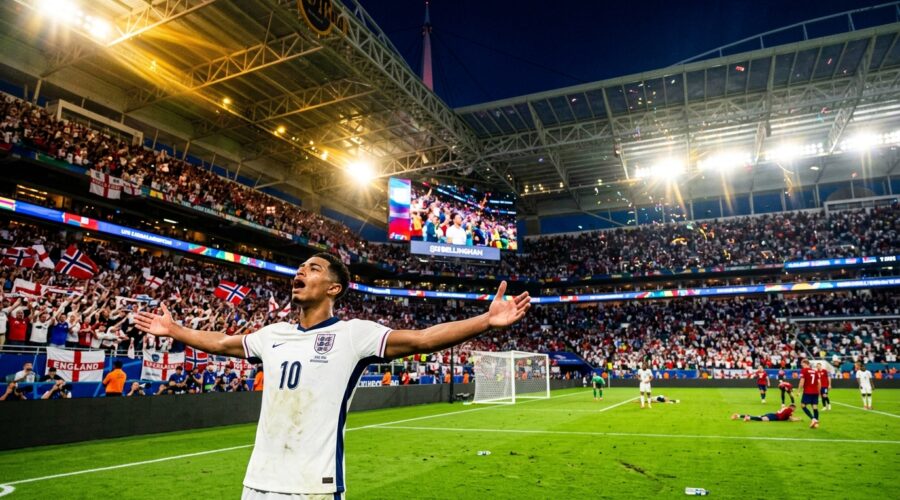
The scoreboard will tell you England 2–1 Norway after extra time. What it will not tell you is the forty-five minutes in which England looked like a side assembled at random from a hotel lobby and asked to contain the most terrifying forward on the planet. Football has a way of making history tidy in retrospect, and this quarterfinal at the Hard Rock Stadium — FIFA’s blandly rebranded “Miami Stadium” — will be remembered as the night Jude Bellingham dragged England into the last four by sheer force of individual genius. The ninety-nine matches leading to it probably had more attractive football. Very few had a better story.
The Weight of the Occasion
There is something particular about an England quarterfinal, a specific flavour of collective anxiety that has been fermenting since 1990 and has never quite cleared. England have reached this stage of a World Cup nine times — in 1954, 1962, 1966, 1970, 1986, 2002, 2006, 2022, and now 2026 — and been eliminated at it every time bar one — 1966, when they had the advantage of playing the tournament in their own backyard. A nation does not accumulate that much quarterfinal suffering without developing a deep structural nervousness about the occasion itself. And this one, in the flat evening heat of South Florida, against a Norway side carrying Erling Haaland at the absolute peak of his powers, felt heavier than most.
Hard Rock Stadium holds just over sixty-five thousand people for soccer matches and sits in Miami Gardens, a flat, sun-drenched patch of the Florida sprawl that feels a long way from Wembley. The English contingent inside it was loud enough. The Norwegian contingent was louder, emboldened by the knowledge that their team had no business being here — this was Norway’s first-ever men’s World Cup quarterfinal — and was therefore free from expectation in the way that England, perversely, never are.
Haaland: The Monster That Dan Burn Slew
The entire pre-match conversation had been organised around one question: who stops Haaland? Seven goals in five games coming into the quarterfinal. A thirty-nine percent conversion rate — the best by any player with fifteen or more shots at this World Cup, just short of Gary Lineker’s forty percent in 1986. A goal every fourteen touches, a figure so extraordinary it barely feels like a football statistic at all, more like a force of nature expressed in numbers. His second goal against Brazil in the Round of 16 — a thunderbolt from twenty-two yards that curled past Ederson as though physics were merely a suggestion — had been voted FIFA’s Goal of the Tournament for that round. The man had been scoring in every single game of this World Cup. Airlines were trolling each other on social media about him. Prime ministers were weighing in. “Haaland Mania” was the phrase that kept appearing in print, and for once it was not hyperbole.
England’s answer, it turned out, was Dan Burn.
The Newcastle centre-back, not a man whose name you would typically associate with neutralising generational strikers, was magnificent. He was physical without being reckless, positionally shrewd, and — crucially — unflustered by the occasion in a way that the occasion seemed to demand he should be. By full time, “BIG. DAN. BURN.” was trending, which is the sort of cultural moment that makes you remember why football, for all its periodic awfulness, remains irreplaceable. Haaland, born in Leeds and more than familiar with the rhythms of the English game from his years at Manchester City, produced flashes of menace throughout. But Burn kept him peripheral in a way that his tournament statistics had suggested was barely possible.
John Stones, for the record, had one of those moments that age a manager by several years — a nervous error that nearly gifted Norway a second goal and confirmed his status as a player capable of sublime composure and sudden, inexplicable fragility in almost the same breath. Tuchel’s hair, one imagines, is appreciably greyer than it was in June.
Schjelderup, the Half-Time Equaliser, and “Hey Jude”
Andreas Schjelderup gave Norway the lead in the first half with a goal that owed something to fortune — the kind of opener that settles a crowd and unsettles an opponent. The Norwegian fans inside Hard Rock Stadium celebrated with the uncontained joy of people who had watched their country fail to qualify for the previous World Cup edition and still can barely believe they are here. In truth, Norway were the better team for large stretches. They pressed with structure and discipline, they created chances, and they defended with a collective intelligence that reflected a side that had dispatched Brazil — Brazil — just six days earlier.
Then Bellingham happened.
Just before the half-time whistle, he collected the ball in a position from which most footballers would have looked for a simple pass. He did not look for a simple pass. He set off on a mazy, weaving solo run through the Norwegian defensive structure — past one challenge, past another, threading through the kind of tight spaces that a player of his build has no right to navigate with that much composure — and slotted home with a calm that felt almost contemptuous of the occasion. The England fans responded with “Hey Jude,” bouncing it off the evening air in Miami in a way that would have seemed surreal to anyone watching without context. Surreal, but somehow completely right.
Bellingham had done the same in the Round of 16, scoring twice against Mexico at the Azteca — the match in which England became the first team ever to beat Mexico at that ground in a World Cup fixture, ending a ten-game unbeaten home record in a result that still seems mildly preposterous when you read it back. A brace in that game. A brace now. He is the first player to score two or more goals in consecutive World Cup knockout matches at the same tournament since Diego Maradona in 1986, a list so short — Kocsis in 1954, Pelé in 1958, Garrincha in 1962, Maradona in 1986 — that it reads less like a statistical record and more like a roll call of the sport’s mythology.
Bellingham is twenty-three years old.
Extra Time and Morgan Rogers’ Moment
Ninety minutes were not enough. Norway had a second goal disallowed during the second half — the Norwegian fans in the stadium momentarily believing the quarterfinal had been settled before the equaliser in the stands gave way to the slow, grinding realisation that VAR had intervened — and then struck the crossbar in a moment that made Tuchel close his eyes. The German manager admitted afterwards, with characteristic directness, that “we got lucky” and that his side had “made life very, very difficult for ourselves.” This was, given that Norway had been the better team for perhaps sixty of the ninety minutes, a fairly significant understatement dressed as candour.
Extra time. The first period. Morgan Rogers, not a player who had dominated the tournament narrative up to this point, struck from distance — the sort of shot that a goalkeeper is supposed to hold. The Norwegian keeper could not hold it. The rebound dropped to Bellingham, who did not miss. He never misses in moments like this. The tap-in was the simplest goal of his tournament, a yard-and-a-half finish, and the hardest-earned. England 2–1 Norway. The second period of extra time passed in a collective holding of breath and a great deal of last-ditch clearances and eventually gave way to a full-time whistle that sent Oasis’s “Wonderwall” echoing around a stadium in South Florida — which is either the most English thing imaginable or the most improbable thing imaginable, depending on your disposition.
What Haaland Leaves Behind
Erling Haaland finished with seven goals in six matches. He will not win the Golden Boot — Mbappé and Messi are both on eight, both still in the tournament — but his debut World Cup was a spectacle of clinical violence that the competition will not forget quickly. His tally of seven goals at his first World Cup is greater than the individual debut-tournament totals of Messi, Mbappé, and Cristiano Ronaldo, though it falls short of their six goals combined. He is twenty-five years old and will presumably be back in 2030, at which point the conversation about where he ranks among the sport’s all-time forwards will be rather less contested than it currently is.
Nico O’Reilly, who shares a dressing room with Haaland at Manchester City and was good enough to have spent most of the quarterfinal trying to stop him, was diplomatically generous in the aftermath. “Erling is Erling,” he said. “He’s an unbelievable striker, world-class.” He is right on both counts. The fact that England got through this match owes something to Bellingham’s brilliance and rather more to the kind of fortune that Tuchel, to his credit, did not pretend was anything else.
Norway, meanwhile, leave this tournament having done something genuinely historic. Their first World Cup in twenty-eight years. Their first-ever quarterfinal. A win over Brazil in the last sixteen that will be talked about in Norwegian football for decades. Martin Ødegaard called England a “massive test” before kick-off. His team passed it, for eighty minutes at least. The game simply required another ten.
The Semi-Final Picture — and England’s Appointment With History
The four semi-finalists are France, Spain, England, and Argentina. A tournament final worthy of the name is taking shape — or possibly two of them, depending on what happens on July 14 and 15.
France against Spain is the appetiser: Mbappé against a Spanish structure that has dismantled most opponents with the kind of systematic suffocation that Tuchel will already be studying on film. England against Argentina is something else entirely. This is England’s fourth World Cup semi-final in their history — 1966, 1990, 2018, and now 2026 — and only the second in three editions, which represents either genuine progress or a scheduling coincidence, depending on how cynical you feel. Argentina, meanwhile, have a long history of semi-final appearances and have not always converted them into final berths — they were beaten by Uruguay at that stage as far back as 1987. They are the reigning world champions. They have Messi, who is joint-top of the Golden Boot with eight goals, operating with the specific, unhurried precision of a man who knows he is running out of World Cups.
Harry Kane and Jude Bellingham are joint-fourth in the Golden Boot race with six goals each — the first pair of teammates in World Cup history to each reach that total in the same tournament — and England’s attacking depth has not looked this coherent since, well, 1966. Kane will know that this is his last realistic chance at a World Cup final. Bellingham will know that the comparisons to Maradona are only going to intensify if England beat Argentina in a World Cup semi-final.
The history does not need embellishing. It is already almost too good.
Conclusion: Found a Way
“Character, perseverance, we found a way to win a game again,” Bellingham said afterwards. “We gave all we got — everyone smashed it. So proud of this team and getting to a semi-final. The whole country are behind us.”
He was right, and he was also perhaps being slightly generous to a team that required an individual of his particular brilliance to compensate for its collective frailties. England did not dominate Norway. England did not outplay Norway for most of the match. England produced one moment of genius before half-time and one stroke of fortune in extra time, and those two things were the margin. Great tournaments are full of teams who found a way. The really interesting question — the one that England fans have been circling for sixty years — is whether finding a way is enough against Argentina.
July 15 will be a long time coming.