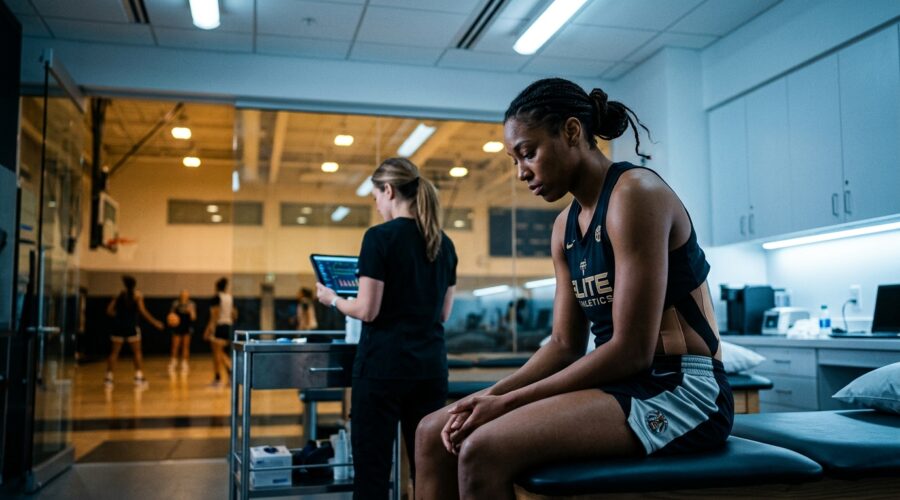
On the morning of May 20, 2026, Caitlin Clark ordered her usual breakfast — two eggs over medium, potatoes, and two blueberry waffles with butter and syrup — fully expecting to lace up that night. She texted her training staff. She texted her personal physiotherapist. She went through her pregame lift at Gainbridge Fieldhouse. And then, 100 minutes before tip-off against the Portland Fire, she decided her body simply was not ready.
That decision cost Indiana a formal warning from the WNBA for late injury reporting. It sparked the usual online firestorm of hot takes. And it revealed, in cleaner terms than any press release ever could, exactly what the Fever are dealing with in 2026: the greatest player in the league right now is managing a chronic lower back condition that has no clean endpoint — and both she and the franchise have made a deliberate, calculated choice to live with that uncertainty rather than fight it.
Head coach Stephanie White confirmed as much on May 28, telling reporters that Clark would carry a “probable (back)” designation on every injury report for the foreseeable future. This was not damage control. It was a statement of philosophy. The “probable” tag is not a red flag. It is the system working exactly as intended.
How We Got Here: A Cascade That Started in 2025
To understand what Indiana is managing right now, you have to go back to the wreckage of Clark’s 2025 season. What began as left quad tightness in the preseason devolved into a full left quad sprain, then a left groin sprain, then a season-ending right groin injury on July 15, and finally a left ankle bone bruise sustained during an attempted August workout return. Clark appeared in just 13 of 44 regular-season games. For a player who had redefined WNBA viewership — involved in 21 of the 24 WNBA events that topped 1 million viewers during the 2024 calendar year — her absence caused a 55 percent drop in national TV ratings over a two-week stretch, per Nielsen data.
The injuries themselves were damaging enough. But Clark has been candid about something that does not show up in a box score: the psychological toll.
“It was these kind of nagging injuries that would build up and build up and dealt with one on top of the other,” she said in March 2026. “I think that played with my mind even more than knowing I would be out for a set period of time.”
Sports psychologists have a name for what Clark is describing. Kinesiophobia — the irrational or amplified fear of movement and re-injury — is one of the primary psychological barriers in return-to-sport literature. Research published across multiple injury cohorts consistently identifies it as the leading psychological reason athletes fail to return to pre-injury performance levels, with over 50 percent of athletes in some studies reporting significant fear upon return. It is especially pronounced after a cascade of soft tissue injuries, where the unpredictability of the original damage is itself part of the trauma.
Clark, to her credit, has named it directly without needing the clinical label.
“I understand my body almost too well, to a point now,” she said in May. “And it’s something I wasn’t enough in touch with before my injuries, and now I understand it very well. You just become hypercautious about certain things.”
That hypercaution is not weakness. In the context of a 44-game regular season with a playoff push in October, it is arguably the most rational approach a player and her coaching staff could take.
What the Numbers Say When She Is Out There
Here is the part that makes Indiana’s situation so fascinating, and so different from a typical injury story: Caitlin Clark is playing at an elite level.
In nine of Indiana’s first eleven games, Clark has posted 18.7 points per game — tied for seventh in the entire WNBA — while leading the league outright in assists at 7.9 per game. She leads Alyssa Thomas (7.7 APG), Chelsea Gray (7.2 APG), and Jordin Canada (6.6 APG) in that category. She is pulling down 4.5 rebounds, contributing a steal per game, shooting 89.6 percent from the free-throw line, and sitting at a plus-28 plus/minus. On June 8, she buried a deep three-pointer with 1.2 seconds remaining to seal a 78-76 road win over the Washington Mystics.
None of that is the output of a player who is broken. It is the output of a player being carefully preserved.
The Fever’s front office reportedly restructured Clark’s role for 2026 with a specific objective: reduce physical wear in the regular season so she arrives at October’s playoffs fresher and more explosive than any version of herself the league has ever seen. They added ball handlers to allow her to play more off the ball. They are targeting 30 minutes per night rather than the 36-plus that contributed to last year’s physical deterioration. White has not hidden this framework — she just refuses to call it load management, a term that implies a healthy player being rested. Clark is not being rested. She is being protected.
There is a meaningful difference, and the distinction matters for how Indiana’s season should be evaluated.
The Roster That Can Hold the Line
What makes this strategy viable — what makes the “probable” designation a management plan rather than a crisis — is that Indiana no longer depends on Clark to simply survive a game she misses.
The proof came on May 20 itself. Without Clark, the Fever dismantled Portland 90-73. The reason is a supporting cast that has quietly become one of the most formidable in the league under the terms of the new collective bargaining agreement.
Kelsey Mitchell is the clearest example. The eight-year veteran, now one of the highest-paid guards in the WNBA under the new CBA, is averaging 20.5 points per game as Indiana’s leading scorer. On June 4, Mitchell surpassed 5,000 career Fever points against the Atlanta Dream — becoming only the second player in franchise history to reach that mark, joining Hall of Famer Tamika Catchings. Mitchell scored a game-high 25 points on 11-of-15 shooting in that contest; Clark added 17 points of her own. Mitchell does not need Clark on the floor to dominate a game. She demonstrated that with 30 points in the season opener and again in Portland’s absence.
Aliyah Boston is having what may be her best professional season: 15.9 points, 7.6 rebounds, and a 50.0 field goal percentage, anchoring Indiana’s frontcourt with a reliability that makes opposing coaches scheme around her. She has expanded her offensive range as well, shooting 35.3 percent from three on the year after going 3-for-4 from deep against Atlanta. Boston’s contract, also restructured under the new CBA, represents a franchise-level commitment to keeping the core intact through a genuine championship window.
The depth beyond the Big Three is real, too. Lexie Hull is flirting with elite 3-and-D territory at 40.0 percent from beyond the arc. Monique Billings brought immediate frontcourt energy after signing in April. The one concern alongside Clark’s back is Sophie Cunningham, who is also listed day-to-day with a separate issue — a second medical file that warrants watching, even if it does not approach Clark’s level of significance to the team’s identity.
The broader evidence of Indiana’s ceiling without their star? In the 2025 playoffs — with Clark watching from the bench in Black Air Force 1s and a “Bench Mob” energy that became its own story — the Fever beat Atlanta in the first round and pushed the eventual champion Las Vegas Aces to five games in the semifinals. That is not a team that collapses without one player. That is a team that understands how to compete at the highest level under duress.
The Standings Picture and What Comes Next
As of June 10, Indiana sits at 6-5, ranking eighth in ESPN’s power rankings — up from 11th — in a 15-team league that now includes expansion franchises in Portland and Toronto. The top eight seeds qualify for the playoffs. The Fever are near the cutline, sitting roughly half a game ahead of the ninth-place Los Angeles Sparks, with real separation still to be carved out above them. Atlanta, New York, and Dallas all sit comfortably ahead. The goal of earning a top-four seed and home-court advantage in the best-of-three first round remains in sight but will require consistent play over the second quarter of the season.
The schedule over the next three weeks is manageable, with home matchups against Chicago, Toronto, back-to-back Phoenix games, and a visit from Los Angeles all slotted in. But the pivot point of Indiana’s early summer is the Atlanta home-and-away split on June 18 and June 20. The Dream are the second seed in the league at 7-3. Splitting that series would be a statement. Sweeping it — with a healthy Clark — would reframe the Fever’s ceiling entirely.
The four realistic scenarios for the rest of the season span from “Clark plays through the designation with minimal absences and Indiana lands in the 4th-to-6th range” to “recurring flare-ups erode the seeding and push Indiana toward the 7th or 8th slot they currently occupy.” The most optimistic path — and the one the franchise appears to be actively engineering — is the fourth: Clark plays 35 to 38 of 44 games, averages closer to 30 minutes than 36, and arrives at October’s playoffs with her body less degraded and her game more dangerous than it has been since she first arrived in the league.
That scenario requires trusting a process that is, by design, uncomfortable. It requires accepting a “probable” designation on every game-day report and resisting the instinct to treat each one as a crisis. It requires believing, as Clark herself has said, that playing Game 5 of the year at less than full confidence is not worth the risk of a longer-term setback.
The Bigger Picture the League Cannot Afford to Ignore
Caitlin Clark is not just a franchise player managing a back issue. She is, at this moment, the commercial cornerstone of a league operating under a $2.2 billion media rights deal that was in no small part built on her visibility. The WNBA’s expansion to 15 teams in 2026 — with Portland and Toronto joining the fold — represents institutional momentum. But the 55 percent viewership drop that followed her 2025 injury absence is a data point no league executive has forgotten.
What makes this particular injury story different from last year is the nature of the condition itself. A chronic back issue that is managed rather than acute is, counterintuitively, a better prognosis than the cascade of soft tissue injuries that consumed 2025. The “probable” tag is a ceiling on the uncertainty. It means Indiana knows what they are dealing with. It means Clark knows what she is dealing with. It means there is a plan.
Coach White’s frustration with the WNBA’s late-reporting warning was genuine and warranted. “My reaction to the warning is, for what? Because we did things the right way,” she said flatly. She was correct. A player waking up with unexpected stiffness at 7 a.m. on game day is not a reporting violation. It is the unpredictable reality of managing a professional athlete through a season-long maintenance challenge.
The Fever did not hide Clark’s condition. They communicated it the moment they knew it. Then they adapted, won the game without her, and welcomed her back two days later to hit a logo three and jawing at opposing players for a technical foul, laughing afterward about the fines that were surely coming.
That is not a team in crisis. That is a team that has internalized exactly what it takes to peak in October rather than exhaust itself in May. The “probable” tag will stay on the injury report. Indiana would not have it any other way.