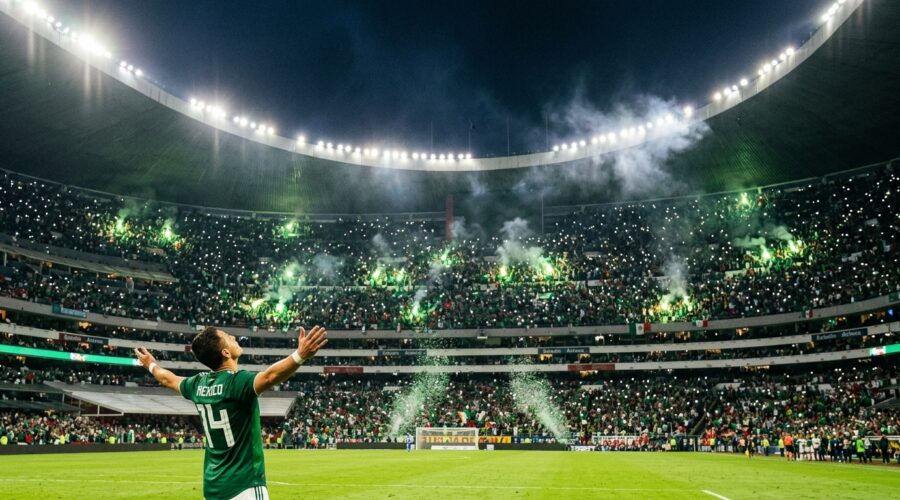
There are days at a World Cup that function as mere schedule-fillers — competent matches that move the bracket along without leaving much of a mark on the memory. Wednesday, July 1, 2026 was emphatically not one of those days. Across four matches and two nations, forty years of Mexican hurt were finally laid to rest, a seventeen-year-old from Mexico City reminded the world of a name from 1958, Harry Kane dismantled every English goalscoring record that remained standing, and Belgium — somehow, impossibly, gloriously — did it again. The United States, for good measure, ended a drought of their own. By the time the last penalty was buried at Lumen Field in the small hours of the Pacific time zone, it felt less like a football day and more like a reckoning.
Mexico 2–0 Ecuador — The Ghost Finally Leaves the Azteca
They called it el Quinto Partido. The fifth match. The game Mexico could never reach. From 1994 to 2018, El Tri were eliminated at the Round of 16 in seven consecutive World Cups — an almost cosmically precise cruelty — and the curse had long since passed beyond footballing analysis into the realm of national mythology. In 2022, they did not even make it that far, crashing out in the group stage before the knockout rounds could apply their familiar twist of the knife. Wednesday night at the Azteca, under a noise that shook the old concrete to its foundations, Mexico finally broke it.
Julián Quiñones opened the scoring in the 22nd minute with a thunderous strike, the kind of finish that silences whatever residual doubt might still be lurking in the stands. Raúl Jiménez added a calm second nine minutes later, assisted by Quiñones, and that, more or less, was that. Mexico controlled the shape of the match with an assurance that their previous knockout exits had never promised. Ecuador mustered seven shots to Mexico’s fifteen, managed a single effort on target all evening, and were never meaningfully in the contest. Piero Hincapié earned a red card deep in stoppage time for covering his mouth during a confrontation — the sort of moment that felt almost incidental by then, a footnote on a night that belonged entirely to the home side.
Mexico are now unbeaten in ten World Cup matches at the Azteca, and they remain one of only three teams — alongside France and Argentina — to have won all three group-stage matches without conceding a goal. The statistics are tidy enough. But no number captures the forty years that exhaled out of this stadium on Wednesday night.
What may last even longer in the memory, though, is the name that will be spoken in the same breath as all of this. Gilberto Mora, number nineteen, born on October 14, 2008, and seventeen years old at this tournament, started the match and became only the second player in history to start a World Cup knockout fixture at such an age. He was 17 years and 259 days old for the Ecuador match on June 30. The first was Pelé, in 1958, at seventeen years and 239 days. Mora is not yet the player that sentence invites you to imagine — no teenager is, and the comparison would be unfair to both of them — but the composure and spatial intelligence he showed against Ecuador were not the qualities of a boy filling in. He is the youngest player ever to both start and come on as a substitute for Mexico at a World Cup. He is also, in about five days’ time, someone England’s defence will need to solve at this same ground. Good luck.
England 2–1 Congo DR — Kane Tears Up the Record Books, Again
England had been, to put it charitably, unconvincing in the group stage. A four-goal opener against Croatia, followed by a goalless draw with Ghana and a slightly laboured win over Panama — Thomas Tuchel’s side had the look of a team searching for a gear it wasn’t entirely sure it possessed. Congo DR, organised shrewdly by Sébastien Desabre and buoyed by Yoane Wissa’s three group-stage goals, appeared entirely capable of making those concerns permanent.
Brian Cipenga gave them the lead, and at half-time, with the Leopards holding their shape and England’s attacks dissolving predictably in the final third, elimination was not an unreasonable prognosis. Then Harry Kane decided he had records to attend to.
Two second-half goals, both assisted by Anthony Gordon, turned the match inside out within minutes. The equaliser, Kane would later say, was his favourite goal of this tournament — which is the kind of thing a man says when the weight of expectation is briefly, blissfully absent from his shoulders. The winner followed almost immediately. A brace. Clinical, inevitable, and accompanied by the quiet dismantling of yet another milestone: eleven World Cup goals for England, surpassing Gary Lineker’s long-standing record of ten. Eighty-four international goals in total. Five at this tournament, joint third in the Golden Boot race.
It is worth pausing on what Wissa and Congo DR offered before Kane intervened. Wissa hit the post at a moment when a second goal might have finished England entirely. Goalkeeper Lionel Mpasi produced what may yet be the save of the tournament — a full-stretch denial of Jude Bellingham’s header that had no right to be reached. Congo DR had emerged from Group K with four points and a 3–1 win over Uzbekistan, and they showed in Atlanta that their presence in the knockout rounds was entirely merited. They simply had the misfortune of playing England when Harry Kane was in the mood to rewrite history.
Declan Rice returned to the midfield after sitting out a previous match, and Tuchel’s three changes steadied the ship. But England’s path to the Round of 16 was not elegant. It was Kane. It is almost always Kane.
Belgium 3–2 Senegal (AET) — Some Nations Are Simply Built Different
At 85 minutes in Seattle, Senegal led 2–0. Habib Diarra and Ismaïla Sarr — a man with four goals in this tournament and one of its most arresting performers — had built a lead that looked, by any reasonable reading, unassailable. Belgium had failed to find any coherent route through a Senegalese defensive structure that had absorbed everything put to it. The match was over.
Then Belgium remembered who they are.
Romelu Lukaku converted a cross from Thomas Meunier in the 86th minute to make it 2–1. In the press box, several journalists reportedly began writing final-score paragraphs. They were, in the magnificent tradition of World Cup press boxes everywhere, entirely wrong. Three minutes later, Youri Tielemans, the Belgian captain, spotted that Senegal goalkeeper Mory Diaw had committed himself to his line, and placed a finish with the kind of composed certainty that should not be physiologically possible under that pressure. Two goals in three minutes. Two-all. Extra time.
The goal that ended it came in the 125th minute — to be precise, at 124 minutes and 44 seconds — which makes it, officially, the latest goal in the history of the World Cup. Lamine Camara brought Tielemans down in the area, the penalty was given amid Senegalese protests that have not entirely subsided, and Tielemans buried it in the upper right corner. Belgium win 3–2. Rudi Garcia, their coach, had the honesty to say afterwards: “Senegal deserved to win. But I am happy it was us.” It is the most honest thing a manager has said at this tournament.
The historical echo is almost too neat. Belgium came back from 2–0 down to beat Japan 3–2 in the 2018 World Cup Round of 16, with Nacer Chadli scoring a dramatic injury-time winner. Wednesday in Seattle is only the second time in eleven World Cups that a team has overturned a two-goal deficit in the knockout stage to advance. Both times, it has been Belgium. There is a pattern here that is either extraordinary or slightly terrifying depending on which side of it you are standing on, and Senegal know exactly which side they are standing on.
Sarr exits the tournament with four goals and a ruinous sense of what might have been. His Golden Boot hopes are finished. Belgium, meanwhile, meet the United States on July 6 at this same Lumen Field — a rematch of the 2014 Round of 16, when they won 2–1 in extra time. They will arrive in Seattle, one suspects, believing very strongly in their own mythology.
USA 2–0 Bosnia-Herzegovina — Pochettino’s Republic, One Win at a Time
The United States’ most recent World Cup knockout victory before Wednesday had been their 2–0 defeat of Mexico in the Round of 16 back in 2002 — though that drought was at least partially broken earlier in this very tournament, when they beat Paraguay 4–1 in the Round of 32 on June 12. Still, the exits had come reliably in the intervening years, in varying shades of disappointment — narrow, agonising, occasionally farcical — and the question of whether this generation of American players had the substance to string together knockout wins had become the defining anxiety of a programme that has talent in considerable supply and tournament nerve in rather less.
Folarin Balogun answered most of that question on the stroke of half-time. A combination worked by Christian Pulisic and Weston McKennie released him, and he finished for his third goal of the tournament, tying Landon Donovan’s record of three goals at a single World Cup — itself the joint second-highest single-tournament tally in USMNT history, behind Bert Patenaude’s four goals in 1930. In the 82nd minute, Malik Tillman curled a free kick from the edge of the box into the net — his first World Cup goal, and the kind of strike that replays well — to seal it.
The discomfort, of course, was Balogun’s red card: a serious foul on Tarik Muharemović that left the United States with ten men for the final twenty-six minutes. Pulisic was categorical afterwards that the dismissal was unjust. The ESPN VAR review raised questions about the protocols. The referee’s decision stood. What also stood, immovably, through the remainder of the match were Tim Ream and Chris Richards, whose defending with a man short was the kind of resolute, unspectacular excellence that never quite gets the headlines it deserves. Matt Freese, starting in goal ahead of the previously first-choice Matt Turner, contributed an excellent performance of his own.
Bosnia captain Edin Džeko, forty years old and conducting himself throughout with the dignity that age and experience tend to bring, pushed for a way back in and found none. Mauricio Pochettino becomes the most successful manager in USMNT World Cup history with three wins — more than anyone before him — and his side now await Belgium in Seattle on July 6 with revenge as the subplot and genuine belief, earned rather than borrowed, as something closer to the main event.
The Golden Boot, the Bracket, and What Comes Next
After Wednesday, the Golden Boot standings read: Kylian Mbappé and Lionel Messi level at six goals apiece, with Kane at five — still very much in the race with a live team and a habit of scoring in knockout rounds. Erling Haaland, who scored the decisive goal to send Norway past Ivory Coast on June 30 and keep their tournament alive, also sits at five, with Norway facing Brazil in the Round of 16 on July 7. Vinicius Junior and Ousmane Dembélé sit at four each for Brazil and France respectively. The race is, to use the technical term, wide open, and the fact that the two men currently leading it play for sides who have not yet conceded a goal in this tournament suggests it may remain that way for some time.
The remaining six Round of 32 fixtures — Spain, Portugal, Switzerland, Australia, Argentina, and Colombia all still to play — will complete the bracket over the next two days before the Round of 16 begins on July 4. Canada face Morocco, France face Paraguay, and then on July 5, Mexico host England at the Azteca in what is already the most anticipated tie of the knockout stage: a seventeen-year-old who started a match at 17 years and 259 days old as the second youngest in World Cup knockout history, in a stadium soaked in recently lifted curses, against a man with eleven World Cup goals who has spent the better part of a decade accumulating records he was never quite supposed to reach.
All three co-hosts — the United States, Mexico, and Canada — have advanced to the Round of 16. The last sole host to win the World Cup was France in 1998, and the thought is not entirely absent from the minds of those associated with this expanded, sprawling, occasionally chaotic, but undeniably alive tournament. Wednesday, July 1 offered four reasons to believe that whatever happens next, it will be worth watching. It usually is. It just does not always announce itself quite so loudly.