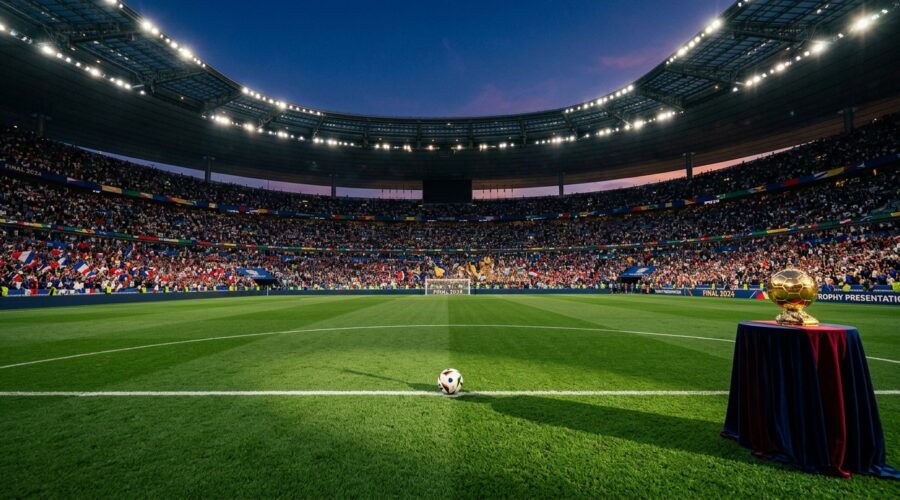
Forty-eight nations began this tournament. Some were making their first appearances on the grandest stage in football. Some were simply making up the numbers — an inevitable, perhaps uncomfortable, consequence of the expanded format. And yet, as tends to happen when the knockout rounds tighten the noose, the noise and the clutter have fallen away. What remains, on this July 13 rest day with the semi-finals a breath away, is something close to perfection: France, Spain, England, Argentina. The four heaviest names in the history of the sport, occupying the four remaining chairs.
Nobody can quite believe it. And nobody, if they are being honest, would have wanted it any other way.
What the Quarter-Finals Gave Us
Before we look forward, the quarter-finals deserve their moment. They were, taken together, four matches of escalating drama — as though the tournament had been quietly building its argument and finally, in the space of four days across four American cities, chose to make it all at once.
France 2–0 Morocco — Gillette Stadium, Boston (July 9)
France did what France do: controlled, composed, and occasionally breathtaking. Morocco, the tournament’s most compelling surprise package — they had already eliminated the Netherlands on penalties in the Round of 32 before defeating co-hosts Canada 3–0 in the Round of 16 — defended with the spirit and organisation their coach has made their hallmark. For sixty minutes, Bounou kept them in it, producing a fine penalty save to deny Mbappé and giving the crowd at Foxborough a genuine sense that something memorable was being constructed.
It was not. In the 60th minute, Mbappé found his goal regardless — his eighth of the tournament, his twentieth of a World Cup career that, at the age of 27, has already entered genuinely historic territory. Six minutes later, Dembélé made it two, his fifth goal of the competition, making him only the second French player in history to score five or more in a single World Cup — after Just Fontaine, who scored 13 in 1958. Mbappé himself, with eight goals in this tournament alone, is the third. The final shot count read 21 to 4. France are, when they choose to impose themselves, a machine of quite frightening efficiency.
The Mbappé goal, though. Twenty career World Cup goals. One behind the man waiting in the other half of the draw. The sort of number that makes the rest of the tournament feel almost mythological in its stakes.
Spain 2–1 Belgium — SoFi Stadium, Los Angeles (July 10)
Belgium arrived with their first-choice goalkeeper on the treatment table. Thibaut Courtois, one of the finest goalkeepers in the world on his best days, watched from somewhere he did not wish to be as backup Senne Lammens pulled on the gloves and stood between his nation and elimination. For much of the match, it appeared he might just get away with it. Fabián Ruiz gave Spain the lead from a rebound on the half-hour, De Ketelaere equalised with a well-taken header eleven minutes later, and the match settled into the kind of tense, evenly-contested affair that seemed certain to drift into extra time.
Then Mikel Merino happened.
Merino, who had already scored the winner against Portugal in the Round of 16 in the first minute of second-half stoppage time — after the ninety minutes had already elapsed — was not about to let the semi-finals pass without him. Pau Cubarsí struck a speculative long-range effort in the 88th minute. Lammens fumbled. Merino arrived at the moment the ball did. 2–1. Spain were through.
It is worth pausing on this. Merino has now scored two decisive late knockout goals from the substitutes’ bench in the same World Cup. There is a particular kind of footballer — intelligent, tireless, with the composure to arrive late into a penalty area when a match is screaming for someone to do exactly that — and Merino has announced himself as one of the finest examples of the type the sport has produced in some time. He may end this tournament without a single starting place and still be its most impactful individual.
Spain have conceded just one goal in six matches. One. The defensive structure that Luis de la Fuente has constructed is as disciplined and spatially coherent as anything in the tournament, and it has been achieved without sacrificing the attacking verve that has made this generation of Spanish players so genuinely exciting to watch. They are, by any reasonable assessment, the form team of the competition.
England 2–1 Norway AET — Hard Rock Stadium, Miami (July 11)
Norway’s run to the quarter-finals was a genuine, wholehearted, football-romanticism-affirming achievement. A country of five million people, competing in their first-ever World Cup quarter-final, carrying Erling Haaland — one of the most lethal goalscorers of his generation — at the peak of his powers. It was, for the neutral, a fairy tale worth rooting for.
England did their level best to let them stay in it.
Schjelderup gave Norway the lead on 36 minutes. Bellingham equalised before half-time. The second half and extra time were chaotic, officiating-wise, with two Norway goals disallowed — one for a Haaland foul the Norwegians disputed furiously, another in circumstances that left Alf-Inge Haaland, watching from the stands, reaching for his phone to describe his countrymen as robbed. Whether those decisions were correct is a matter that will sustain Norwegian sports radio for the better part of a decade.
The decisive moment came in the 93rd minute, which is to say the third minute of extra time, when England’s Morgan Rogers drew a spill from goalkeeper Ørjan Nyland. Jude Bellingham was, inevitably, exactly where he needed to be. Six goals in the tournament. England were through.
Thomas Tuchel, to his credit and possibly his slight embarrassment, called his side “lucky” in the post-match interview. It was the honest assessment. Bellingham’s single-word response — “whatever” — had the air of a man who has decided that arguing with his own manager in the press is simply not worth his evening. He had two goals. England had a semi-final. The rest was noise.
Haaland departs with seven goals and the quiet dignity of someone who gave everything a tournament of this scale could demand. Norway ran out of luck at the right moment for England. The manner of it will sting for a while.
Argentina 3–1 Switzerland AET — Arrowhead Stadium, Kansas City (July 12)
The last quarter-final was the most dramatic — a match that had everything: a Messi corner that set up the opening goal, a Swiss equaliser, a VAR sequence of such Byzantine complexity that even the players appeared to lose track of which booking was being overturned, and then, when it seemed Argentina might run out of ideas against ten men, Julián Álvarez and Lautaro Martínez to settle the argument in extra time.
Alexis Mac Allister, flicking home from a Messi corner in the 10th minute, scored what turned out to be Messi’s 11th career World Cup assist — all to different players, a fact so specifically absurd it almost resists comprehension. Dan Ndoye equalised for Switzerland. Then Breel Embolo, after a VAR sequence that initially booked Argentina’s Leandro Paredes before correcting itself and dismissing Embolo for simulation, was sent off on 72 minutes. Swiss coach Murat Yakin later said the ruling “destroyed our game.” Embolo left the pitch in tears.
Argentina, despite the numerical advantage, could not find the breakthrough until the 112th minute when Álvarez struck from distance. Martínez sealed it at the death. Six consecutive wins. The Messi-led Argentina continue their pursuit of something only two nations have ever achieved: consecutive World Cup titles. Italy managed it first, in 1934 and 1938. Brazil repeated the feat in 1958 and 1962 — that side had Pelé and Garrincha. This Argentina side has Messi, eight goals deep into what is almost certainly his final tournament, and a team that has found ways to win in every manner the draw has demanded of them.
The Semi-Finals
France vs Spain — AT&T Stadium, Dallas (July 14, 3:00 PM ET / 8:00 PM BST)
The football gods, who are occasionally accused of lacking a sense of occasion, have conspired to stage this particular encounter on July 14. Bastille Day. The national day of the French Republic. The symbolism is almost too neat: France, on their own cultural high holiday, facing the team that has beaten them in each of the last two major knockout meetings — the Euro 2024 semi-final, then 5–4 in the Nations League semi-final in June 2025.
Spain have Lamine Yamal, who turned 18 yesterday and is already conducting himself on a football pitch with the unhurried authority of someone who has been here before. Against France in knockout football, his record is a rather unsettling 5–0. France have Mbappé, who is chasing a record that until very recently belonged to the man on the other side of the draw, and who has the particular quality of turning big matches into personal galleries. The duel between the two of them — the established brilliance against the emerging phenomenon — is the tactical spine around which both managers will construct their evenings.
De la Fuente will set Spain in their familiar shape: compact, disciplined, devastating in transition, rotating the ball with the patience of a side that has given up one goal in six matches and sees no particular reason to change the habit now. Deschamps will ask France to be France — to absorb, to wait, and then to unleash.
The question is whether France, who have the superior individual firepower, can dismantle a defensive structure of such collective rigour. Spain do not concede space. They do not concede cheap possession. They have, in Unai Simón, a goalkeeper of the contemporary mould — comfortable with the ball, commanding in his area — and in front of him a defensive line that holds its shape with the kind of disciplined spatial awareness that makes life genuinely miserable for centre-forwards used to receiving the ball in pockets of space.
History, recent history at least, belongs to Spain. The Bastille Day narrative belongs to France. One of these things is more relevant on a football pitch than the other.
England vs Argentina — Mercedes-Benz Stadium, Atlanta (July 15, 3:00 PM ET / 8:00 PM BST)
There are football matches and then there are events. This is an event. On June 22, 1986, at the Estadio Azteca in Mexico City, Diego Maradona punched a ball into Peter Shilton’s net with his left hand, waited four minutes, and then scored what is still widely regarded as the greatest individual goal in football history. Argentina 2, England 1. A quarter-final. A rivalry cemented in the kind of folklore that does not require factual accuracy to sustain itself — only repetition, and time, and the peculiar willingness of both nations to pick at the wound.
That was forty years ago. The two nations have not met at a World Cup since. On July 15, in Atlanta, they will meet again.
Maradona is gone. The Azteca is not the venue. And yet the shadow falls regardless, because that is the nature of football mythology: it does not require the original participants to be present. England will feel it. Argentina will feel it differently — as inheritance, as motivation, as a kind of obligation to the ghost of the most gifted footballer their country ever produced, right up until the moment a 38-year-old man named Lionel Messi touches the ball and reminds everyone that the inheritance is in safe hands.
Messi has eight goals and two assists. He has scored a hat-trick in this tournament. He has provided assists to ten different players across six World Cups. He is, by every available metric, the best player left standing in this competition, and he is doing all of this at an age at which most footballers have long since retired and begun working on their television punditry.
England have Bellingham, who is 23 and who has been quietly constructing the kind of tournament that makes careers. Six goals, important goals, in every big moment. Tuchel’s admission that his side have been lucky carries the implicit acknowledgement that they have not yet shown their best — which is either a warning to Argentina or a reason for anxiety, depending on your perspective. Kane is on six goals. The possibility of a two-legged Golden Boot assault from England’s attacking line is not inconceivable.
Argentina, six wins deep, are a team that has learned to find solutions. They have won from behind. They have won with ten men against them. They have won in extra time. They do not panic. Tuchel’s England will need to decide, fairly quickly, whether they are going to press high and force the issue or sit and invite the pressure — because there is no comfortable middle ground against a side of Argentina’s quality, and the manager who chooses to bus the park in this particular fixture will answer for it long after the tournament is over.
The Golden Boot: A Rivalry Within the Rivalry
At the top of the scoring charts, Kylian Mbappé and Lionel Messi are level on eight goals apiece. Messi leads on assists — at least nine, the most in World Cup history since records began in 1966 — which currently gives him the tiebreaker edge should they finish equal on goals. Mbappé has three assists to his name. Erling Haaland, who was threatening to gate-crash their conversation with seven goals, has been eliminated and sits watching from home, which is perhaps the cruellest exit the tournament has produced.
Kane and Bellingham are both on six, which means England’s semi-final is simultaneously a World Cup knock-out match and a Golden Boot push. For once, the individual and the collective interest are perfectly aligned.
But the real story is this: Mbappé is on 20 career World Cup goals. This is his third World Cup. Messi’s all-time record — which Messi himself broke earlier in this tournament — now stands at 21. Mbappé, with two matches potentially remaining, could surpass it. Messi, with two matches potentially remaining, could extend it further. The two greatest players of their respective generations are, in the final week of a World Cup, racing each other not just for the trophy but for the most significant individual record in the history of the competition.
There is no spreadsheet for what that means. There is no expected-goals model that captures the weight of it. It is simply extraordinary, and the correct response is to sit with it for a moment before the semi-finals begin.
The Road to MetLife
July 18 brings the third-place play-off in Miami — a match that will matter enormously to whichever eliminated semi-finalists are contesting it, and somewhat less to everyone else. July 19 brings the final at MetLife Stadium in East Rutherford, New Jersey: the largest NFL stadium in the United States, forty-two miles from where Maradona’s hand left its mark on a generation of English football fans, and several thousand miles from anywhere four nations with this much history have any business deciding a World Cup.
And yet here we are.
France against Spain on Bastille Day. England against Argentina for the first time in forty years, with the hand of Maradona hovering somewhere over the proceedings like a footnote that refuses to become one. Messi, at 38, chasing a second World Cup and a first Golden Boot. Mbappé, in the fullness of his powers, chasing the record that belongs to the man standing next to him in the history books. Bellingham, at 23, auditioning for a place among the great English players at the great English moments. And Spain, with their one goal conceded and their tactical coherence and their maddening, relentless, beautiful passing game, making a compelling argument that individual genius must eventually yield to collective intelligence.
The rest day is necessary. Not for the players, particularly — they are professionals, conditioned for precisely this — but for the rest of us, who need a moment to absorb the fact that we are about to watch four of the most important football matches of the decade, back to back, over the course of six days.
Take the rest day. You will need the energy for what comes next.