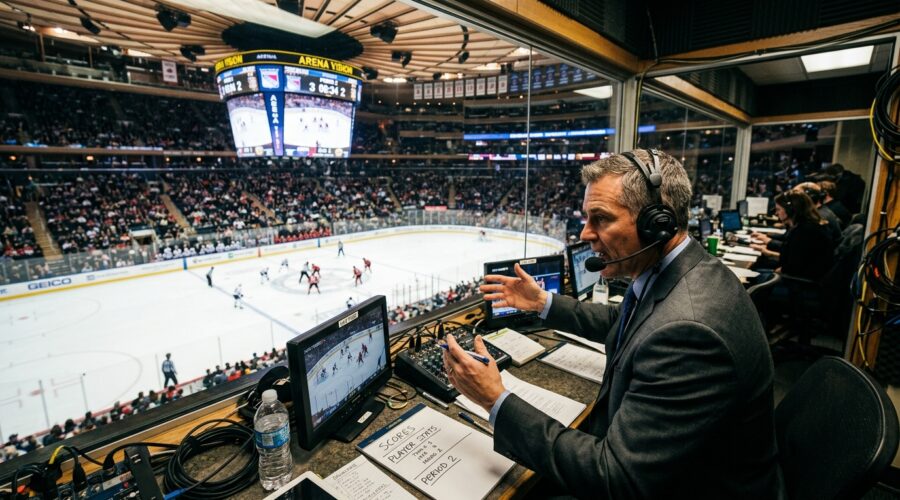
In July 2024, nine current and former NHL players walked into the league’s U.S. headquarters in Midtown Manhattan, strapped on headsets, and tried to do something none of them had ever done professionally: talk about hockey while hockey was actually happening. Some of them were nervous. Some were surprisingly natural. One of them was about to become a broadcast superstar.
That one was Erik Johnson — the 2006 No. 1 overall draft pick, 17-year NHL veteran, and 2022 Stanley Cup champion with the Colorado Avalanche. He showed up to the inaugural NHL Broadcast Training Camp with no agenda and low expectations. “I had nothing going on that July of 2024,” Johnson said, “so I figured, ‘What the heck? Let’s give it a try.'” Fourteen months later, he retired from playing and signed with ESPN within days. His first national broadcast came on October 24, 2025, working alongside ESPN’s Steve Levy in Buffalo. By early 2026, the Denver Gazette was calling him “on a fast track to TV superstardom.”
What happened between that nonchalant July afternoon and an ESPN contract is now the most powerful proof of concept the NHL Broadcast Training Camp has. It is the story the league keeps telling, the name that gets invoked in every module, the living argument for why this program exists. At the 2026 camp, held July 13–14, Johnson’s name “was thrown around at this year’s seminar like a former valedictorian,” as ESPN reported. He is the program’s north star.
But the camp is far bigger than one success story — and the timing of its growth could not be more consequential. Hockey’s broadcast landscape is undergoing radical, simultaneous transformation on both sides of the border, creating a genuine and urgent demand for experienced, credible on-air talent. The NHL Broadcast Training Camp is not just a nice gesture toward retiring players. It is quietly becoming one of the most strategically important talent development programs in professional sports media.
The Problem the Camp Was Built to Solve
For most of hockey broadcasting’s history, there has been a fundamental tension in the booth. Seasoned broadcasters know their craft deeply but may understand the game at a surface level. Former players understand the game at a cellular level but have never called a faceoff in their life, never worked a producer in their ear, never delivered a confident take under studio lights with fifteen seconds to fill. The result has often been broadcasts that feel technically competent but emotionally hollow — or, conversely, analytically rich but visually and aurally disjointed.
Steve Levy, ESPN’s veteran studio host and the camp’s de facto academic dean, put it plainly: “This aspect is two very different things. There’s hockey, and then there’s the broadcast aspect. And in our case, the broadcast is probably more important than the hockey. They already know the hockey, so we’re trying to help them out with the broadcast end. You really need to be good at both to make for a good show.”
Commissioner Gary Bettman conceived the camp with a dual purpose that neatly solved both sides of that problem. As he described it: “One, it gives players, former players, something to focus on as to their next career. And it keeps them close to the game, which is important to the players. But at the same time, having an opportunity to have a new group of broadcasters who are close to the game, have a unique perspective on the game, is another way for our fans to be connected to the game and get new and different insights from the perspective of a former player.”
The camp found its home under the NHL Player Development App — a league-supported digital hub offering current and former players access to career development resources, personal growth programming, and wellness tools. The broadcasting curriculum was a natural extension of that infrastructure. And it launched in July 2024 with nine participants and a one-day format, deliberately experimental in scope.
Inside the Curriculum: Two Days That Mirror a Lifetime of Being Coached
The camp’s curriculum spans seven distinct modules, each led by active broadcasters at the top of the industry. The play-by-play and booth work sessions — where participants call real Stanley Cup Final footage alongside some of the sport’s most respected voices — are run by multiple broadcasters including Kenny Albert of TNT, Eddie Olczyk, Jody Shelley, Brian Boucher, Steve Levy, and Ashlyn Sullivan. Eddie Olczyk — “Edzo” — leads color commentary and telestrator work, teaching the precise art of breaking down a goal or a defensive breakdown in real time, with visual tools, while a producer is counting down in your ear.
Levy runs the studio hosting and between-period segment module, covering on-camera presenting, debate-driving, and delivering takes with confidence. Brian Boucher and Jody Shelley of TNT handle between-the-benches and ice-level reporting — the nuanced craft of knowing when to speak, when to stay silent, and how to signal to a producer that you’ve spotted a moment worth replaying. Ashlyn Sullivan and Kathryn Tappen lead sideline reporting and on-camera interviewing modules, sharpening participants’ instincts for live, unscripted moments. Rounding out the week are sessions on social media, podcasting, personal brand-building, and the increasingly essential skill of game preparation using advanced analytics.
Players arrive having already done homework — footage to study, team statistics, storylines to build. They leave with two things no other program offers: a personalized broadcast tape and written faculty notes, critiquing their performance and identifying specific areas for growth. It is, intentionally, a mirror of the coaching culture they lived inside for their entire playing careers.
That cultural alignment turns out to be the camp’s secret weapon. Faculty member after faculty member has noted that hockey players are uniquely equipped to absorb and apply rapid feedback. Levy observed: “Some of the players just have a natural ability to be able to work in this business, and for others it’s going to take a little work. But what I love is the passion that they all have for being here. They’re really good students. Hockey players like to be coached. They only know how to be coached. You can see a marked improvement in just a couple of days here.”
Cam Janssen, the former enforcer turned podcast host who attended the 2026 camp, discovered something humbling in that process. “I thought I was going to be good at a couple of these, and I didn’t think I was. All of a sudden, I was nervous. It’s like playing a game. I turn a puck over a couple times… Then I go out there, have a big hit and have an energy shift.” The metaphor is precise and telling. Broadcasting, like hockey, requires recovering quickly from mistakes under the pressure of a live audience.
Three Classes, Six Working Broadcasters, and a Growing Pipeline
The camp has now produced three classes across three summers — nine participants in the inaugural 2024 cohort, eight in 2025, and eight again in July 2026. Approximately 25 current and former players have passed through the program in total. From the first two classes alone, at least six alumni are actively working in professional hockey broadcasting.
Erik Johnson is the headliner, now one of ESPN and ABC’s top national color analysts less than a year into his post-playing career. But the pipeline runs deeper than one name. Devante Smith-Pelly, the 2018 Stanley Cup champion, is working for Monumental Sports Network and NHL Network. Michael Del Zotto, a 14-year NHL veteran, is contributing to both NHL Network and Amazon Prime Canada. Nate Thompson, who attended both the 2024 and 2025 camps, is working for NHL Network and TSN. Cal Clutterbuck, who officially retired from the NHL in April 2025 after spending the 2024–25 season as a television analyst on MSG Networks, is among the program’s most prominent success stories. And Landon Ferraro — son of longtime broadcaster Ray Ferraro — has landed at Sportsnet in Canada.
The 2025 camp’s expansion to two full days was driven by player and faculty enthusiasm alike. Clutterbuck, reflecting on his experience, captured what no résumé or module description fully conveys: “Just to have conversations with the likes of Eddie Olczyk and Jody Shelley — they’re so willing to give the information to us that we can feel a little more comfortable moving forward.” The hallway conversations and shared dinners have become, by multiple faculty accounts, as educationally valuable as any formal session.
The 2026 class added a dimension the program had not previously explored: an active NHL player. Sean Durzi of the New York Rangers participated alongside retired veterans like Patrick Maroon, Ryan Malone, Tyler Johnson, and Jack Johnson. Durzi’s presence prompted Steve Mayer, the NHL’s President of Content and Events, to raise a fascinating strategic question: “I think it’s even more interesting when the guy is still playing. After a taste of this, does he think about the interviews that he does, the content that he’s involved with? Does he look at it a little differently? Does he retire a bit early because he knows he has a future?”
Durzi’s own assessment of the program was unambiguous: “If you’re ever interested in broadcasting, it’s a no-brainer at this point. You’re working with the best in the world. You’re getting experience. You’re getting reps. You’re getting everything you need to succeed.”
The Market Is Moving Toward Them
The camp’s growth is happening at precisely the right moment — not by accident, but by design, and perhaps by luck. The NHL’s broadcast landscape on both sides of the border is in the middle of a seismic restructuring that is generating genuine, immediate demand for new on-air talent.
In the United States, the collapse of FanDuel Sports Networks — formerly Bally Sports, the regional sports network giant — left seven NHL franchises without local television homes heading into the 2026–27 season. The Carolina Hurricanes, Columbus Blue Jackets, Detroit Red Wings, Los Angeles Kings, Minnesota Wild, Nashville Predators, and St. Louis Blues all found themselves without a broadcaster. The NHL’s response was to launch an in-house centralized production operation, NHL Productions, to fill the void — committing an investment in the high-seven to low-eight-figure range. The league hired Rob McGlarry as General Manager of Local Media to lead the effort. Steve Mayer framed the move in expansive terms: “Our Emmy Award-winning production team has a long track record of delivering world-class content and unforgettable fan experiences. Adding live production capabilities is a natural next step, allowing us to introduce groundbreaking technologies, innovative graphics and bold creative concepts that will bring fans even closer to the NHL.”
That in-house production operation needs on-air voices. Camp alumni are a natural talent pool.
In Canada, the landscape shifted even more dramatically. Rogers Sportsnet signed an $11 billion CDN, 12-year rights deal through the 2037–38 season — the most valuable sports media contract in Canadian history. And on July 28, 2026, Amazon Prime Video announced a 12-year sublicensing agreement with Rogers to exclusively carry Wednesday Night Hockey in Canada beginning September 30, 2026. The deal encompasses at least 26 regular-season games and select Stanley Cup Playoff series, delivered in both English and French.
Amazon’s arrival as a serious hockey broadcaster is significant beyond the dollar figures. The streaming giant brings a production philosophy oriented around dynamic graphics, integrated statistics, and behind-the-scenes access — a style that places a premium on articulate, analytically fluent on-air talent who can contextualize data without losing the emotional thread of a live game. Michael Del Zotto is already working for Amazon Prime Canada. He will not be the last camp alumni to find a home there.
The Diversity Imperative
The camp exists within a sport that has made meaningful but incomplete progress on representation in its broadcast landscape. The NHL’s own first Diversity and Inclusion Report found that 83.6 percent of NHL employees are white — a figure that reflects the broader demographic reality of the sport’s fanbase and workforce.
The broadcasters who have broken barriers in hockey media have done so largely on their own terms, without the kind of structural support the camp now provides. Kevin Weekes became the first Black analyst in ice hockey broadcasting in 2009 and has built a career at ESPN across multiple decades. Cassie Campbell-Pascall was the first woman to do color commentary for Hockey Night in Canada in 2006, and joined ESPN as an analyst for NHL coverage in 2021, when ESPN began broadcasting NHL games for the first time in 17 years. Leah Hextall became the first woman to call play-by-play for a nationally televised NHL game on March 8, 2020, when she called a Calgary Flames–Vegas Golden Knights game on Sportsnet. Everett Fitzhugh became the first Black team broadcaster in NHL history when the Seattle Kraken hired him in 2020. Anson Carter has become one of the most prominent Black hockey voices in North America, working for both TNT and Sportsnet.
The camp’s stated ambition includes actively recruiting players from all backgrounds, including BIPOC players and those from non-traditional hockey markets. Devante Smith-Pelly, a founding camp alumnus and member of the NHL Player Inclusion Coalition, represents what that pipeline can produce. The potential future expansion to PWHL players would extend the camp’s reach significantly. The structural pathway the camp provides — mentorship, tape, faculty notes, network connections — is exactly the kind of scaffolding that historically underrepresented groups in broadcasting have lacked.
Beyond the Camp: A Broader Ecosystem
The NHL Broadcast Training Camp sits within a growing ecosystem of hockey-adjacent broadcasting education, though it occupies a unique position at the top of that pyramid by virtue of its direct network access and faculty credentials. The broader landscape includes Sports Management Worldwide’s Hockey Career Conference, which brings broadcasters, general managers, and scouts together around the NHL Draft. It includes Play By Play Sports Broadcasting Camps, which serve aspiring broadcasters as young as ten across more than thirteen cities. It includes the NFHS Play-by-Play Announcing Course, a free online entry point for grassroots youth broadcasters. And it includes Be On Air Sportscasting School, which offers comprehensive diploma programs in sports broadcasting craft.
The hockey podcast ecosystem has also emerged as a genuine and lucrative broadcasting pathway in its own right. Sports podcast demand has grown 41 percent since 2019, according to SiriusXM Media research, and hockey is among the strongest growth segments within that category. Paul Bissonnette and Ryan Whitney’s Spittin’ Chiclets, distributed through Barstool Sports, proved that authentic locker-room credibility can build a massive digital audience without a network deal — a lesson the camp now formalizes into curriculum through its social media and podcasting module.
Kenny Albert noted the distinction between the entertainers — the Bissonnettes and the P.K. Subbans — and the more analytical, straight-line analysts: “It’s a combination.” Knowing which type you are, and leaning into it, is itself a form of professional self-awareness the camp actively cultivates.
The Proof of Concept That Changed Everything
All of it — the curriculum, the faculty, the network scouts in the room, the Amazon deal, the in-house NHL production hub — circles back to Erik Johnson and what his trajectory means for the program’s credibility and ambition.
Johnson’s path from camp participant to ESPN analyst in fourteen months was not a fluke. NHL Deputy Commissioner Bill Daly personally told Johnson he had what it takes for national television. Levy saw it immediately and said so publicly: “He’s got all the qualities we’re looking for. He’s able to put himself out there and he’s not afraid. He wasn’t afraid on the ice — he’s an American-born, No. 1 overall pick who’s won a Stanley Cup. Other than scoring 1,000 goals, he’s a perfect analyst. I think he’s a TV superstar waiting to happen.”
ESPN’s Mike Monaco, who worked with Johnson through his first season, was just as effusive: “I don’t think it could be a more natural transition than what it’s been the first few months. I’ve told him this, and I’ll tell anyone who will listen, that he is about to be a superstar in this.”
Johnson himself described the emotional weight of the journey in a way that reframes the camp’s purpose entirely. “When I was a kid, I watched NHL Tonight with all those broadcasting legends on there and at times I wanted to be a broadcaster more than I wanted to be a hockey player,” he said. “To fulfill two dreams of my life of playing in the NHL and now being a broadcaster with ESPN — I would have been happy with either. Now I’m lucky to do both.”
That is the story the camp tells about itself, and it is true. A program built to give retiring players a structured pathway into media has, in three years, produced six working professional broadcasters, attracted talent scouts from every major hockey network, expanded its participant pool to include active players, and positioned itself as a direct feeder into the most rapidly changing broadcast landscape in hockey history.
What Comes Next
The camp’s participant list is now competitive — players actively seek invitations rather than need to be recruited. The curriculum evolves each year, with new footage, new modules, and new platform considerations. The addition of social media strategy and podcasting as formal curriculum reflects the reality that building a personal audience before landing a network deal is now a legitimate and measurable career strategy.
Future expansion possibilities include more participants per class, additional sessions per year, and regional camps tied to AHL markets where aspiring broadcasters could get live repetitions on local broadcasts before reaching national audiences. The most successful camp alumni — Johnson, Smith-Pelly, Del Zotto, Thompson, Clutterbuck, Ferraro — are now actively working in the business. The most promising of them may one day return as faculty, completing a cycle that began with a single, experimental day in Manhattan.
The NHL Broadcast Training Camp started as a good idea. It is becoming an institution. In a league navigating the collapse of the regional sports network model, the arrival of streaming giants as primary rights holders, and a generation of fans who consume sports through podcasts and social media as readily as through television, having a pipeline of credible, coachable, hockey-literate voices is not a luxury. It is a competitive necessity. The players who walked through those doors in Midtown Manhattan already knew the game better than almost anyone alive. The camp is teaching them how to tell the rest of us about it — and hockey broadcasting will be better for it for a long time.